
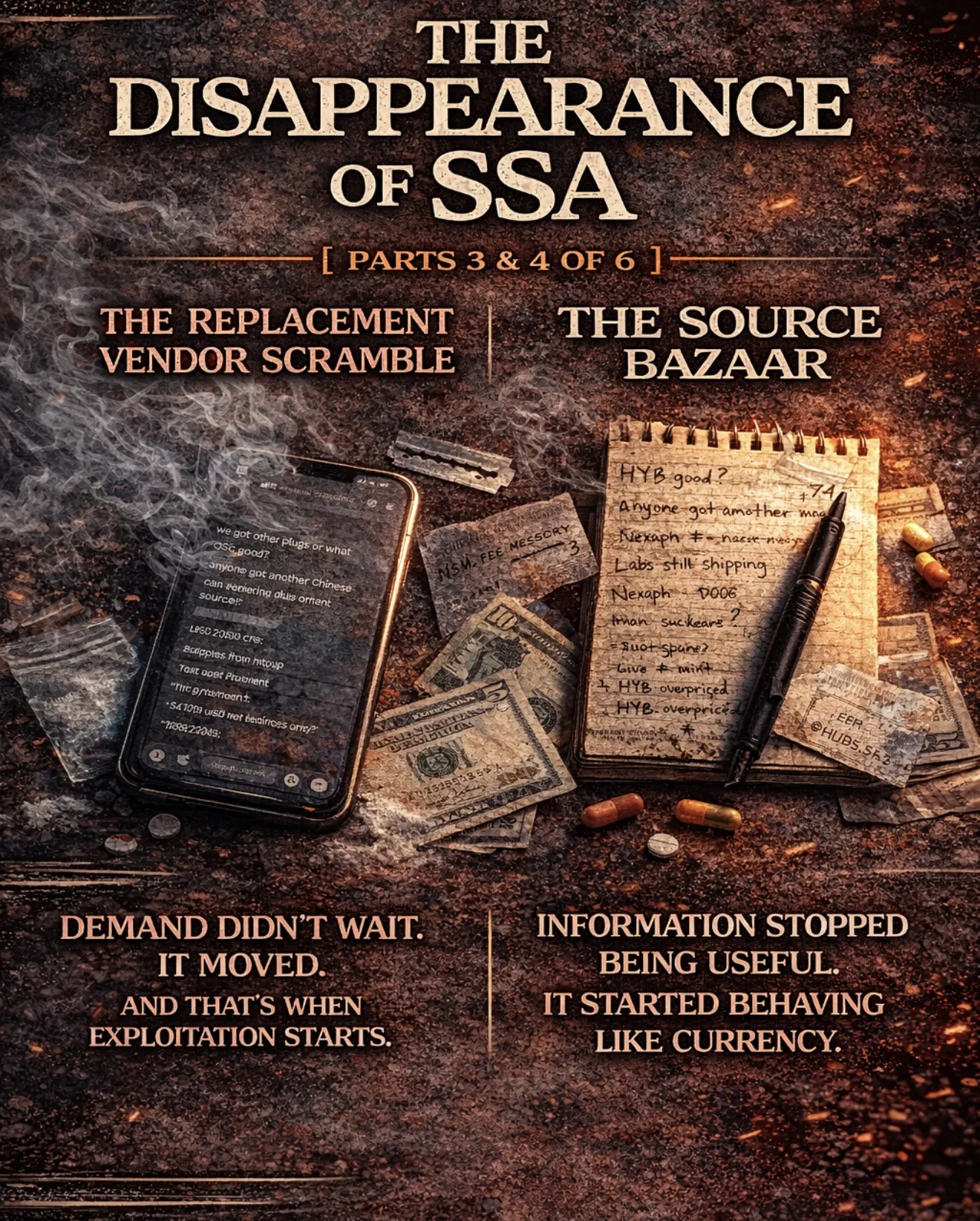
Part 1 covered the lead up to SSA’s disappearance and the communication breakdown that made the shutdown visible. Part 2 followed the immediate aftermath, where the first response was not recovery but regrouping: a new server, called SSA Disciples formed, uncertainty spread, and trust quickly shifted from the company to a handful of familiar names.
Part 3; The Replacement Vendor Scramble
Once it became clear no answers were coming, attention shifted.
Not slowly.
But immediately.
The chat didn’t stay on what happened.
It moved to who replaces them.
That shift matters.
Because once it starts, the collapse is no longer just about one vendor disappearing.
It becomes about where trust goes next.
And that process is rarely calm.
The Shift Happens Fast
Within minutes, the focus had already moved on to replacement.
The questions changed.
Not:
what is going on?
is this temporary?
has anyone heard anything official?
But:
“we got other plugs or what”
“QSC good?”
“anyone got another Chinese source?”
“can someone drop a new source then?”
“what’s next best source for peptides?”
“need contact information for a new sales person”
“do guys have a good vendor?”
“lf reliable source for reta”
The situation was still unclear.
The silence still hadn’t been explained.
And yet the scramble had already started.
That tells you something important about markets like this:
Demand does not wait for certainty.
It redirects.
Demand Didn’t Stop, It Moved
That is the real shift.
The story is no longer just:
vendor disappears
It becomes:
where does the trust go now?
Because the need itself does not vanish with the source.
People still want product.
They still want continuity.
They still want something that feels safe enough to step into the gap.
So names start getting thrown around.
Some are backed immediately.
Others are questioned just as quickly.
Some are dismissed on sight as the next scam waiting to happen.
That process was:
rushed
emotional
suspicious
and full of disagreement
Which is exactly what you would expect in a fragile market losing one of its major anchors.
The Monetisation Phase
Then another layer appeared.
Brokerage.
What started as people sharing alternatives quickly became something else.
Specific sources were being pushed as:
vetted
reliable
actively shipping
In at least one case, a replacement vendor was openly linked to commission while still being presented as a solution.
That changed the tone immediately.
Because now the problem wasn’t just uncertainty.
It was motive.
Suspicion Turns Inward
At that point, the server stopped reacting only to the collapse.
It started reacting to each other.
The accusations came fast:
people calling each other feds
accusations of commission bias
complaints about inflated pricing
disbelief at what was being presented as “help”
frustration that the supposed solution looked worse than the original problem
The scramble had already been unstable.
This made it worse.
Because once people start wondering whether the replacement is being pushed for profit rather than trust, the whole atmosphere changes.
The market doesn’t just lose a vendor.
It loses its footing.
The First Replacement Fails
Then even that pathway started to crack.
The replacement vendor quickly fell apart under scrutiny.
the prices were mocked
the source was dismissed
and the person pushing it lost permissions after accusations of commission taking
The attempt to stabilise the gap collapsed almost as quickly as it had appeared.
That is a familiar pattern in spaces like this.
A low-cost, high-trust source disappears.
A gap opens.
And almost immediately it begins to fill:
with alternatives
with intermediaries
with new claims
with new incentives
That does not automatically mean every replacement is fake.
But once fear enters the space, opportunity follows it in.
What This Changes
By this point, the problem wasn’t just finding a replacement.
It was deciding whether any replacement could be trusted at all.
And once that happens, the collapse deepens.
Because now the market is not just dealing with absence.
It is dealing with pressure, competition, suspicion, and the speed at which people start trying to fill the vacuum.
That is where Part 4 begins.
Not with explanation.
With access.
Part 4; The Source Bazaar
By this stage, SSA Disciples, the regrouping server had stopped functioning as support.
It was no longer:
a place to understand what happened
a place to wait for updates
or a place where answers might arrive
It had become something else.
The focus wasn’t on SSA anymore.
It was on access.
The Shift in Behaviour
The questions had changed again.
Now it was about:
which labs were still shipping
who still had working contacts
whether HYB was overpriced or comparable
whether Nexaph was worth it
whether TFC was legit
whether India was usable
whether domestic was safer
whether only US warehouse stock was still moving
And most importantly:
who was still willing to share anything at all.
That is when the whole space starts to resemble something closer to a bazaar than a support room.
Not orderly.
Not reliable.
But active.
Everything becomes transactional.
Not just product.
Information too.
Gatekeeping vs Exposure
Two positions formed quickly.
Some tried to limit damage:
keep sources private
reduce exposure
stop public sharing
Others pushed the opposite:
share everything
rebuild access as fast as possible
keep replacements moving
At the same time:
some refused to disclose contacts
others begged for them
some accused others of being feds
others accused them of gatekeeping
Both sides were reacting to the same thing:
loss of trust.
But they moved in opposite directions.
One tried to contain the damage.
The other tried to outrun it.
Information Becomes Valuable
As supply became uncertain, information changed value.
A vendor name.
A number.
A link.
A screenshot.
All of it became something to:
trade
protect
or withhold
Access wasn’t just useful anymore.
It had become leverage.
That is one of the clearest signs that a market is no longer stable.
Not when product disappears.
When information starts behaving like currency.
The Stockpile and Survival Phase
As access became more uncertain, the tone shifted again.
Less about finding answers.
More about holding out.
People started talking about what they already had:
enough RETA
enough test
enough stock
Others focused on what they didn’t:
only a few vials left
missed the last order window
just about to start
timing completely off
By that point, the focus had shifted again.
From replacement to endurance.
The Shift to Crisis Thinking
Once that question takes over, behaviour changes.
Decisions get faster.
Standards drop.
Confidence starts passing for credibility.
People become more willing to:
move quickly
trust weak information
follow whoever sounds certain
take risks they normally wouldn’t
Because at that point it no longer feels like a market.
It feels like time running out.
That is when panic becomes practical.
And that is when bad decisions start looking reasonable.
What Part 4 Shows
Part 3 was about the scramble.
Part 4 is about what the scramble becomes.
Not just replacement.
Not just argument.
A live market for access, contacts, names, rumours, and leverage.
By this stage, the collapse is no longer just about the disappearance itself.
It is about what grows in the space left behind.
And before any of it can really be understood, the timeline has to be rebuilt properly.
That is where Part 5 begins.
Comments