
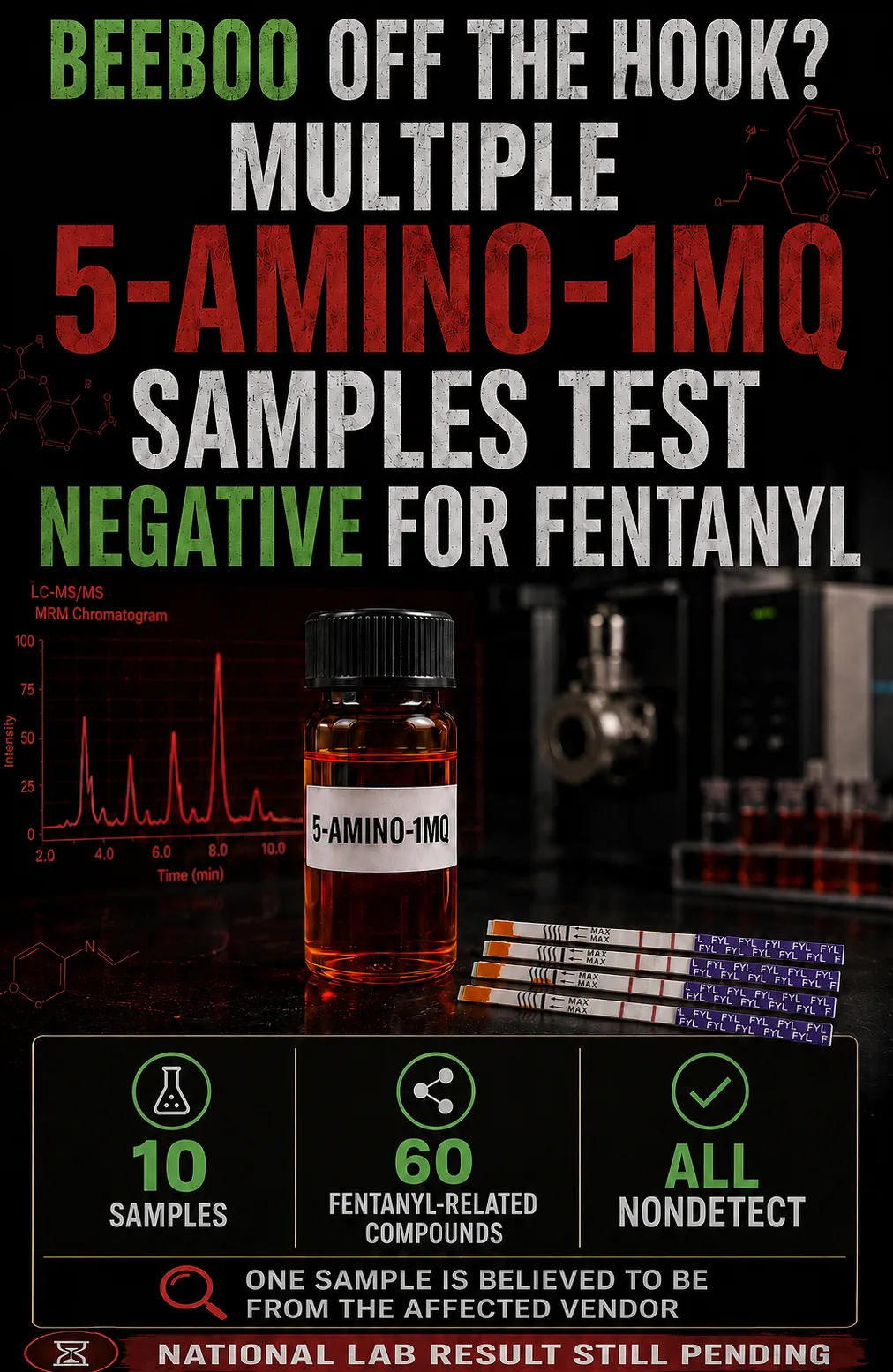
Vanguard Laboratory has now carried out further testing following the positive fentanyl strip results linked to liquid 5-Amino-1MQ sold by the vendor Beebo. Dustin from Vanguard tested ten separate 5-Amino-1MQ samples from different suppliers, including vials, capsules and an authenticated Sigma-Aldrich reference standard.
When tested at high concentration, every sample, including the reference standard, produced a presumptive positive result on the fentanyl strips. However, when the samples were diluted according to the strip manufacturer’s instructions, they all tested negative.
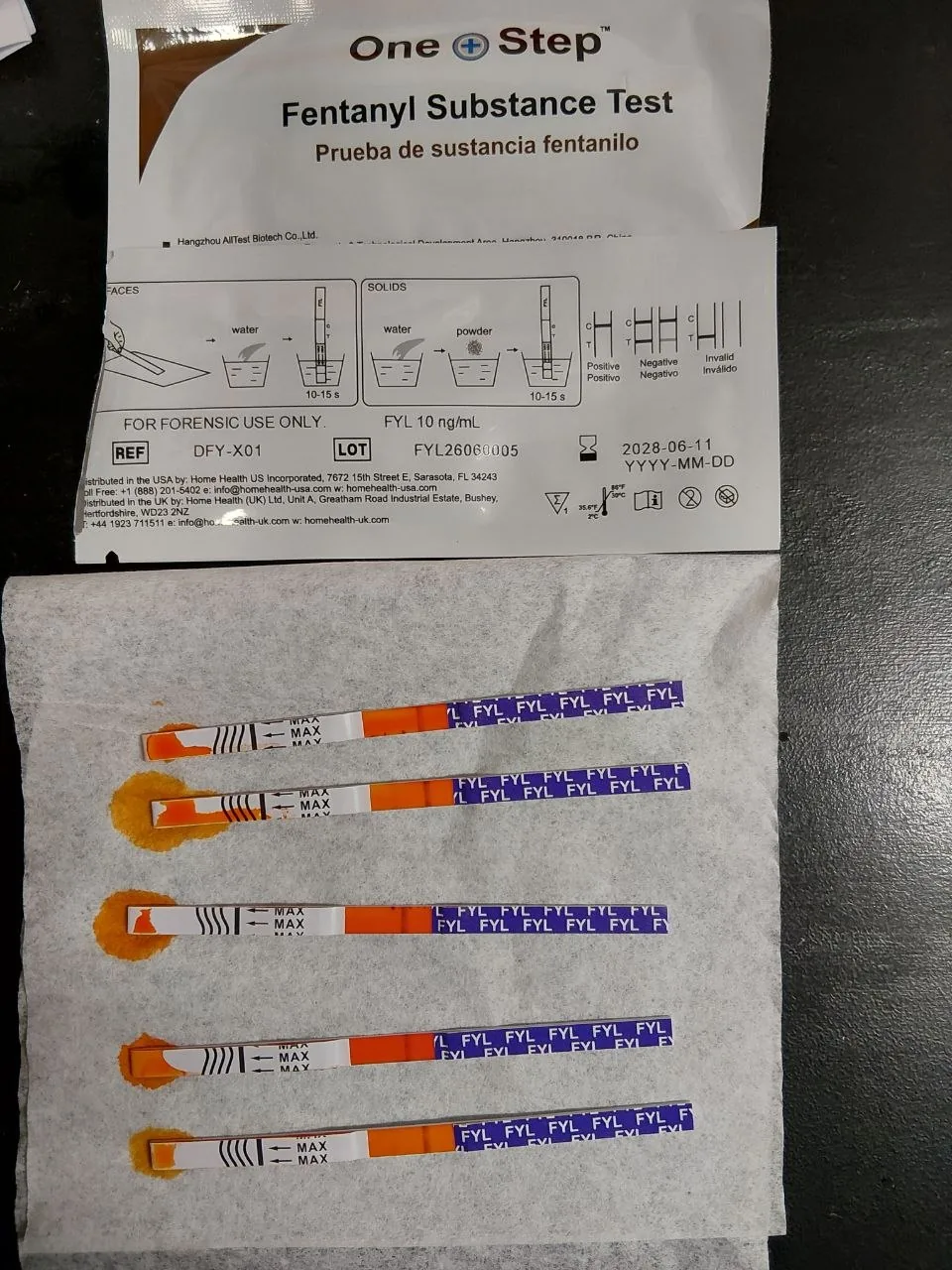
The photograph above, from Vanguard Lab, shows five of the concentrated tests showing a single visible control line on each strip, which would ordinarily be interpreted as a presumptive positive result. However, the test membranes are also heavily stained orange by the 5-Amino-1MQ solution, demonstrating substantial interference from the sample itself. These are not clean or confirmatory positive results. When the products were diluted according to the strip manufacturer’s instructions, the test lines appeared and every sample tested negative.
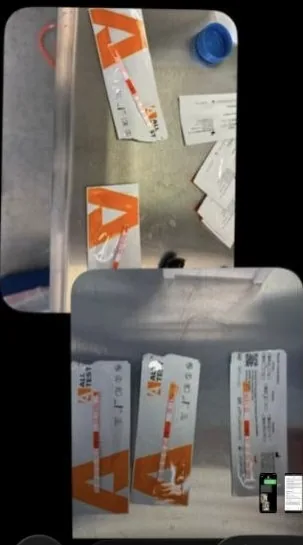
The original ILS photographs also show substantial orange-red staining across the test areas, alongside what appears to be a single visible line. Although this was correctly reported as a presumptive positive under the strip’s ordinary interpretation, its appearance is similar to the concentration-dependent interference later reproduced by Vanguard. ILS said the sample was prepared with nuclease-free water, but the exact dilution ratio and the instructions for those particular strips remain unknown. The photograph therefore supports the possibility of interference, but cannot by itself prove that the original ILS result was false.
Janoshik also diluted his sample before testing, so the difference cannot be explained simply as “undiluted versus diluted.” Dustin said Vanguard probably used different strips with different dilution requirements. Vanguard’s strips instructed the laboratory to add five drops of sample to 5 mL of water; when used this way, every 5-Amino-1MQ sample tested negative.
Janoshik’s dilution ratio and the instructions supplied with his two assays have not been disclosed. The contrasting strip results may therefore reflect differences in strip design, dilution level or both.
Vanguard then used targeted LC-MS/MS to screen the samples for 60 fentanyl-related compounds at a detection level of 10 ng/mL. Every sample, which includes one from the vendor, returned non detect. Vanguard is therefore treating the investigated sample as negative for fentanyl.
Dustin’s current hypothesis is that, at very high concentrations, the cationic quinolinium core of 5-Amino-1MQ interferes with the competitive immunoassay and suppresses the test line, making the strip appear positive.
This doesn’t mean the strips malfunctioned under their intended conditions, they were being used on highly concentrated chemical solutions rather than at the dilution specified by the manufacturer. The findings strongly indicate that the earlier strip reactions were caused by concentration-dependent interference from 5-Amino-1MQ itself, not fentanyl contamination.
We’re still waiting for results from the national laboratory testing Janoshik’s sample, but for now, it looks as though Beebo’s brew is clear of fentanyl, and Beebo (and the rest of the community) can sleep at night again.
Comments