
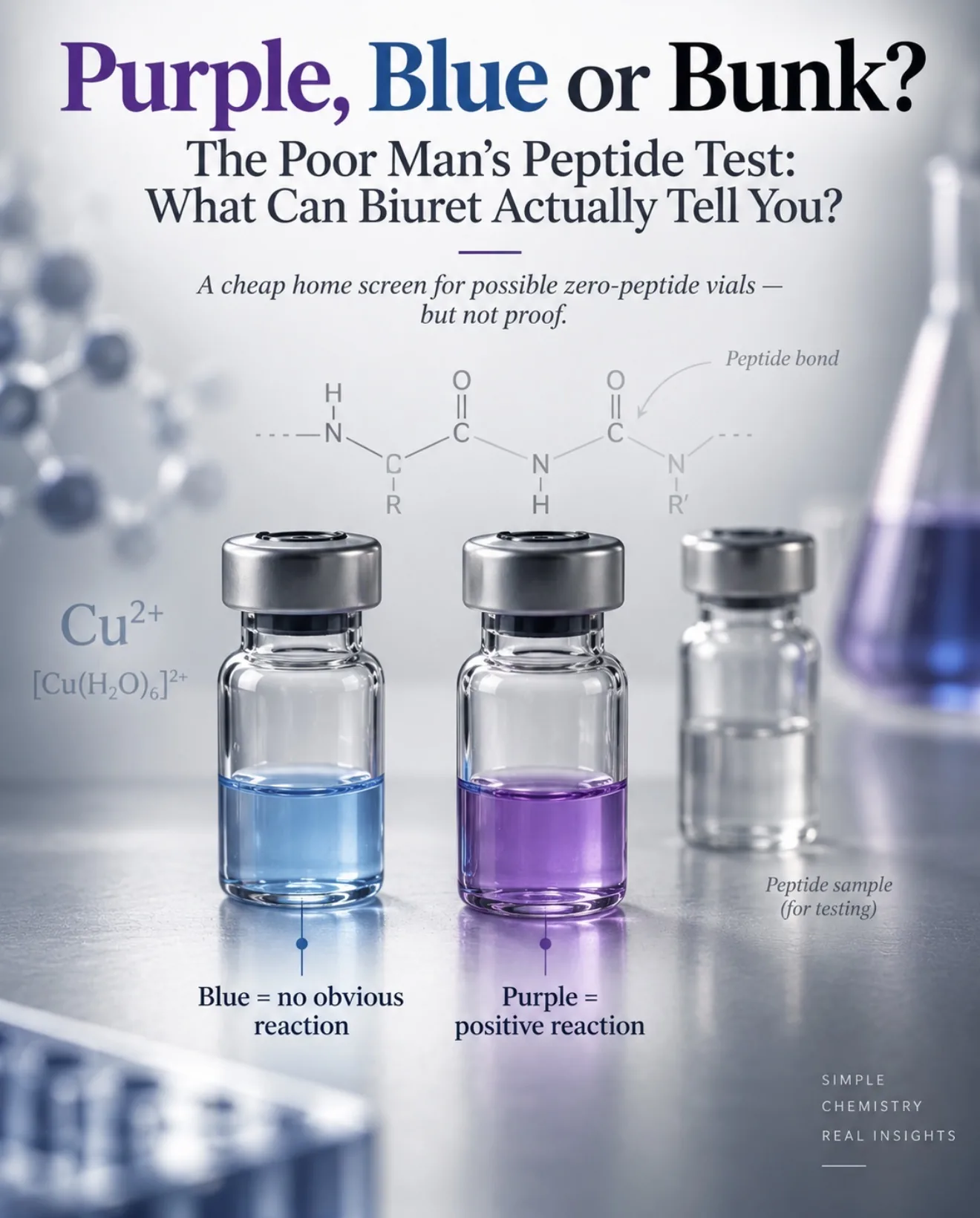
Most of the testing we come across on a day-to-day basis involves HPLC, mass spectrometry, reference standards and equipment costing rather more than most of us have lying around the kitchen. Today someone sent me a video of two reconstituted vials sitting on a table. One was light blue and the other had turned lilac-purple. The explanation was simple:
Purple means peptide. Blue means no peptide.
The test is called a Biuret test, an old and very simple chemical test for peptide bonds. It’s cheap enough to do at home and, according to the customer who sent it to me, has become fairly popular in Brazil, where access to peptide testing laboratories is much more limited. This test was completely new to me, but it caught my interest, particularly as my recent article on the NarcoCheck test for HGH proved useful to quite a few people. So could another ridiculously simple home test actually help people spot a bunk peptide vial?
What is a Biuret test?
The Biuret test isn’t actually testing whether a vial contains retatrutide, Selank, Semax or whatever else happens to be printed on the label. It’s testing for the presence of peptide bonds. Amino acids are joined together by peptide bonds to make peptides and proteins. Biuret reagent contains copper ions in an alkaline solution. When the copper interacts with enough peptide bonds, a coloured complex forms.
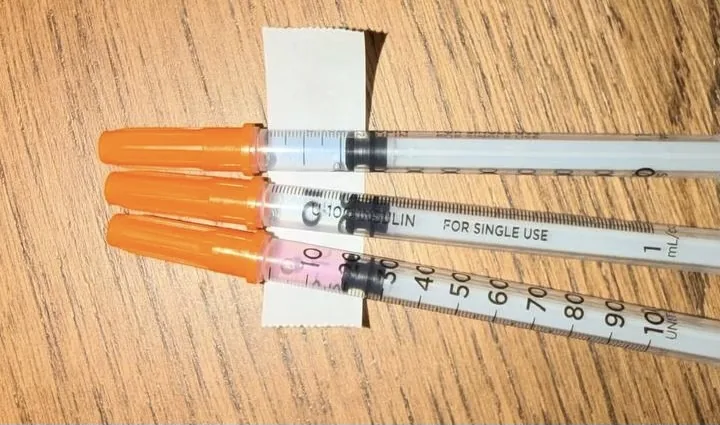
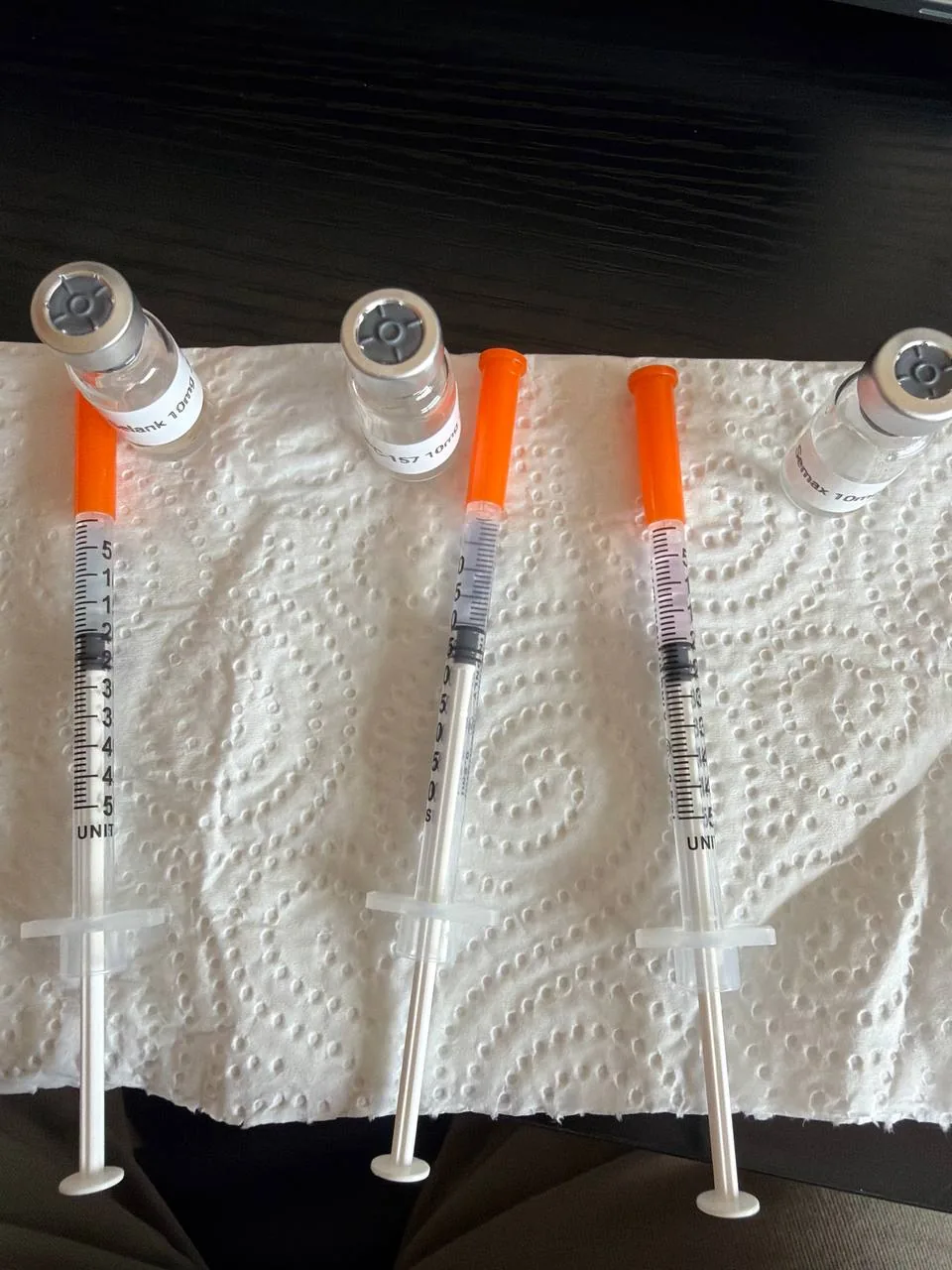
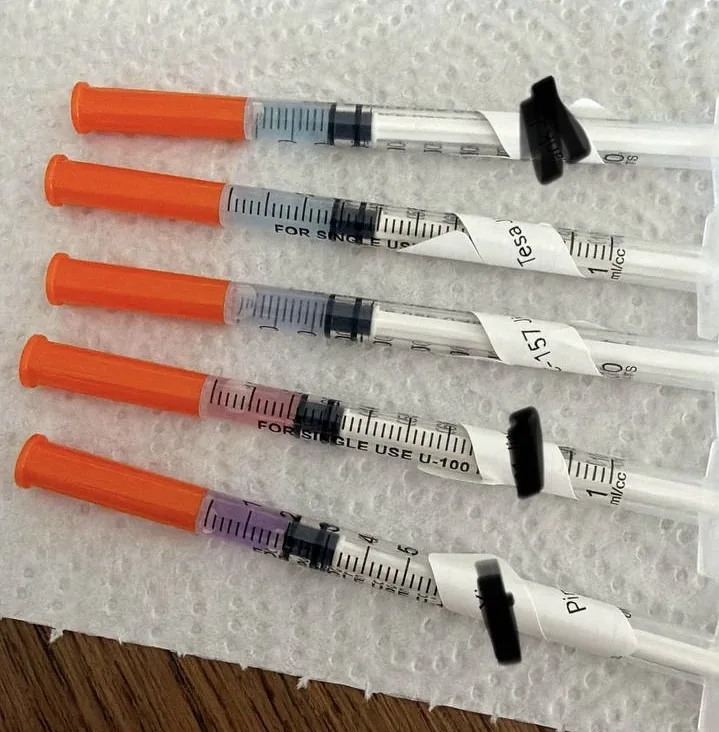
In its simplest visual interpretation:
Blue = no obvious reaction
Violet/purple = positive reaction
There’s nothing novel about the chemistry behind it. The Biuret reaction has been used in labs for decades for protein testing. Thermo Fisher describes peptides containing three or more amino-acid residues as capable of forming the coloured copper complex, with the reaction becoming stronger as more peptide bonds participate. So there is genuine science behind the liquid turning purple. The question is what that purple colour actually proves.
Purple does NOT mean “this is the peptide on the label”
This is probably the most important limitation. If a vial labelled Selank turns purple, the Biuret test has not identified Selank. It hasn’t measured its molecular weight, compared it with a reference standard, established its purity or proved that the vial contains the number of milligrams written on the label. All it has detected is a chemical reaction consistent with peptide-type material being present. Another peptide could produce the same reaction. A protein could produce it too. Certain other compounds can also interfere with copper chemistry. So this is nothing remotely comparable with LC-MS identification. It answers a much more basic question:
Does there appear to be material here capable of producing a Biuret reaction?
For someone trying to identify the exact contents of a vial, that isn’t enough. For someone trying to find out whether a supposedly 10 mg peptide vial might contain virtually no peptide at all, it becomes considerably more useful.
The Customer’s home testing
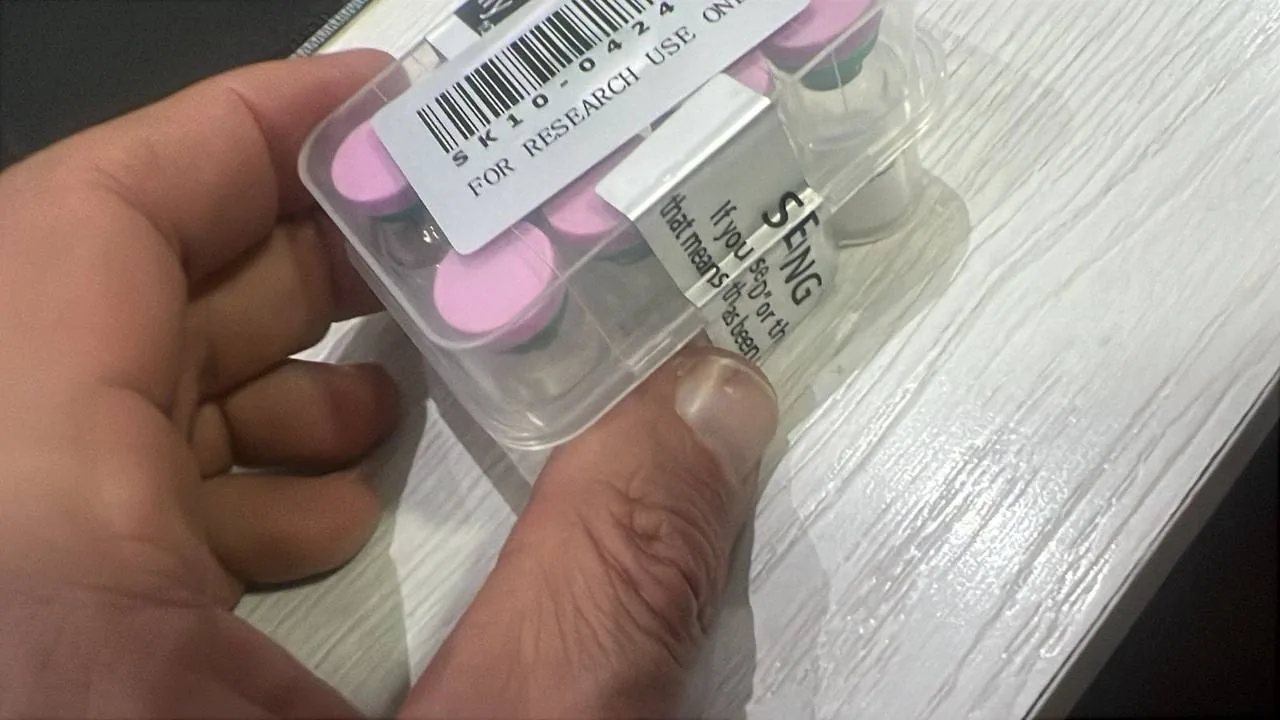
The customer who contacted me, told me the test has become popular in Brazil and is even used there to check whether whey protein actually contains protein. With very limited access to peptide testing labs, he sees it as one of the few inexpensive checks available to him. He showed me Semax and Selank tested alongside each other. The Semax turned purple. The Selank remained blue. His interpretation was straightforward:
“Purple = has peptide. Blue = original colour of the biuret, no reaction at all.”
What makes this particular comparison interesting is that Semax and Selank are both seven-amino-acid peptides containing six peptide bonds. So this isn’t a case of comparing a huge peptide with a tiny one and wondering why one reacts more strongly. A supposedly 10 mg Semax vial produced an obvious positive reaction while a supposedly 10 mg Selank vial didn’t. That doesn’t prove the Selank contained zero peptide. There are other possible explanations, which I’ll come to.
But little or no peptide is certainly one of them.
And that’s exactly the kind of problem a test like this might be useful for flagging. According to the customer, that particular Selank was from a batch for which a Janoshik COA existed. So now we have an interesting disagreement: the COA says peptide was present in the submitted sample, while the individual vial in front of the customer produced no visible Biuret reaction. The cheap test can’t tell us which one is right, but it can tell us that the vial is worth further investigating.
What does a laboratory make of it?
I asked Dustin at Vanguard Laboratory what he thought of using the Biuret test this way. His first reaction was that it’s reasonably reliable for rough estimates of protein concentration, but has relatively low sensitivity. He also pointed out that it doesn’t detect ordinary dipeptides. He described it as:
“semi quantitative at best.”
More importantly, when I showed him the negative result, he described a Biuret test as a presumptive result rather than something he would rely on alone. His view was that an unexpected result could justify sending the vial for confirmation testing. That’s probably the most useful way to look at it.
Can you get a false positive?
Yes. Dustin raised the possibility of compounds capable of binding copper interfering with the test and remembered histidine as one example. There is published work showing that free histidine can form coloured complexes with copper under Biuret conditions. Other amino acids, dipeptides and copper-binding compounds have also been shown to interfere. This becomes particularly relevant because histidine is sometimes used as an excipient or buffer in peptide and protein formulations. That doesn’t mean every product containing histidine will automatically give a false positive. It depends on the amount present, pH, concentration and formulation. But it does mean that a purple colour can’t automatically be attributed entirely to the peptide you’re trying to detect.
So even purple isn’t completely bulletproof.
And what about a false negative?
This is probably the bigger concern if people start using these tests without understanding their limitations. The classical Biuret assay simply isn’t particularly sensitive. Thermo Fisher’s Pierce guidance gives a working range of around 5 to 160 mg/mL for its Biuret assay and notes that it’s considerably less sensitive than newer copper-based protein assays such as BCA. That doesn’t mean that every vial containing less than 5 mg will test negative or every 10 mg vial will turn purple. The number printed on the label isn’t the same thing as the concentration actually being tested. A 10 mg vial reconstituted into a large volume could produce a weaker reaction than a smaller amount dissolved into a much smaller volume. The amount of sample mixed with the reagent matters too.
Dustin pointed out two other obvious ways of producing a misleading negative: over-dilution and incorrect pH. His description was:
“I’d consider it a presumptive result… a reason to get confirmation testing but wouldn’t rely on the result on its own.”
So a blue result doesn’t equal proven zero peptide, but if the test has been performed properly and a supposedly substantial peptide sample remains completely indistinguishable from the blue negative control, little or no peptide becomes a reasonable suspicion.
Very small peptides are harder
Not every peptide should be expected to produce an equally obvious result. The Biuret reaction can occur with tripeptides, meaning peptides containing three amino acids and two peptide bonds, but those very short peptides can be much harder to assess visually than larger peptides. This came up in K-Hole Lab Chat when a member shared a reference table he’d made showing the number of amino acids and peptide bonds in commonly sold peptides. He explained that, in his own testing, peptides with only two peptide bonds can be difficult to judge unless he has a negative control sitting alongside them.
KPV is a good example. It’s only three amino acids long with two peptide bonds. It’s theoretically capable of producing a Biuret reaction, but you wouldn’t expect it to be as easy to interpret as something such as retatrutide or tesamorelin with dozens of peptide bonds. That distinction also matters when looking at compounds sold alongside peptides which aren’t peptides at all. NAD+, 5-Amino-1MQ and SLU-PP-332 contain no peptide bonds, so you wouldn’t expect them to give the classical violet Biuret reaction simply because they happen to be sold by peptide vendors.
A negative control makes a big difference
This was one of the most useful practical points to come out of the Lab Chat discussion. Looking at one tube and deciding whether it’s sufficiently purple can be subjective. Putting it beside untouched blue Biuret reagent gives you something to compare it against. A known peptide sample tested under the same conditions gives you another comparison. This becomes particularly useful if several supposedly identical vials are being screened. If nine produce an obvious colour change and one remains the same blue as the negative control, that single vial becomes rather interesting. It still hasn’t been proven blank, but it shows which one I would send to the lab.
What about peptide blends?
A question was asked whether the test would work on blends. It can produce a positive reaction, but the information becomes even less specific. Imagine a vial supposedly contains four peptides. It turns purple. That does not prove all four peptides are present. Three could be present and one completely absent. Depending on the amounts involved, potentially even one component could provide enough peptide bonds to generate a convincing reaction. So a positive Biuret result on a blend tells you little more than:
There appears to be peptide-type material in the vial.
It can’t establish the identity, amount or ratio of the individual components. Ironically, that makes Biuret potentially more useful for spotting a completely empty or near-empty blend than proving a blend has been made correctly.
Does darker purple mean more peptide?
Potentially, but don’t get carried away. The Biuret reaction can be used quantitatively because the intensity of the colour is related to the amount of peptide or protein participating in the reaction. In a laboratory, that colour is measured using an instrument and compared against standards. Looking at two little tubes with your eyes is a different matter. Lighting, dilution, reaction time, pH, peptide structure and other substances in the vial can all influence what you see. So:
Dark purple does not equal “this vial contains 12 mg.”
Under tightly controlled and identical conditions, colour intensity might give you a rough comparison between samples. That’s about as far as I would take it, which fits Dustin’s description of the test as semi-quantitative at best.
Then there is GHK-Cu
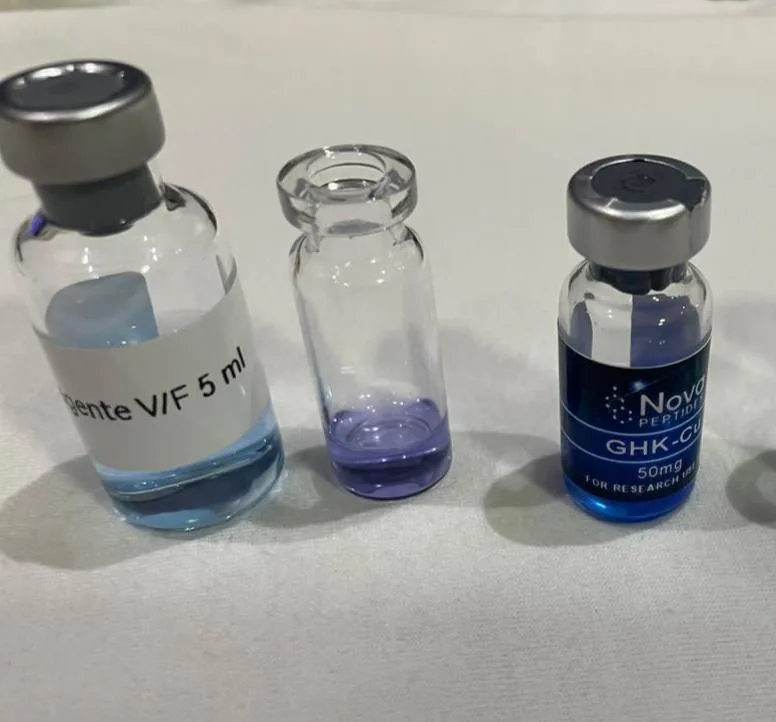
I was also shown testing involving GHK-Cu. This one is considerably messier. GHK-Cu is itself a copper complex and already has a distinctive colour. You’re then adding a copper-based colour reagent and attempting to interpret another colour change visually. GHK itself is a tripeptide and therefore has two peptide bonds, so there’s a basis for a Biuret reaction. But GHK-Cu is hardly the cleanest product to use to demonstrate a test whose entire readout depends on copper chemistry and colour. I’d be much more cautious interpreting that result than I would a clear blue-to-purple change from an uncoloured peptide solution.
Why bother with it at all?
For someone in the US or Europe with relatively easy access to peptide testing laboratories, the obvious response to a questionable vial might be: Send it to a lab. But that rather misses the point of why the customer is using this test. He is in Brazil, where he says access to peptide testing laboratories is extremely limited. Biuret reagent, on the other hand, can be bought locally for very little money. Brazilian listings put basic reagent at around R$20, a small kit at around R$28, with larger bottles also available cheaply.
When your alternative is international shipping, considerably higher costs and potentially no practical access to a peptide testing lab, a simple presumptive test starts to make much more sense. He isn’t claiming that his purple tube replaces HPLC or mass spectrometry. He’s using something accessible to answer a much more basic question before deciding what to do next. And that’s where I think Biuret potentially has a place: not as a replacement for laboratory testing, but as a cheap first-line screen where proper testing isn’t realistically accessible.
When the cheap test disagrees with the COA
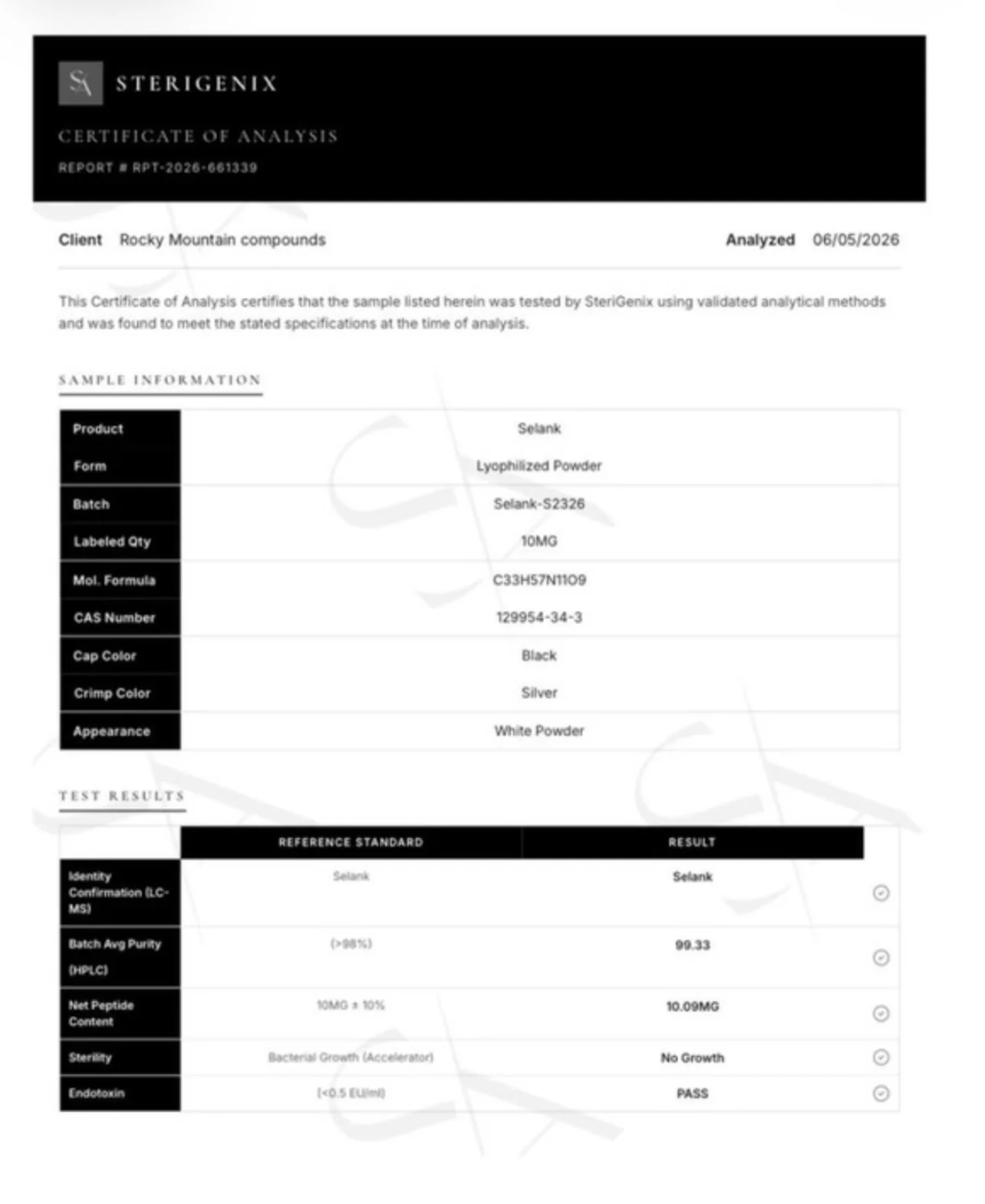
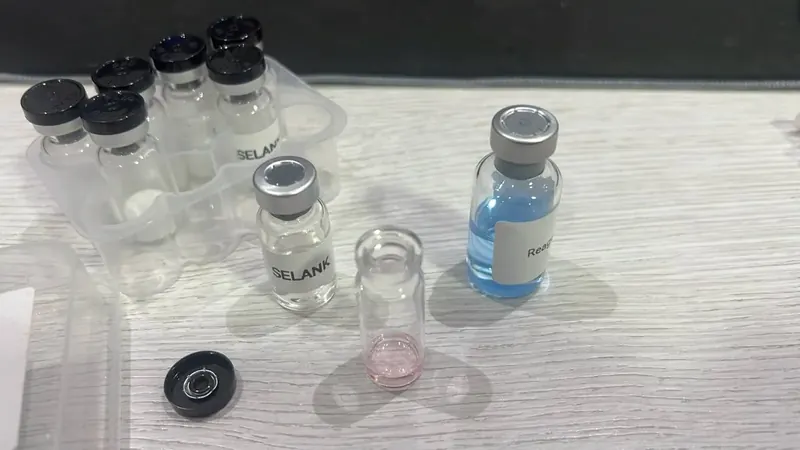
The Janoshik-associated Selank wasn’t the only example I was shown. Another product he tested had previously been tested by SteriGenix, showing a passing result, yet the Biuret test remained blue with no visible reaction. SteriGenix is a lab that’s being looked at because of serious questions surrounding its testing records, so naturally that example caught my attention. Again, the Biuret result doesn’t prove the COA wrong. There are still other possibilities. The beauty, and limitation, of Biuret is that it can’t tell us which explanation is correct. But for something costing very little, it has potentially identified exactly which vial deserves proper analysis.
EDIT: An important complication with Selank
After publishing this, a reader pointed out something important about the negative Selank result.
Selank is TKPRPGP, meaning three of its seven amino acids are proline. Proline can interfere with the copper coordination involved in the Biuret reaction, and studies of Biuret chemistry have found reduced or unusual reactivity with proline-containing peptides.
That gives us a plausible chemical reason why Selank may remain blue even when peptide is present.
This also changes how I would interpret the SteriGenix example, because that negative vial was Selank too. I wouldn’t now use a negative Selank Biuret result on its own as evidence of a zero-peptide vial or an incorrect COA.
Semax also contains proline, but its sequence is different and it produced a clear purple reaction in the example I was shown, which reinforces another limitation of the test: peptide sequence matters, not just the number of peptide bonds.
Blue doesn’t necessarily mean bunk, particularly with proline-rich peptides such as Selank. Before interpreting a negative Biuret result, you need to know whether that specific peptide is expected to give a reliable visible reaction under the test conditions.

Comments