
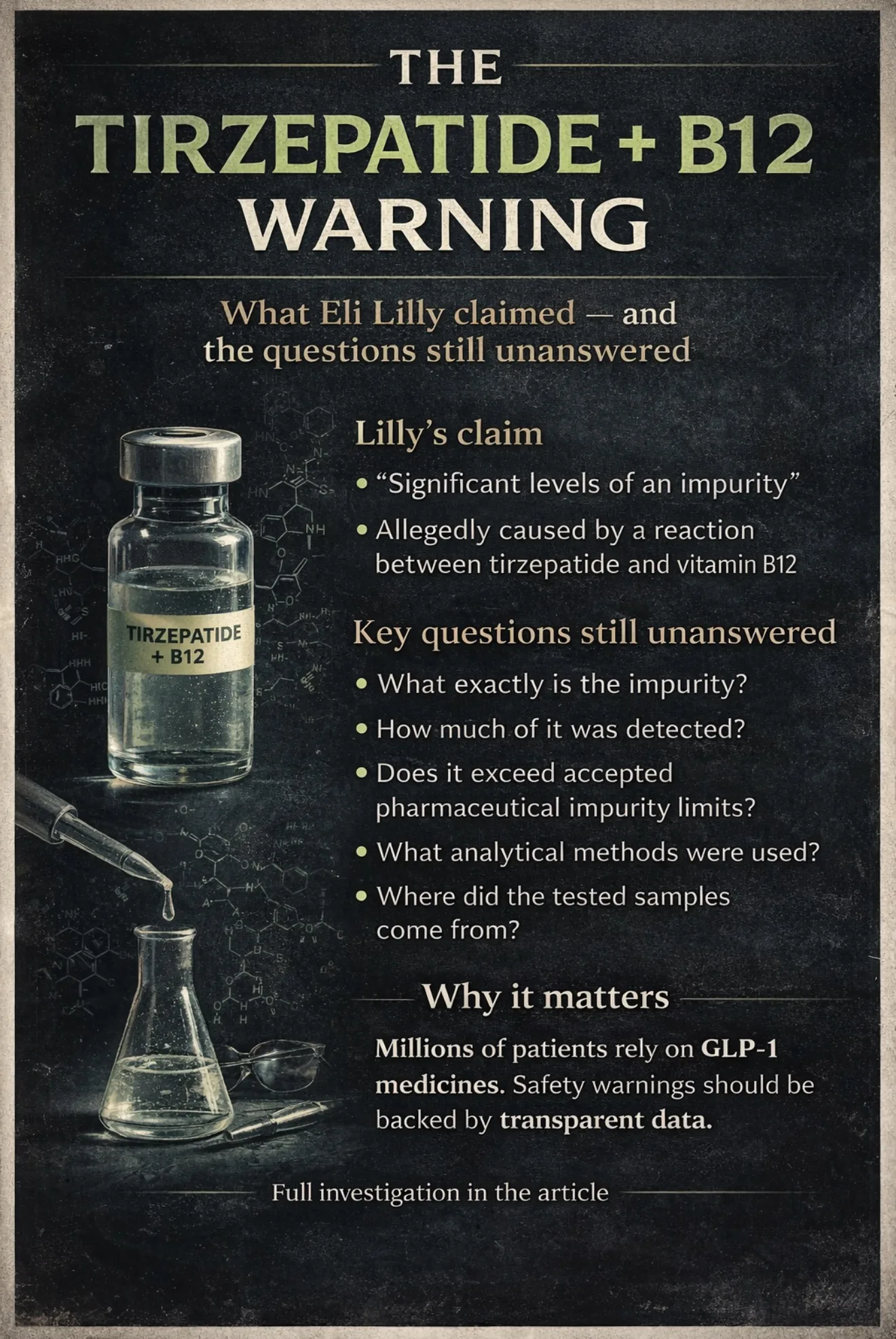
On 12 March, Eli Lilly released an open letter warning of potential patient safety risks associated with tirzepatide compounded with vitamin B12. The company stated that its testing had found “significant levels of an impurity” created by a chemical reaction between tirzepatide and B12.
However, the work cited appears to be a preprint authored by individuals employed by Eli Lilly & Co. and has not yet undergone peer review, meaning it has not been independently evaluated by external scientists. In addition, very few technical details were provided about the findings.
The Key Question
If Lilly has identified a dangerous impurity formed when tirzepatide is mixed with vitamin B12, the finding would be significant. Such a reaction could affect how compounded formulations are prepared and potentially trigger regulatory action.
But evaluating a safety claim normally requires detailed disclosure: what impurity was found, how much was detected, how the samples were obtained, and how the testing was performed.
Those details were largely absent from Lilly’s announcement. That absence is what makes the claim difficult for outside scientists to evaluate, and why the reaction from pharmacists and industry groups has focused less on the allegation itself than on the lack of supporting information.
In response, Scott Brunner, CEO of the Alliance for Pharmacy Compounding (APC), described Lilly’s announcement as producing “heat without much light.”
He noted that several key pieces of information normally provided when making such claims were missing, including:
what the impurity actually is
how much of it was detected
whether the levels exceed accepted pharmaceutical impurity limits
what analytical methods were used
where the tested samples originated
These are not minor details. They are the basic information scientists normally require to evaluate a potential drug safety claim.
Why Sample Origin Matters
One of the most important unanswered questions concerns where the tested samples came from.
The term “compounded tirzepatide” can refer to a wide range of products. A medication prepared by a licensed compounding pharmacy operating under pharmacy board oversight is very different from a peptide powder purchased online from an overseas supplier and mixed in a med spa.
Yet Lilly’s statement simply says that the company tested “compounded products being marketed to Americans.”
That phrasing leaves open the possibility that the samples could have come from any number of sources, including sellers that legitimate compounding pharmacists would never recognize as part of their profession.
Brunner also raised questions about how the samples were handled prior to testing.
Peptide drugs such as tirzepatide are complex molecules that can degrade if mishandled or stored improperly. Degradation products can appear as impurities even when the original formulation was sound. This is precisely why pharmaceutical stability testing is tightly controlled.
Without knowing how the samples were stored, transported, or aged prior to analysis, it is difficult to interpret the significance of any impurity that may have been detected.
The Missing Chemistry
Another unanswered question concerns the impurity itself.
Lilly’s letter does not identify the compound or explain why it would necessarily be dangerous.
Pharmaceutical chemists routinely detect trace impurities in medications, including FDA approved drugs. Regulators normally evaluate impurities based on:
chemical structure
concentration
toxicological profile
Without knowing what the impurity actually is, scientists outside Lilly have no way to determine whether the finding represents a genuine safety concern or simply a routine by product that falls within accepted pharmaceutical standards.
If Lilly has identified a legitimate safety issue involving tirzepatide combined with vitamin B12, the appropriate response would be transparency: publishing the data, identifying the impurity, quantifying the levels detected, and explaining the testing methods used.
Until those details are released, the announcement raises more questions than it answers.
A Broader Pattern
The B12 impurity claim also raises a larger question.
This is not the first time Eli Lilly has issued public warnings, legal threats, or market shaping statements about non brand GLP-1 supply channels.
Between September 2023 and March 2026, Lilly repeatedly escalated public warnings and legal actions against non brand versions of tirzepatide, the active ingredient in Mounjaro and Zepbound.
These actions have targeted a wide range of products, including:
compounded preparations
counterfeit injectables
research use only products
imported knock-offs
non approved dosage forms such as oral tirzepatide
Across this period, Lilly’s messaging has followed a recognisable pattern: non brand products are framed as unsafe, unapproved, chemically unreliable, or contaminated.
Recurring Claims Raised by Lilly About Non-Brand GLP-1 Products
Risk factor / Lilly’s claims
Chemical purity
Alleged detection of an unknown impurity when tirzepatide is mixed with additives such as vitamin B12.
Sterility
Claims that some non brand samples from non regulated sources contained bacterial contamination.
Potency
Concerns that some products may be under-dosed, over-dosed, or otherwise not match their stated strength.
Formulation / ingredients
Objections to altered formulations, added ingredients, and non-approved dosage forms such as oral tirzepatide.
A Consistent Pattern in Lilly’s Messaging
Across 2024 to 2026, Lilly repeatedly raised concerns about contamination, impurities, structural differences, potency, and altered formulations in non-brand tirzepatide products.
These are serious allegations. But they have also drawn criticism for limited transparency about sample sourcing, chain of custody, and analytical disclosure.
The Compounding Industry Pushback
The Alliance for Pharmacy Compounding has consistently argued that originator companies blur an important distinction between:
1.legitimate state licensed pharmacy compounding under patient specific prescriptions, and
2. illicit sellers operating outside the pharmacy system
That distinction is important;
A preparation dispensed by a licensed compounding pharmacy is not the same thing as a counterfeit product sold online or a peptide powder imported and mixed in a med spa.
Yet public messaging often compresses these very different categories into a single rhetorical bucket.
This problem becomes particularly acute when media reports amplify the language of “compounded” risk without clarifying whether the tested products actually came from licensed pharmacies or from counterfeit or grey market channels.
In that sense, the issue is not simply what Lilly claims to have found, but how those findings are framed.
The Salt Form Confusion
Another issue often raised in the broader GLP-1 debate concerns “salt forms.”
However, this controversy primarily involved semaglutide, not tirzepatide.
Some compounded products were reported to contain semaglutide sodium or semaglutide acetate instead of the base molecule used in approved medicines.
That issue is therefore largely separate from Lilly’s tirzepatide-specific claims, even though it is often folded into the wider discussion about compounded GLP-1 drugs.
The Chemistry Question
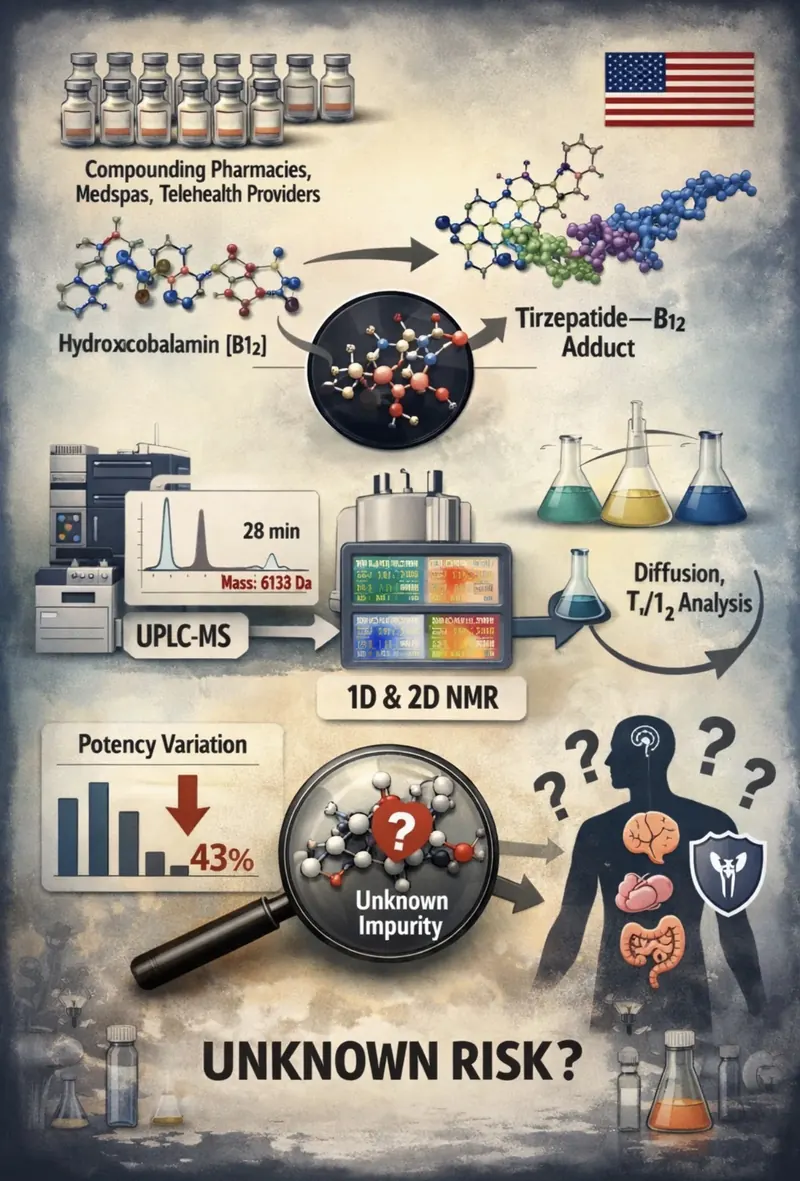
Lilly’s latest claim centres on a proposed chemical reaction between tirzepatide, a peptide drug, and vitamin B12.
However, peptide medicines such as tirzepatide can also degrade under certain conditions, including:
temperature fluctuations
improper storage
extreme pH environments
exposure to light or oxidation
When degradation occurs, fragments of the molecule can appear as impurities during analytical testing. That does not necessarily mean a new harmful compound has formed through a reaction with another ingredient.
Vitamin B12 itself has been used safely for decades in injectable medications and compounded formulations. While interactions between drugs and additives can occur, distinguishing a true chemical reaction from routine degradation normally requires detailed analytical work.
Without that level of disclosure, it remains unclear whether Lilly has identified a meaningful new safety claim or a degradation by-product.
The GLP-1 War: A $100 Billion Market
The debate around compounded and non-brand GLP-1 medicines cannot be understood without considering the scale of the market involved.
Drugs such as Ozempic, Wegovy, Mounjaro, and Zepbound have rapidly become some of the most commercially successful pharmaceutical products in history. Analysts widely project that the global GLP-1 market could exceed $100 billion annually within the next decade.
For the companies that developed these medicines, the stakes are enormous.
These drugs required years of research, clinical trials, and regulatory approvals. Pharmaceutical companies therefore argue that alternative supply channels, including counterfeit products, illicit sellers, and unregulated formulations, threaten both patient safety and the integrity of the regulatory system.
At the same time, unprecedented demand has created a complex secondary ecosystem.
During periods of shortage and restricted insurance coverage, patients have increasingly turned to:
compounding pharmacies
Telehealth providers
international suppliers
research use peptide vendors
These markets are highly heterogeneous. Some operate under pharmacy regulations and physician prescriptions. Others operate in legal grey zones or outside the healthcare system entirely.
Why Transparency Matters
Millions of patients now rely on GLP-1 medicines to treat diabetes, obesity, and related metabolic conditions.
Ensuring those patients receive safe, effective, and accurately represented medications should remain the central goal.
If a genuine chemical interaction between tirzepatide and vitamin B12 has been identified, publishing the underlying data would allow scientists, regulators, and clinicians to evaluate the risk properly.
Until that happens, the announcement remains a claim that raises important questions, but does not yet provide enough information to answer them.
And when warnings are issued without supporting data, patients can find themselves caught in the middle of a debate they did not create.
Comments