
Introduction
The peptide market is suddenly sitting at an unusual crossroads.
On February 27, 2026, Robert F. Kennedy Jr. appeared on the Joe Rogan podcast and stated that roughly 14 of the 19 peptides removed from compounding in 2023 could potentially return to FDA Category 1. Compounds such as BPC-157, TB-500, CJC-1295, Ipamorelin, AOD-9604, Selank, and Semax were mentioned as examples.
If such a change were formally implemented, it could reopen a legal pathway for compounding pharmacies to produce these peptides again under physician prescriptions.
However, an important detail remains.
No official FDA reclassification reflecting that claim has yet been published.
For now, the statement exists as a political announcement rather than a regulatory change.
Yet the market has already begun reacting to the possibility.
At the same time, another development shook the peptide ecosystem.
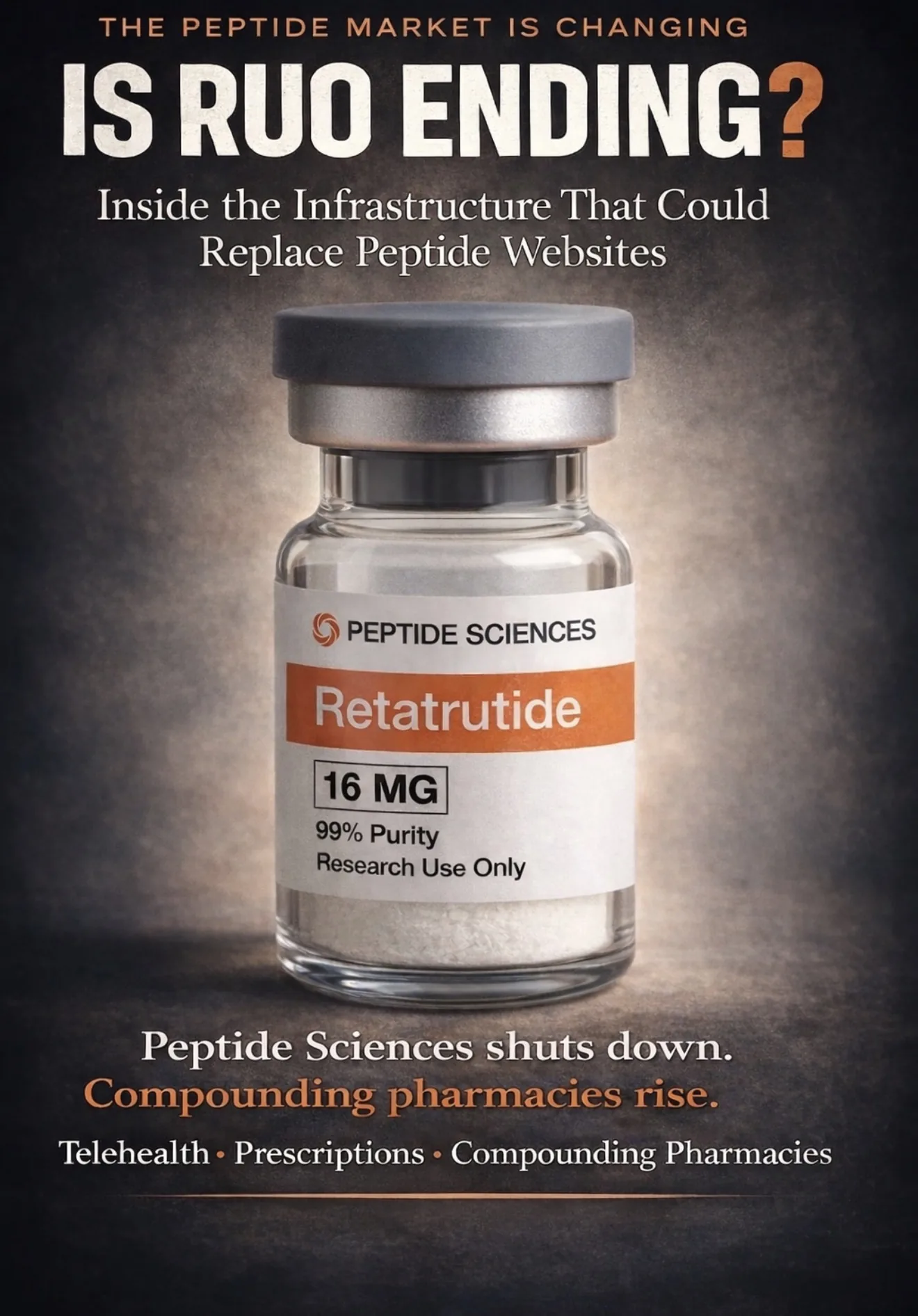
Peptide Sciences, one of the most prominent research-use-only peptide vendors, has announced it is shutting down operations.
Whether that shutdown proves permanent or simply a rebrand remains unclear.
But the timing has intensified a much larger question:
If the RUO reseller model begins to disappear, what replaces it?
The Slow Squeeze on Compounding and RUO
To understand why the market may be shifting now, it helps to look at the pressure building across both sides of the peptide ecosystem.
For years the market operated through two parallel channels. On one side were compounding pharmacies, which could produce certain peptide therapies under physician prescriptions. On the other were research-use-only vendors, which sold peptides directly to consumers through websites labeled for laboratory research.
Both systems operated under growing pressure.
The compounding environment tightened significantly in 2023 when the FDA moved several peptides out of routine compounding eligibility. Compounds such as BPC-157, TB-500, CJC-1295, and Ipamorelin were removed or placed under review within the FDA’s bulk substances framework.
At the same time, the explosion in GLP-1 weight loss drugs created a temporary compounding boom. During shortages of semaglutide and tirzepatide, pharmacies were permitted to compound versions of these drugs under enforcement discretion.
But once supply stabilised, regulators reminded pharmacies that producing copies of FDA approved drugs would no longer be tolerated under the same conditions.
In other words, compounding had briefly expanded, and then tightened again.
While pharmacies were facing regulatory tightening, the research peptide ecosystem encountered a different form of pressure.
The RUO model relied heavily on two things: the “research use only” disclaimer and access to payment processing and banking infrastructure.
As the peptide market grew larger, particularly during the GLP-1 boom, both became harder to maintain.
Payment processors began classifying peptide merchants as high risk categories. Vendors reported rolling reserves, transaction monitoring, settlement delays, and sudden account reviews once transaction volume increased.
A pattern emerged in payment processing discussions. Small vendors might survive at lower scale. But once sales reached significant volume, scrutiny intensified rapidly.
The result was a squeeze from both directions: compounding becoming more tightly regulated, and RUO vendors facing increasing financial infrastructure risk.
For years the two models coexisted in an uneasy balance.
Now that balance may be shifting.
Two Visions of the Post RUO Market
As pressure builds on both compounding and RUO distribution, the peptide market appears to be reorganizing itself around new delivery models.
Within the industry, two broad visions have begun to emerge.
Vision One: The Physician Controlled Model (see editors note at the bottom for clarification)
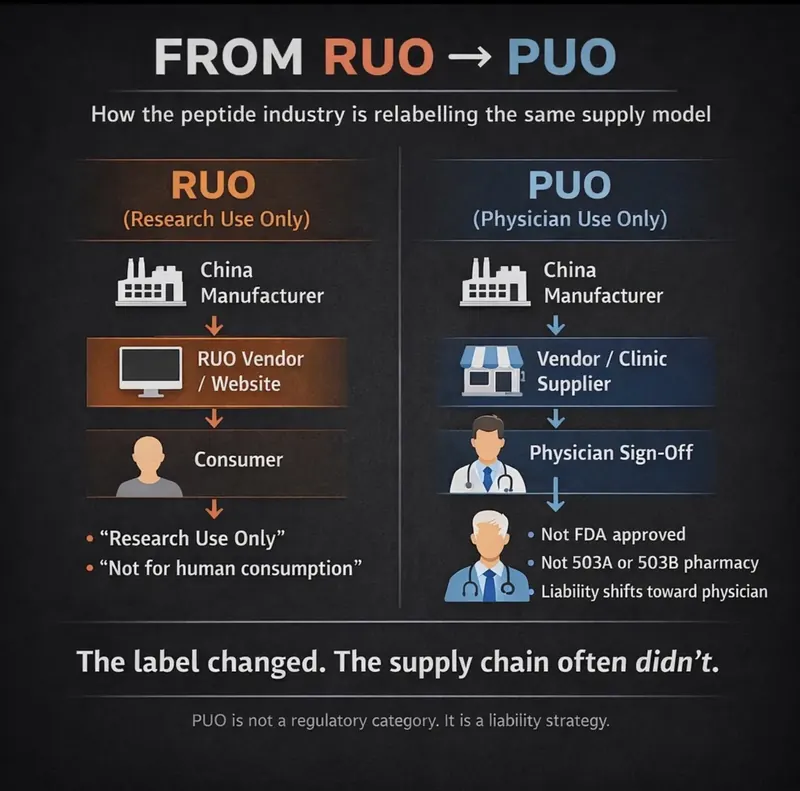
One view is that peptides will move firmly into a physician controlled system, often described as a PUO model, physician use only.
Under this vision, peptides would no longer be purchased directly through websites.
Instead, the pathway would look something like this:
Peptide API manufacturer supplies the active ingredient
→ Physician or clinic writes the prescription
→ Compounding pharmacy prepares the final medication
→ Patient receives the treatment
Doctors become the gatekeepers.
Access to peptides moves inside medical practices, longevity clinics, and prescription frameworks, effectively removing the consumer facing reseller layer entirely.
Vision Two: The Telehealth Compounding Infrastructure
A second vision is already being built.
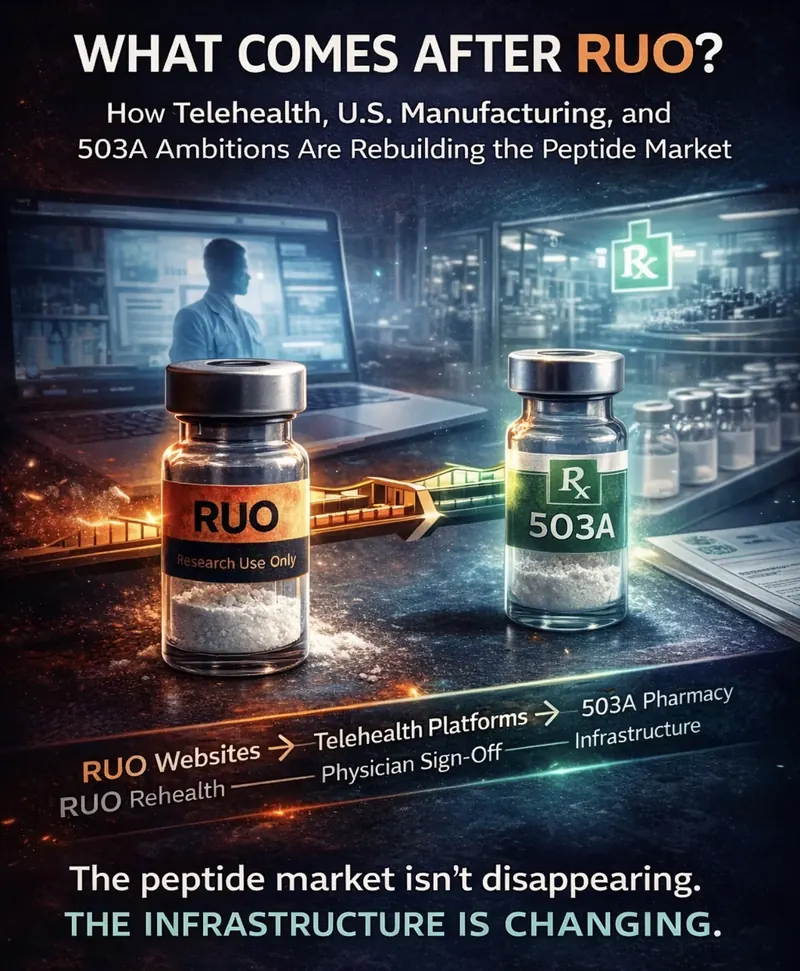
According to Aminos Analytics, Brandon is building a sterile compounding pharmacy and Telehealth pipeline called Low Tide Pharmacy, a model designed for national scale distribution.
The structure looks like this:
API manufacturer supplies the peptide API
→ telehealth platform and clinics generate prescriptions
→ U.S. sterile compounding pharmacy prepares the medication
→ patient receives the treatment
Instead of websites acting as the intermediary between manufacturers and consumers, large compounding pharmacies become distribution hubs.
These pharmacies would supply telehealth patients, outside physicians, and longevity clinics.
In the case currently under development, the planned facility includes sterile compounding infrastructure, multiple clean room pods for parallel production, in house testing of incoming API and finished compounds, Telehealth prescribing networks, and a hybrid model accepting prescriptions from outside physicians.
The goal is nationwide mail order distribution through physician prescriptions.
The Supply Chain Doesn’t Actually Change
One surprising detail is that the underlying supply chain may not change as much as many people assume.
Even the builders of this new compounding infrastructure acknowledge that the peptide API will still largely come from China, which remains the dominant source for peptide manufacturing.
In other words:
China API manufacturers
→ U.S. compounding pharmacies
→ prescriptions
→ patients
The peptides themselves remain unchanged.
The distribution layer is what shifts.
But there is also a third route that does not disappear:
China supplier
→ direct buyer
That route remains in the background for people willing to order directly from overseas manufacturers.
The market therefore does not move from China to the United States.
Instead, it appears to split.
On one side sits a regulated prescription channel built around telehealth and compounding pharmacies. On the other remains a direct overseas channel for buyers willing to operate outside that framework.
What gets squeezed in the middle is the Western RUO reseller layer.
The Pressure on RUO
If both of these visions share one assumption, it is this:
the RUO reseller layer disappears in the West.
Several forces are pushing in that direction simultaneously.
Regulators have warned repeatedly about peptides marketed as research chemicals but clearly intended for human use.
Payment processors have become increasingly cautious about supporting high volume peptide merchants.
And the scale of the market has made the category increasingly visible.
One recurring theory is that success itself may have become the problem.
Small vendors might survive at lower scale.
But once businesses reach millions in revenue, the infrastructure supporting them becomes much harder to maintain.
Additional Structural Factors
Two additional factors may also shape how this transition unfolds.
The first is the distinction between 503A pharmacies and 503B outsourcing facilities.
Most of the models discussed here rely on 503A pharmacies, which compound medications for individual patients based on prescriptions. But 503B facilities operate at a different scale, producing larger batches of sterile medications for healthcare settings under a more industrial regulatory framework. If peptides continue moving toward prescription based distribution, the real long term scale may emerge not only through Telehealth linked 503A pharmacies, but through larger 503B style infrastructure as well.
The second is state level enforcement.
The FDA is not the only regulator shaping this market. State Boards of Pharmacy often determine how aggressively peptide related compounding is scrutinised in practice, and in some cases regional operators may feel state pressure long before any federal action arrives. That means the future of the peptide market may be shaped not just by national policy, but by how unevenly that policy is enforced across different states.
The Peptide Sciences Question
All of this brings the focus back to the event that triggered the current debate.
The shutdown of Peptide Sciences.
For years, Peptide Sciences represented the most developed version of the RUO reseller model: a large catalogue, professional lab style packaging, multiple research only notices, and a deliberately neutral storefront designed to look more like a supplier than a wellness brand.
Unlike many smaller sellers, it appeared to take compliance presentation seriously while still operating inside a legally grey market.
If this proves to be a genuine shutdown rather than a rebrand or transition, it would mark a significant turning point for the RUO reseller model.
Several explanations have already been suggested: payment processor pressure, regulatory scrutiny, competitive pricing pressures, or a simple rebrand and restart.
None of these explanations have been confirmed publicly.
But the timing raises a broader question.
At the same time that one of the largest RUO vendors appears to be disappearing, new prescription based infrastructure is being built to serve the same demand.
The Real Question
The peptide market may not be disappearing.
Demand from clinics, longevity practices, and consumers remains strong.
What may be changing is how that demand is delivered.
For more than a decade the RUO reseller layer sat between manufacturers and consumers.
If regulatory pressure, payment infrastructure, and scale risk make that model increasingly unstable, the market will not vanish.
It will reorganize.
Whether the future belongs to physician controlled access, large Telehealth compounding hubs, or some hybrid of both remains to be seen.
But one thing appears increasingly likely:
The next phase of the peptide market is already beginning to take shape.
Editor’s note / clarification
After publishing this article, I did some further research into the term Physician Use Only (PUO).
One important point is that PUO is not a formal regulatory category in the way that 503A or 503B compounding is.
Unlike licensed compounding through pharmacies, PUO appears in many cases to function more as an industry labelling and liability framework, designed to shift responsibility toward the prescribing physician rather than the vendor.
In other words, the shift from RUO → PUO may not always represent a move into a fully regulated prescription model. In some cases, it may instead reflect a relabelling of the distribution pathway, with the underlying supply chain remaining broadly similar.
I’ll be exploring that distinction in a separate article.
Comments