
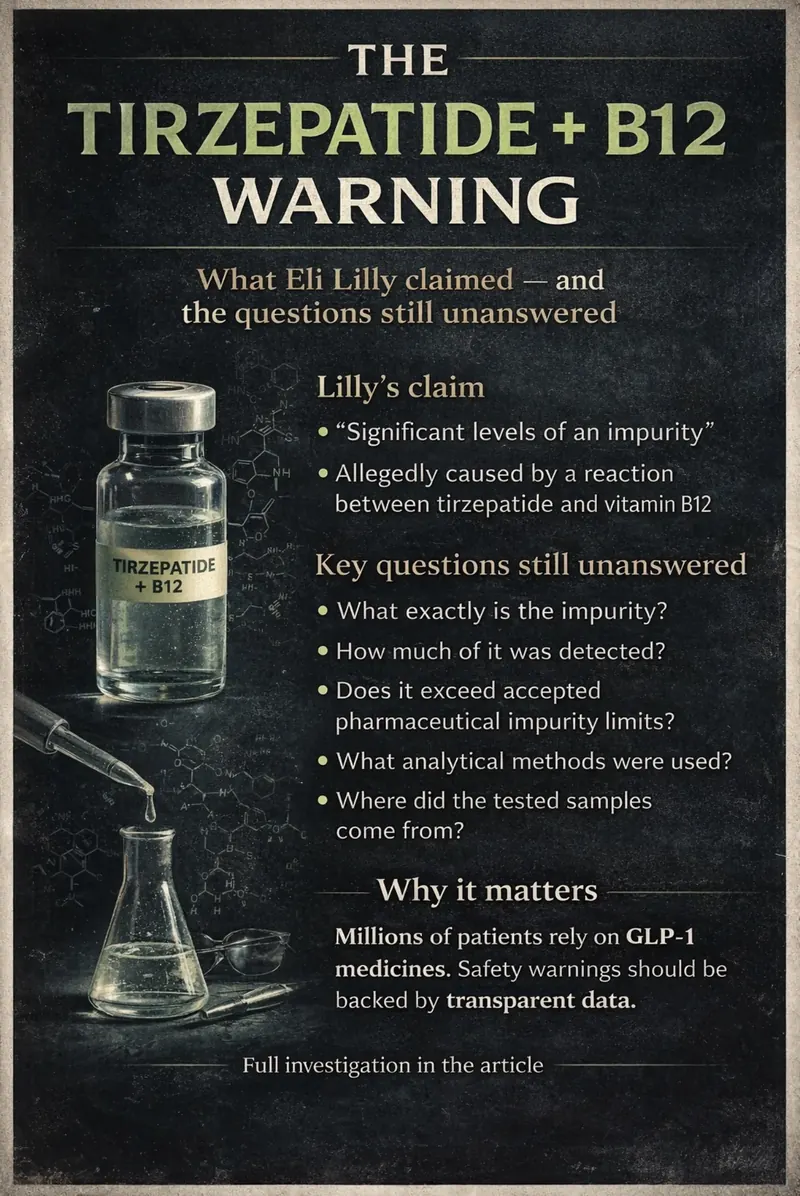
On 12 March, Eli Lilly released an open letter warning of potential patient safety risks associated with tirzepatide compounded with vitamin B12. The company stated that its testing had found “significant levels of an impurity” created by a chemical reaction between tirzepatide and B12.
Since then, Lilly has also published a preprint describing its findings in more detail.
https://www.medrxiv.org/content/10.64898/2026.03.09.26347818v1
The manuscript reports that a previously unidentified impurity, described as a tirzepatide - B12 adduct, was detected in all analyzed samples, in some cases representing up to around 10% of the total peptide content. It also notes that some samples tested were significantly under strength compared to their labelled dose.
At first glance, that appears to provide a stronger scientific basis for Lilly’s warning than the original press release alone.
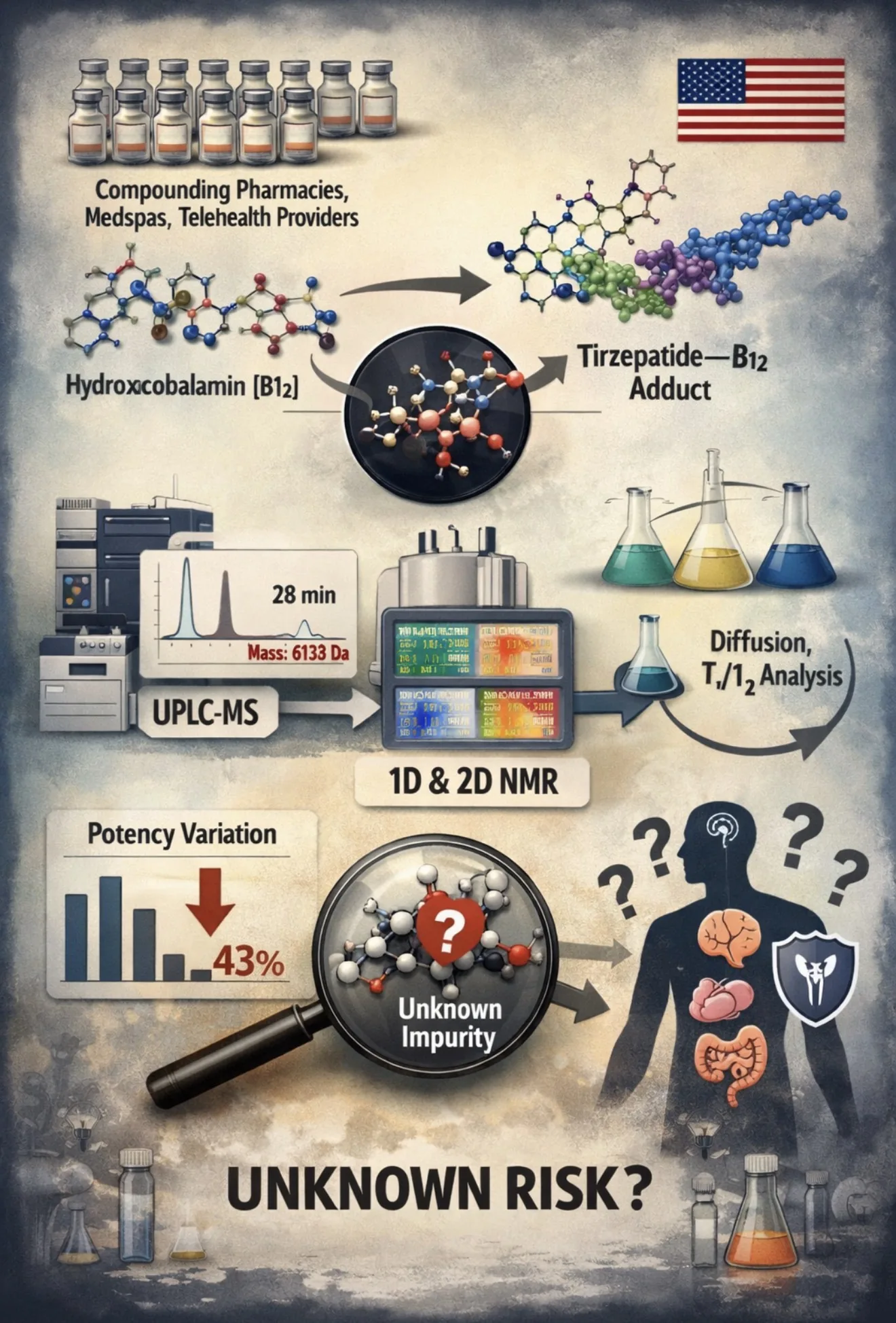
In total, 10 compounded samples were analysed
from a range of sources across the United States, including compounding pharmacies, medspas, and telehealth providers.
Analytical Approach
The market samples were primarily analysed using:
UPLC-MS (Ultra-High Performance Liquid Chromatography-Mass Spectrometry
to assess impurity profiles, determine molecular mass, and evaluate potency
To investigate the origin and mechanism of the observed impurity, Lilly then prepared its own laboratory samples by mixing tirzepatide with hydroxocobalamin at a 1:1 molar ratio, which the paper says was consistent with the makeup of the samples tested by UPLC-MS. These mixtures were prepared in phosphate-buffered saline (PBS) at pH 7.4 to mimic physiological conditions.
These lab prepared samples were then analysed using
1D and 2D NMR spectroscopy (including ¹H-¹³C HSQC and ¹H-¹⁵N HSQC experiments
to examine structural and conformational changes
Diffusion NMR technique
to assess changes in molecular size, diffusion behaviour, and apparent molecular weight
Key Finding
1. Presence of a consistent impurity
A previously uncharacterised impurity was detected in all 10 samples analysed
The impurity had a retention time of approximately 28 minutes
MS analysis showed a mass of approximately 6,138 Daltons, compared with 4,810.52 Daltons for tirzepatide alone
This was interpreted as being consistent with a tirzepatide-B12 adduct
2. Evidence of molecular interaction
The adduct appeared to remain intact under denaturing conditions and did not dissociate during electrospray ionisation mass spectrometry, suggesting a stable association
Lilly interprets this as consistent with B12 being covalently or coordinately attached to tirzepatide, likely through a ligand substitution reaction
3. NMR evidence of structural change
Using the 1:1 lab-prepared tirzepatide/B12 mixtures, Lilly reports that NMR experiments showed:
significant changes in lineshape, intensity, and chemical shifts in the B12 signals in the presence of tirzepatide
more modest but still detectable changes in tirzepatide signals
new peaks in the 2D ¹H-¹³C HSQC spectra, interpreted as alternate states of B12 in solution
perturbations in the 2D ¹H-¹⁵N HSQC spectra, which Lilly interprets as evidence of changes in tirzepatide’s structural properties upon binding B12
4. Diffusion and relaxation data
Diffusion NMR experiments showed:
decreased diffusion rates for both tirzepatide and B12 in the 1:1 mixtures
increased T1/T2 ratios, particularly for B12
Lilly interprets these findings as consistent with an increase in apparent molecular size and conformational change resulting from interaction between the two molecules.
5. Quantitative significance
The tirzepatide-B12 adduct was reported at levels of up to ~10% of total polypeptide content
6. Potency variability
The 10 market samples showed a wide range of potency
Some tested as low as 43% of labelled strength
This is a separate finding from the impurity itself and points to a broader product quality issue.
Interpretation by the Authors
The authors argue that the tirzepatide-B12 interaction may:
perturb GIP and GLP-1 receptor binding
alter pharmacology and efficacy
affect absorption, distribution, metabolism, and excretion
increase the risk of immunogenicity
They also frame the impurity as part of a broader set of concerns around compounded tirzepatide, including:
inconsistent potency
contamination risks
misleading promotion
lack of FDA style pre market evaluation
absence of impurity qualification and regulatory oversight
Critical Limitation
Despite these findings, the paper explicitly states that
no studies in humans, animals, or laboratory biological models have been conducted to assess
safety
toxicity
efficacy impact
long term outcomes
So while the preprint presents analytical evidence of a tirzepatide-B12 interaction, the clinical significance remains unknown.
Important Methodological Context
The impurity itself was detected in real world compounded samples using UPLC-MS.
However, the mechanistic and structural interpretation of how that impurity forms comes from Lilly’s own lab-prepared 1:1 molar ratio tirzepatide/B12 mixtures analysed under controlled conditions.
That is an important distinction.
The study directly supports the presence of an impurity in the sampled products. However, the explanation for how that impurity forms, and how broadly those findings apply to real world formulations, depends in part on model conditions created by Lilly, including a 1:1 molar ratio setup.
While the authors state this ratio was consistent with their analytical data, it reflects an inferred interaction rather than a directly confirmed formulation composition of the sampled products.
Key takeaway
Lilly’s preprint reports that 10 compounded tirzepatide + B12 samples contained a previously uncharacterised impurity consistent with a tirzepatide-B12 adduct, in some cases at levels up to 10% of total polypeptide content, and that some samples were also significantly under strength. The impurity was detected in real world samples by UPLC-MS, while Lilly’s interpretation of the interaction mechanism and structural effects comes from lab prepared 1:1 tirzepatide/B12 mixtures analysed by NMR. The paper presents analytical evidence of interaction, but not clinical evidence of harm.
Crucially, several key questions remain unanswered. The paper does not identify the impurity’s structure in full, quantify its levels against accepted pharmaceutical limits, or provide data on its safety, toxicity, or clinical effects. It also does not establish how representative the 10 samples are of the wider market or how real world formulations compare to the 1:1 model used in laboratory testing.
In other words, the study provides analytical evidence that an interaction can occur, but leaves open fundamental questions about how often it occurs, under what conditions, and whether it has any meaningful clinical impact.
My original post is here
Comments