
I’ve decided to revisit this piece because the original only covered part of the story. There is more to say, obviously, but not all of it belongs here, and not all of it belongs now. For now, this is the part I’m ready to tell.
Another reality of living inside a tight-knit grey market community, where news spreads fast and is often driven by a small group who have appointed themselves chief snoops, is this:
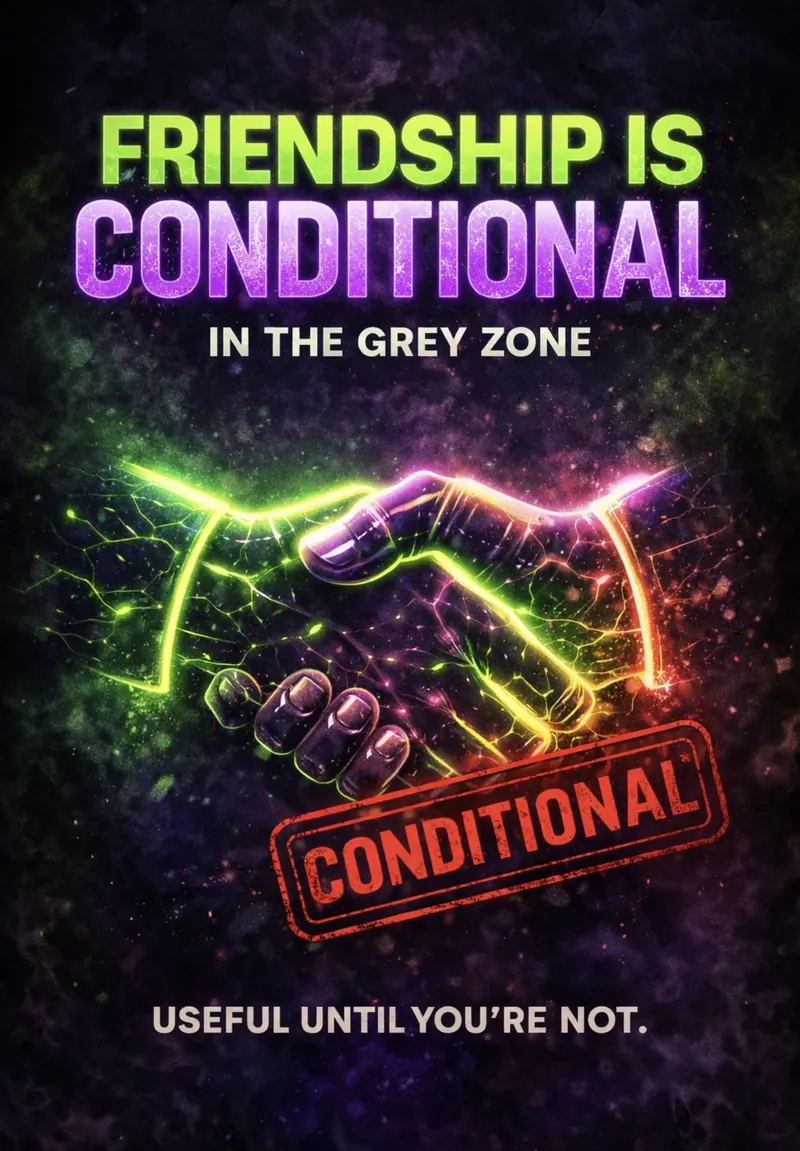
Friendship is conditional.
One minute, someone is your friend. The next, they’ve turned on you.
You are useful while you are helping them, answering questions, offering protection, sharing information. But the moment you publish something they don’t like, the knives come out. Suddenly, you are labelled a problem, a traitor, even a cancer.
There are also those who are so obviously two-faced it’s almost laughable.
Whether I ask for it or not, and I usually don’t, I get sent screenshots of people talking about me. So I tend to know exactly what’s being said behind my back. What’s more interesting is that some of these same people will sit in my server while criticising it elsewhere.
I’ve seen people brag about getting their alt account into my server, as if that’s some kind of win against me. What they don’t seem to realise is that unless they cause problems, which they usually don’t, I really don’t care. If anything, they’re just consuming the same content they criticise elsewhere.
What I do find strange is how people I barely know seem to have me living in their head rent free.
There’s an account on another forum, frog profile picture, who reacts to almost everything I post. Always with a laughing emoji. Supposedly derogatory. But still consistent. Still attention. Still effort.
Then there are the ones who get nervous.
In another Discord server, led by someone claiming to be a doctor, I was messaged as soon as I started my TikTok account and asked not to mention his server publicly. It hadn’t even crossed my mind at that point. I rarely engaged with it.
But after I started my Substack, something shifted. There was a sense of panic, as if I might start naming and shaming them. That reaction alone tells you more than anything else.
What makes that even more interesting is that I had previously defended him. When he received backlash over his views on Cagri and amylin fibrils, I offered him a chance to present his position properly in the Swiss server, where the discussion was actually happening. He declined, and sent others to argue for him instead.
Some people prefer to control the narrative from a distance.
What also stood out was that one of some people’s main concerns seemed to be whether I was monetising Substack or not. That in itself was revealing. Paid subscriptions can be an automatic feature on Substack, and Ive since turned them off. But apparently even that was hard for some people to get their heads around. I suppose the idea that someone might actually enjoy doing this, and choose to do it for free, does not fit very neatly into the way they see the world.
What’s also become clear is that a certain small corner of this community, the ones who like to call themselves OGs, are very uncomfortable with what I’m doing across different platforms.
That’s fine.
If anything, they’ve given me more reason to keep going.
They can treat it like a whack-a-mole game. Shut one platform down, I’ll appear somewhere else. I don’t stop. And I don’t forget.
Most of that, I can file under: predictable.
What isn’t predictable, or at least not easy to accept, is something else entirely.
It’s not the opportunists.
It’s not the snitches.
It’s the people who felt genuine.
The ones you let into your inner world. The ones you made plans with. The ones that felt like they might exist beyond the screen.
One minute, you’re talking like old friends. The next, they’re gone.
No explanation. No goodbye.
Just silence, and a question you’re left sitting with:
Was any of it real, or was I only valuable while I was useful?
And sometimes, they come back.
For a moment, it feels like nothing changed. Like you’ve picked up exactly where you left off. You think maybe something real is still there.
But it doesn’t last.
The same pattern returns.
One minute they’re present. The next, they’re gone again.
That’s where the real impact sits.
Not in the loss itself, but in the repetition of it.
That cycle creates a kind of emotional whiplash. You’re pulled back into something familiar, only to be dropped out of it again just as quickly.
Not because the connection wasn’t real, but because it wasn’t stable.
Those are the ones that stay with you.
They leave a mark.
And they force you to learn something you didn’t want to learn:
In the grey zone, friendship isn’t stable.
It’s conditional.
And those conditions can change without warning.
Comments