
One of the hardest things to explain to outsiders about the online grey space is this:
There’s no real accountability.
Not the “call the manager” kind. Not the “chargeback” kind. Not the “leave a bad review and warn others” kind.
In most normal markets, accountability exists because there are structures behind the scenes: formal identities, payment rails, legal obligations, reputational systems that stick.
In the grey space, those structures don’t exist, or they exist only in a fragile, informal way.
And once you understand that, a lot of behaviour that seems shocking starts to make grim sense.
People can disappear
In this space, people don’t just leave.
They vanish.
One day you’re talking. The next day you’re blocked. Their profile picture becomes a grey silhouette.
For the blocker, it’s a simple click.
For the person on the other side, cut off without explanation or closure, it can leave a real psychological bruise.
No accountability. No conversation. Just silence.
Sometimes it isn’t a block at all. The username changes. The account disappears. The server is gone. They “quit the scene.”
And if they want to come back?
They return under a new name.
New profile. New handle. New story.
No continuity. No consequences.
Vendors can ghost
Vendors can do the same thing, sometimes for reasons that are understandable (pressure, enforcement, payment issues), and sometimes for reasons that are not.
They can:
delay for weeks
stop replying
move platforms
quietly shut down
restart under a new brand
When promises aren’t fulfilled, reship guarantees, refunds, replacements, buyers often have no route to resolution beyond public pressure.
But even public pressure is complicated here.
Why people don’t report
In a normal consumer world, people report problems because it protects others.
In the grey space, reporting can feel like self-sabotage.
Because everyone knows what sits behind the curtain:
attention attracts enforcement
enforcement attracts shutdowns
shutdowns destroy communities
and nobody wants to be “the person who brought heat”
So people choose silence.
Not because nothing happened, but because they’re trying to protect themselves, protect others, or protect the ecosystem
That’s how the accountability vacuum sustains itself.
The social cost of speaking
Even when people do speak up, they often pay for it.
In tight communities, raising concerns can trigger:
Server raids
loyalty tests
character attacks
accusations of “drama”
being blocked, removed, or labelled a problem
And that creates a chilling effect.
People learn quickly that it’s safer to stay quiet than to become the centre of a conflict.
So bad behaviour doesn’t just continue.
It gets normalised.
Nothing can be done
That’s the bleak part.
There isn’t a regulator you can call without putting everyone at risk.
There isn’t a universal dispute system.
There isn’t a stable identity layer.
There isn’t a robust public record.
There is only:
documentation
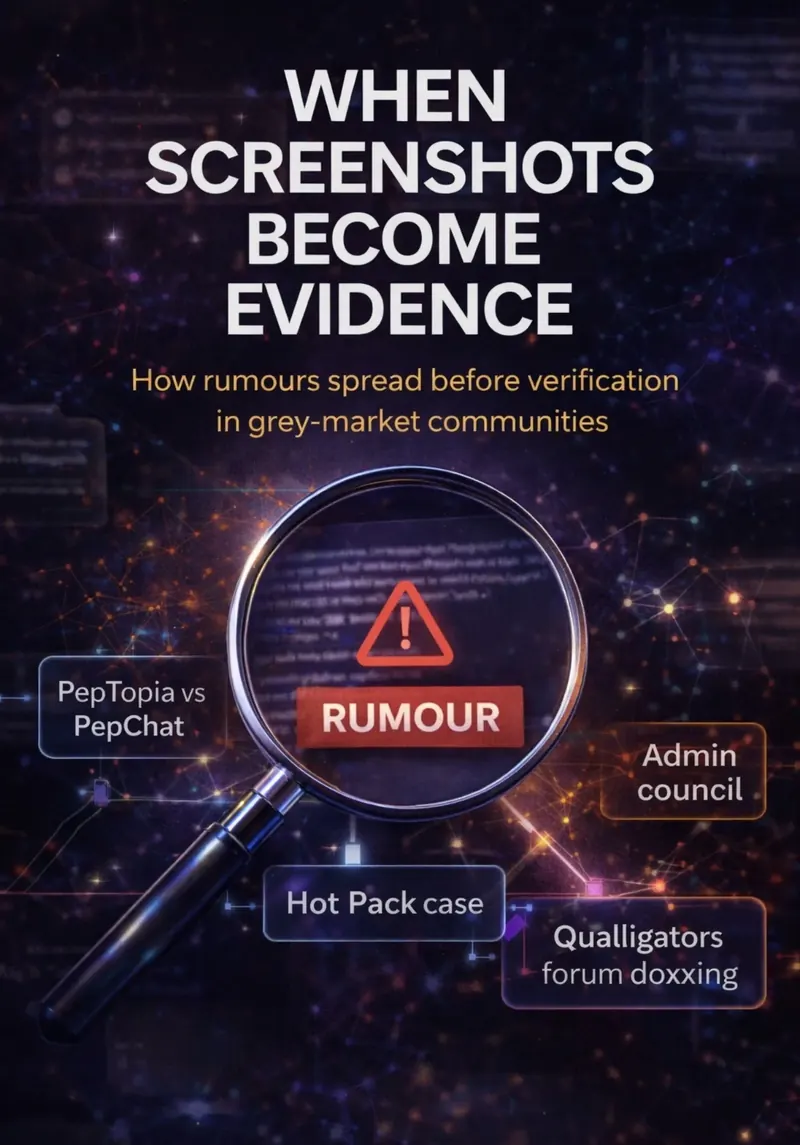
community memory
and the hope that enough people care about evidence to prevent repeats
And even those are fragile.
Because platforms get nuked.
Servers disappear.
Messages get deleted.
And the same people reappear in a new skin.
So what’s the point of documenting it?
Because in an accountability vacuum, memory is enforcement.
The closest thing this space has to accountability is:
people comparing notes
spotting patterns
tracking behaviour over time
and refusing to let narratives reset every time someone changes their username
You can’t stop everything.
But you can make it harder for bad actors to wipe the slate clean.
And in the grey space, that’s often the only justice available.
So if you’re the type to block people, maybe pause for a moment next time, take a breath and consider what that silence does to the person on the other side.

Comments