
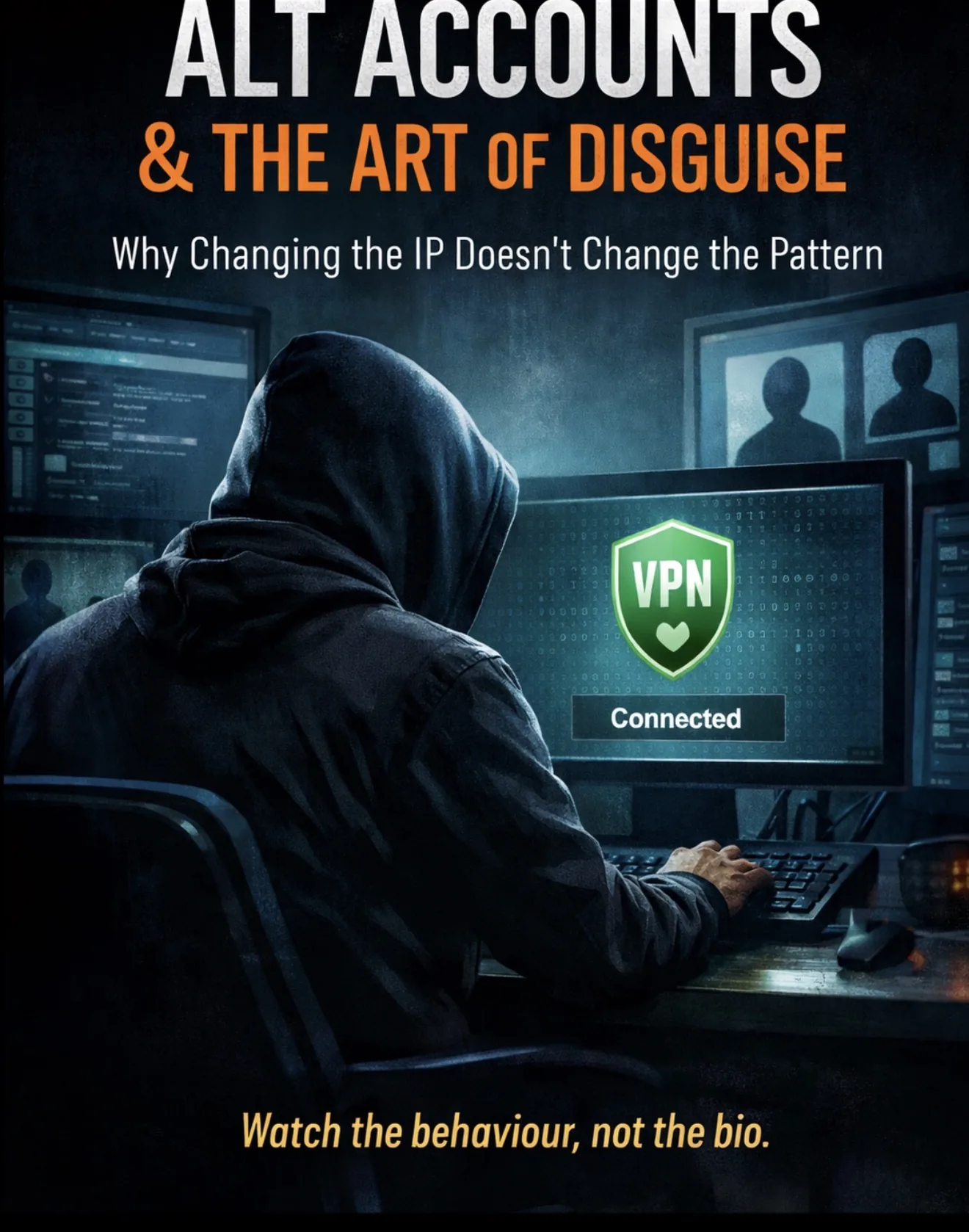
In the grey market, peptides aren’t the only thing being reconstituted. So are identities and since I’m apparently the queen of alt accounts, who better than me to an article on alt accounts and tips on how to spot them.
But before I go any deeper, for those readers who’re not from the grey zone who may be unaware of what an alt account even is, it’s short for “alternative” account and it’s a secondary profile, separate from a users main account. It’s used mainly to maintain privacy, separate personal / professional lives, test content, engage in niche communities or keep tabs on people without affecting the reputation of the main account or letting people know that you’re spying on them.
The History of Alt Accounts (How We Got Here)
Alt accounts didn’t start in the grey market. Alt accounts have existed for as long as online forums have.
1) The Ancient Era: Forums, IRC, and “I Swear This Isn’t Me” (1990s to early 2000s)
Back in the dial up days, the internet was basically:
forums,
message boards
IRC ( internet relay chat) chatrooms,
and teenagers with too much time on their hands
People made extra accounts for the same reasons they do now:
privacy (“my friends can’t see I’m in this weird niche forum”)
reinvention (“new city, new me, new username”)
chaos (trolling before it had a brand identity
bans (mods existed, therefore ban evasion existed)
This is where the classic alt archetype was born
“I’m definitely a different person, I just happen to type in the exact same way and argue with the same three people.”
2) The Golden Age: Gaming and the Birth of the “Smurf” (2000s)
Online games made alts normal.
People created “smurf” accounts to:
play anonymously,
avoid reputation damage,
test strategies,
or to crush newer players without risking their main account’s record.
This era normalised the idea that you can have a “main identity” and a “shadow identity” for different behaviour.
And once that idea took hold, it didn’t stay in gaming for long.
3) Social Media Era: The “Finsta,” the Burner, and Reputation Management (2010s)
Instagram and Twitter scaled the concept.
Now alts weren’t just for trolls, they were for image control:
“public me” vs “private me”
“professional me” vs “unhinged me”
“hot takes me” vs “I’m here for stalking exes me”
The alt account became less like a crime and more like a lifestyle choice:
One account for being perceived. One account for being honest. One account for being messy.
4) The Modern Era: Platform Crackdowns + Shadow Browsing (late 2010s to now)
As platforms got stricter (bans, moderation, automated detection), alts became operational:
ban evasion
“testing the waters” before posting
reading without being seen
watching rivals
quietly gathering intel
And as a bonus: people realised you can run multiple identities without doing much work, because the internet rewards confidence, not verification.
That’s the real fuel.
Why This Matters in Grey Market Spaces
Grey market communities didn’t invent alts, they just made them useful.
Because when you mix:
money,
risk
reputation,
bans,
scams,
and public accusations…
alts stop being “extra accounts” and start being infrastructure
In this world, alts are used for
reputation laundering (new name, same seller)
sockpuppet vouching (“I’ve ordered 12 times, perfect vendor!” posted by someone created yesterday)
ban survival (the hydra: cut one head off, two new accounts appear)
silent monitoring (reading everything while staying invisible)
conflict management (one account to sell, one account to argue, one account to play victim)
You can frame it like:
In normal life, people change outfits. In grey market Discord, they change usernames.
What Is (and Isn’t) an Alt Account?
Before we go any further, we need definitions. Because not all multiple accounts are “alts.” And not all alts are sinister.
Multi Account (Transparent Segmentation)
This is normal.
One person.
Multiple accounts.
Openly linked.
Examples:
Personal account
Business account
Podcast account
Research only account
Everyone knows they’re connected. There’s no performance of “another person”.
This isn’t an alt. It’s organisation.
Pseudonymous Identity
Also normal.
One person.
One consistent alias.
Used across platforms.
The name may not be your legal name, but it’s stable. It builds reputation. It carries continuity.
That’s not deception. That’s internet culture.
Writers, gamers, researchers, whistleblowers this is standard practice.
The True Alt (Identity Split)
Now we’re in different territory.
A true alt usually involves:
A separate identity not publicly linked to the main
Behaviour that wouldn’t happen under the primary account
Interaction between accounts as if they are different people
Narrative influence (vouching, attacking, validating, amplifying)
This is where it shifts from “organisation” to “simulation”.
That’s the key word
Simulation.
The Sockpuppet
This is the evolved form.
A sockpuppet account exists specifically to:
defend the main account
vouch for products or services
attack critics
create artificial consensus
evade bans
reset reputation after exposure
Now we’re not in “privacy” territory anymore.
We’re in reputation engineering.
These sort of accounts are very common in the scammer servers, where their job is to give credibility and trustworthiness to the scammer.
Having multiple accounts isn’t suspicious.
Simulating multiple people is.
Why This Matters in Grey Market Community
When you combine:
money
low regulation
reputation based trust
bans and server nukes
anonymous payments
Identity becomes currency.
And once identity becomes currency, fragmentation becomes strategy.
That’s when alts stop being harmless and start being infrastructure.
Discord, Alts & the Rise of Detection
Discord changed the game.
Unlike early forums:
Accounts are free.
Creation takes seconds.
Email verification is minimal friction.
Switching between accounts is easy.
Servers are privately owned micro communities.
In gaming servers, this wasn’t a big issue.
In grey market or high conflict spaces? Different story.
Because now:
banned users reappear in minutes,
sellers rebrand overnight,
sockpuppets can inflate trust signals,
reputation can be wiped and restarted.
Discord didn’t create alts.
It lowered the barrier to creating and cycling identities.
Enter Double Counter
Then moderation escalated.
Bots like Double Counter appeared.
What Double Counter does (in simple terms):
Detects suspected alternate accounts.
Flags users who share IP or device indicators.
Helps prevent ban evasion.
Allows servers to require verification.
Links account clusters when possible.
It’s basically an immune system for servers.
Not perfect.
Not omniscient.
But enough to discourage obvious alt cycling.
Discord, Verification Bots… and the First Time I Heard the Word “VPN”
I can’t really talk about Double Counter (or any alt detection culture on Discord) without mentioning VPNs, as on discord they often go hand in hand.
Unsurprisingly then, the first time I ever heard the word “VPN” was during my Discord onboarding.
The person helping me advised me to turn off my VPN if I was using one, as sometimes verification won’t work.
At that point I had no idea what a VPN was and was too embarrassed to admit that, so I took at risk and ignored it. As I had no issue joining, I assumed it wasn’t important and promptly forgot about it.
What are VPNs and why they were originally Invented
A VPN (Virtual Private Network) was created to solve one problem:
How do employees securely access a private company network from outside the office?
Back in the 1990s, businesses started connecting offices over the internet. The internet was public. Corporate data wasn’t supposed to be.
They needed a way to:
encrypt data in transit
create a secure “tunnel”
make remote devices appear as if they were inside the company network
That’s what a VPN does.
It builds a secure tunnel over a public network.
The Corporate Era (1990s to Early 2000s)
VPNs were used by:
Banks
Governments
Universities
Large corporations
If you worked from home, you connected to your company VPN to:
access internal files
use internal systems
send sensitive data securely
It was about encryption and access control.
Not anonymity.
Then the Consumer Shift Happened
As the internet commercialised and data tracking increased, VPNs moved into the public space.
People started using them for:
Protecting themselves on public Wi-Fi
Avoiding ISP tracking
Bypassing geographic content restrictions
Accessing blocked websites
Avoiding data collection
This is when VPNs became mainstream.
How a VPN Actually Works
A VPN doesn’t make you invisible.
It changes the route your internet traffic takes.
Normally, when you connect to a website or app:
Your device connects through your ISP (Internet Service Provider).
Your real IP address is visible to the service you’re connecting to.
Your ISP can see which domains you’re visiting (though not encrypted content).
When you use a VPN, the process changes slightly.
Step 1: A Secure Tunnel
Your device first connects to a VPN server.
That connection is encrypted, often using protocols like OpenVPN or WireGuard.
You can think of it as wrapping your internet traffic in an encrypted envelope before it leaves your device.
Step 2: IP Address Substitution
Instead of your home IP address appearing to websites or apps, the VPN server’s IP address appears.
So:
Discord sees the VPN server’s IP.
Not your ISP issued IP.
This is why your apparent location can change when using a VPN.
Step 3: ISP Visibility Changes
Your ISP can still see:
That you are connected to a VPN server.
The amount of data transferred.
When you connected
But they cannot easily see:
The specific websites inside that encrypted tunnel.
The content of your traffic.
The VPN provider, however, becomes the new intermediary.
So you are shifting trust, not eliminating it.
Important Clarification
A VPN does not:
Hide your Discord account.
Erase your device identity.
Prevent behavioural patterns from being observed.
Automatically bypass detection systems.
It mainly:
Changes your outward facing IP address.
Encrypts your traffic between you and the VPN server.
On paper, a VPN is just infrastructure. In practice, once tools designed for privacy become widely accessible, they start to serve many different purposes, some mundane, some controversial.
The Reputation Shift
Later, VPNs became associated with:
Torrenting (a peer to peer method of sharing files rather than downloading from a single server. It’s legal or illegal depending on what’s being shared.
Circumventing bans
Masking IP addresses
Political activism in censored countries
And our good old friend the alt account
Alt Accounts, IP addresses and the Illusion of Reset
In online communities, identity is rarely just a username. It’s a cluster of patterns.
An account has:
a creation date
a posting history
behavioural patterns
writing style
login timing
and sometimes shared network indicators
IP addresses are only one piece of the picture, not the whole story.
And this is where the “illusion of reset” gets interesting. I once spoke to someone I’d describe as an alt maestro, who has more accounts than I’ve had hot dinners and they gave me a piece of advice that stuck: if you’re creating an alt, don’t just make a new username, create a character. Decide who that account is, and step into that persona when you use it.
For me, that’s easier said than done. I’m hopeless at pretending to be someone I’m not. But on the upside, I’m fairly intuitive, and I’ve become good at spotting them.
So it makes me laugh when I hear people claiming I have 20 TikTok accounts, or when I see them trying to work out who my “alts” are.
I do have several Discord accounts, but they all have my profile picture and “Krysia” in the username. By my own definition (and also by any reasonable one), those don’t qualify as alt accounts.
So I’m probably not the best person to give advice on how to be a convincing alt. But I can give advice on how to spot one, and none of it is rocket science.
Account Age and Activity Gaps
The most obvious clues are often hidden in an account’s history.
The “Fresh” Profile: The account was created very recently and has little to no posting history. That said, older Discord accounts can be bought these days, so “account age” alone isn’t foolproof.
The “Sleeper” Account: An account created years ago that shows almost no activity, until it suddenly “wakes up” to defend a specific person, vendor, or viewpoint.
Low Karma / Low Followers: On platforms like Reddit or X, a lack of visible reputation despite high confidence and heavy involvement in controversial topics can be a tell.
Behavioural Patterns
Alt accounts often exist for a single purpose, and that makes their behaviour unusually predictable.
Laser Focus: The account only posts about one topic, one brand, or one person. Most real users have some variety: hobbies, memes, random opinions, normal life noise.
The “Supportive Echo”: One account posts, and a second account reliably appears within minutes to agree, like, retweet, or reinforce the same point.
Aggressive Defence: Alt accounts are often used as “attack dogs” to say things the user doesn’t want attached to their main, professional, or “clean” profile.
Linguistic Fingerprints
People find it surprisingly hard to change how they naturally communicate.
Recurring Slang or Typos: The same odd abbreviations, repeated spelling mistakes, unusual punctuation habits (hello, constant “…”) or identical phrasing.
Cadence and Tone: When two accounts write with the same rhythm and swing between the same formal or informal tone in the same discussion, they may not be as independent as they appear.
Inside Knowledge: The account “accidentally” knows details about a situation that a genuine outsider wouldn’t realistically have
Technical Coincidences
No single technical overlap proves anything, but clusters are hard to ignore.
Shared Media: Posting the same screenshots, photos, or memes, often with the same cropping, captions, or file artefacts.
Timing Patterns: Both accounts are consistently active at the same times of day and go quiet at the same times too (often reflecting the same time zone and routine).
Following Patterns: A brand new account that instantly follows the exact same niche set of people as another account is rarely random.
Low Footprint Accounts: Privacy is valid, some people genuinely don’t want a visible trail. But when an account exists almost exclusively around one person, one topic, or one conflict, that narrow footprint can be telling.
This isn’t about “proof.” People lurk. People use VPNs. People keep burner accounts just to read drama in peace. But when the same patterns keep resurfacing, the timing, the voice, the instant vouching, the single purpose appearances, you don’t need to be a detective to recognise coordination.
So if a “random” account suddenly slides into your replies, DMs you for a private chat, or appears in your followers list overnight, remember this post. Assume nothing, and keep your guard up.
Comments