
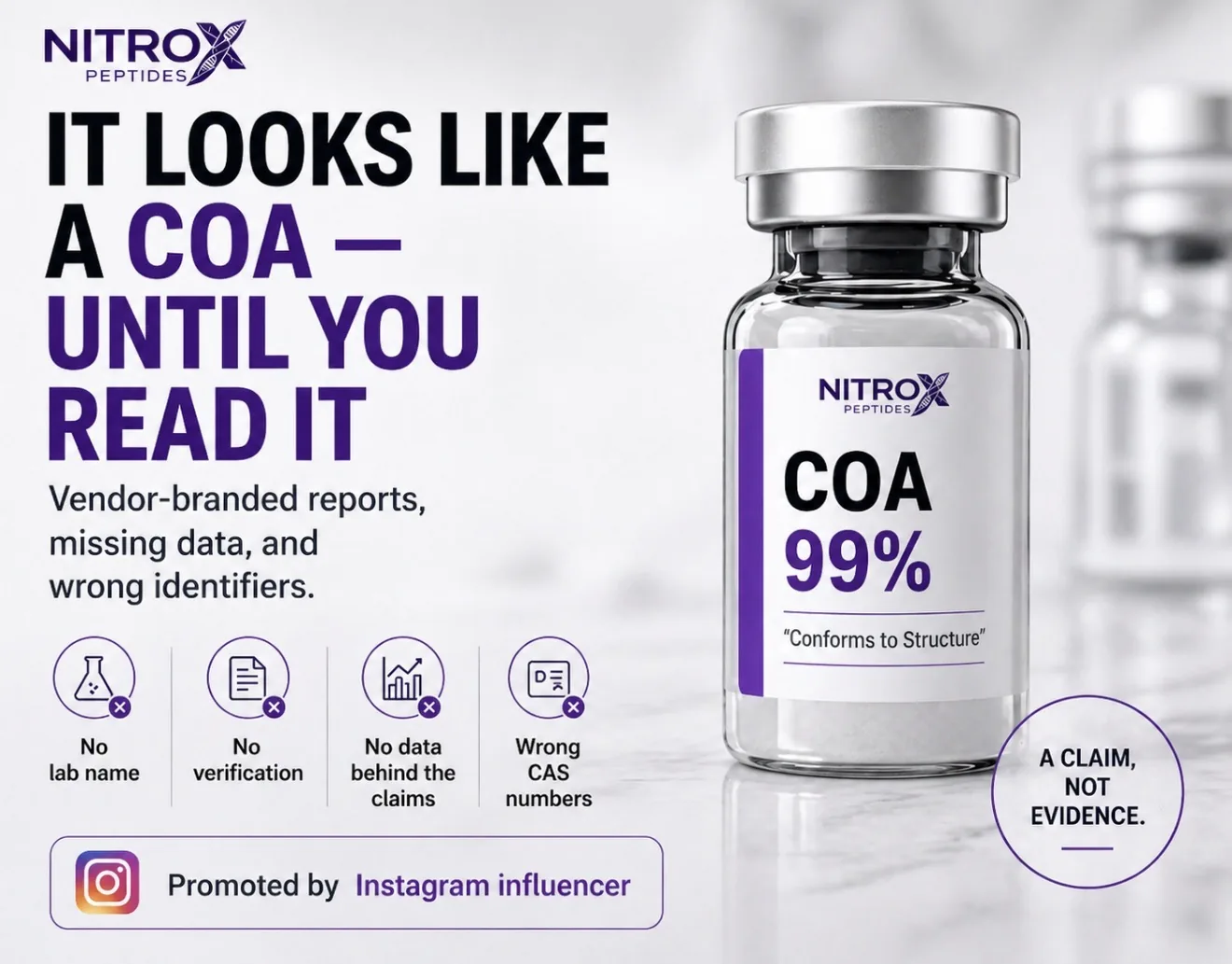
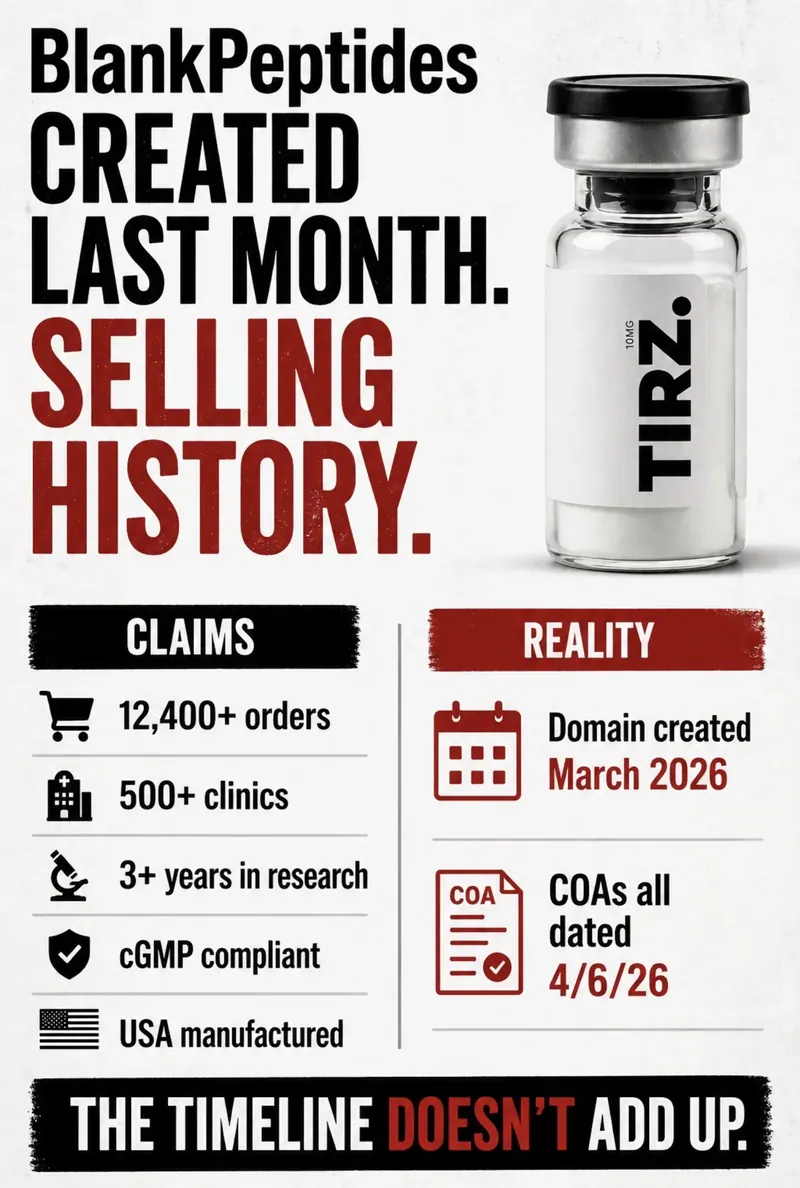
This RUO website is being promoted by an Instagram influencer and it was sent to me by someone who was concerned about the fake looking COAs on the site, so I decided to check the website out myself.
At first glance, NitroX Peptides looks like many other polished RUO peptide websites. It has the usual clean layout, purple branding, a search bar, product categories, shopping cart, and a catalogue-style setup that makes it feel like a normal online store.
The site repeatedly states “Research Use Only” and says the products are not for human or animal use. But at the same time, the products are grouped under familiar buyer-friendly categories such as fat loss, libido, sleep & relaxation cognitive & brain, muscle growth, recovery, and growth hormone. So while the disclaimer says one thing, the browsing structure points people toward obvious human-use goals.
The site also presents itself as a “trusted research peptides source” and uses reassurance language such as lab-verified purity, discreet worldwide shipping, and quality control on every batch. It advertises worldwide delivery, with an estimated shipping time of 3 to 5 weeks, and payments are crypto only, using USDT or USDC.
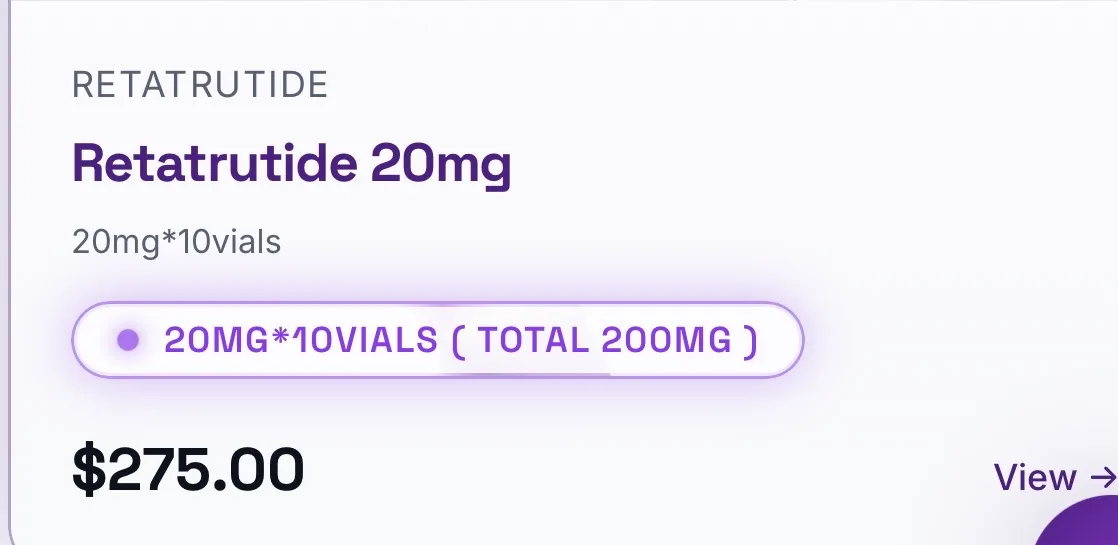
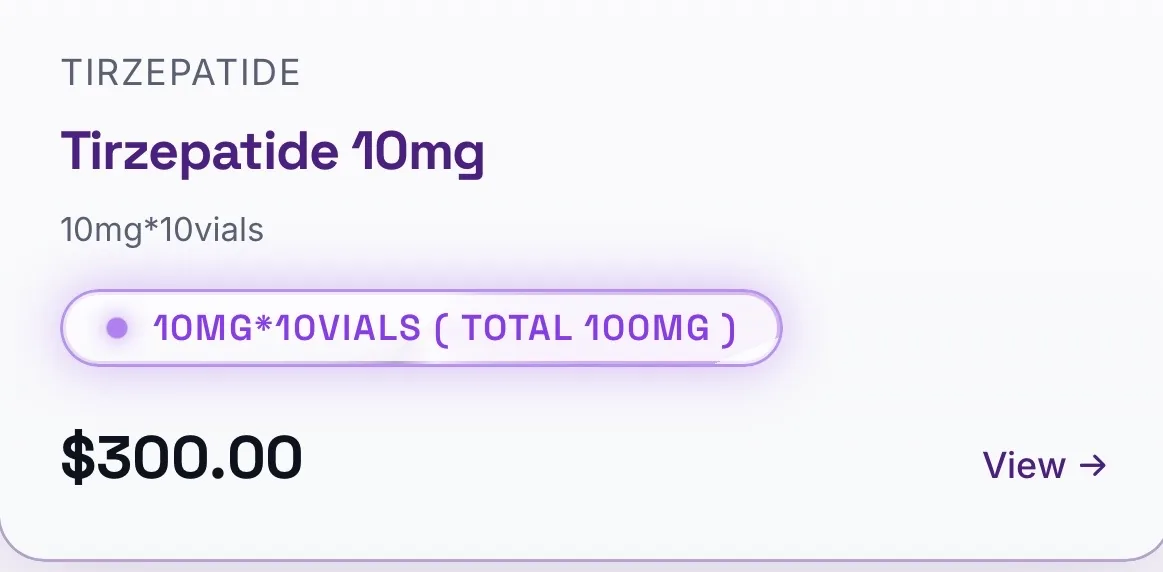
The prices are much higher than what I’m used to seeing buying from China.
For example, 10 x 10mg Tirzepatide is listed at $300, while 20mg x 10 Retatrutide is $275, which is cheaper than the 10mg Tirzepatide. That made me wonder whether it was actually a mistake.
Another example is 10 x 5mg AOD, which is listed at $225. That feels particularly expensive given that AOD is generally a worthless peptide, so that stood out too.
It’s clear the site isn’t just selling products; it’s selling confidence too. It looks modern, organised, and professional, which is exactly why the COA issue matters.
The COAs
I then looked at the COAs, because the website says “COA PDF,” and that’s where most people will either be reassured or confused.
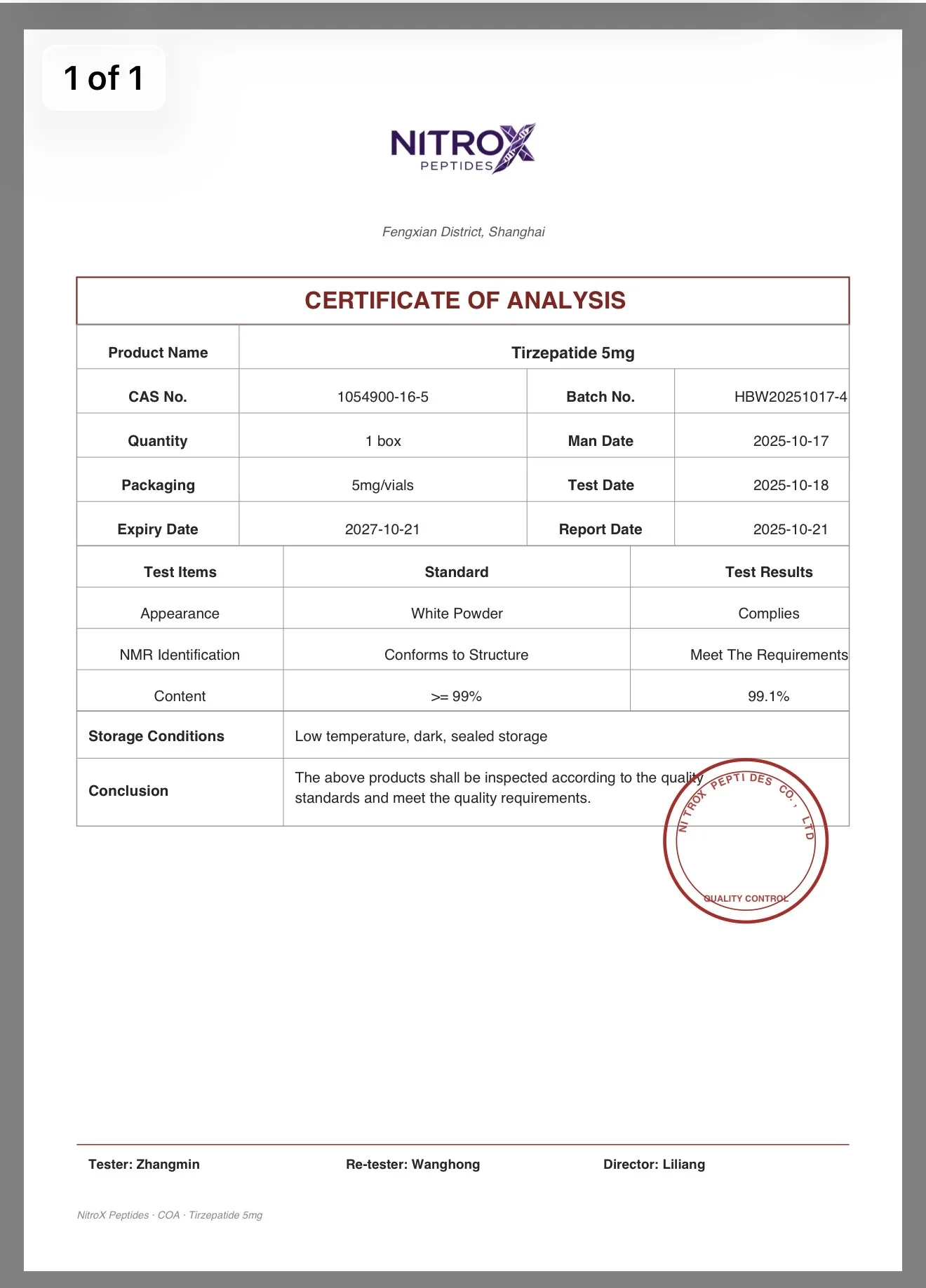
When you click the “COA PDF,” the document looks official at first glance. It has the familiar certificate layout, batch numbers, dates, a Shanghai location, generic testing language, and a red stamp.
But once you look closer, it becomes confusing rather than reassuring.
The COAs are not like the third-party reports most people are used to seeing. They sit somewhere between a raw material COA and a finished-product COA. The testing section is extremely limited, more like a basic raw certificate, but the document also lists finished-product details such as “1 box” and “5mg/vials,” “10mg/vials,” or “20mg/vials.”
That matters because a raw API COA usually refers to bulk material, not retail vial strengths. If a document lists vial strength, it’s being used to support the finished product. But this COA doesn’t provide the kind of data needed to verify a finished vial.
The testing section includes only three items: appearance, NMR identification, and content. Appearance is listed as “complies,” NMR identification is marked as “meets the requirements,” and content is reported as 99.1%. There is no chromatogram, no method detail, no NMR data, no sample traceability, and no independent lab verification.
The COAs are also branded with the NitroX Peptides logo and stamped with a NitroX quality control seal. There’s no independent laboratory named anywhere, no verification link, no lab contact details, and no way to trace the report back to a third-party testing provider. The only identifying details are three generic Chinese names listed as tester, re-tester, and director.
So the issue isn’t just that the COA is minimal. It appears to borrow the look of a raw material certificate while being used to reassure buyers about a finished vial product. Even compared with minimal legitimate raw COAs, these documents are weak. A more complete raw COA often includes peptide content, water content, residual solvents, endotoxin, microbial limits, amino acid ratio, assay information, or other supporting data. These NitroX documents do not.
Up to this point, I was still giving the COAs the benefit of the doubt. But then I spotted the bigger problem: the CAS numbers are wrong.
The Tirzepatide COA lists 1054900-16-5, when Tirzepatide is commonly listed as 2023788-19-2.
The Semaglutide COA lists 8949700-43-2, when Semaglutide is commonly listed as 910463-68-2.
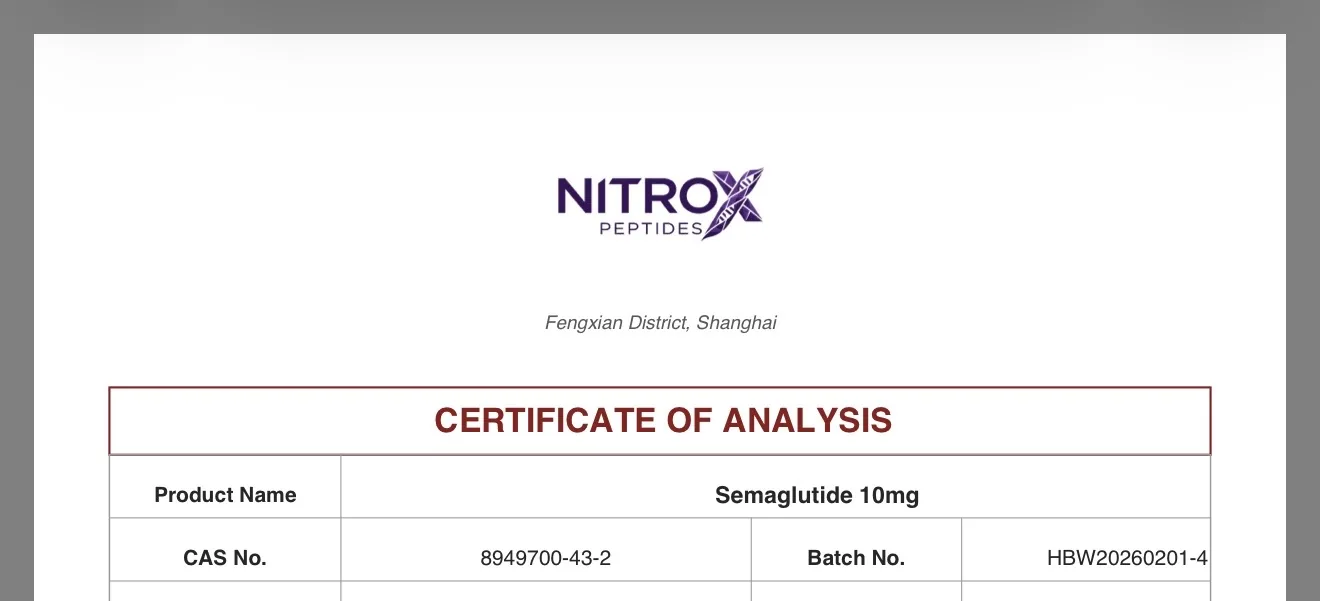
The MOTS-c COA lists 4464100-40-1, when MOTS-c is commonly listed as 1627580-64-6.
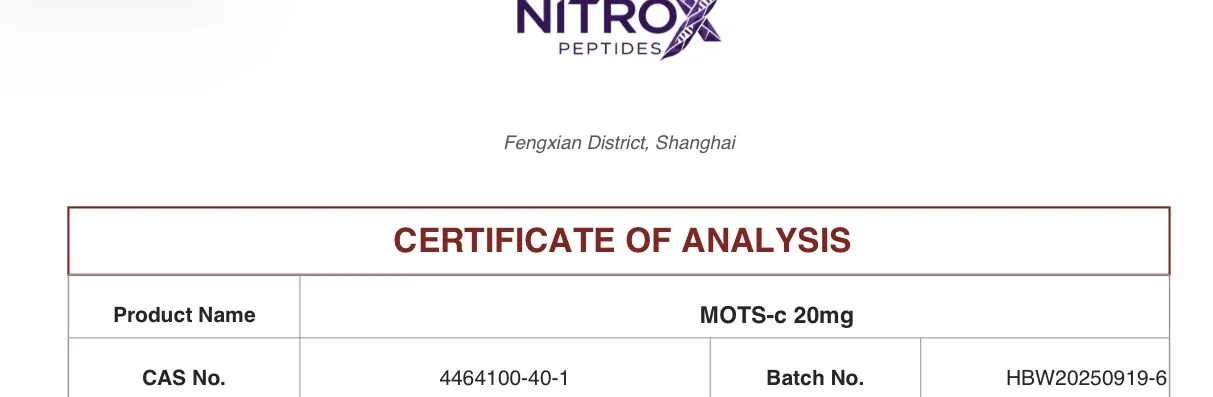
That isn’t a small formatting issue. A CAS number is one of the most basic identifiers on a COA. It’s not subjective, and it’s not something that should be “close enough.” If the basic chemical identifier is wrong, the document can’t be treated as reliable.
Across multiple products, the same template appears to be reused, with only the product name, batch number, dates, purity result, vial strength, and CAS number changing. But if the fields being changed are wrong, that points to careless templating rather than serious quality documentation.
So this isn’t simply a case of “raw COA versus finished-product COA.” These are vendor-issued certificates with no third-party verification, very limited supporting data, and basic factual errors.
In simple terms, it looks like a lab report, but it’s controlled by the seller, can’t be independently verified, and contains incorrect identifiers. That makes it a claim, not evidence.
Taking all of these findings together, I don’t trust these COAs. In my view, they look fake or at minimum so careless and unverifiable that they should be treated as worthless. And if a vendor is willing to publish documents like this as proof of quality, then I wouldn’t trust the products behind them either.
After questioning NitroX directly, their own replies made the issue clearer. When asked which lab the COA came from, they said:
“It’s our own lab.”
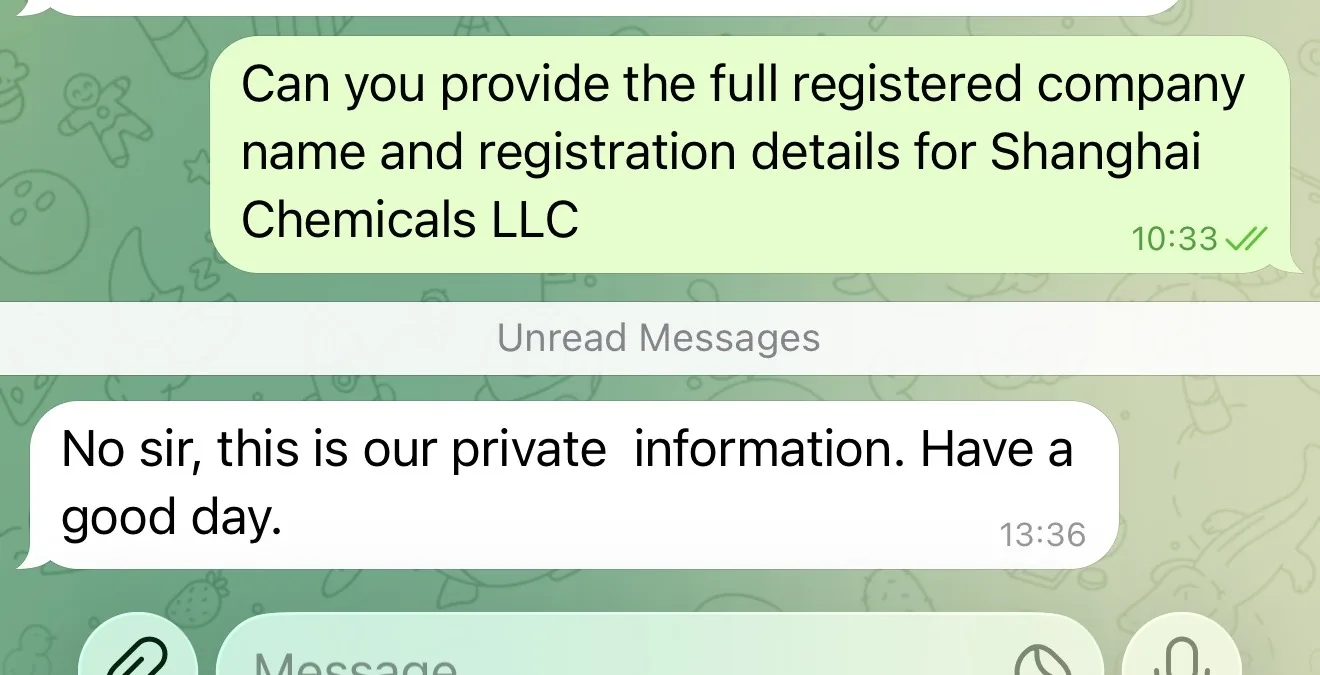
They also claimed they are “official resellers from Shanghai Chemicals LLC.” When asked who Shanghai Chemicals LLC is, they replied:
“It’s our factory. Yes they make our peptides.”
So the COA is not from an independent third-party lab. At best, it’s internal testing controlled by the same side selling the product. When asked what method was used, they said:
“It’s used HPLC.”
But they didn’t provide a chromatogram, method details, sample ID, or supporting data showing how the reported 99.1% result was reached.
Most importantly, when asked whether the COA was for the finished product or the raw material, they replied:
“For the finished product.”
That removes the ambiguity. NitroX says this is a finished-product COA, but the document doesn’t provide finished-product evidence. It gives a basic certificate style summary, with no independent lab, no verification, no traceable analytical data, and wrong CAS numbers.
The vendor also suggests customers can send the products to Janoshik themselves for testing, but that’s not a solution. That pushes the cost of quality control onto the buyer. If a customer has to pay around $300 extra to verify a product after already paying inflated prices, then what exactly is the premium price for?
A vendor charging higher prices should be doing the testing before sale, not asking customers to buy first and verify later. That’s not quality control that’s outsourcing risk to the customer.
In my opinion, this COA is completely fake. I also don’t believe there is a legitimate “Shanghai Chemicals LLC” behind this. My view is that they are sourcing products from China without proper testing, then presenting them as if they’ve verified in-house.
That is actually worse than vendors who openly sell untested products. At least in those cases, buyers know what they’re not getting. Here, the impression is being created that the products are tested and validated when the documentation doesn’t support that.
The pricing reinforces that point. The products are being sold at significantly higher prices than buying direct from China, but without any credible evidence of added quality control. If you’re going to pay a premium, there should be proof behind it.
The fact that this vendor is being promoted by an Instagram influencer makes it even more concerning. If that promotion is paid or incentivised, it raises serious questions about how these products are being recommended.
Based on everything above, I wouldn’t trust this vendor. My advice would be not to rely on social media promotion when making decisions like this, and to avoid vendors who cannot provide verifiable, independent testing.
Comments