
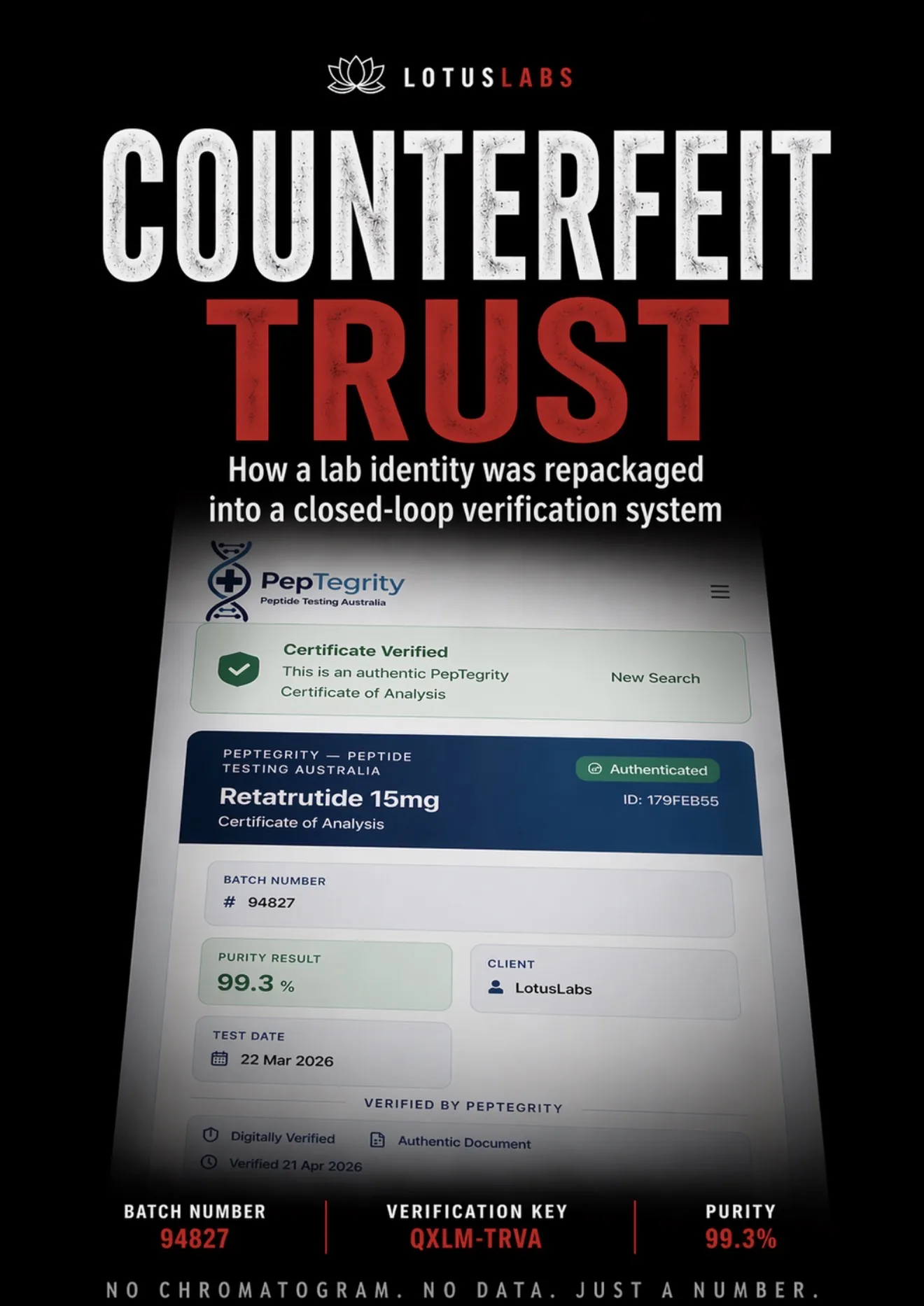
In the grey market, a lot of trust seems to be placed in vendors and their COAs, especially in the online single-vial market.
In the China-direct grey market, where products are purchased in kits of 10 vials, forfeiting a vial for testing is not a big issue. It is manageable, particularly if more than one kit is purchased. With online stores mostly selling single vials, that is much less realistic. Buyers are therefore pushed into relying on vendor-provided COAs rather than genuinely independent third-party verification, which is what these certificates are supposed to represent.
But how trustworthy are they?
The online vendors tend to be perceived as more trustworthy than Chinese suppliers, largely because they are positioned as being based in places like the US and are offering COAs for their products. But when you look more closely and speak to others in the industry, the concerns that come up are different.
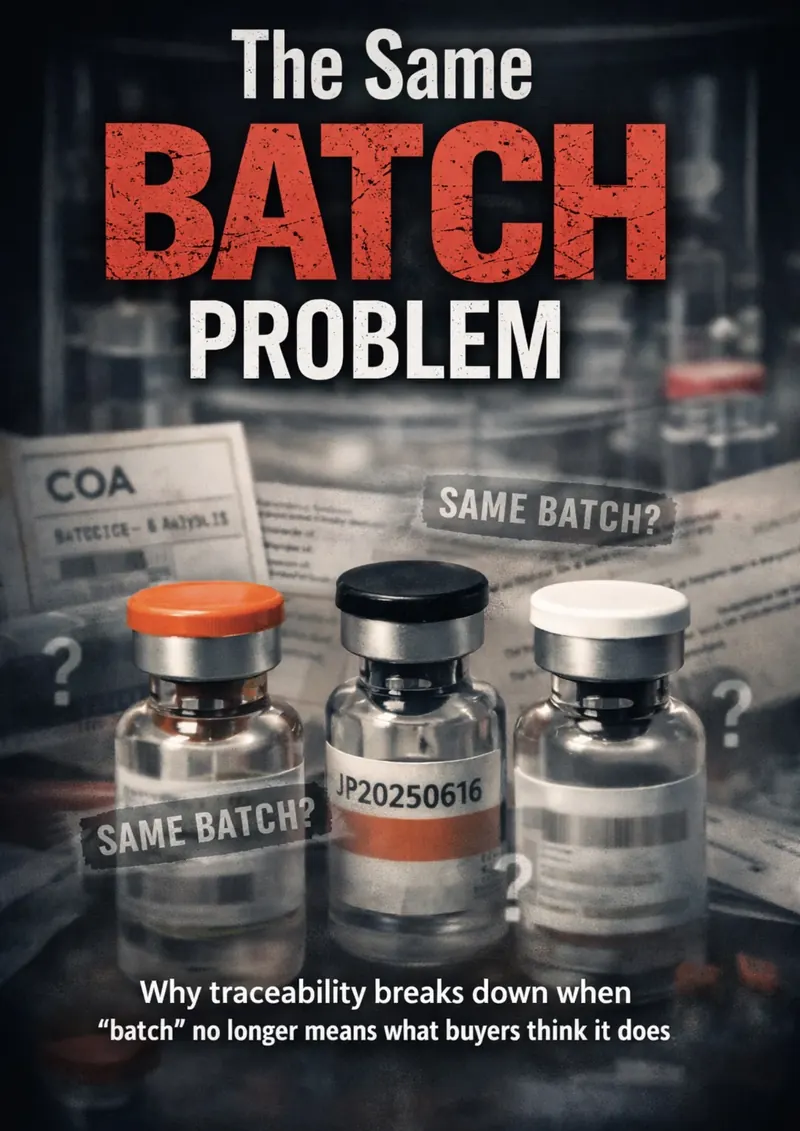
One serious concern is the alleged practice of some vendors requesting specific vial cap colours to match already existing COAs. Manufacturers themselves do not care. They will provide whatever cap colour is requested, label batches however the buyer wants, or even leave them unlabelled entirely. This allows the reseller to match products to existing COAs or assign their own batch numbers after the fact.
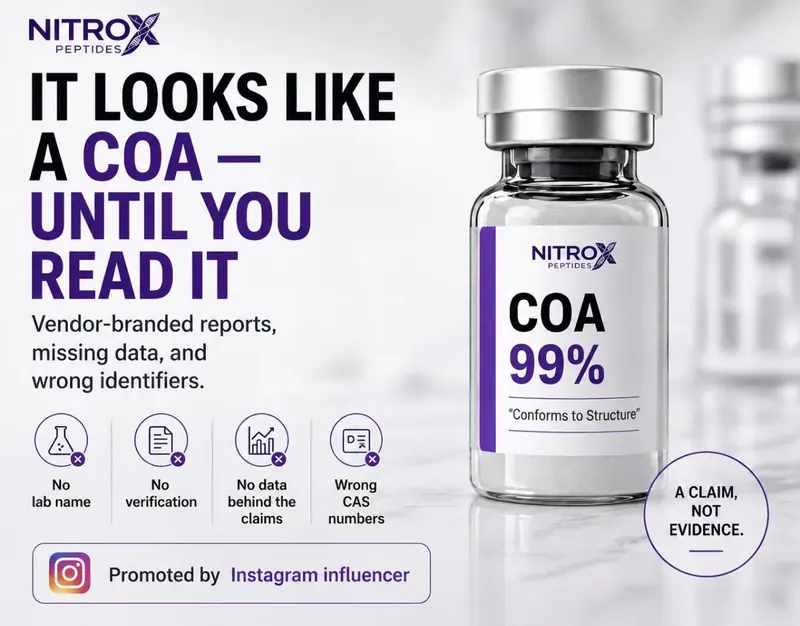
For online single-vial sales to justify higher prices, there is an expectation that products come with their own COAs. In reality, not all of them do. Some do not even have batch numbers attached. That creates a situation where a buyer sees a product with a clean-looking COA and feels reassured, even though that reassurance may not be based on anything truly verifiable.
Buyers are placing a lot of trust into these resellers, often more trust than the place in the original Chinese vendors, but it’s worth asking why. Why should an online reseller automatically be trusted more?
The following case is an example that, on the surface, ticks all the right boxes.
The storefront: LotusLabs.com.au
At first glance, the website looks polished. It has a dark, modern design, a clean layout, professional branding, and neatly presented vials with consistent labelling and high-quality product images. Everything is styled to feel premium, controlled, and credible.
Each product comes with a Certificate of Analysis: a lab name, a batch number, a purity figure, and a verification link. On the surface, it feels structured, tested, and legitimate. That is where the reassurance comes from. High purity. Third-party tested. Verified. The certificate becomes part of the value.
The price
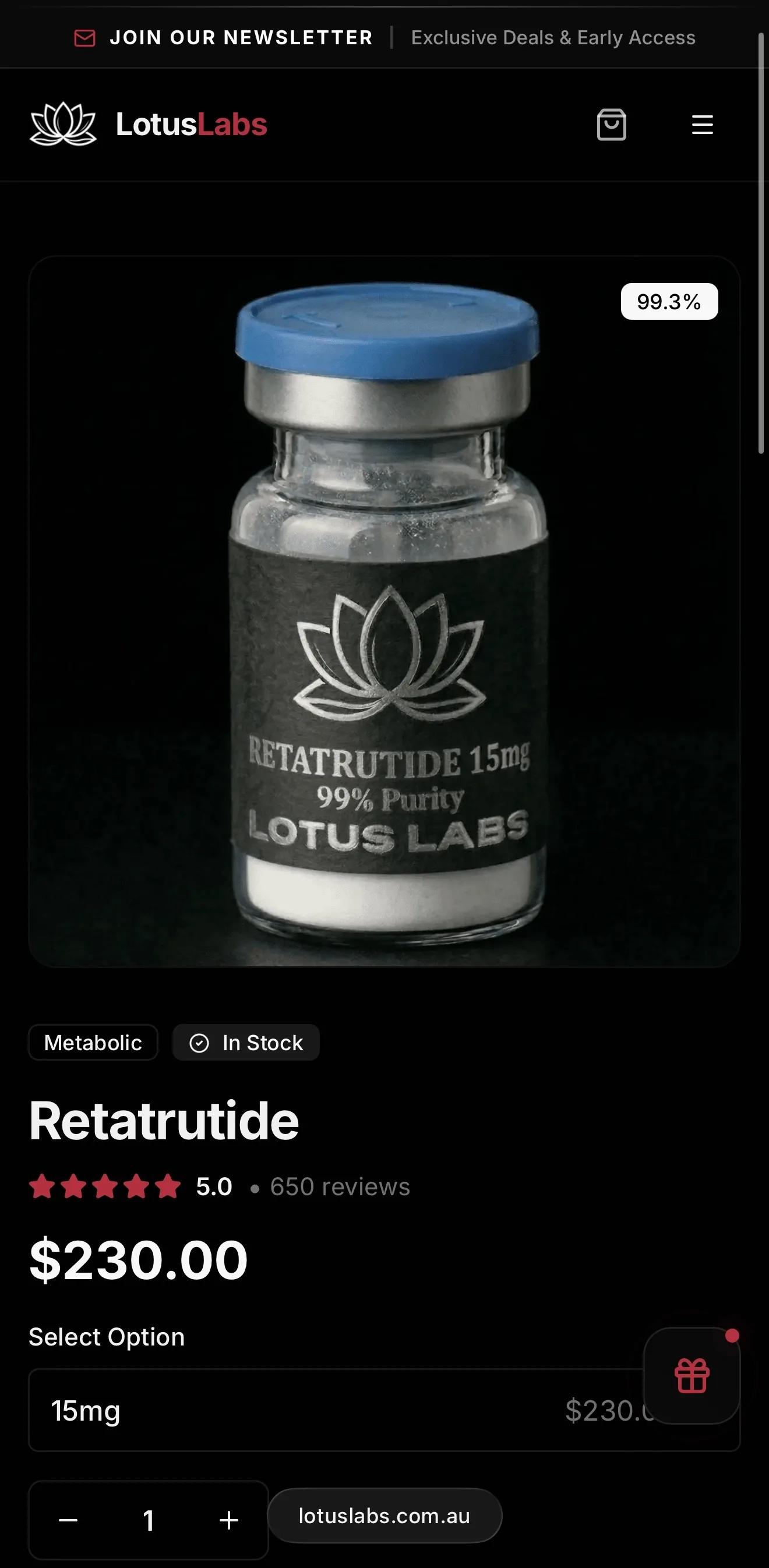
The products themselves are sold at a premium:
Retatrutide 15mg, $230
Tirzepatide 10mg, $150
Cagrilintide 10mg, $130
5-Amino-1MQ, $180
MOTS-c 10mg, $140
These are single vials priced far above what you would expect from direct supply channels. This is not budget grey-market pricing. It is premium single-vial pricing, backed by the language of purity, testing, and verification.
What sits underneath
Despite the polished presentation, the purchasing side is much more limited. Payment methods are restricted to Bitcoin and bank transfer. Both are final. No chargebacks, no easy reversals, no third-party protection.
It looks professional. It feels verified. But everything that creates that trust sits inside the same system.
PepTegrity.com.au: The testing company
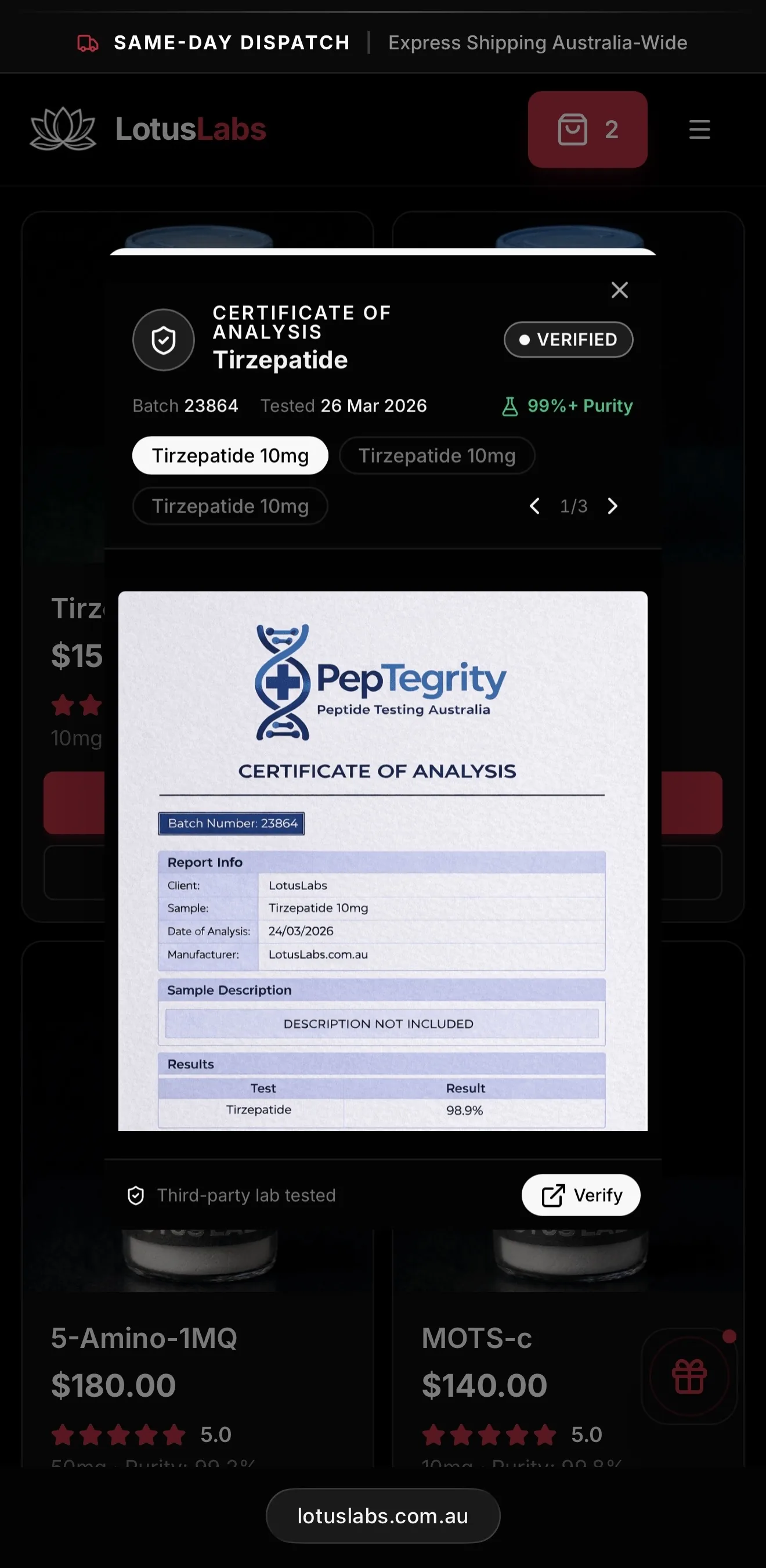
Then I noticed something else. Every COA across the site was coming from the same testing company, so I looked into that too.
The website presents itself as a professional independent lab. It uses clean design, clinical imagery, and strong language around “precision testing,” “verified results,” and “complete confidence.” It lists standard methods such as HPLC, LC-MS, and GC-MS, and claims to offer third-party analytical testing across a wide range of compounds. On paper, it looks like a legitimate testing service. But when you look closer, the detail starts to thin out.
They offer an “instant quote” or “get a quote” option, but it does not function. There are no prices quoted anywhere for testing, no breakdown of what different analyses cost, and no indication of turnaround times or sample requirements.
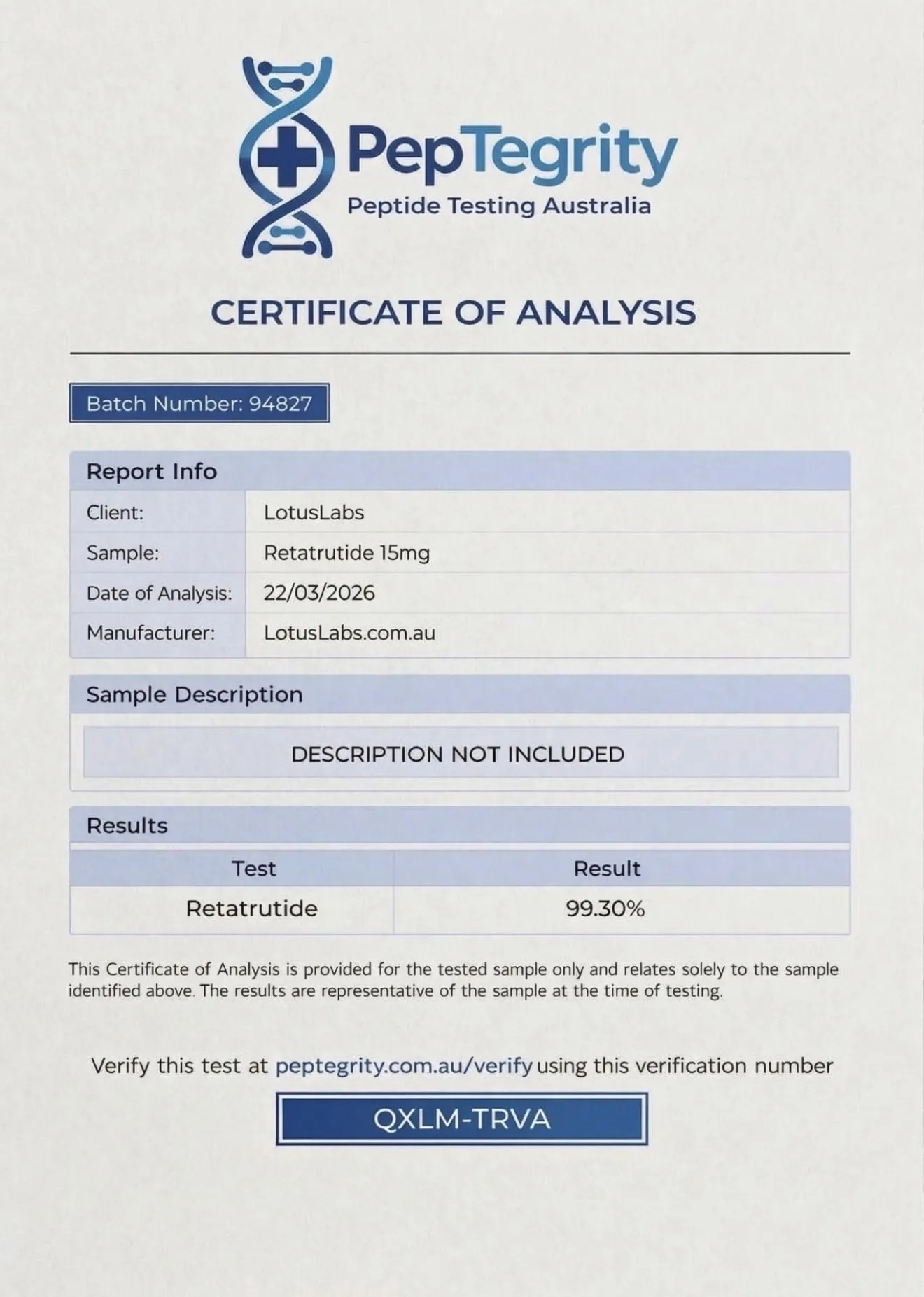
At the same time, the COAs being issued are extremely basic. Purity is listed. A batch number is included. A verification key is provided. Beyond that, there is very little: no vial picture, no mass confirmation, no chromatogram, and no supporting analytical data.
The mismatch
That creates a disconnect.
The website describes a full analytical service using multiple validated techniques, but the certificates do not reflect that level of testing. The methods are detailed; the results are simplified. If a lab is genuinely running HPLC and LC-MS, you would expect more than a single purity figure.
Another key point
The scope of testing also raises questions.
The site lists a very wide range of compounds, peptides, SARMs, GLP-1 agonists, and more, suggesting broad capability across different analytical methods. At the same time, it appears to be producing COAs across that range almost immediately.
A testing service that appears to cover everything, across multiple categories, with uniform output and minimal detail raises obvious questions about how that testing is actually being carried out.
The loop
When you combine that with what is happening on the storefront, where every product has a COA, every COA comes from the same source, verification is routed through a public portal and the output is simplified, you end up with a system that looks complete on the surface but is difficult to verify independently.
The connection between the storefront and the testing site does not rest on branding alone.
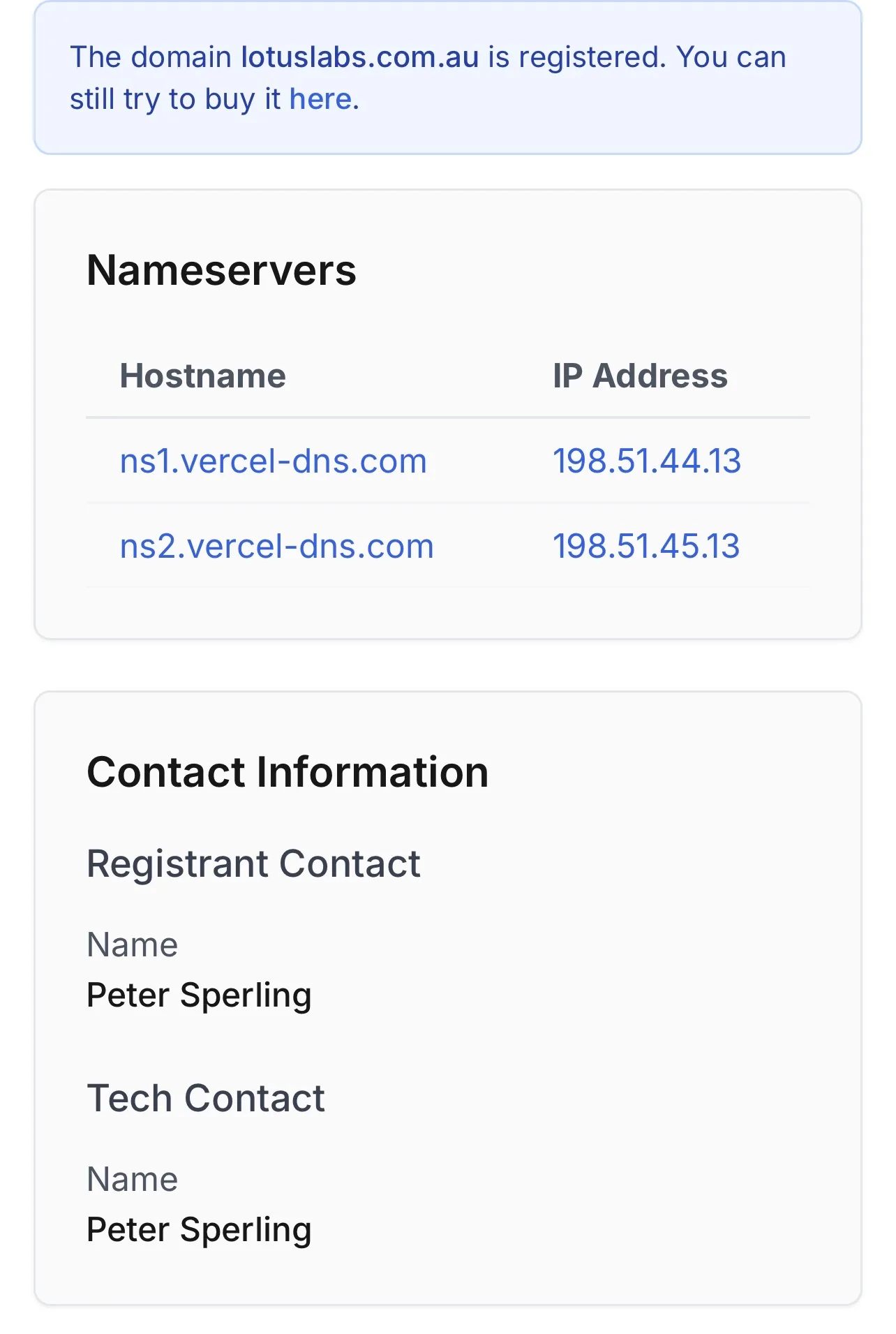
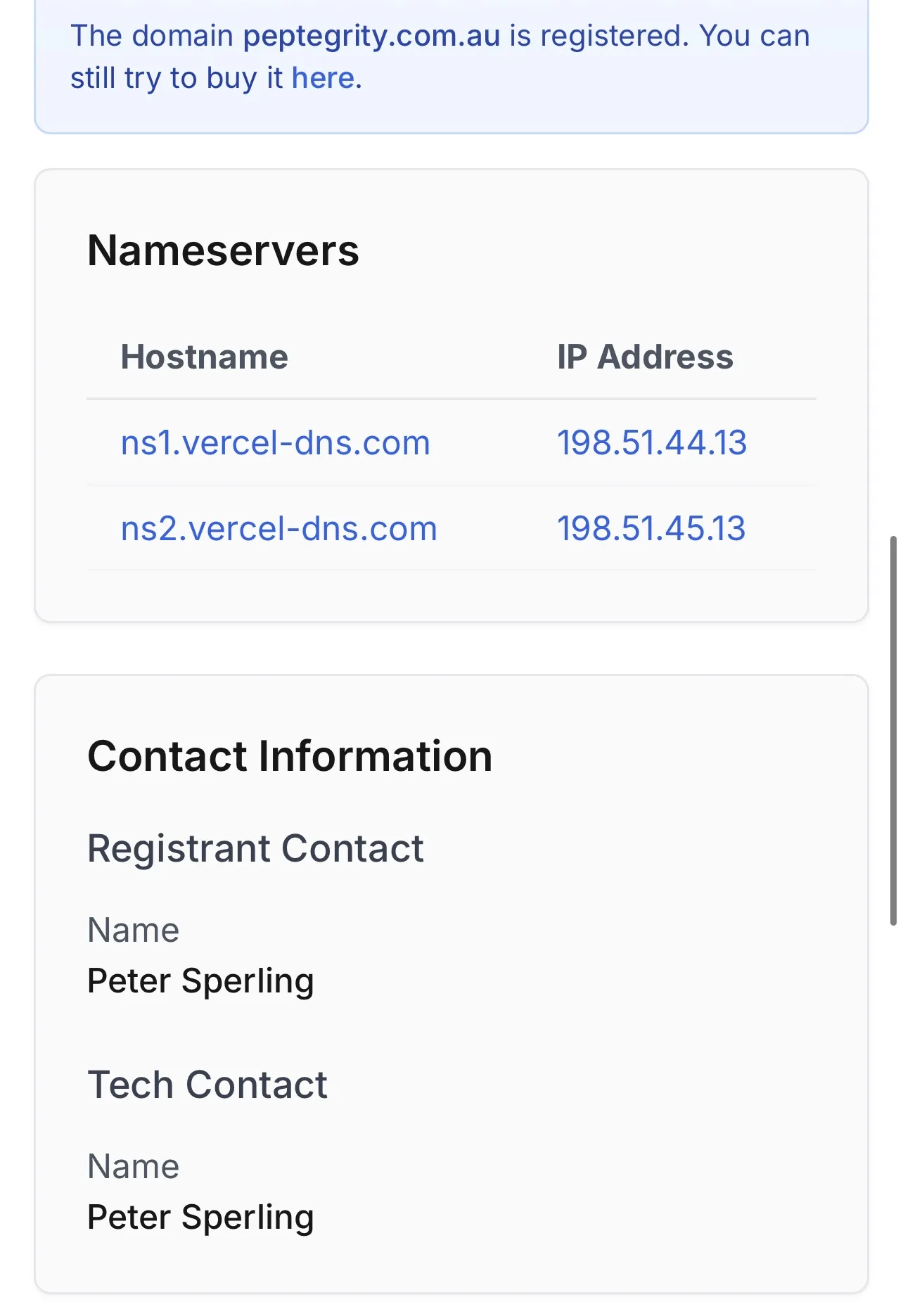
Domain records show both sites registered to the same owner, Peter Sperling / PETER PTY. LIMITED, under the same ABN. They also use identical Vercel nameservers, the same registrar, and a similar recent registration timeline. Taken together, those overlaps make it difficult to treat the store and the testing site as clearly independent entities.
This isn’t just about one site or one set of certificates, it’s about how easy it is to build a system that looks verified without being independently verifiable.
A lab name.
A certificate.
A verification page.
All the right signals, none of the separation.
Because real verification doesn’t point back to itself, and if it does, it’s not verification at all.
Comments