
Context
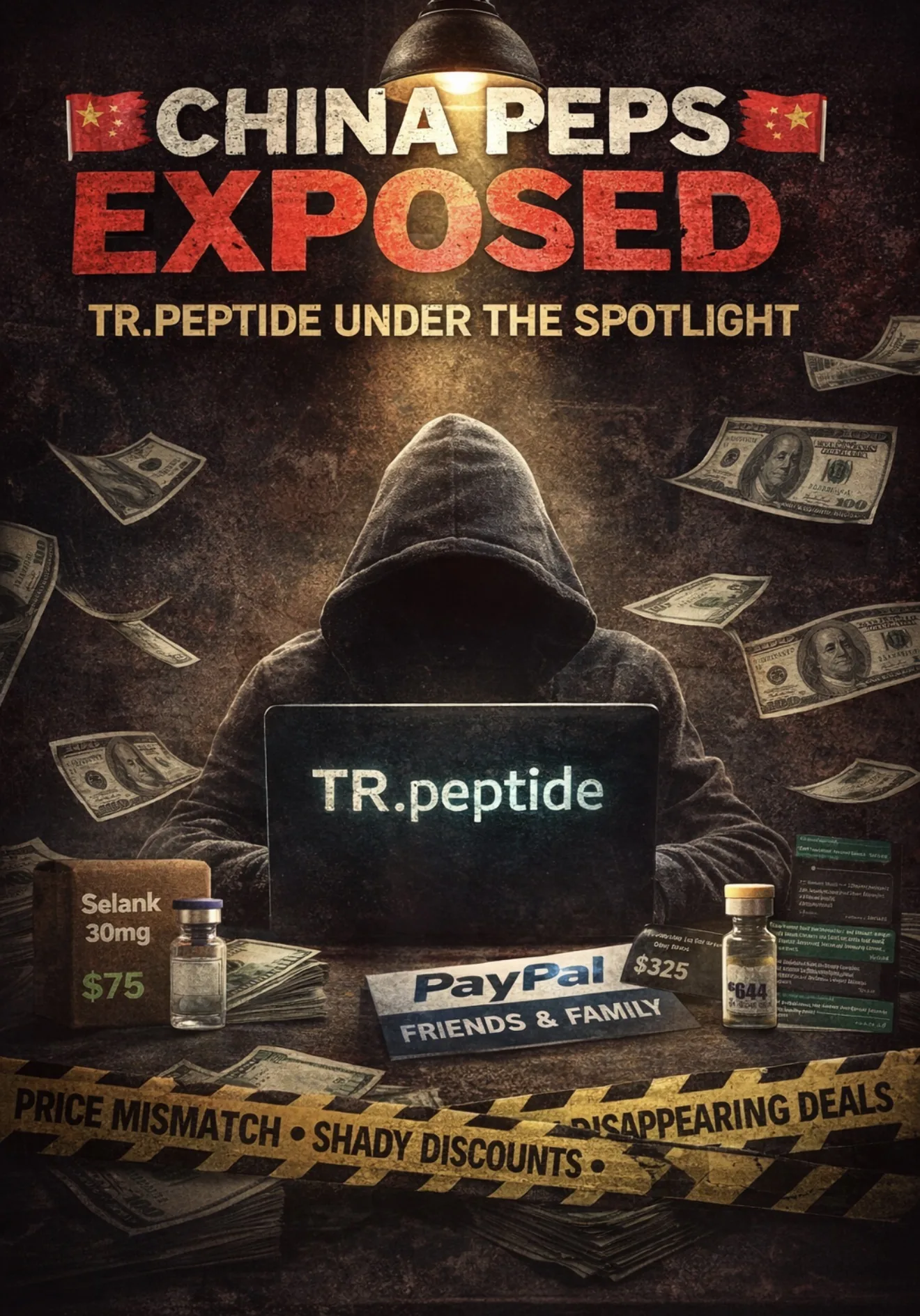
This case comes from my China Peps Exposed channel, where I document patterns of behaviour from Chinese peptide reps and vendors.
To be clear, these are not outright scammers.
Most of these vendors do deliver product.
But that doesn’t mean the business practices are transparent.
What I’m documenting here is not always outright fraud, but a pattern of conduct that should concern buyers: inconsistent pricing, shifting “discounts,” pressure tactics, deal structures that shift in real time, failure to honour guarantees, reps directing customers to non company wallets, companies closing ranks instead of explaining what happened, and Telegram chats that disappear when problems start.
Not fraud.
But not transparent either.
And in a market where buyers are already taking on risk,
that kind of behaviour carries risk.
The Setup
A buyer entered this conversation expecting one simple thing:
Selank 30mg at $75.
That was the promo price publicly advertised on PepChat.
What followed wasn’t just a mistake.
It was a sequence.
And that sequence is where trust broke down.
From Advertisement to Quote
Instead of the advertised $75, the buyer is quoted:
$112 for Selank 30mg
The explanation:
“The price might have been listed incorrectly; the discrepancy is just too large.”
At this point:
the advertised deal is dismissed
responsibility is shifted
and the reference point changes
Serena, the TR.peptide rep then sends what she calls the “correct price” list, moving the buyer further away from the original offer.
The “Discount” That Follows
After apologising, Serena promises:
a discounted price as a token of apology
But when that list arrives, it doesn’t function like a real discount:
Selank 10mg → $60 (promo was $38)
NAD → $80 (unchanged)
Oxytocin → $48 (unchanged)
AICAR → $76 (unchanged)
VIP → $121 (slightly reduced)
There is no clear baseline
No clear reduction
Just a new set of numbers.
A Clear Comparison, Ignored
The buyer then gives a clean market reference:
Semax 10mg available elsewhere for $48
They ask:
Can you match, or is the gap too large?
This is a straightforward moment to:
Compete
explain
or draw a clear line
Instead, the response is:
$64
No explanation. No adjustment.
The Order Moves Forward Anyway
The buyer removes Selank and Semax and proceeds with:
NAD 1000mg
Oxytocin 10mg
AICAR 100mg
VIP 10mg
Everything appears settled.
Until the total arrives.
The Calculation Error
Serena provides:
$385
The buyer immediately recalculates:
$325
The seller corrects it.
In isolation, this is minor.
In context, it isn’t.
By now, the buyer has had to verify:
the advertised price
the quoted price
the “correct” price
the “discounted” price
and now the total
Payment Before Resolution
Serena then sends a PayPal link and instructs:
“Please select Transfer to Friends and Family. Do not add remarks.”
At this point:
pricing is still unclear
the discount is unresolved
and payment removes protection
The risk shifts entirely onto the buyer.
The Final Shift
When asked about the promised discount, the offer changes again:
“Complimentary product next time” and when the buyer threatens to cancel his order, she offers to reduce the price to $315
The buyer proposes a reasonable alternative
Replace the $10 with a single vial of Selank and Semax
A low cost, high trust solution.
Instead, the terms change again
Spend over $500 to receive a sample
The Pattern
By this stage, a clear pattern has formed
the original advertised deal is not honoured
the pricing reference keeps shifting
the discount changes form multiple times
the total is miscalculated
the resolution becomes conditional
the buyer is repeatedly asked to accept more uncertainty
The End
The buyer walks away.
Not because of one issue.
But because of all of them.
The Real Takeaway
This wasn’t a pricing problem.
It was a consistency problem.
Trust isn’t lost when something goes wrong.
It’s lost when the fix keeps changing.
Final Thought
If a buyer has to:
check your numbers
confirm your product
question your pricing
and interpret your discount
before sending money…
then the transaction was never stable to begin with.
Summary
This was not handled like a trustworthy sale.
The problem wasn’t one bad ad or one calculation error.
It was that every attempt to fix the issue created a new version of the deal.
That kind of constant reframing kills confidence fast.
By the end, walking away was the sensible decision.

Comments