
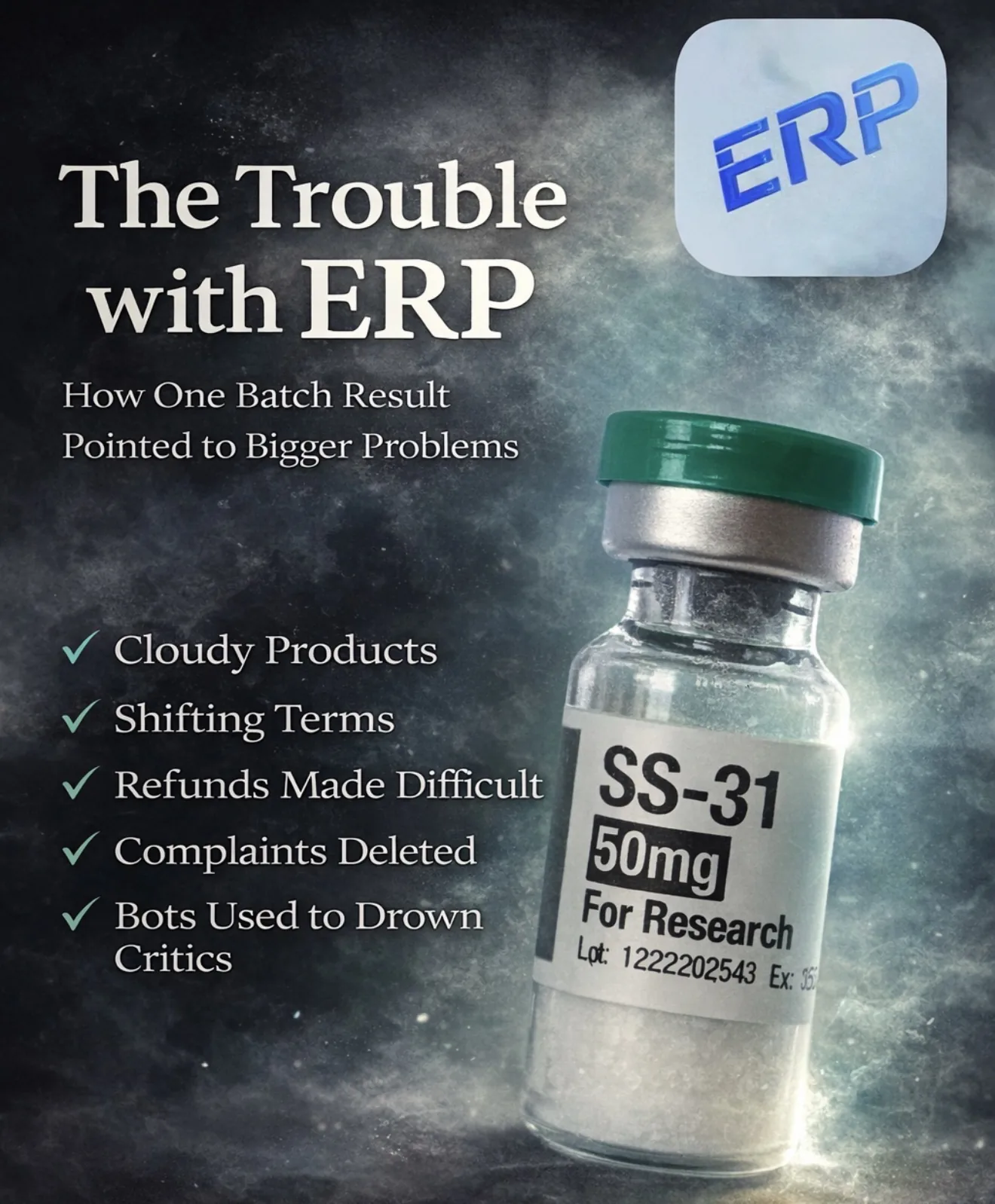
This started with a customer-led group test involving roughly 80 to 85 people. Participants bought ERP products themselves, pooled samples, voted on which peptides to send, and organised independent Janoshik testing under the deliberately neutral label “Strong Like Bull” (SLB) so the COAs could not easily be reused by ERP for marketing.
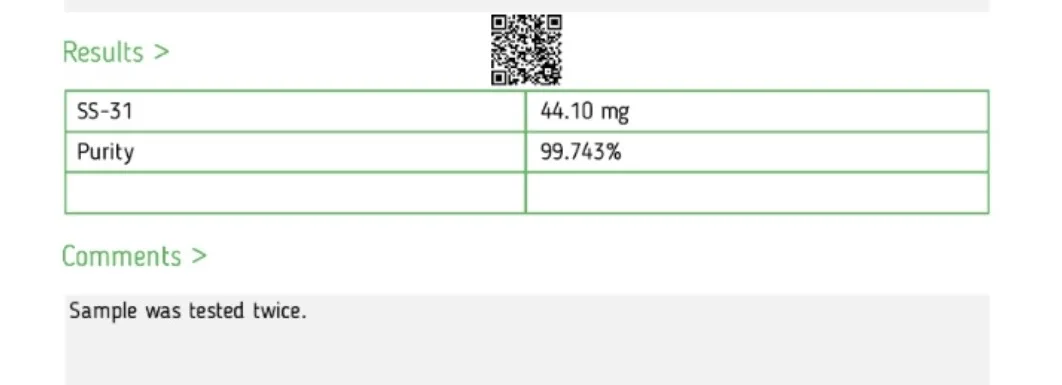
Around 12 ERP peptides were tested and although most products came back acceptable on purity, one product stood out: SS31 50mg. That result showed 44.10 mg, which is about 11.8% underfilled, and also raised an endotoxin concern.
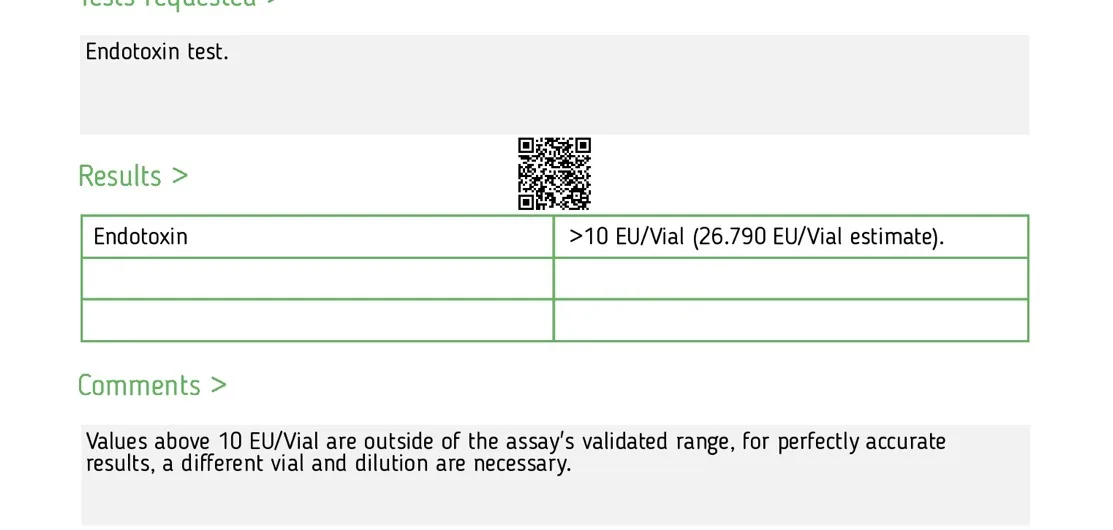
The SS31 endotoxin result came back above the assay’s validated reporting range: reported as >10 EU/vial, with an estimated value of 26.790 EU/vial. That means the vial was clearly flagged high for endotoxin, but the exact figure was only an estimate and would have required retesting at a different dilution for precise quantification.
After getting the result, the group says they approached ERP and asked for a refund or reshipment. ERP’s response was not a straightforward refund or replacement. Instead, they were offered only possible credit on a future order, with no definite amount. That was the point where the issue stopped being just about one SS31 result and started snowballing. Once it became clear that ERP was not going to deal with it cleanly, more people began coming forward with their own complaints, about cloudy products, shifting policies, extra charges, missing items, deleted chats, and refund requests that went nowhere.
SS31; The Result That Changed Everything
On refunds, the position is clear early on: even if a product doesn’t pass testing, a full refund is not offered. The only option presented is some undefined credit on a future order, despite the product being one of the more expensive items.
Once the SS31 evidence is presented, 44.10 mg vs 50 mg and the endotoxin result, the response moves to delay and then into technical explanations rather than resolution.
On endotoxins, the explanation is that meeting stricter standards would require additional sterilisation, increasing cost and potentially reducing peptide activity. On fill, the claim is that products are overfilled (1.25x), but that some may show lower detected content due to product characteristics, implying the test result may not reflect the true fill.
That explanation then shifts again, suggesting the content may be too high, causing poor dissolution and leading to inaccurate test results. At one point, a refund is mentioned, but only briefly, and that position does not hold once the situation is fully understood.
The policy position is more direct: endotoxin is not covered, and the fallback solution is exchange, not refund.
Taken together, the pattern is no clear refund offered test results challenged rather than accepted, endotoxin excluded from warranty, under fill reframed as a detection issue and exchange or future credit pushed instead.
The overall impression is not of a straightforward resolution, but of multiple explanations being used in parallel to avoid issuing a full refund.
In one case, a buyer pressed for a refund after the SS31 result had already been shared with ERP and discussed with the group test lead. The response remained unchanged: no direct refund, only an undefined proportion of credit on a future order. In this incident, the refund request was met with a laughing emoji, reinforcing the perception that the issue was not being taken seriously.
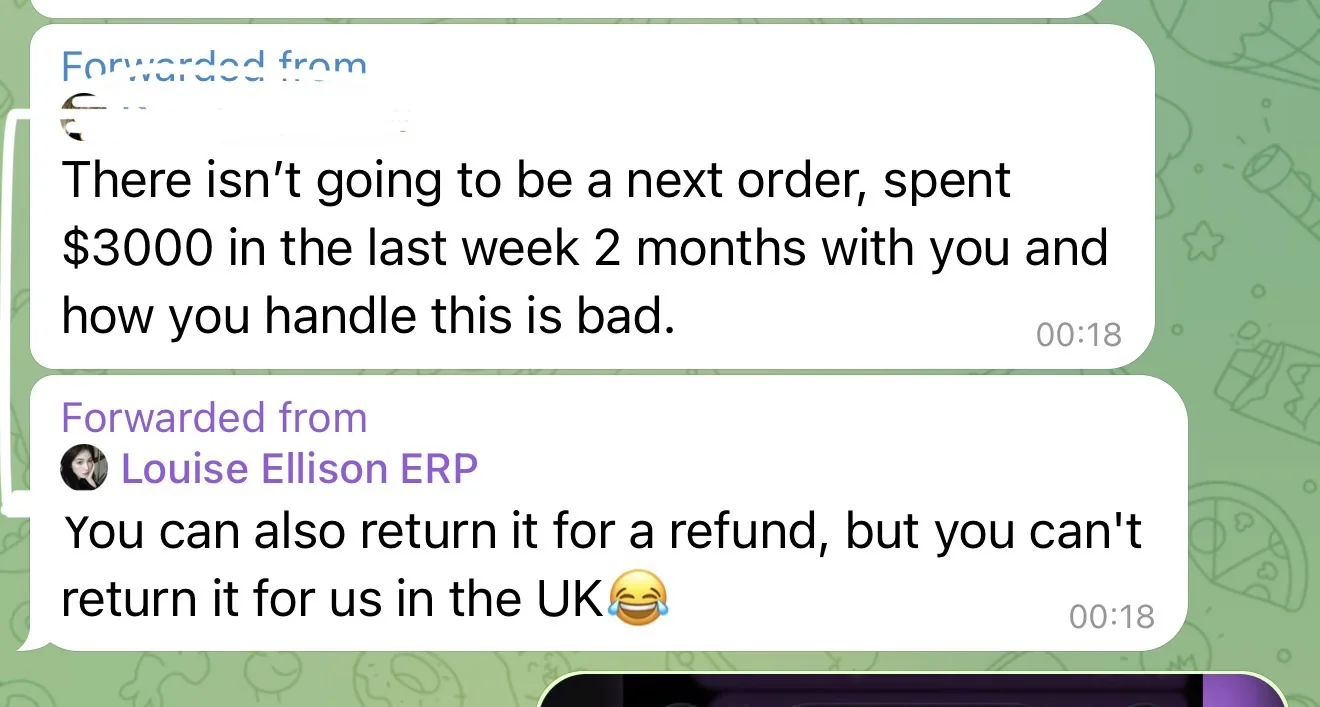
When the buyer made it clear there would be no further orders, ERP pointed to a return-for-refund option, but immediately noted that returns from the UK were not possible. In practice, that left no workable refund path. The buyer then escalated to the possibility of a chargeback. According to the account provided, they were subsequently banned and the related chat messages were removed.
The ERP Promise vs Reality
ERP presents itself as having a “special quality inspection department”, only selling products that “pass quality inspection”, able to “refund the full amount” if there are problems with purity and quality and offering “lab-tested products straight from our lab”, ensuring “top-tier quality” and running a stocked “USA warehouse with fast, secure delivery”
That was the promise.
What follows is the reality buyers say they experienced.
The ERP Reality
Product Issues; SLU-PP-332
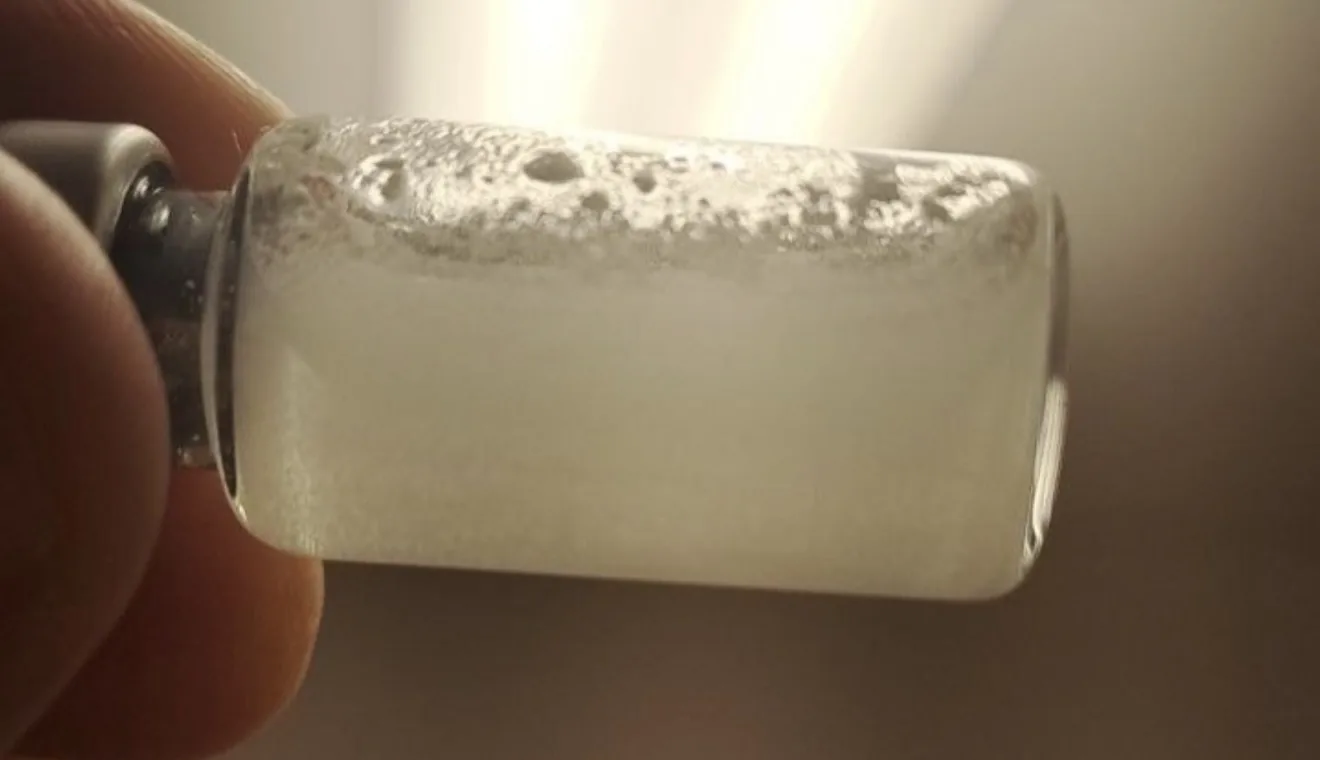
The SLU-PP-332 issue followed a familiar pattern of shifting explanations. First, ERP blamed the cloudy recon on Hospira BAC water and told the buyer that another customer had the same problem, but that switching to a cheaper BAC water made it work. When that explanation was challenged, the story changed. ERP then said Slupp was naturally turbid regardless of what was used and that this did not affect normal use.
The deeper problem is that SLU-PP-332 appears to require a DMSO-based solution to dissolve properly, something that is not straightforward and not suitable for the average user to be improvising with. So the issue was not simply a cloudy vial. It was a product being sold in a form that ordinary buyers could not reliably reconstitute with standard BAC water, followed by changing explanations instead of a clear warning or proper resolution.
The cloudy MOTS-c
A separate issue raised involved MOTS-c reconstituted using ERP’s BAC water. The solution initially appeared completely clear, but after 24 hours in the fridge it turned cloudy. The BAC water itself was reported to be within a normal pH range (6 to 7), leaving the cause unclear. The change suggests instability after reconstitution rather than a simple mixing error.
The “another” American address
A customer in Brazil is told that a parcel returned to ERP’s Hong Kong warehouse could not be refunded, only reshipped. Despite the product being physically returned to the seller, ERP refused to issue a refund and instead asked for an alternative shipping address in the USA. The buyer points out the contradiction directly: the product is not lost, yet the money is not returned. This is another example of ERP limiting outcomes to reshipment while avoiding refunds, even when the goods are back in their possession.
Canada Shipping and Shifting Terms
The buyer confirms shipping to Canada, gets a quoted total including shipping, then later is told that because of FedEx inspection issues they now recommend Canada Post instead, and the shipping difference will only be refunded on the next order. That is not a clean refund. It is another example of terms changing after the sale is already moving, money being held as future-order credit and the customer being nudged into ordering again to recover what they already paid
Repeat Orders, Repeat Problems
Another recurring complaint was that problems were not resolved cleanly, but rolled into the next sale. In one case, a buyer describes a pattern across three separate orders: the first order arrived short, the second included cloudy product that was thrown away, and by the third order they had paid for express shipping that was not honoured and were being asked to pay again for previously affected products.
In a separate case, a buyer says they were originally told a seized order would be fully refunded or reshipped, only to be told afterwards that the policy had changed. The revised terms required either paying 50% to have the order reissued or accepting a 30% refund. The key detail is timing, the policy was changed after the order had already been placed.
Together, these examples reinforce the same pattern: when something went wrong, the resolution was not fixed at the point of failure, but adjusted afterwards in a way that reduced the refund and shifted more cost back onto the buyer
Discount Promised, Terms Pulled Back
A buyer placed a large order on the understanding that a 4% discount has been agreed. After the order is already in motion, that position changes. The 4% is no longer honoured, and the buyer is told that 3% is the lowest possible discount, with a revised total issued.
The issue is not confusion over percentages. It’s that the buyer appears to have proceeded on one set of terms, only for those terms to be reduced afterwards. Placed alongside the rest, it fits the same pattern: expectations set early, then adjusted once the buyer is already committed.
Free Shipping That Wasn’t
A buyer qualifies for free shipping based on the stated threshold. After the order is placed, they are told their location is classified as a remote area, the standard shipping route cannot be used, and an additional fee is required for express delivery. The cost is first introduced at around $85, then increased further depending on the size of the order.
The issue is not that some locations cost more to ship to. It’s that the additional charge is introduced after the expectation of free shipping has already been set. Again, the structure is the same: terms presented one way at the start, then revised once the order is already underway.
Bad Batch, Wrong Body
A buyer reports a problem with a product and asks for a refund, or at least for the amount to be credited toward a future order. The response does not address the condition of the product directly. Instead, it shifts to saying no one else has reported the issue, suggests the buyer consult a doctor, and frames the outcome as dependent on the characteristics of the body.
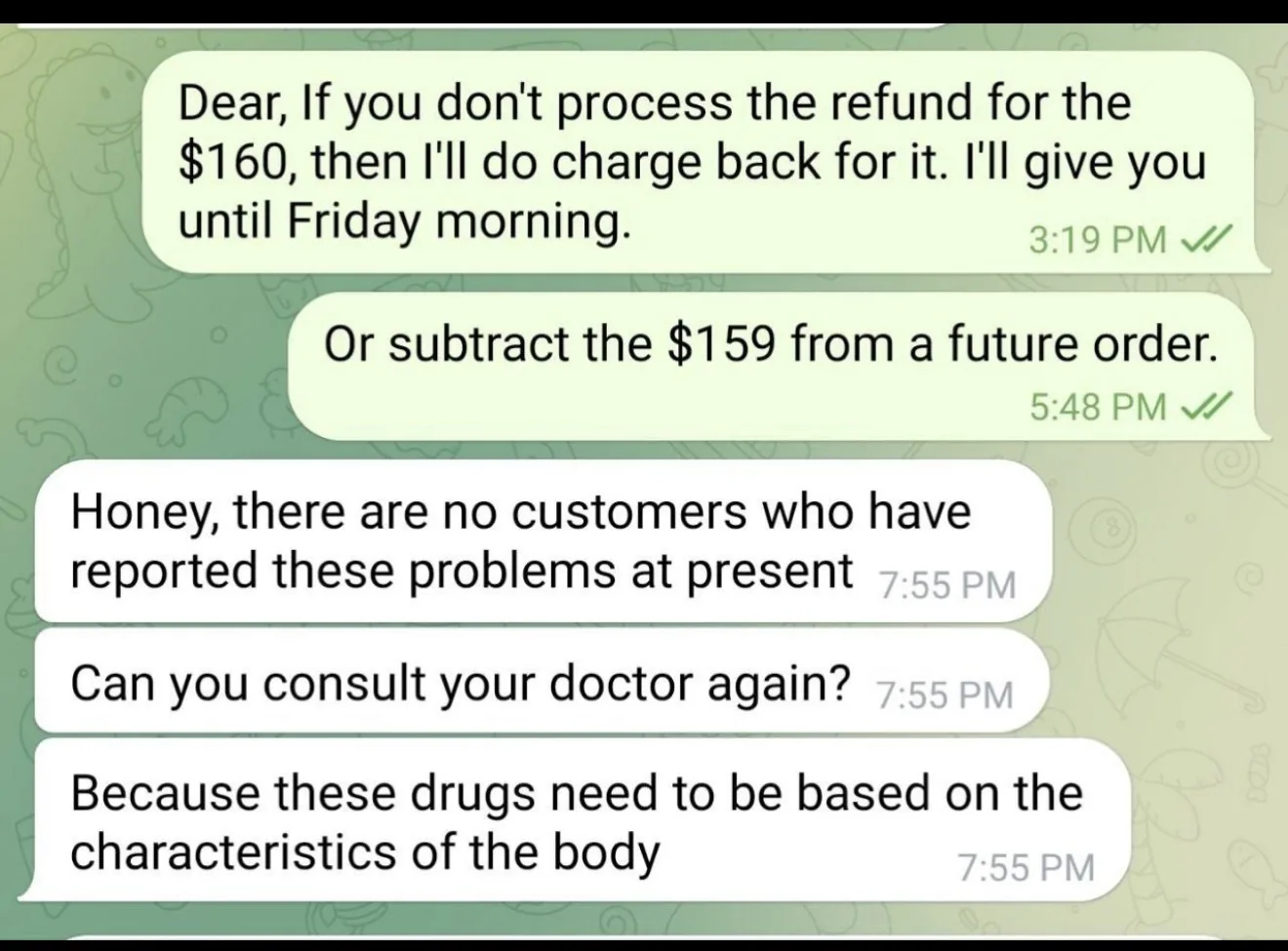
That matters because the complaint being raised is about a visible issue with the product. The response moves away from that and onto the user. Set alongside the other material, it reads as another instance where a product complaint is redirected rather than resolved.
The Lucky One
A buyer asks for an update on the SS31 issue. After checking internally, the outcome comes back as a 20% deduction on a future order, calculated at roughly $174.60.
This is presented as the resolution. It is not a refund or a replacement, but a partial credit tied to another purchase. Within the wider pattern, it stands out not as an exception, but as a clearer example of how these situations are being handled in practice.
This buyer is framed as the lucky one, as they’re one of the few not to have been banned from the group after asking for a refund.
Chat Deletion and Control of Narrative
At this stage, the issue shifts from product complaints to how those complaints are handled publicly.
A warning is posted outlining the main concerns: failed endotoxin results, underfilled vials, refusal to refund or reship, and a broader pattern of unresolved issues. It also accuses ERP of deleting bad COAs, banning users who complain, and using bots to flood the chat and drown out complaints.
What follows is immediate. Right after the warning goes up, a bot account appears in the chat. That is the key detail. The point is not just that the chat becomes noisy. It is that the warning is followed straight away by bot activity, which supports the claim that complaints are being buried once they are made public.
In that context, the issue is no longer only the complaint itself. It is the use of bots, deletions, and bans to control how long that complaint stays visible.
Attribution Shift: “Not Our Product”
Another line of response is to question whether the tested product can be linked to ERP at all. Rather than addressing the underfill and endotoxin result directly, the focus moves to attribution: the manufacturer is not explicitly listed as ERP, a neutral label was used, and differences in cap colours are raised to cast doubt on origin.
Conclusion
What began as one bad SS31 result ended up exposing something much bigger.
It brought wider problems into view: cloudy SLU-PP-332 and the advice given around it, cloudy Reta being treated as something customers should work around rather than get replaced, MOTS-c reconstitution concerns, shipping terms changing after orders were placed, discounts being pulled back after buyers had already committed, missing kits being rolled into future orders instead of refunded, and complaints being met with chat deletions, bans, and attempts to dispute attribution. In other words, SS31 was the point that cracked things open. What followed was a broader pattern of product issues, shifting terms, weak remedies, and damage control once customers started pushing back


Comments