
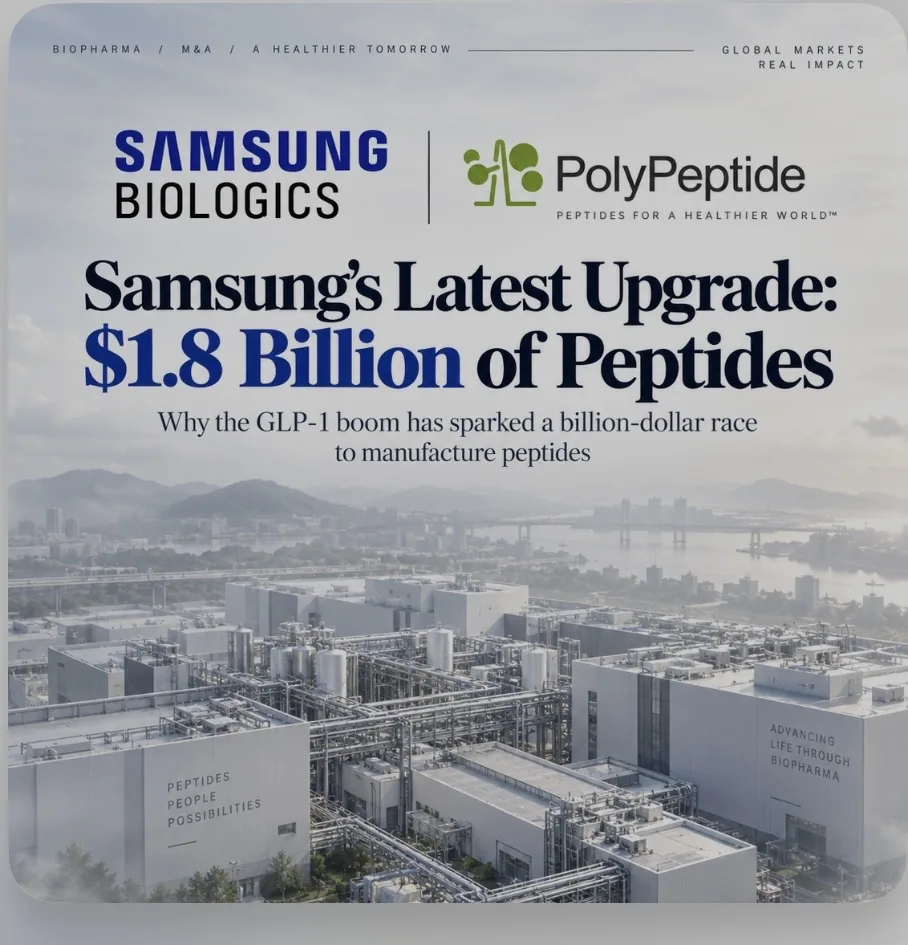
Samsung Biologics is preparing to spend roughly $1.8 billion acquiring PolyPeptide Group, a specialist peptide manufacturer with production roots stretching back to 1952. On the surface, it’s just another pharmaceutical acquisition, but look a little closer and it becomes part of a much bigger story.
The question is no longer whether peptides are becoming important, that’s quite obviously already happened. The question is why some of the biggest pharmaceutical manufacturers in the world are now committing billions to the infrastructure required to make them at enormous scale.
PolyPeptide gives us part of the answer. In the first half of 2026, 68.4% of its revenue came from metabolic therapeutics, while revenue from that area increased 72.7% in a year. GLP-1 receptor agonists form part of that broader metabolic business, and the company has separately linked major manufacturing expansions to GLP-1 demand. GLP-1 drugs are no longer just driving sales of obesity and diabetes treatments; they’re also reshaping the manufacturing industry behind them. And Samsung is not the only company spending heavily.
First, Samsung hasn’t suddenly decided to make peptides
This isn’t Samsung Electronics taking a break from televisions and phones to knock out a few peptides. It’s Samsung Biologics, one of the world’s major biopharmaceutical contract manufacturers.
On 20 July 2026, Samsung Biologics announced an all-cash offer for PolyPeptide Group, a specialist manufacturer of peptide active pharmaceutical ingredients (API). The offer values PolyPeptide at CHF 1.46 billion (roughly $1.8 billion). Samsung has since announced a KRW 3 trillion capital raise, with approximately KRW 2.71 trillion earmarked for the acquisition.
However, the deal hasn’t completed yet and remains subject to the required shareholder acceptance and regulatory approvals As of 8 September, the main tender period is due to run from 15 September until 12 October, and Samsung is aiming to complete the acquisition towards the end of 2026. So Samsung isn’t yet the owner, but it clearly wants to be.
So what exactly is worth $1.8 billion?
PolyPeptide isn’t a new company hoping to cash in on the obesity boom. Its manufacturing history goes back to peptide production in Malmö in the 1950s, although the independent PolyPeptide business dates from 1996. Today it operates a network of GMP manufacturing sites across Europe, the US and India. More importantly, look at what’s happened to its business. During the first half of 2026, PolyPeptide generated €236.6 million in revenue, up 41.6% from the previous year. Revenue from metabolic therapeutics grew 72.7%. And metabolic therapeutics accounted for 68.4% of revenue, with GLP-1 receptor agonists forming part of that broader category. PolyPeptide specifically includes GLP-1 receptor agonists within this category. That’s an eye catching number.
Samsung isn’t buying a peptide company because someone in a boardroom thinks GLP-1 drugs might become popular one day. It’s trying to buy a company whose business is already being transformed by them.
Follow the factories
PolyPeptide has already spent around €100 million building new large-scale solid-phase peptide synthesis capacity at Braine-l’Alleud in Belgium. Production began there in December 2024. The capacity supports a multi-year commercial agreement with a GLP-1 customer, with annual revenue potential initially estimated at around €100 million and subsequently increased to around €125 million as the ramp-up improved. By the first half of this year, PolyPeptide said the facility was operating at target utilisation.
Then there’s Malmö.
PolyPeptide is spending another approximately €100 million there to double its SPPS capacity. The company says the additional production will mainly fulfil a large commercial agreement and has openly described the customer as an important GLP-1 customer. By September 2025, PolyPeptide disclosed something else interesting: that roughly €100 million Malmö investment was largely funded by a large pharmaceutical partner. But who that is, we don't know.
I went looking for evidence connecting these contracts to semaglutide, tirzepatide, retatrutide, Lilly or Novo Nordisk, but there isn’t enough to make any of those claims. What we can say is much stronger anyway: large pharmaceutical companies are already committing serious money to secure commercial GLP-1 peptide manufacturing capacity.
Samsung isn’t the only one spending
This is where the story stops being about Samsung.
CordenPharma is in the middle of an investment programme of more than €1 billion over three years to expand peptide manufacturing. Its new Swiss facility alone represents an investment of more than €500 million and is planned to contain more than 5,000 litres of SPPS reactor capacity. Meanwhile, expansion at its Colorado operation is expected to add another 25,000 litres, taking total SPPS reactor capacity there to more than 42,000 litres by 2028.
And Corden isn’t being particularly mysterious about why. When its programme was still being described as a €900 million investment, company executives said it was being driven primarily by the extraordinary growth in GLP-1 agonists and a shortage of manufacturing capacity. The programme has since grown beyond €1 billion. Then, in August 2026, CordenPharma completed the acquisition of AmbioPharm, adding peptide manufacturing operations in South Carolina and Shanghai to its network.
That starts to look rather less like one company making a speculative investment and rather more like an industry trying to secure production capacity before somebody else does.
From kilograms to tonnes
Bachem makes the change in scale particularly clear. For decades, it says, peptide APIs were commonly manufactured at kilogram scale for relatively small patient populations. But GLP-1 drugs have changed the maths. Diabetes and obesity medicines can potentially be taken chronically by enormous numbers of people. Bachem now says demand for peptide API is increasingly moving beyond kilograms and into multi-kilogram and metric-ton quantities. That’s Metric tonnes of peptide API. And Bachem has been expanding accordingly. Its Building K facility in Bubendorf was specifically designed for industrial-scale manufacturing, while its planned US expansion at Vista is intended to support production volumes of up to one metric tonne.
PolyPeptide uses similarly revealing language in its own reports. It describes itself as moving from laboratory-scale production towards a robust industrial manufacturing model.
This is where the scale of what’s happening becomes clear. Peptide manufacturing itself isn’t anything new, but the volumes now being demanded are on a completely different level
And then there is Lilly
The manufacturers of the drugs themselves are spending on an even bigger level, although these figures need to be kept separate from CDMO peptide-synthesis investments.
In 2024, Lilly increased its commitment to its Lebanon, Indiana manufacturing site to $9 billion. That site is being built to increase API production for tirzepatide, the active ingredient in Mounjaro and Zepbound, alongside other pipeline medicines. Lilly described it as the largest investment in synthetic-medicine API manufacturing in US history.
Then in January 2026, Lilly announced another $3.5 billion manufacturing site in Pennsylvania for injectable medicines and delivery devices, including next-generation weight-loss treatments such as retatrutide. This isn’t a $3.5 billion investment specifically in peptide API synthesis, but it shows the scale of manufacturing infrastructure being built around the next generation of GLP-1 medicines.
That doesn’t mean we should add $9 billion, $3.5 billion, Samsung’s $1.8 billion and Corden’s €1 billion together and announce some enormous fake total for “peptide factories.” They’re different types of investment. Some are API facilities, some cover finished injectable medicines and devices and some are CDMO capacity programmes. Samsung’s figure is an acquisition rather than construction spending. But taken together they show where an extraordinary amount of pharmaceutical capital is heading.
The race isn’t to discover peptides. It’s to make enough of them.
I’ve spent a lot of time recently looking at what happens before a finished vial appears: APIs, purity, synthesis, purification and the difference between something being called “99% pure” and actually being manufactured to pharmaceutical standards. This is the other end of that same story. A peptide can look like a relatively small molecule on paper. Making huge quantities of it reproducibly, purifying it, controlling impurities, validating the process and doing it under GMP conditions is another matter entirely. The GLP-1 boom has forced that problem into industrial territory.
PolyPeptide is building. Bachem is building. CordenPharma is spending more than €1 billion and buying another peptide manufacturer. Lilly is putting billions into its own manufacturing network. And Samsung has decided that rather than starting from scratch, it’s prepared to offer around $1.8 billion for a company that already knows how to do it.
I started looking into this because Samsung seemed like the strange part of the story. It isn’t. The strange part is how quickly peptide manufacturing has gone from kilograms and specialist production to tank farms, huge SPPS capacity, metric-ton ambitions and billion-dollar investment programmes.
Samsung isn’t starting the peptide race. It is paying $1.8 billion to join one that is already well underway.
TL;DR: GLP-1 medicines are doing more than driving sales of obesity and diabetes treatments. They’re pushing peptide manufacturing into a capacity-constrained, industrial-scale phase. Samsung’s proposed $1.8 billion acquisition of PolyPeptide is part of a wider pattern of major CDMO expansion, consolidation and pharmaceutical manufacturing investment.
References
Samsung Biologics, All-cash offer to acquire PolyPeptide Group, 20 July 2026. Offer value approximately CHF 1.46 billion. Samsung Biologics acquisition announcement
Samsung Biologics, Public tender offer prospectus, 31 August 2026. Details of the tender timetable, conditions and Samsung Peptide AG as offeror. Samsung tender offer prospectus announcement
PolyPeptide Group, Half-Year Report 2026. H1 revenue of €236.6 million; metabolic therapeutics represented 68.4% of revenue and grew 72.7% year on year. PolyPeptide H1 2026 business review
PolyPeptide Group, Large-scale SPPS capacity in Braine-l’Alleud starts production. Approximately €100 million investment and commercial GLP-1 supply agreement. PolyPeptide Braine-l’Alleud announcement
PolyPeptide Group, Doubling production capacity at Malmö. Approximately €100 million expansion supporting a major commercial agreement. PolyPeptide Malmö expansion
PolyPeptide Group, Malmö expansion milestone. Further detail on the expansion and funding by a large pharmaceutical partner. PolyPeptide Malmö milestone
CordenPharma, Peptide platform expansion. Multi-year investment programme exceeding €1 billion, including major European and US peptide-capacity additions. CordenPharma peptide expansion
CordenPharma, GLP-1 manufacturing expansion. Discussion of the role of rapidly growing GLP-1 demand in its peptide-capacity programme. CordenPharma GLP-1 expansion discussion
CordenPharma, Acquisition of AmbioPharm, August 2026. Adds peptide manufacturing capacity in South Carolina and Shanghai. CordenPharma AmbioPharm acquisition
Bachem, GLP-1 demand and peptide manufacturing. Discussion of the transition from traditional kilogram requirements towards much larger commercial peptide API volumes. Bachem on GLP-1 peptide demand
Bachem, Building K, Bubendorf. Industrial-scale manufacturing facility for modern APIs. Bachem Building K announcement
PolyPeptide Group, Annual Report 2024. Discussion of the company’s transition towards an industrial manufacturing model. PolyPeptide 2024 business review
Eli Lilly, Lebanon, Indiana manufacturing expansion, May 2024. Total planned investment increased to $9 billion to expand API production for tirzepatide and pipeline medicines. Lilly Indiana manufacturing investment
Eli Lilly, Pennsylvania manufacturing site, January 2026. More than $3.5 billion planned for injectable medicine and device manufacturing, including next-generation weight-loss medicines such as retatrutide. Lilly Pennsylvania manufacturing announcement
Comments