
The peptide market tends to focus on the finished vial: identity, quantity, HPLC purity, endotoxin and sterility. Far less attention is paid to the material that existed before the vial, who manufactured the peptide API, what specification it was purchased against, how it was purified and what happened to it before filling and lyophilisation.
Finished-vial testing provides valuable evidence about the sample tested. Understanding the upstream supply chain adds another layer: the origin of the bulk peptide, the specification selected by the purchaser, any additional purification and the companies responsible for each stage of production.
A fuller picture of that market comes from peptide API documentation from Nanjing Hanxin Pharmaceutical Technology, a bulk retatrutide COA, historical GL Biochem pricing and information from Ethan , who describes his work as supplying peptide raw materials to downstream manufacturers in China.
The material also illustrates one of the most important distinctions in peptide testing: “99% purity” describes one characteristic of the material rather than everything contained in a bag of API.
The manufacturer of the peptide may be different from the manufacturer of the vial
Ethan says he works for Nanjing Hanxin Pharmaceutical Technology and that his role involves finding downstream manufacturers that require peptide raw-material powder.
He describes the supply chain in distinct stages. Upstream companies manufacture peptide API or raw peptide powder. Further downstream, other companies process, fill and freeze-dry that material. Traders and distributors can sit between those manufacturers and the eventual seller.
That distinction is important in a market where the word “factory” can cover several very different operations. A company operating a lyophilisation and filling line may be separate from the company that synthesised and purified the peptide. Factory photographs or videos can therefore show one stage of production without identifying where the API itself originated.
Ethan describes the filling and freeze-drying sector as the midstream. He says Guangzhou has a particularly large concentration of these facilities and that quality problems can arise either in the raw material upstream or during downstream processing and filling. He also says traders are common, adding another layer between the original API manufacturer and the company selling the finished product.
Ethan says traders can create another break in traceability because they may not always know who actually manufactured the product they are selling. He described cases in which traders themselves are misled by companies presenting as freeze-drying manufacturers, offering low prices and quality guarantees.
He said some of these operations are actually cosmetics factories rather than specialist peptide manufacturers, and claimed that in the worst cases they purchase mannitol rather than peptide raw material. He’s also considered a customer-supplied raw-material model, where the purchaser controls the API and a separate manufacturer performs the downstream processing, as a way of providing greater transparency over the material used in the finished product.
According to Ethan, Hanxin supplies peptide raw material to established chemical and pharmaceutical companies with the facilities and business qualifications required to handle it. He described a recognised Chinese “chemical enterprise qualification” as a minimum requirement.
Purity can be part of the purchasing decision
Ethan describes raw peptide being available at different quality levels and prices. In his terminology, lower-cost research material may be supplied around 95 to 98% purity, higher-end research material around 98 to 99%+, while pharmaceutical or GMP material carries more extensive manufacturing controls, testing and documentation.
He said higher-end research material can cost around 1.5 to three times as much as lower-grade material, with pharmaceutical material costing considerably more.
The broader commercial principle is straightforward: peptide material can be ordered to a particular specification, and greater purification adds cost.
GL Biochem provides a clear example. Its 2016 custom peptide synthesis price table offered crude and desalted material alongside defined HPLC purity specifications of >75%, >80%, >85%, >90%, >95% and >98%.
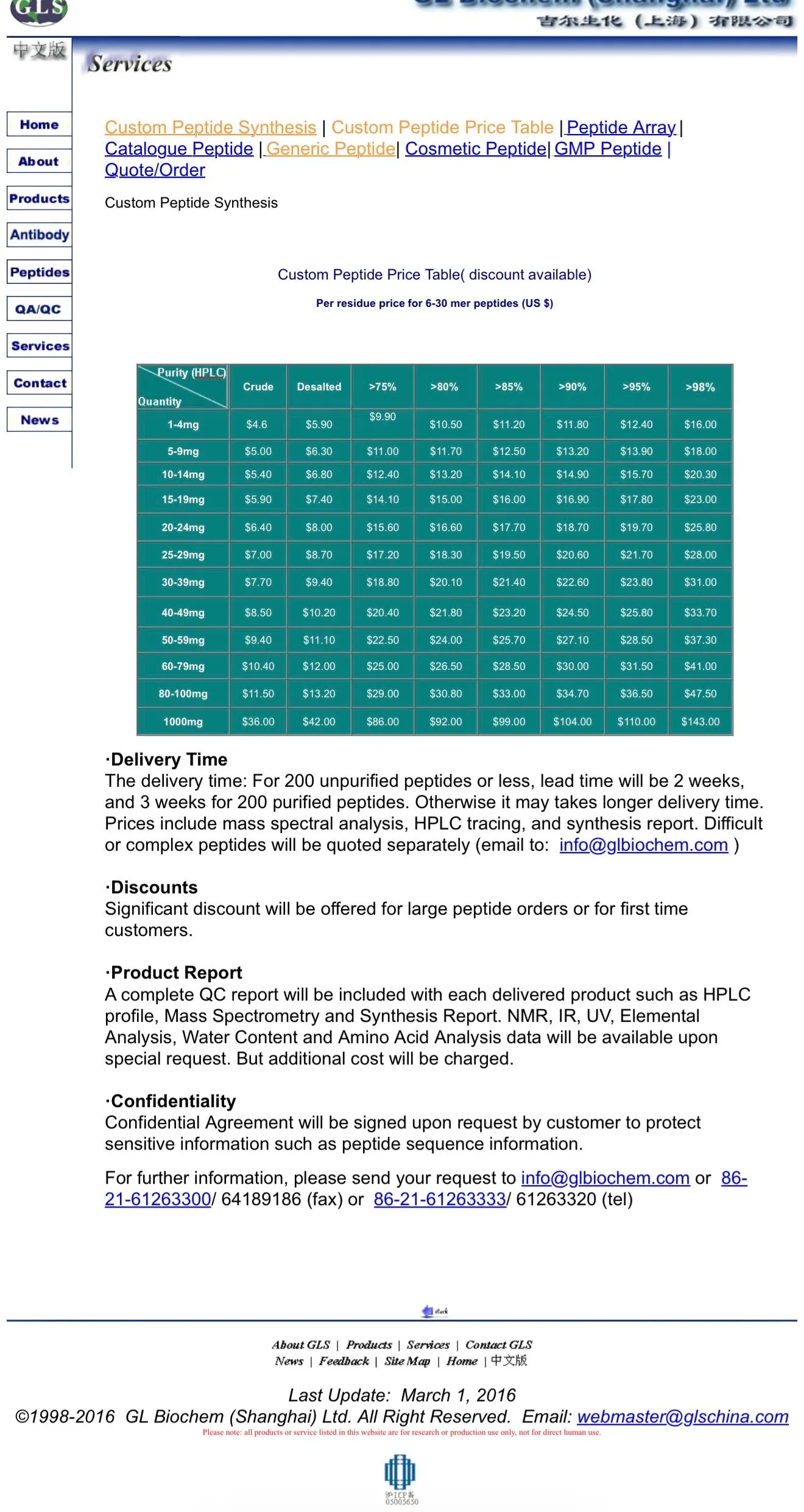
For a 25 to 29 mg custom synthesis, the table listed $20.60 per residue at >90% purity, $21.70 at >95% and $28 at >98%. For 50 to 59 mg, the respective prices were $27.10, $28.50 and $37.30. The company also advertised purification above 99% and at different production scales.
Its standard service included mass-spectrometric analysis, an HPLC trace and a synthesis report, with additional analyses including NMR, IR, UV, elemental analysis, amino-acid analysis and water determination available separately.
GL Biochem’s current site describes more than 350 synthesis staff, more than 250 purification engineers, around 200 analytical and preparative HPLC systems and production of more than 10,000 purified peptides per month. It lists custom, catalogue and GMP peptides among its services.
The 2016 pricing structure demonstrates an important feature of the upstream market: purity can be specified at the point of purchase, with additional purification carrying an additional cost.
A 95% raw material does not become 99% through freeze-drying
A 95% raw material would not become >99% simply through formulation, filling or lyophilisation. Reaching a genuinely higher chromatographic purity requires a separate purification process, such as preparative HPLC, carried out by a manufacturer with the appropriate capability.
Ethan said this is technically possible but expensive, difficult and associated with product loss, making it more practical to purchase high-purity material from the outset.
This distinction matters when assessing a finished vial reported at >99% purity. If the starting API was genuinely 95%, achieving a comparable >99% result requires an additional purification stage somewhere in the manufacturing chain.
Hanxin as an upstream supplier
Nanjing Hanxin Pharmaceutical Technology describes a substantial peptide and pharmaceutical operation. Established in 2017, it reports a 13,000-square-metre R&D facility containing peptide synthesis, purification, formulation and analytical laboratories, supported by automated peptide synthesis, preparative chromatography, HPLC/UHPLC and LC-MS systems. The company also describes GMP production facilities with raw-material capacity extending from hundreds of grams to kilogram scale and injectable production lines. Hanxin Pharmaceutical
Hanxin’s public API catalogue provides another example of peptides being offered to different specifications. Semaglutide and tirzepatide are listed at >99% for injection and >98% for tablets, while liraglutide is offered at >95% and >99%. Hanxin Pharmaceutical
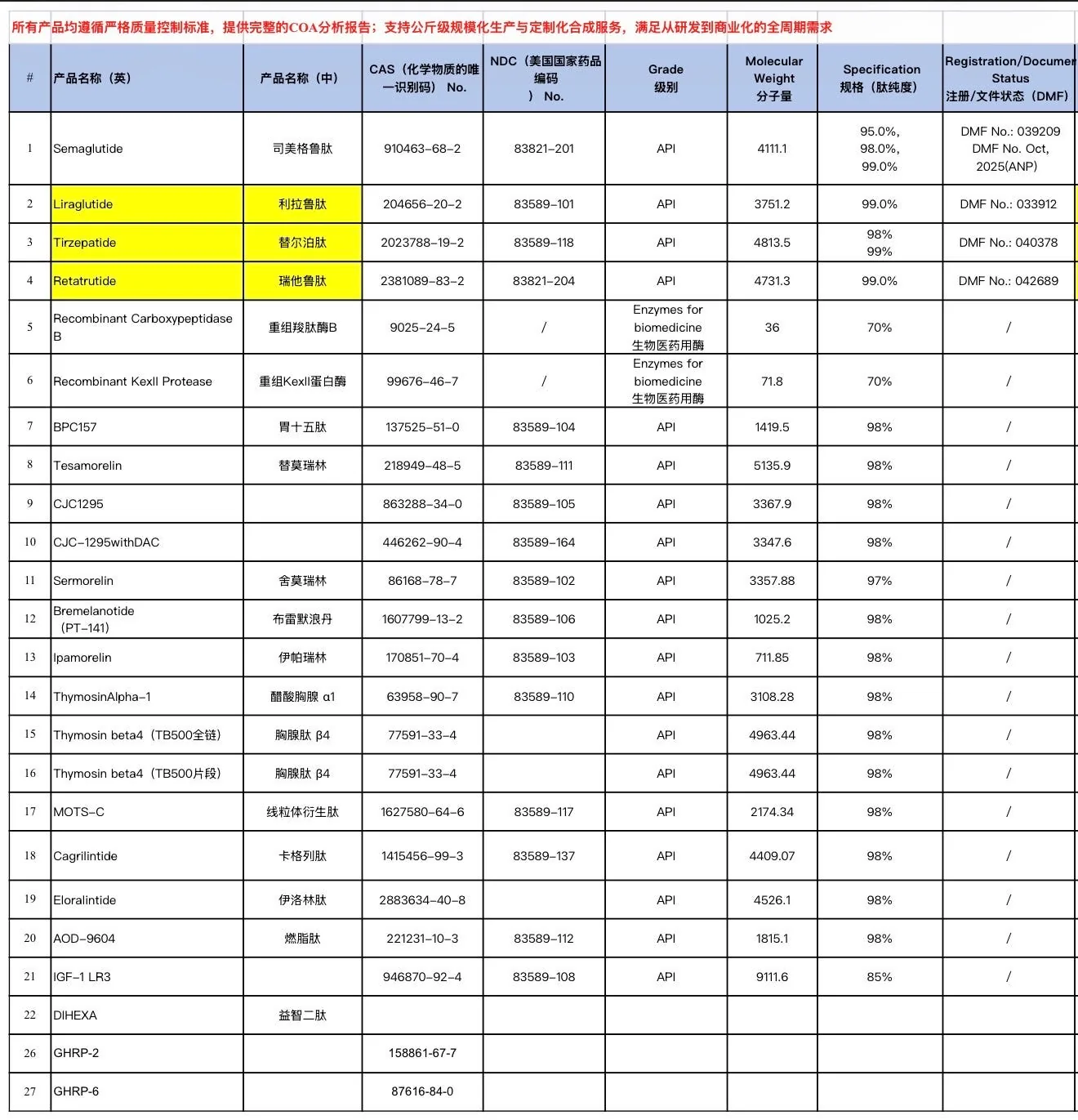
Ethan also supplied a Hanxin product sheet listing retatrutide as an API with a 99.0% specification, NDC 83821-204 and DMF 042689. Public NDC records also identify Nanjing Hanxin with bulk retatrutide under that product code. An NDC listing identifies the product in FDA’s directory rather than representing FDA approval.
What the retatrutide API COA shows
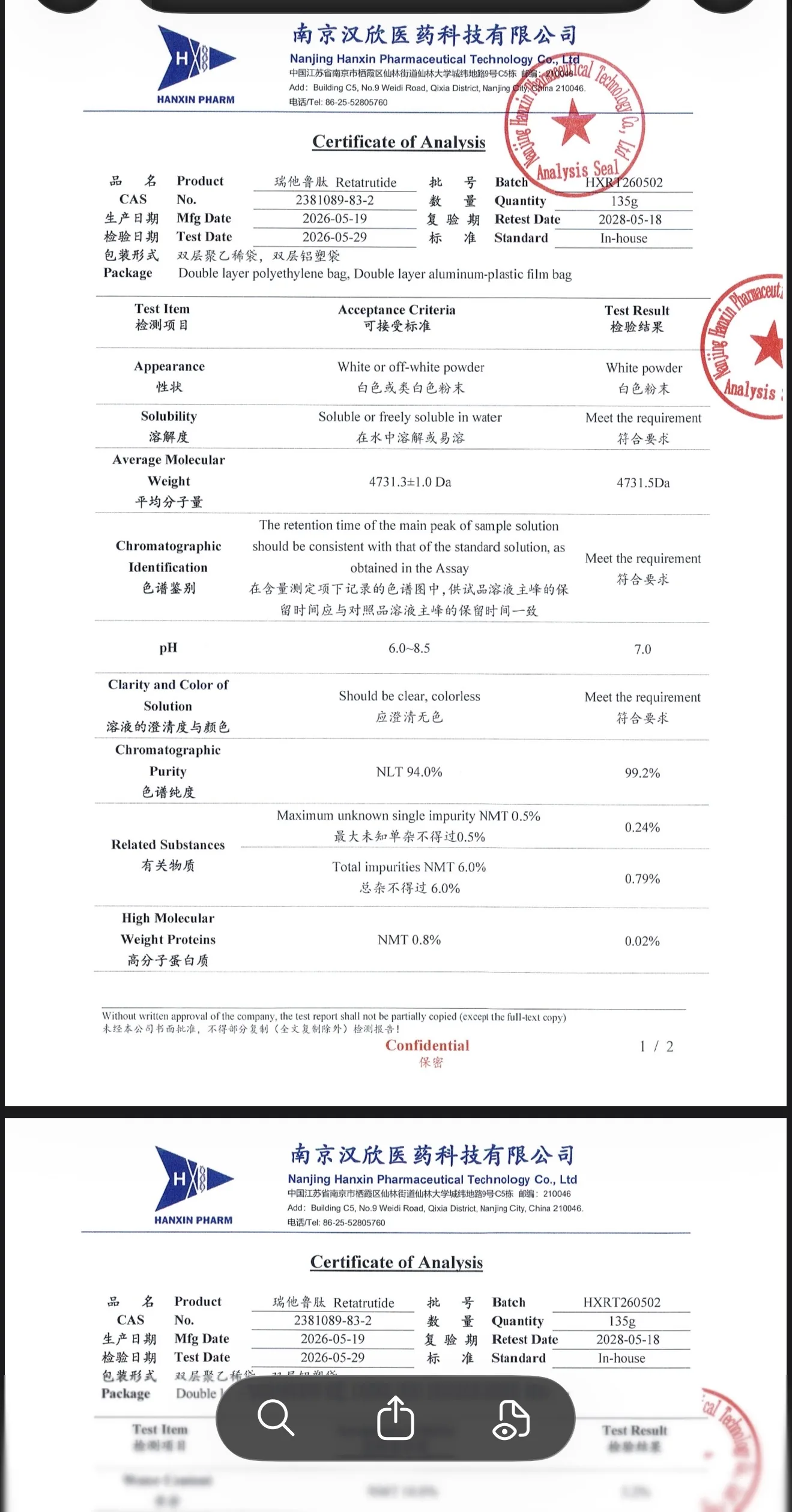
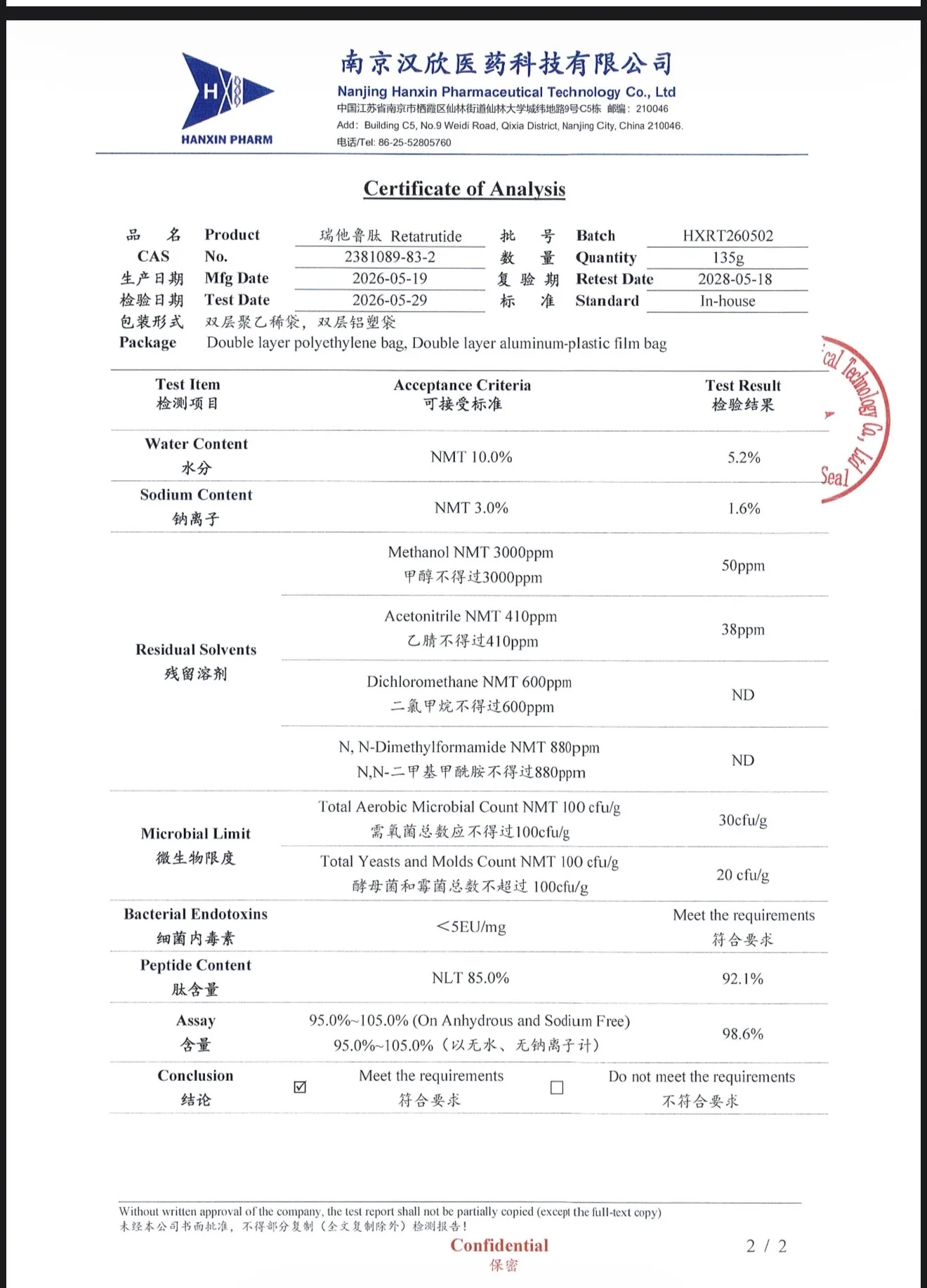
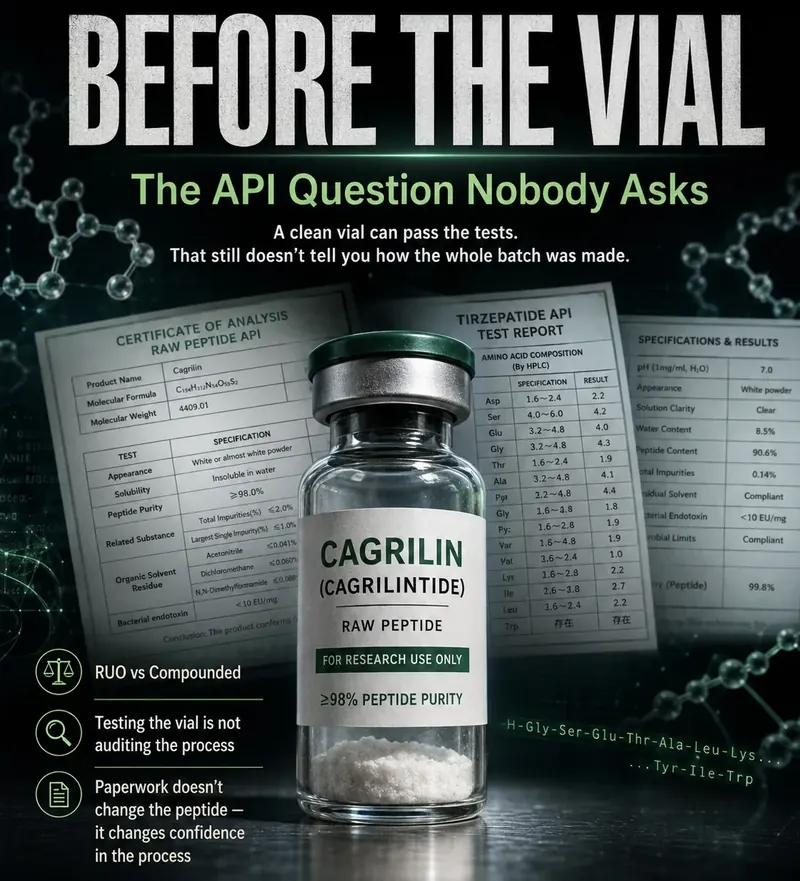
Ethan supplied a Hanxin COA for 135 g of retatrutide, batch HXRT260502, manufactured in May 2026. The API certificate covers considerably more than the identity, quantity and HPLC purity combination commonly seen on finished-vial reports. It includes identity, related impurities, water, sodium, residual solvents, microbiological limits, endotoxin, peptide content and assay.
The batch reported 99.2% chromatographic purity, with total related impurities of 0.79% and a largest unknown impurity of 0.24%. Water was 5.2%, sodium 1.6%, methanol 50 ppm and acetonitrile 38 ppm. Dichloromethane and DMF were reported as undetected. Microbial counts were within the stated limits and the endotoxin specification was <5 EU/mg.
The most revealing figures are:
Chromatographic purity: 99.2%
Peptide content: 92.1%
Assay on an anhydrous and sodium-free basis: 98.6%
These figures describe different characteristics of the same material. HPLC purity measures the proportion of the main peptide peak relative to detected peptide-related impurities under the chromatographic method. It doesn’t mean that 99.2% of the physical powder by weight consists of retatrutide.
Water, counterions and other components are accounted for separately, which is why the same bulk material can report 99.2% chromatographic purity while containing 92.1% peptide by content.
The COA also treats endotoxin separately from chromatographic purity, reporting 99.2% HPLC purity alongside an endotoxin specification of <5 EU/mg. Chemical purity and endotoxin burden are separate quality measurements.
The same API is only the beginning of the comparison
A compounding operation and an RUO manufacturer could potentially obtain peptide from the same upstream API manufacturer. That common origin would still represent only the first part of the finished-product chain.
After the API is received come incoming testing, storage, formulation, filtration, filling, environmental controls, lyophilisation and finished-product release. An API COA describes the starting material, while a finished-vial COA describes the material after downstream processing.
This is why identifying the API manufacturer is valuable without making the upstream COA a substitute for finished-product testing. Both describe different stages of the same product.
The missing piece is traceability
The strongest connection would be a documented chain from the finished-vial lot back to the filling or lyophilisation batch, then to the bulk API lot used and finally to the original API manufacturer’s COA. That becomes particularly important when the API manufacturer, filler, trader and retail vendor are separate businesses.
A genuine API COA establishes the characteristics of a particular bulk batch. Linking that document to the finished vials establishes that the material described by the COA was actually used to manufacture them That’s a more meaningful form of factory evidence than photographs of equipment alone.
Before the vial
The evidence gives a more complete picture of what “99% purity” represents.
Hanxin’s retatrutide COA reports 99.2% chromatographic purity, 92.1% peptide content and 98.6% assay on an anhydrous and sodium-free basis. GL Biochem’s pricing shows that purity can be selected and paid for upstream. Ethan’s description of the supply chain shows how peptide synthesis, purification, filling and lyophilisation can also involve different companies.
The finished-vial result remains important, but it represents the end of a much longer manufacturing chain.
A fuller assessment begins earlier: who manufactured the API, what specification was purchased, whether the incoming material was verified, who filled and lyophilised it, and whether those stages can be traced to the finished batch.
That is the part of the peptide supply chain that remains least visible, and the part that begins before the vial ever exists.
Comments