
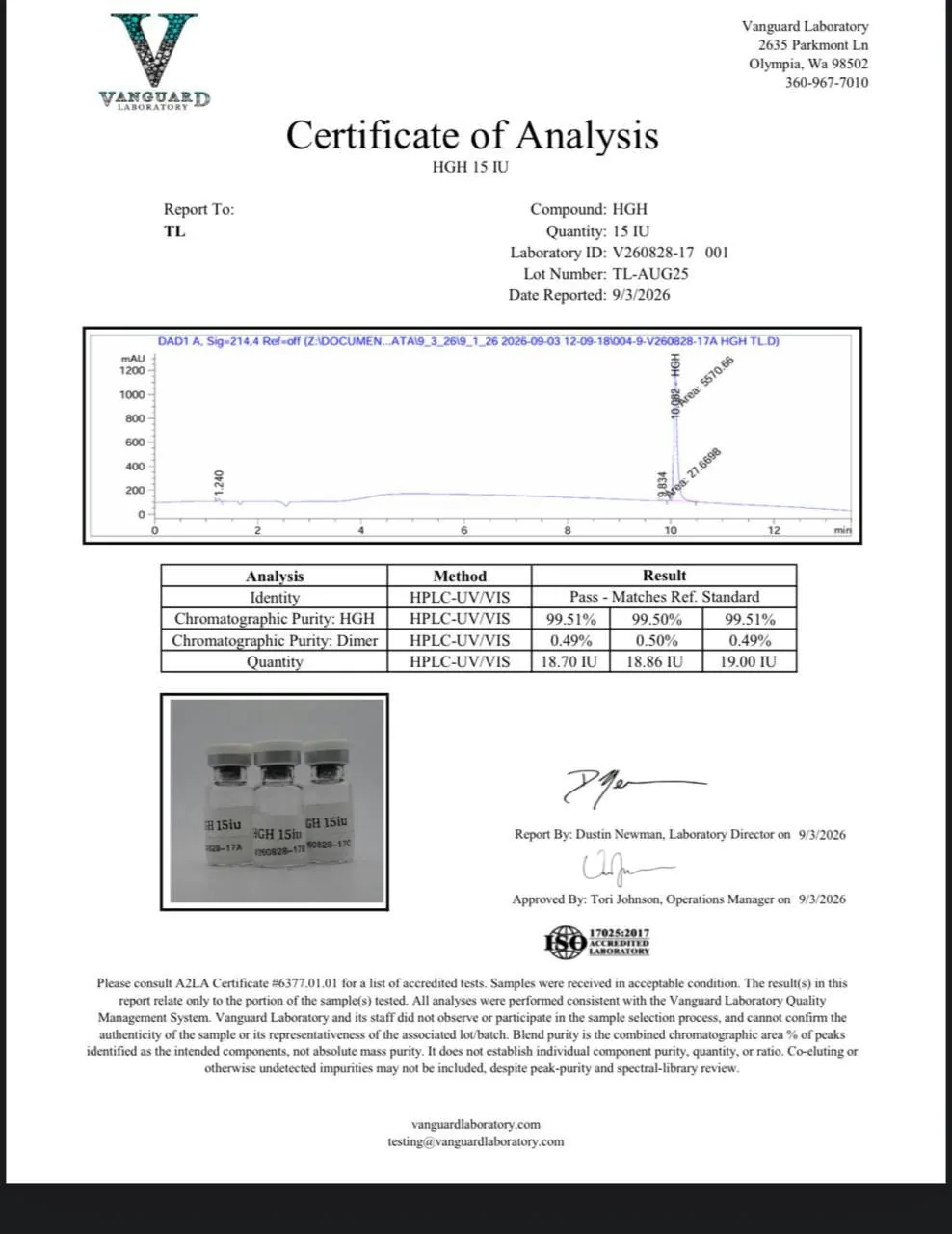
A recent HGH COA appears, at first glance, to show an almost perfect result. The product was labelled as 15 IU, passed an identity comparison against a reference standard and returned an HGH chromatographic purity of 99.50 to 99.51%. Dimer was reported at just 0.49 to 0.50%. On the surface, those figures appear conclusive. The detail beneath them tells a more complicated story.
The report and the laboratory’s subsequent explanation raise a far more interesting question: if three vials report 99.5%, while the laboratory says its recent HGH tests average 96 to 97% and attributes the difference to method choice, what does an HGH “purity” percentage actually tell us?
The result
The Vanguard Laboratory report for lot TL-AUG25, dated 3 September 2026, contains results from three individually tested vials:
Identity: Pass, matches reference standard
HGH chromatographic area percentage: 99.51%, 99.50% and 99.51%
Dimer chromatographic area percentage: 0.49%, 0.50% and 0.49%
HPLC-derived quantity: 18.70 IU, 18.86 IU and 19.00 IU
The report estimates approximately 18.70 to 19.00 IU per vial using an HPLC-based calculation. This is roughly 25 to 27% above the 15-IU label claim if the laboratory’s calibration, recovery, formulation handling and conversion of chromatographic response to IU have been appropriately validated. It shouldn’t be assumed to be a direct biological potency measurement. ICH Q6B distinguishes potency, expressed in units of biological activity, from quantity, normally expressed as a physicochemical measure of protein content. A higher number shouldn’t automatically be presented as a benefit; accurate labelling is part of quality control.
Vanguard subsequently confirmed that each column represents a vial tested individually. The lab normally includes only one chromatogram in the report, although the additional chromatograms can be provided if requested. That clarification makes the result more useful: all three tested vials returned closely matched figures for chromatographic area and HPLC-derived quantity. It provides evidence of consistency across those three vials, but it can’t establish consistency across the rest of the lot.
Read the small print
The most revealing part of the COA isn’t the large 99.5% figure. It’s the qualification printed underneath it. Vanguard explains that its reported purity is the combined chromatographic area percentage of peaks identified as the intended components. It’s not absolute mass purity. The disclaimer also says that co-eluting or otherwise undetected impurities may not be included.
That distinction changes how the result should be read. In simple terms, HPLC separates detectable material as it passes through a chromatographic system. The instrument produces peaks, and the software or analyst integrates the areas assigned to those peaks. A main HGH peak accounting for 99.5% of the included chromatographic area doesn’t mean that 99.5% of everything inside the vial has been independently identified as correctly folded, biologically active HGH.
Because the reported HGH and dimer percentages sum to 100.00% in each vial, the report appears to present a normalized distribution of the chromatographic area assigned to those two reported categories. Without the full chromatograms, integration tables, peak list, method conditions and reporting rules, however, it can’t be determined whether no other peaks were detected or whether other signals were excluded, unresolved, below threshold or not reported.
This is why “chromatographic area percentage” is often a more honest description than simply calling the number “purity.”
Why the method can change the answer
Vanguard said the lab’s average across its last 1,000 HGH tests was approximately 96 to 97%, excluding non-detects. It suggested that the unusually high result might reflect a difference between what it described as an official compendial method and a newer method that is more sensitive to purity-related peaks, although not necessarily more sensitive to dimer content. No full method details or same-vial comparison were provided, so the explanation cannot be verified for this sample. It remains plausible, but unconfirmed.
This is the central point: a percentage doesn’t exist independently of the method that produced it.
Change the column, mobile phase, gradient, run time, wavelength, sample preparation, detection threshold or integration rules and the chromatogram can change. A method capable of separating more minor variants may show additional peaks that a less sensitive or less selective method does not resolve. If two compounds co-elute into one peak, a clean-looking main peak may contain more than one component.
Other substances or quality problems may be poorly captured, or completely missed, by a particular HPLC-UV method. These can include host-cell proteins or DNA, endotoxin, microbial contamination, insoluble particles, some aggregates, residual solvents, excipients, leachables, weakly absorbing species and variants that co-elute with the main peak. No one chromatogram is a complete safety or quality assessment.
Even the placement of the baseline and the decision about which features count as peaks can affect the reported area percentage. This doesn’t mean that labs can invent any answer they like, it means that comparisons require more than placing two headline percentages side by side. Before comparing results, it’s necessary to know whether the laboratories used equivalent methods, reference standards, detection limits and integration practices. Without that information, 99.5% from one method isn’t automatically better than 97% from another.
Does pharmaceutical HGH reach 99%?
Yes, pharmaceutical manufacturing can produce recombinant HGH that meets a 99% HPLC criterion. A 2010 study of final anion-exchange chromatography in recombinant HGH manufacturing reported acceptance criteria of at least 99% HPLC purity and 99% monomer protein content across three batches. However, the paper doesn’t establish that every genuine HGH sample should return 99% under every method. Nor does it prove that three customer-submitted vials reporting 99.5% are equivalent to licensed pharmaceutical HGH.
The study assessed much more than one headline percentage. Its quality checks also included endotoxin, host-cell protein, isoelectric focusing, Native-PAGE and process validation, all within a controlled manufacturing system with defined operating parameters and acceptance criteria. That difference is crucial. A pharmaceutical product is supported by control of the raw materials, cell line, fermentation, purification, formulation, filling, storage and batch release process. Third-party testing of three finished vials can provide useful information, but it can’t recreate that entire chain of evidence.
Identity is not the whole structure
The COA records an identity pass because the sample matched a reference standard using HPLC-UV/VIS. That’s useful evidence, but it shouldn’t be stretched into a claim that every aspect of the molecule has been established. A matching retention time can support identity under that method. It doesn’t, on its own, provide a complete amino-acid sequence or demonstrate correct three-dimensional folding and biological activity. An intact-mass result would add different information, but matching molecular weight alone would still not prove that every amino acid occupies the correct position.
This is why biological products are normally characterised with several complementary techniques. International ICH guidance states that the absolute purity of biological products is difficult to determine and that results are method-dependent. It recommends estimating purity through a combination of methods and treating identity, potency, quantity, product-related impurities, process-related impurities and contaminants as separate questions.
What the COA can support
The three submitted vials produced very similar reported results. Under Vanguard’s stated HPLC-UV identity comparison, the main analyte behaved consistently with its HGH reference standard. Under that chromatographic method and its reporting and integration scheme, the main reported HGH peak represented about 99.5% of the included chromatographic area, while dimer represented about 0.5%. The lab’s HPLC-based calculation estimated approximately 18.70 to 19.00 IU per vial rather than the 15 IU stated on the label. The data are compatible with samples dominated by material that behaves like the laboratory’s HGH standard in that assay.
That is meaningful evidence. It’s not meaningless merely because it’s incomplete, but it’s narrower than claiming that the vials are “99.5% perfect.”
What it cannot establish
The result doesn’t establish biological potency, complete molecular structure, sterility, endotoxin or particle safety, whole-batch consistency, manufacturing quality or equivalence to a licensed product. Those questions require separate tests and evidence beyond a single HPLC result. ICH Q6B treats identity, purity, potency, quantity, contaminants and manufacturing controls as separate parts of the overall quality assessment.
The cost of comprehensive testing
Comprehensive testing on every kit, or every vial, would rapidly erase the price advantage of unregulated HGH. This isn’t an argument against testing or for simply buying the cheapest product. Third-party testing can reduce particular uncertainties, but it can’t turn a black-market product into a licensed medicine.
Bloodwork sits in the same limited category. Comparing IGF-1 before and during exposure may show that the GH-IGF-1 axis has responded, and IGF-1 is used clinically because its level is more stable than circulating GH. But a rise can’t identify the contents of a vial, prove the stated quantity, or establish sterility, endotoxin control, correct folding or freedom from particles. It’s evidence of a biological response, not a substitute for product analysis.
Visible appearance is another separate question. A vial can return a high chromatographic area percentage and still reconstitute cloudy or contain floaters. That could reflect incomplete dissolution, aggregation, a formulation or reconstitution problem, or contamination; appearance alone can’t identify the cause. But the HPLC percentage doesn’t make the problem disappear. Licensed Genotropin instructions require the reconstituted product to be inspected and state that only clear solutions without particles should be used.
The realistic choice isn’t between “test everything” and “test nothing.” It’s to understand exactly what each affordable test rules in or out, and how much uncertainty remains after the report arrives.
The bigger lesson
The grey HGH market often treats laboratory percentages as if they were universal grades: 97% and above is excellent and 95-96% is good. The reality is less tidy. A lower result produced by a method that resolves more impurities may be more informative than a higher result produced by a method that combines or misses them. A beautiful chromatogram can still leave unanswered questions, while a more complicated chromatogram may reflect better separation rather than a worse product.
The answer isn’t to stop testing, it’s to stop asking one test to answer every question.
This 99.5% COA is valuable precisely because it exposes the limits of the number printed on it. The correct conclusion isn’t that the HGH has been proved virtually perfect, nor that the result is meaningless. It’s that the result describes what one method could identify, separate and measure in three submitted vials under its own conditions.
A 99.5% chromatographic area result is a strong result within its assay’s scope. It becomes misleading only when it’s used as a substitute for every other quality attribute that the assay was never designed to measure.
Sources
Vanguard Laboratory, HGH 15 IU Certificate of Analysis, laboratory ID V260828-17 001, reported 3 September 2026.
Vanguard Laboratory follow-up clarification: multiple columns on this report represent individually tested vials; additional chromatograms are available on request.
Verification of the final anion exchange chromatography in the r-hGH manufacturing process, Biotechnology and Bioprocess Engineering 15, 488 to 496 (2010).
ICH Q6B: Specifications, Test Procedures and Acceptance Criteria for Biotechnological/Biological Products, US Food and Drug Administration.
IGF-1 (Insulin-like Growth Factor 1) Test, MedlinePlus.
Genotropin Summary of Product Characteristics, electronic Medicines Compendium.
Comments