
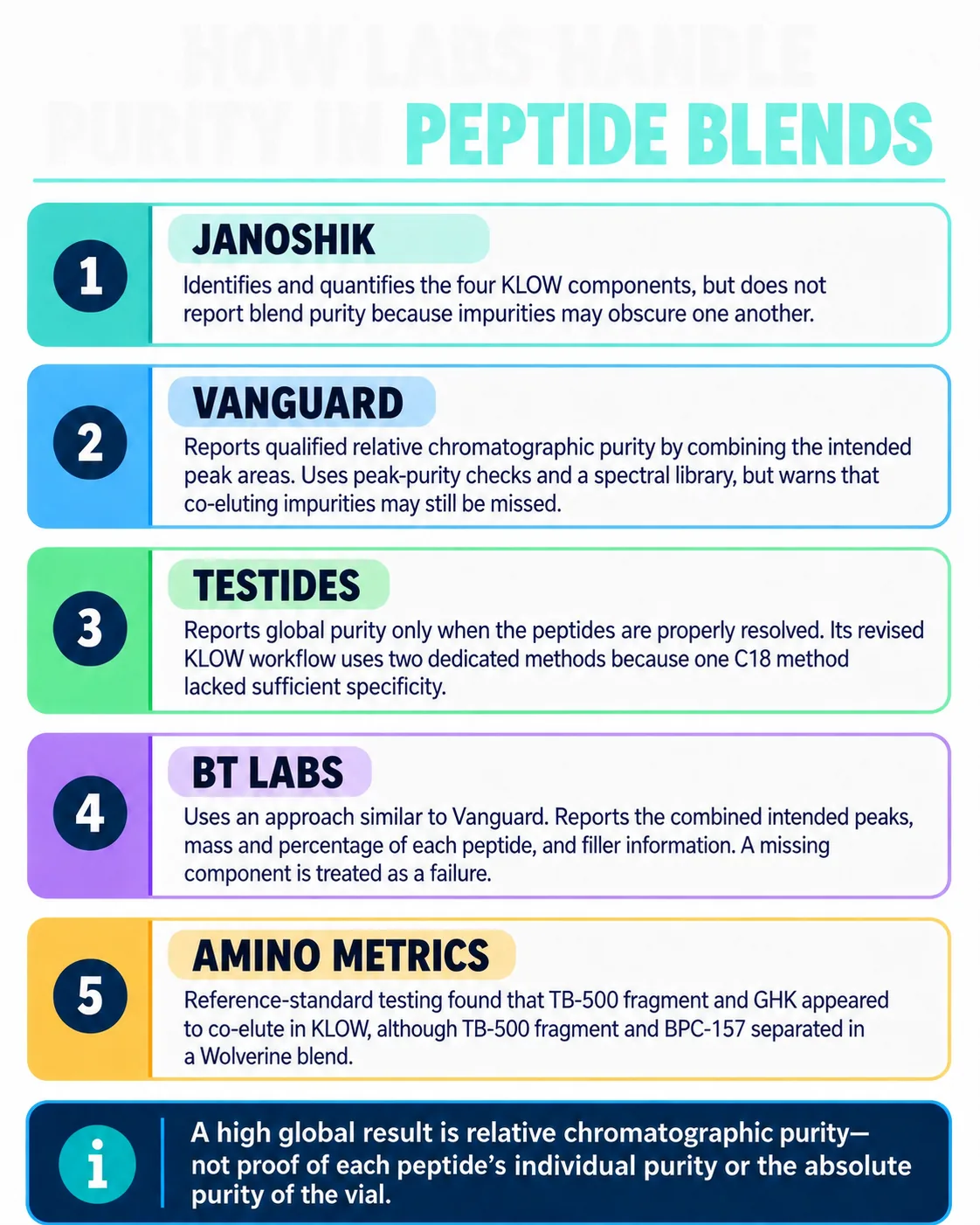
The question came for KLOW80, a blend containing four intended components: GHK or GHK-Cu, TB-500, BPC-157 and KPV. Janoshik says peptide purity can’t be measured in blends because impurities from the different peptides may obscure one another. But even if a lab can’t establish the individual purity of all four peptides, could it still report one result for the blend as a whole?
Vanguard, Testides and BT Labs said they could, provided the number is properly qualified and the intended component peaks are adequately separated. What they’re describing is relative chromatographic purity: the proportion of the detected and integrated peak area assigned to the expected components. It’s not the individual purity of each peptide or the absolute purity of everything in the vial.
Why Janoshik Does Not Report It
Why Janoshik Does Not Report It
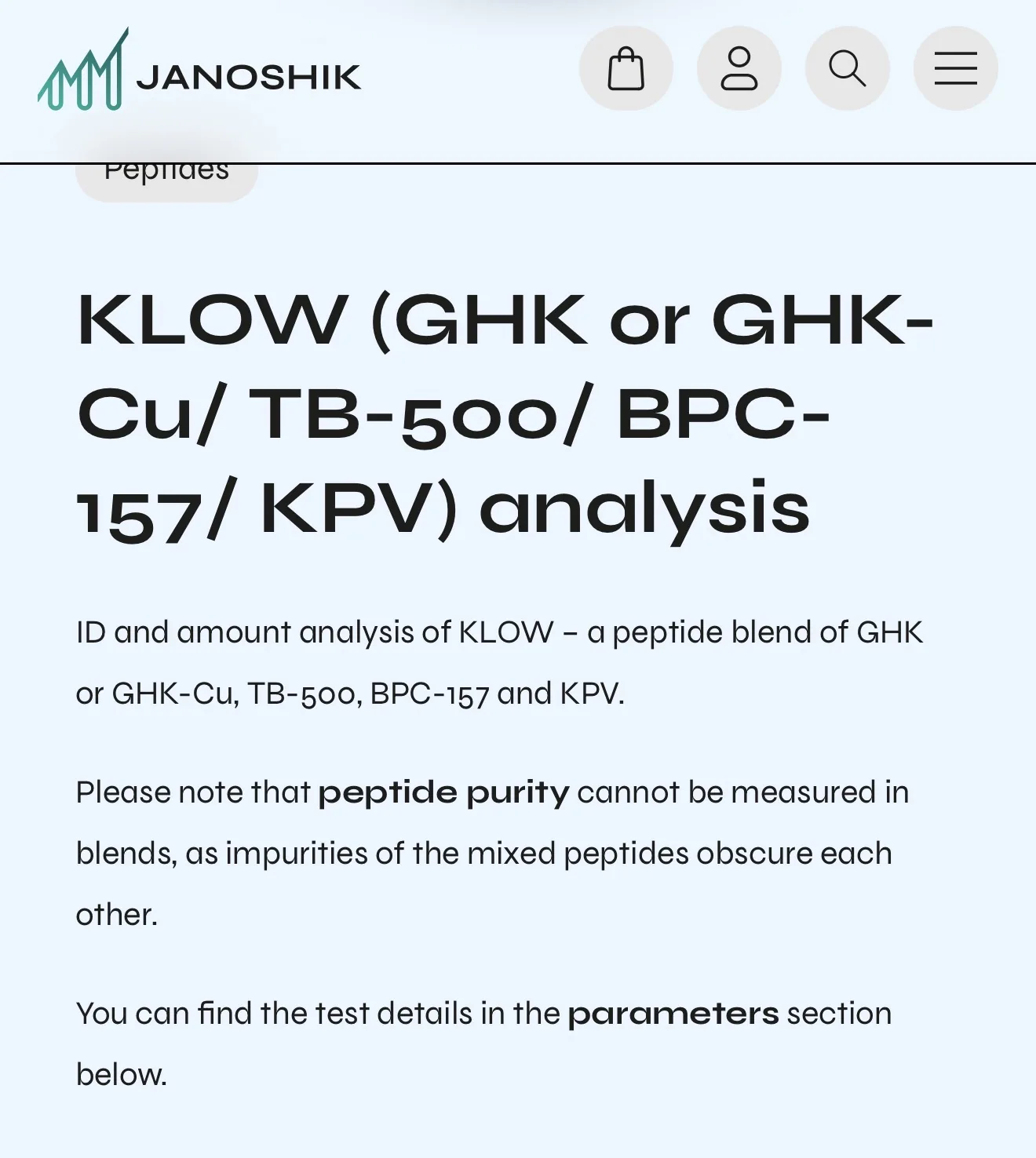
Janoshik’s KLOW testing page offers identification and amount testing for the four components but states that peptide purity isn’t measured. The same warning appears on its BPC-157/TB-500 and CJC-DAC/Ipamorelin blend tests. The reason is that an impurity belonging to one peptide may overlap with another peptide or one of its impurities. If the lab can’t determine where each impurity came from, it can’t defensibly report that the BPC-157 is 99%, the KPV is 98% and the GHK is 97%. Janoshik therefore reports identity and amount but not peptide purity. Other labs accept that individual purity can’t be established and instead calculate one overall result from the peaks assigned to the intended components.
What Vanguard Reports Instead
Dustin said Vanguard initially refused to report purity on blends but changed his approach after being overwhelmed with emails asking why no result had been included. For KLOW80, Vanguard adds together the areas of the four identified component peaks and compares that figure with the total integrated peak area:
Combined area of the four intended peaks ÷ total integrated peak area × 100
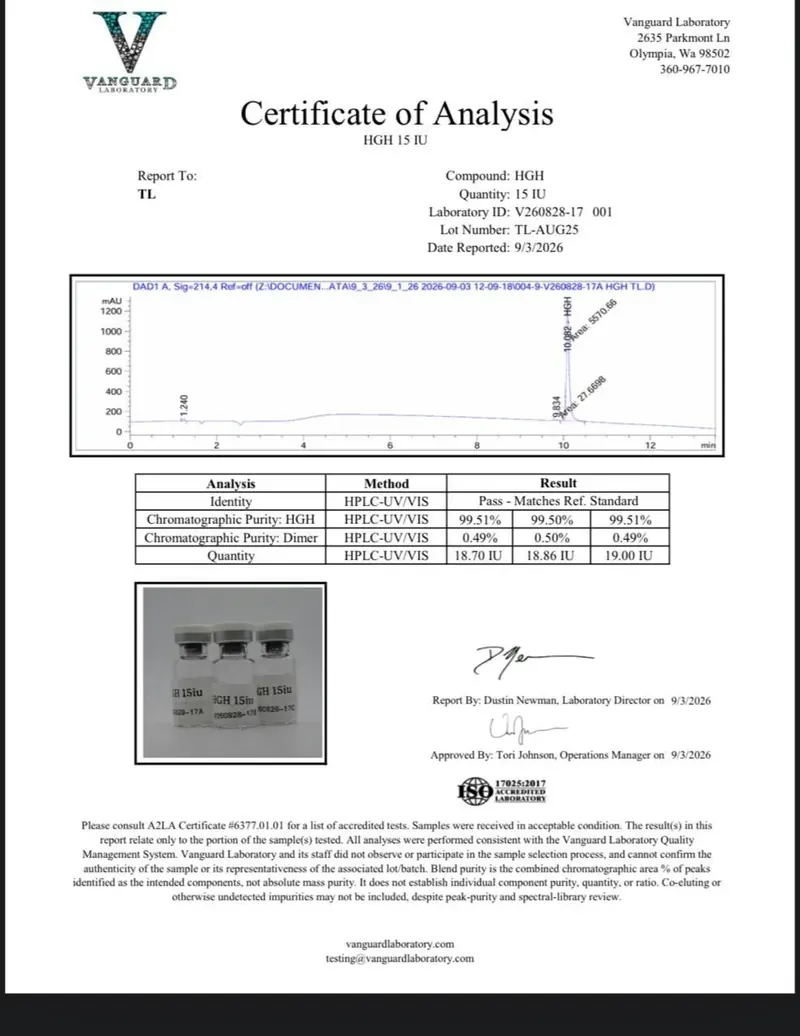
Any separate detected peak outside those four components is treated as an impurity for the calculation. Vanguard said he sees blends with large impurity peaks and decided that a qualified overall result was more useful than reporting nothing. He also checks peak purity and compares the component peaks with its spectral library. Those checks may reveal some co-elution, but they can’t rule out every impurity hidden beneath another peak. Vanguard now places this disclaimer on its blend COAs:
“Blend purity is the combined chromatographic area % of peaks identified as the intended components, not absolute mass purity. It does not establish individual component purity, quantity, or ratio. Co-eluting or otherwise undetected impurities may not be included, despite peak-purity and spectral-library review.”
That qualifier changes what the number means.
What BT Labs Reports
BT Labs uses an approach similar to Vanguard’s. They report the combined chromatographic area of the intended peaks, while warning that co-eluting impurities can’t be ruled out. Whether the result is meaningful depends on the blend and the retention-time separation between its components. BT Labs also reports the mass of each peptide, each peptide’s percentage of the vial and information about the filler. These are separate measurements: the combined peak-area result describes relative chromatographic purity, while the individual results describe the amount and composition of the blend.
The lab said that one of the claimed peptides has been missing from many recent blend samples. It treats a missing component as a failure and normally doesn’t report a blend-purity figure unless the customer asks for it. A vial containing only three of four claimed peptides may still look chromatographically clean, but a high overall percentage doesn’t compensate for an absent ingredient.
Why 99% Peak Area Is Not 99% of the Vial
A result of 99% relative chromatographic purity means that 99% of the integrated area detected under that method was assigned to the expected component peaks. It doesn’t necessarily mean that 99% of the material in the vial consists of those peptides by mass. Different peptides may produce different detector responses for the same mass. Excipients or contaminants that don’t respond adequately may contribute little or nothing to the chromatogram. The calculation only includes what the method detected and integrated.
There’s also the problem of co-elution. If an impurity forms its own separate peak, it can be included as impurity area. If it leaves the column at the same time as BPC-157 and hides beneath that peak, its area may instead be counted as BPC-157. Spectral peak-purity checks can reveal some co-elution when the hidden substance has a sufficiently different UV spectrum. They may miss contaminants with similar spectra or those that don’t absorb adequately at the selected wavelength. Waters notes that properly quantifying an impurity generally requires adequate separation and appropriate calibration.
Separation Comes First
Vanguard said relative chromatographic purity is meaningless if the main component peaks aren’t separated back to the baseline. When peaks overlap, the lab can’t reliably determine where one ends and another begins or whether a smaller impurity is hidden inside the overlap.
Testides agreed that a global result can be reported only when the peptides are properly resolved. For KLOW, he found that one standard C18 method didn’t provide enough specificity for GHK and replaced the single-method approach with two dedicated runs. The lab now prepares one sample and splits it into two vials. Run A uses a specialised “Early Method” for the fast-eluting KPV and GHK-Cu. Run B uses an optimised C18 method for BPC-157 and TB-500. Each run provides identification and quantification for its two components. Testides is still developing the purity calculation. He said the result would be chromatographic purity under the current method, but he hasn’t yet explained how the two runs will be converted into one overall percentage. Peak areas from different methods can’t simply be combined as though they came from one chromatogram without an appropriate calculation and validation.
KLOW Shows Why the Exact Peptide Form Matters
Amino Metrics prepared blends using reference standards. He successfully separated BPC-157 and the TB-500 fragment in a Wolverine blend, with retention times matching the reference materials. KLOW behaved differently. The TB-500 fragment appeared to co-elute in the void with GHK rather than forming an adequately separated peak. Amino Metrics said his earlier KLOW methods had been developed for TB-500 long form, which was much easier to separate than the fragment, and that this could explain some of the discrepancies he’s seen.
The label “TB-500” therefore isn’t enough on its own. A method developed for the long form can’t automatically be assumed to resolve the fragment. If the fragment and GHK co-elute, an overall purity calculation isn’t defensible until that separation problem is solved.
Are the Laboratories Actually Disagreeing?
Not about the limitations. All of them recognise that impurities can overlap and that a global percentage cannot establish the individual purity of each peptide. Janoshik chooses not to report purity because those limitations prevent a defensible peptide-purity result. Vanguard and BT Labs report a qualified overall area percentage because they believe it still provides useful information about the blend. Testides agrees in principle but is still developing its calculation for the new two-run KLOW method.
The disagreement is over whether a restricted but clearly labelled result is better than no purity figure at all.
What Customers Need to Know
If a lab reports blend purity, the percentage needs enough context to prevent it being mistaken for the individual purity of every peptide or the absolute purity of the vial. The COA or accompanying method information should make clear which components were detected, what peaks were included in the calculation and that the result represents relative chromatographic purity. It should also explain that the figure doesn’t establish each peptide’s individual purity, amount or ratio, and that co-eluting or otherwise undetected impurities may not be included. Where relevant, the lab should also provide enough information about the method and peak separation for the result to be interpreted properly.
So back to the original question; The Answer
Yes, a lab can calculate relative chromatographic purity for a peptide blend when the intended component peaks are identified and properly separated. The number describes the share of detected peak area assigned to those components, nothing more.
It becomes misleading when that qualification disappears and the result is presented simply as proof that the blend is “99% pure.”
Comments