
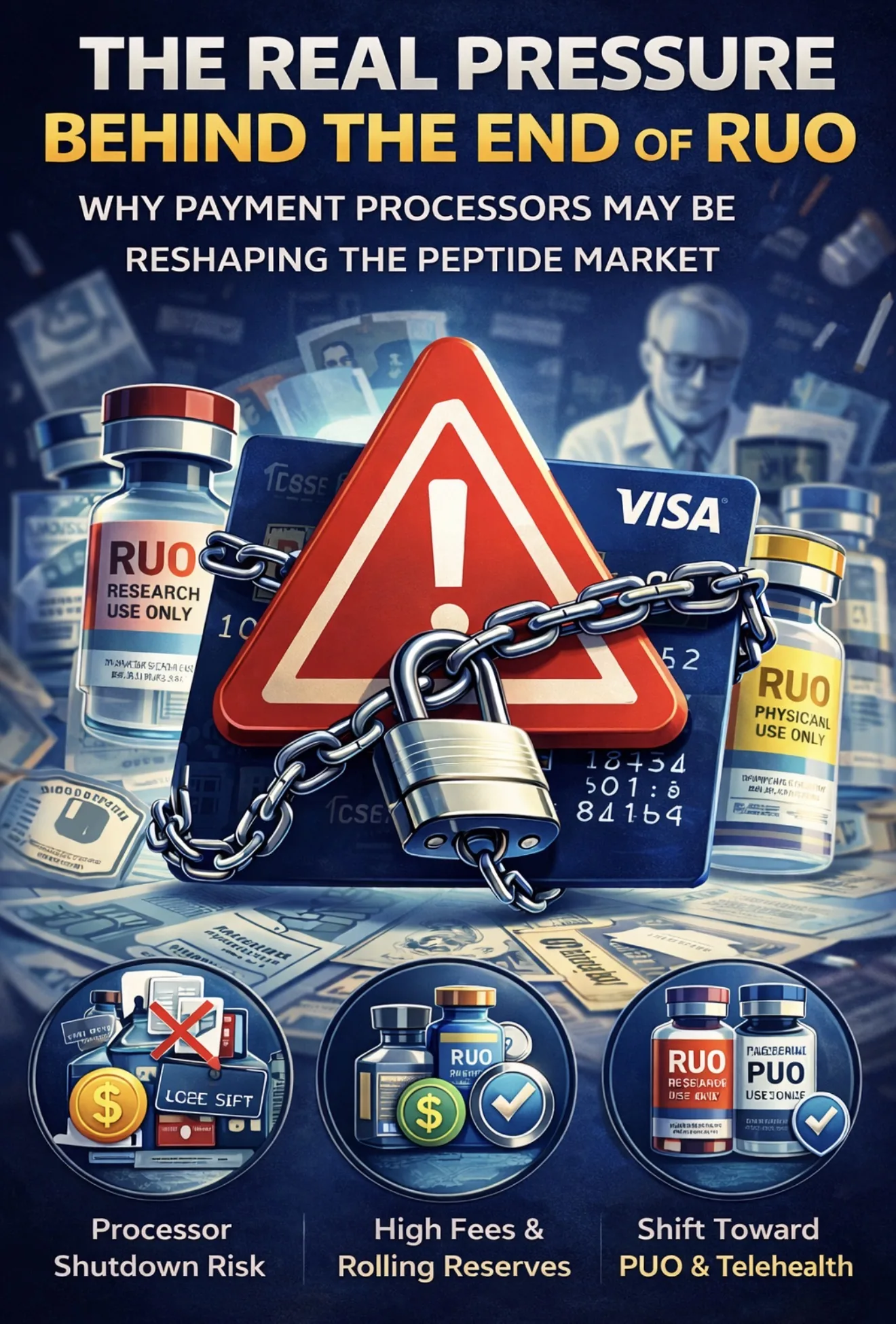
For years the grey market peptide ecosystem managed to operate in a strange legal balance.
Companies sold peptides labelled “Research Use Only.”
Websites carried disclaimers such as “Not for Human Consumption.”
And yet the products were widely discussed in wellness communities, longevity clinics, and online forums.
Regulators were aware of the contradiction.
But the system continued to function.
What may finally be destabilising that model is not only regulation.
It may be payments infrastructure.
The Overlooked Pressure Point
When people discuss the future of the peptide market, the conversation usually focuses on:
FDA enforcement
pharmaceutical lawsuits
compounding pharmacy regulation
the shift from RUO to PUO
But vendors inside the industry are increasingly pointing to something else entirely.
Payment processors.
One industry participant recently summarised the situation bluntly:
“The biggest risk in the research peptide industry right now isn’t supply, compliance, or demand.
It’s payment processors”
In other words, the problem is not making the peptides.
The problem is getting paid for them.
The Hidden Fragility of the RUO Model
The traditional RUO vendor model relied heavily on access to card processing.
For years that was possible through a mixture of:
niche processors
high risk merchant accounts
payment intermediaries
and sometimes payment cloaking arrangements.
But as the peptide market grew, particularly during the GLP-1 boom, payment scrutiny increased.
Processors began to treat peptide businesses as high risk merchants.
That meant:
large rolling reserves
higher processing fees
sudden account reviews
delayed settlements
and in some cases abrupt shutdowns.
In extreme cases, companies report losing processors entirely.
Some vendors describe a pattern where processors simply disappear overnight, leaving large sums of merchant funds frozen or unrecoverable.
When that happens, the legal structure of the business almost becomes secondary.
Without reliable payment infrastructure, the business cannot operate.
Payment Infrastructure Is Now Shaping Behaviour
Recent discussion among payment processing professionals suggests that the pressure on peptide vendors is not limited to account shutdowns or frozen balances.
It is now affecting how companies structure their businesses day to day.
Some vendors appear to be deliberately slowing sales volumes in order to avoid triggering PayPal or Stripe scrutiny. Others are experimenting with card to crypto checkout bridges, where the customer sees something closer to a card payment flow but the merchant ultimately settles in crypto.
That solves some of the problems that usually kill stores in this space:
no rolling reserves
no frozen balances
no sudden processor shutdowns
faster settlement to the merchant
But it creates new trade offs too. In some cases, buyers may need to complete ID verification with a crypto on ramp, checkout becomes less seamless, and the merchant is no longer operating through a conventional retail payment model.
In other words, payment processing is no longer just a backend problem.
It is now influencing:
checkout design
customer conversion
growth limits
merchant structure
and ultimately which vendors are able to survive at scale
That is a very different kind of pressure from ordinary regulatory uncertainty.
The MATCH List Problem
One of the risks discussed inside payment processing circles is being placed on the MATCH list.
MATCH stands for Member Alert To Control High Risk Merchants.
It is a database used by banks and payment networks to track merchants whose accounts were terminated for risk or compliance violations.
Once placed on this list, a business may find it extremely difficult to obtain traditional card processing again.
That creates a powerful incentive to avoid anything that might trigger payment scrutiny.
Including business models associated with research chemical sales.
Why RUO Became a Red Flag
This is where the “Research Use Only” label started to create a different problem.
The wording that once allowed vendors to avoid drug regulation now appears to trigger payment
processor risk flags.
Terms such as:
“research chemicals”
“not for human use”
peptide compounds associated with wellness protocols can attract additional scrutiny from payment networks.
In other words, the label that once helped businesses operate in a legal grey area may now be making them harder to process payments for.
Enter Telehealth and Pharmacy Models
This helps explain why the industry is increasingly exploring alternatives such as:
Telehealth prescribing platforms
physician linked distribution models
licensed compounding pharmacies
From a regulatory perspective these models are complex.
But from a payment perspective they offer something valuable:
legitimacy.
Healthcare businesses that operate through physicians, pharmacies, and telehealth infrastructure can potentially qualify for certifications such as LegitScript, which payment networks often require for healthcare related products.
That makes stable merchant processing much easier.
And stable processing is the difference between a scalable business and one constantly at risk of shutdown.
A Financial Incentive for Structural Change
This creates a powerful economic incentive.
Even vendors who originally built their businesses around the RUO model may now find themselves pushed toward:
physician oversight
Telehealth infrastructure
compounding pharmacy partnerships
Not necessarily because regulators demanded it.
But because the payment system did.
The Real Market Shift
When viewed from this angle, the shift happening in the peptide market begins to look slightly different.
It is not simply:
RUO → PUO.
And it is not only:
Grey market → regulated pharmacy.
Instead, a more practical transition may be occurring.
One where vendors move toward structures that allow them to maintain stable financial infrastructure.
The legal framework determines where liability sits.
But the ability to process payments may be what determines which models survive.
Increasingly, the peptide market appears to be adapting not only to regulators, but to the financial systems that decide who is allowed to keep taking payments.
The Takeaway
For years the peptide market existed in a strange regulatory grey zone.
But markets are not shaped by regulation alone.
They are also shaped by logistics, infrastructure, and finance.
And the quiet pressure now reshaping the industry may not be coming from the FDA at all.
It may be coming from the companies that control the rails of money.
Next Article
In the next piece, we will look more closely at the other side of this transition:
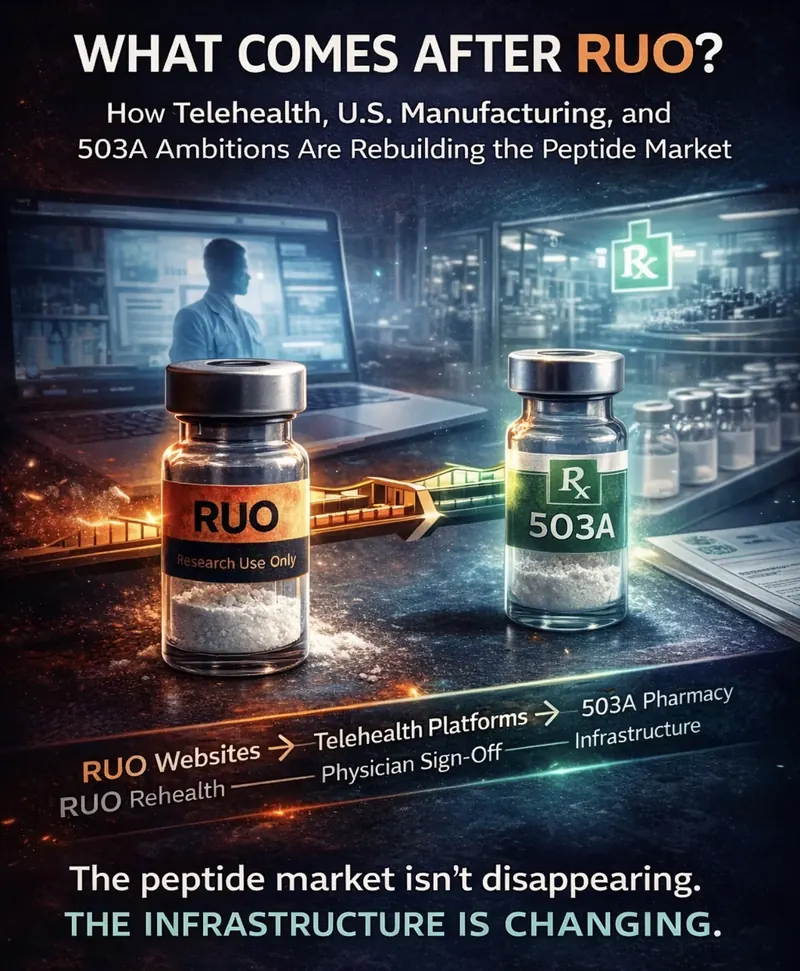
the rapid growth of Telehealth driven compounding pharmacy models and how they may reshape peptide distribution in the United States.
Because if the RUO model is under pressure, the question is not whether demand disappears.
The question is which system replaces it.
Comments