
In my previous articles, I examined the growing pressure on the traditional Research Use Only (RUO) peptide market.
For years the grey market ecosystem functioned within a strange legal and commercial balance. Peptides were sold under labels such as “Research Use Only” and “Not for Human Consumption.” At the same time, those same compounds were widely discussed in wellness communities, longevity circles, and increasingly in clinic-adjacent spaces.
More recently, some vendors have experimented with a different label: PUO; Physician / Prescriber Use Only.
But the deeper question is not simply how the labels are changing.
It is this:
If the RUO model becomes unstable, what actually replaces it?
At first glance the answer appears straightforward: telehealth platforms and compounding pharmacies.
But the reality emerging inside the market appears far more complicated.
This is not just a story about legitimate pharmacy infrastructure replacing research chemical websites. It is also a story about underground U.S. peptide operations, telehealth partnerships, physician sign off models, and long term ambitions to move toward 503A compounding status.
503A: The Proposed Destination
Since the RFK interview, 503A compounding pharmacy licensing has increasingly been discussed inside the peptide industry as a potential path toward greater legitimacy.
Under Section 503A of the Federal Food, Drug and Cosmetic Act, compounding pharmacies operate primarily under state pharmacy board oversight rather than direct FDA manufacturing regulation. They compound medications on a prescription basis for individual patients, rather than producing drugs in bulk for general distribution.
Because of this structure, 503A pharmacies do not operate under the same full pharmaceutical cGMP manufacturing requirements that apply to large drug manufacturers. Instead, they function within the pharmacy regulatory framework, which places greater emphasis on:
prescription based dispensing
pharmacy licensing and pharmacist oversight
record keeping and procedural controls
state level regulatory supervision
From the perspective of vendors currently operating in the grey market, this model can appear relatively attainable.
Industry participants sometimes describe the transition in simple terms: obtaining a 503A licence may take several months of regulatory preparation and tens of thousands of dollars in fees. For businesses already generating significant revenue, that may be viewed as a relatively small investment if it provides a more stable regulatory and commercial footing.
But this description only explains what the 503A model looks like in theory.
It does not necessarily describe how every operator now discussing 503A is currently structured.
Why Clinics Started Looking Beyond Traditional Compounding
Wellness clinics did not create peptide demand from nothing.
They responded to it.
For a period, many clinics prescribed peptides through legitimate compounding pharmacies. But compounding pharmacies can only legally prepare certain substances. That works for compounds such as sermorelin, which was previously FDA approved. It becomes much more complicated for peptides that are still in clinical development or otherwise sit outside conventional compounding pathways.
That created a commercial gap.
Patients increasingly arrived at clinics asking for specific compounds they had seen discussed online. Clinics could see the demand. They could see the revenue opportunity. But legitimate pharmacy channels could not always service that demand cleanly.
That is where alternative infrastructure began to emerge.
The Telehealth Pipeline
One model now being described by industry participants operates through a telehealth driven distribution system.
The workflow typically looks like this:
A patient visits a telehealth platform.
The patient completes a medical intake questionnaire.
A physician reviews the submission.
A prescription is issued.
The product is shipped to the patient.
From the outside this resembles a conventional healthcare workflow:
patient → physician → pharmacy
But the scale and mechanics are different from traditional clinic medicine.
Many telehealth systems operate asynchronously. Patients submit information online, physicians review it later, and prescriptions are issued without real time consultations.
Critics argue that in some versions of this model the physician’s role may function less as traditional patient care and more as sign off infrastructure.
Supporters argue it is simply telemedicine operating at scale.
Either way, it enables distribution volumes that traditional clinics could never achieve.
The Underground U.S. Factory Point
This is where the picture becomes more complicated.
Not every business now discussing telehealth and 503A appears to be starting from an existing licensed pharmacy.
A further possibility raised by industry discussions is that some operators may not be moving directly into licensed compounding at all, but instead into an intermediate structure.
Under this model, an existing U.S. based peptide manufacturing operation could first partner with a telehealth company, use that relationship to establish a clinic facing distribution system, and treat eventual 503A status as a later strategic objective rather than an immediate condition of operation.
Viewed this way, 503A becomes less the current operating model and more the future regulatory wrapper some businesses may be trying to build toward.
This distinction suggests the transition underway in the peptide market is not always a clean shift from grey market commerce into fully compliant pharmacy infrastructure. In some cases, it may instead represent an attempt to move existing manufacturing operations into a progressively more legitimate healthcare framework over time.
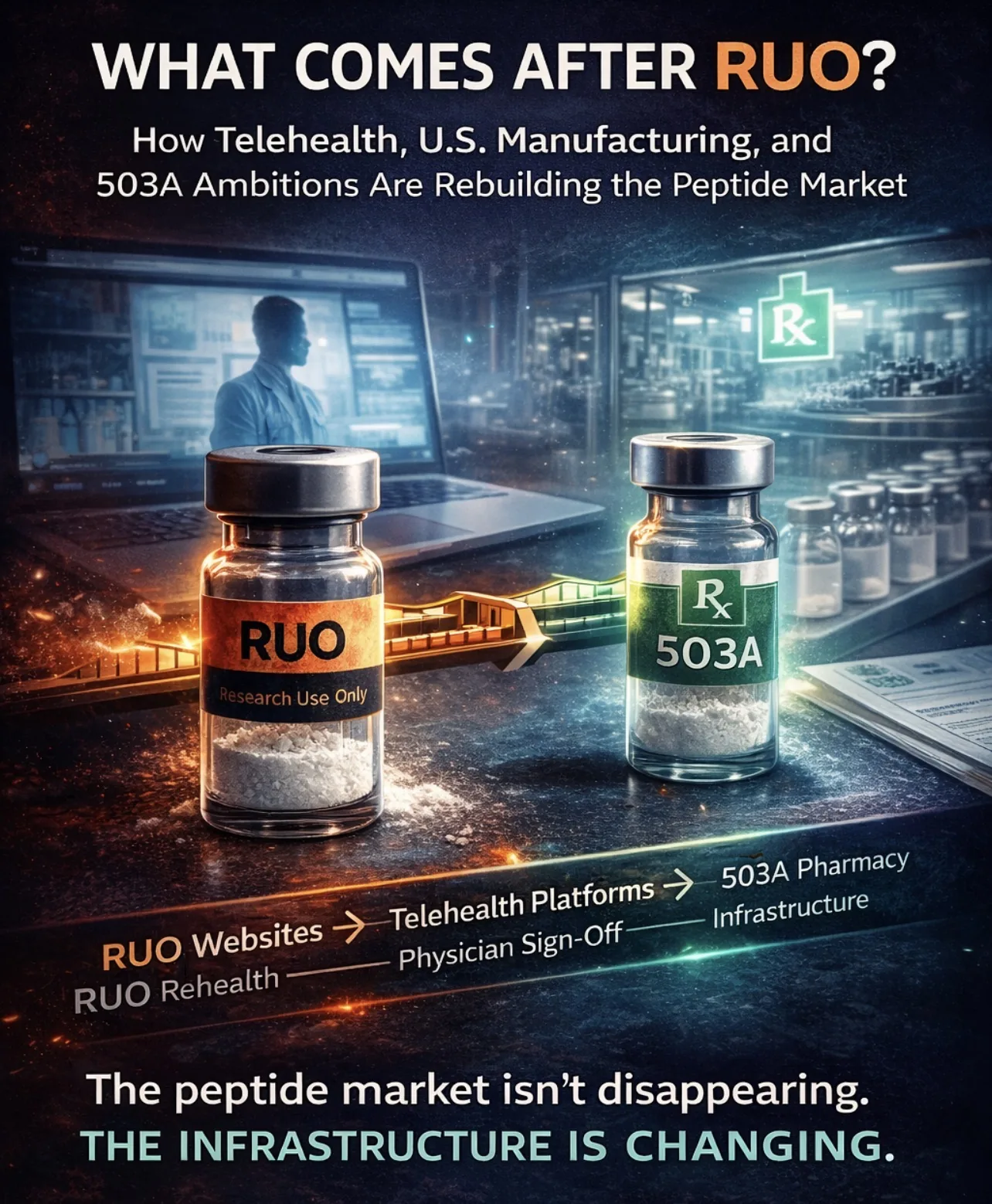
Put differently, the market is not simply moving from:
RUO website → legitimate compounding pharmacy
In at least some cases, it may be moving more like this:
underground U.S. factory → telehealth partnership → future 503A licensing
That is not a clean regulatory transition.
It is an attempt to build a bridge from the grey market into a more defensible healthcare structure.
What Legitimate Sterile Compounding Actually Looks Like
At the same time, there is a real and important difference between licensed sterile compounding pharmacies and vendors importing finished peptide products directly from overseas manufacturers.
Sterile compounding pharmacies emphasise that their medications are prepared under controlled pharmaceutical conditions. The sterile compounding process can involve:
depyrogenation ovens to remove endotoxins from glassware
autoclave sterilisation
biological sterility indicators
endotoxin testing
potency verification
particulate inspection under specialised lighting
controlled clean room environments
These procedures operate under standards such as USP <797>, which governs sterile compounding practices in the United States.
Pharmacies point to these requirements as the key distinction between their operations and vendors importing finished peptide vials directly from overseas manufacturers.
However, those standards describe the fully compliant pharmacy model. They do not necessarily describe every telehealth linked peptide operation currently attempting to move toward that framework.
API vs Finished Product
A recurring argument from pharmacy linked operators is that API is one thing; finished sterile product is another.
Most peptide APIs are still manufactured overseas, primarily in China, with additional production in India. Very little peptide API manufacturing currently occurs in the United States.
Pharmacy operators therefore argue that the critical issue is not where the raw material originates, but whether the final injectable medication is prepared under controlled sterile conditions.
For that reason they emphasise:
their own Certificates of Analysis
third-party sterility and endotoxin testing
controlled manufacturing environments
validated packaging and cold chain shipping
This forms the pharmacy side of the legitimacy argument: imported raw material may still be acceptable, but finished injectable product should not simply arrive in a “technology company” box from an overseas supplier and be treated as equivalent to a properly compounded sterile medication.
The Cost of Legitimacy
Moving into pharmacy infrastructure is not cheap.
Operators describe:
lengthy inspection preparation
hundreds of pages of SOP documentation
multi state licensing complexity
consultant and regulatory advisory fees
accreditation costs
environmental monitoring and sterility controls
shipping and security compliance
This creates a real barrier to entry.
Unlike the RUO website model, the compounding telehealth pathway requires significant capital, documentation, and organisational infrastructure.
That is precisely why some existing underground players appear to be seeking telehealth partners and external funding to make the transition possible.
State Level Regulation Matters More Than Many Assume
Another misunderstanding in peptide discussions is the assumption that once an operation moves into 503A territory, regulation becomes primarily federal.
That is not entirely accurate.
503A pharmacies operate largely within a state driven regulatory framework, not a day to day FDA manufacturing framework.
More broadly, much of the regulatory activity affecting peptide prescribing appears to occur at the state level rather than the federal level.
In practice, many states provide certain exceptions to pharmacy centric rules when physicians treat their own patients in office. Activities that might otherwise require a pharmacy licence, such as reconstitution or limited forms of compounding, may fall within those physician office exceptions.
That is one reason some clinicians compare peptide prescribing to other forms of off label medical practice.
The real issue is not simply whether a doctor can justify using a peptide.
It is whether the physician practises in a state that takes a hands off approach to the physician patient relationship, or one in which licensing boards are more willing to intervene.
Why Florida Keeps Appearing
Florida appears repeatedly in discussions about the evolving peptide market.
The state has become a major hub for:
wellness clinics
telehealth businesses
peptide prescribing networks
clinic facing distribution systems
Several industry participants describe Florida not as a side market but as one of the central ecosystems in which this next phase of peptide distribution is being built.
This does not mean every operation in Florida is identical. But it does suggest that when people discuss the future of the peptide market, they are often referring to a Florida centred network of clinics, telehealth platforms, physician relationships, and pharmacy linked supply chains.
Why the Market Is Moving This Way
Taken together, the direction of travel becomes clearer.
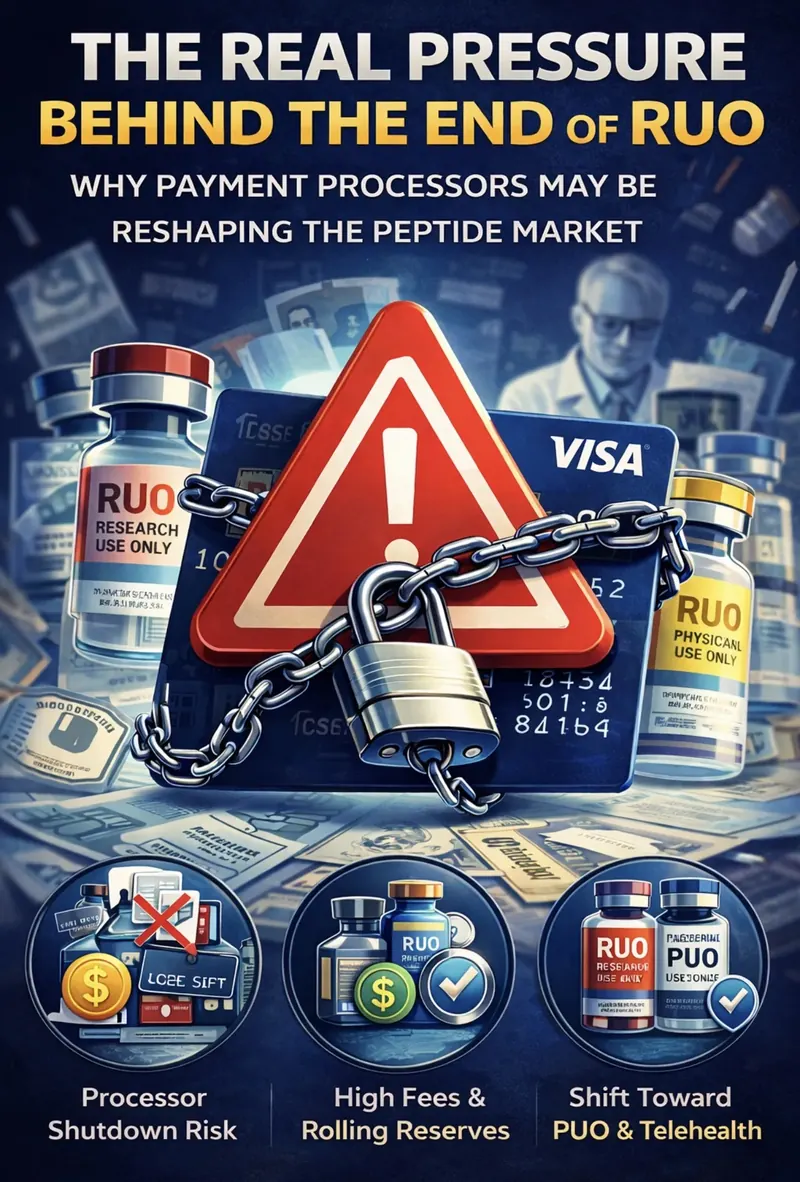
The traditional RUO model is under pressure from:
payment processors
platform scrutiny
regulatory optics
consumer trust concerns
clinic demand for more defensible supply chains
Telehealth and compounding offer something the RUO model never could:
a physician layer
a prescription workflow
compatibility with payment processing infrastructure
stronger institutional branding
a potential pathway toward pharmacy licensing
That does not mean the new system is fully resolved.
But it does make it commercially more survivable.
The Real Transition
The shift underway is not simply:
RUO → PUO
Nor is it simply:
grey market → legitimate pharmacy
Instead, the peptide market appears to be entering a hybrid phase in which:
some operations are licensed compounding pharmacies
some are telehealth platforms working with pharmacy infrastructure
some are clinic facing vendor systems wrapped in physician sign off
and some appear to be underground U.S. manufacturers attempting to acquire the telehealth layer now and the 503A wrapper later
That is the transition now underway.
The Real Question
Demand for peptides is not disappearing.
What is changing is the infrastructure through which that demand is served.
The question is no longer whether the peptide market survives.
It is this:
Which version of the market survives, and who manages to reposition themselves quickly enough to control it.
Comments