
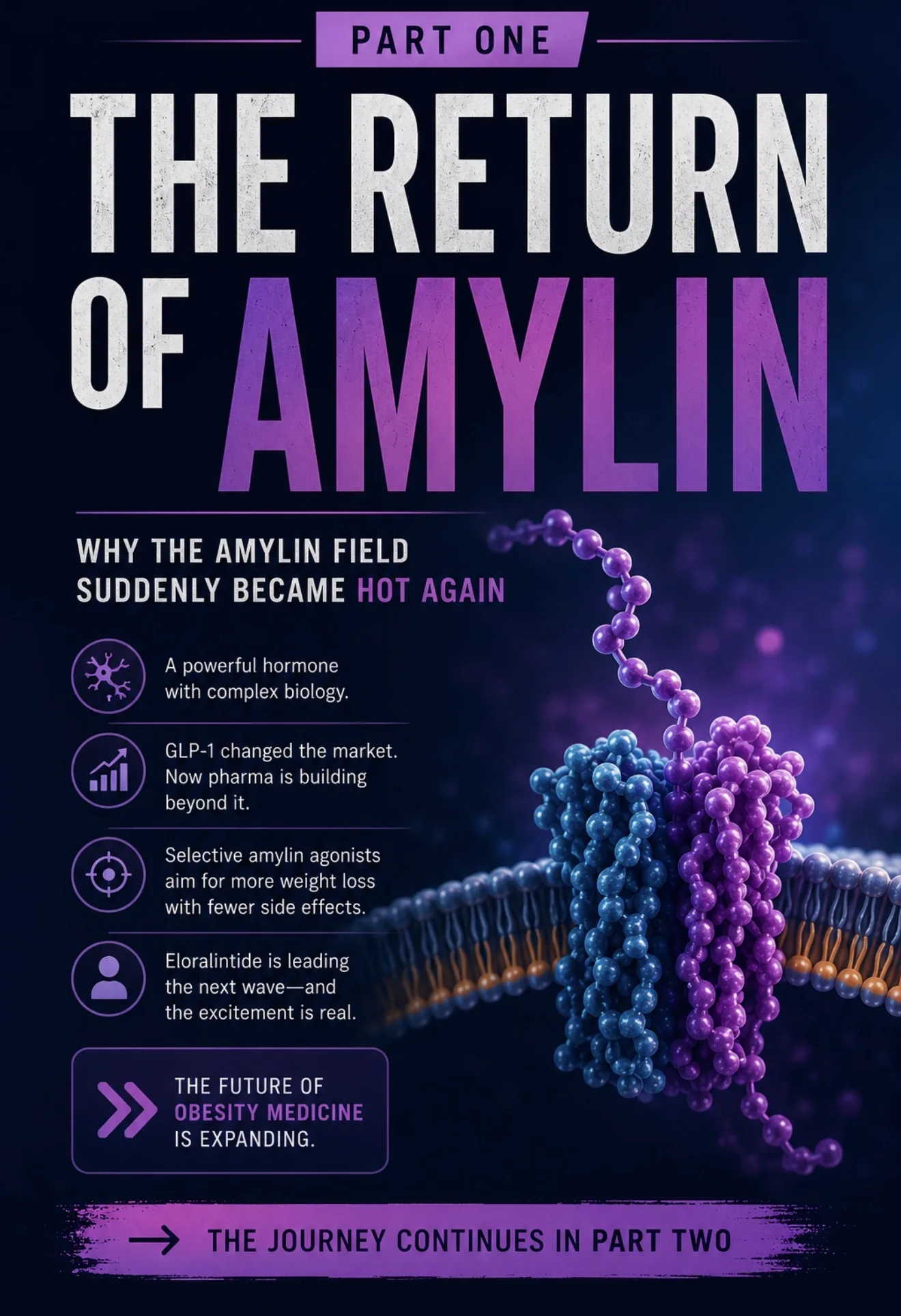
This article was initially just intended to be about Eli Lilly’s newest Amylin agonist, Eloralintide, but it ended up becoming far longer than I originally intended, because to understand why Eloralintide is tricky, we first need to understand why the entire amylin field suddenly became one of the hottest areas in obesity medicine.
So I’ve split this into two parts.
Part One focuses on the bigger picture, what amylin actually is, why pharma is suddenly racing beyond GLP-1s, why companies like Lilly and Novo Nordisk are investing so heavily in selective amylin agonists and why Eloralintide has generated so much excitement around efficacy and tolerability.
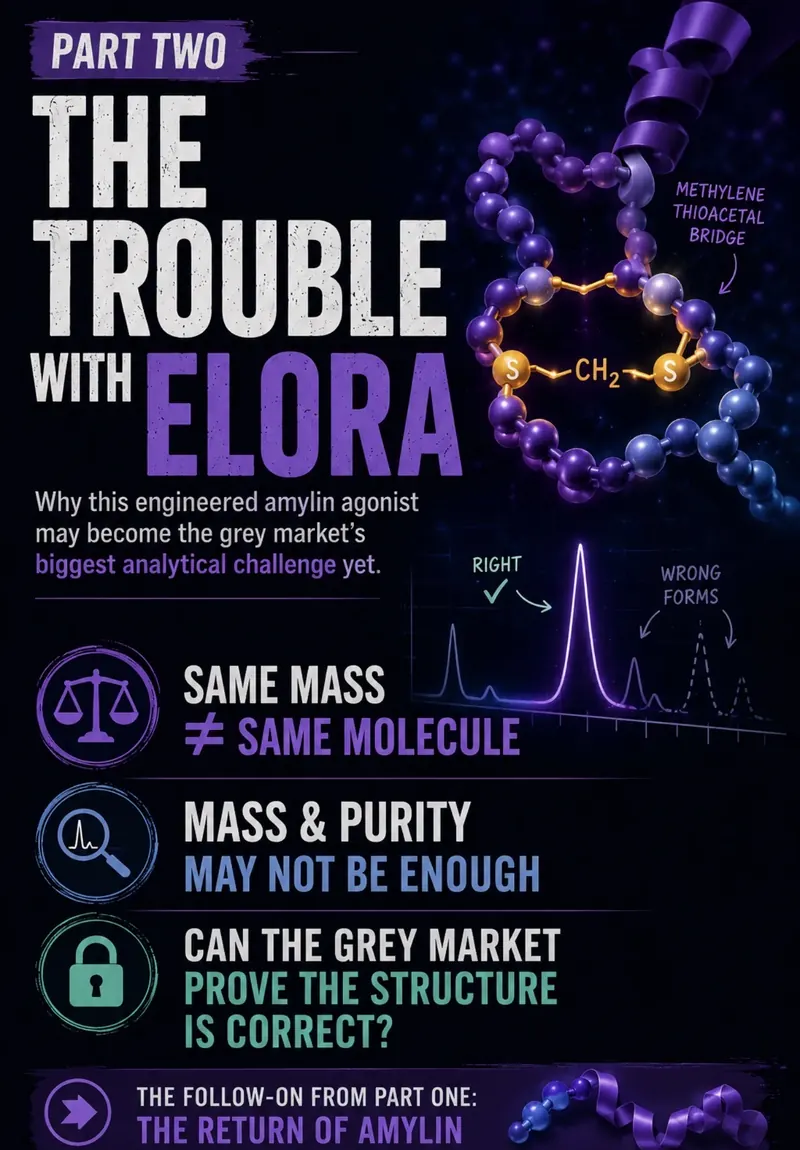
Part Two will move into the chemistry and grey-market side of the story covering why Eloralintide is structurally very different from simpler GLP-style peptides, why standard “mass & purity” testing may not be enough and why this molecule could become one of the biggest analytical challenges the peptide grey market has faced so far.
For years, GLP-1 dominated obesity drug development while amylin remained comparatively neglected. Part of the reason for this was because Amylin biology turned out to be far more complicated.
Unlike GLP-1, which mainly signals through a relatively straightforward receptor system, amylin receptor biology became notoriously difficult to untangle. Researchers spent years trying to determine which receptor subtypes mattered most and how the different RAMP combinations affected signalling. RAMPs, or receptor activity-modifying proteins, act like receptor partners. When they pair with the calcitonin receptor, they help create different amylin receptor subtypes such as AMY1, AMY2 and AMY3. Researchers were then left trying to untangle which pathways controlled satiety and which pathways contributed to nausea and other side effects.
That complexity slowed the entire field down. So while GLP-1 receptor agonists rapidly advanced into blockbuster therapies, amylin drugs progressed much more slowly. Pramlintide was approved back in 2005, but after that the field largely stalled for years. Now that obesity medicine has become one of the most commercially valuable areas in pharmaceuticals, amylin has suddenly returned to the spotlight and the field is becoming crowded quickly.
Novo Nordisk is advancing oral amycretin approaches, while Lilly has rapidly advanced Eloralintide into Phase 3 trials (Enlighten-1 and Enlighten-2). Multiple companies are now racing toward multi-pathway obesity therapies involving combinations of GLP-1, GIP, glucagon and amylin signalling. So the logic is obvious, GLP-1 changed the market, but now companies are searching for the next layer beyond GLP-1, and amylin may be one of the most important pieces of that puzzle.
Why Native Amylin Could Never Simply Be Used As A Drug
One of the biggest pharmaceutical problems with amylin is that the natural hormone is extremely unstable. Native amylin has a strong tendency to aggregate, oligomerise, form insoluble fibrils and create amyloid-like structures, which is partly why the hormone itself was historically difficult to study.
In practical terms, natural amylin is not especially “druggable” and if concentrations increase too much, the molecule tends to clump together and become unstable. That’s forced companies to engineer around the problem. Lilly’s Eloralintide appears heavily modified specifically to solve these issues.
The molecule includes amino-acid substitutions to reduce aggregation, structural engineering around the ring system, fatty-acid conjugation for reversible albumin binding, and other modifications designed to extend plasma half-life and improve stability. That engineering is what allowed Lilly to push the molecule toward once-weekly subcutaneous dosing instead of the frequent injections associated with older amylin therapies.
According to publicly discussed Phase 1 data, Eloralintide also demonstrated significantly greater potency than native amylin while producing strong dose-dependent weight loss with no obvious plateau at early timepoints. That’s why enthusiasm around the molecule accelerated so quickly. But the same engineering that makes Eloralintide more druggable, may also make it far harder to manufacture and verify correctly in the grey market.
Why Eloralintide Is Getting So Much Attention
For years, GLP-1 drugs have dominated the obesity conversation. Semaglutide, tirzepatide and the newer multi-agonists transformed weight-loss medicine by producing levels of efficacy previously thought impossible outside bariatric surgery. But despite the hype, these drugs still come with major limitations, nausea and vomiting, food aversion, fatigue, gastrointestinal intolerance, discontinuation rates and plateau effects. And that’s where Lilly believes Eloralintide may fit in.
Eloralintide isn’t just another GLP-1 analogue, it’s an engineered selective amylin receptor agonist. Amylin itself is a naturally occurring 37-amino-acid peptide hormone secreted alongside insulin from pancreatic beta cells following food intake. It plays a role in satiety signalling, gastric emptying, glucagon regulation, food intake and reward behaviour. Earlier amylin analogues like Pramlintide demonstrated efficacy, but their short duration required multiple daily injections and formulation at acidic pH due to stability problems. Even newer amylin approaches such as Cagrilintide still appear associated with significant gastrointestinal side effects, particularly when combined with GLP-1 therapies.
Lilly’s approach with Eloralintide appears fundamentally different. Rather than simply making another amylin analogue, Lilly engineered the molecule specifically around receptor selectivity and chemical stability. The company replaced native amylin’s traditional disulfide bridge with a more chemically stable methylene thioacetal bridge -S-CH_2-S-. The diagram below shows the structure of Eloralintide. Within the red circle is the methylene thioacetal bridge (-S-CH₂-S-), that replaces native amylin’s standard disulfide bridge (-S-S-)

This modification was designed to reduce some of the instability and chemical liabilities associated with standard disulfide-containing amylins, including bond reduction, disulfide exchange reactions and aggregation-related behaviour. At the same time, Eloralintide was engineered to selectively favour AMY1 receptor signalling while reducing unwanted activity at calcitonin-related pathways believed to contribute to nausea and other GI side effects.
In simple terms, Lilly appears to be attempting to separate appetite suppression
from the “feeling sick” component often associated with non-selective amylin agonism
And the early trial data is why people are paying attention. At 48 weeks, Eloralintide produced weight-loss results approaching 20% in some treatment arms, placing it into serious competition territory with existing GLP-1 therapies. More importantly, much of the discussion surrounding the molecule now centres on tolerability. The hope is not simply “more weight loss”, but it’s comparable efficacy with fewer side effects. If Lilly really has engineered a more selective, more tolerable amylin agonist, Eloralintide could represent one of the first major challengers to the current GLP-1 dominance narrative.
Why The Market Is Watching Eloralintide
Eloralintide isn’t only attracting attention for its standalone weight-loss data, but also for its bigger commercial interest of what it could become next. Lilly is already exploring it as a possible add-on for people using weekly incretin drugs who’ve reached a plateau. In other words, this isn’t just being watched as another obesity drug, it’s being watched as a potential “stall-breaker,” something that could be layered on top of GLP-1, GIP or future multi-agonist therapies.
The future may not be about one molecule replacing another. It may be about stacking complementary pathways, GLP-1 for appetite and glucose control, GIP and glucagon activity for metabolic effects, and amylin signalling for satiety, gastric emptying and food-intake regulation.
That’s why Eloralintide has generated so much interest. It sits outside the GLP-1 family, but may work alongside it. So if Lilly can combine strong weight loss with better tolerability, it becomes more than just another peptide. It becomes a potential platform drug.
But that also raises the stakes for the grey market. The more valuable and commercially exciting Eloralintide becomes, the faster grey-market suppliers will race to produce it. And the faster that race moves, the more important proper structural verification becomes. Because Eloralintide isn’t just another peptide with a new name attached. Its structure is more demanding, its receptor activity depends on precise engineering, and the usual grey-market comfort blanket of “mass and purity” may not be enough.
In Part Two, I’ll look at the chemistry problem, why Eloralintide may be harder to synthesise, harder to verify, and why “close enough” could mean something very different when the molecule’s shape is the whole point.


Comments