
This article is the follow-on from Part One, The Return of Amylin, linked below;
Part One looked at why amylin has suddenly become one of the hottest areas in obesity medicine. This part moves into the grey-market problem, why Eloralintide is structurally different, why standard testing may not be enough, and why “close enough” chemistry may not mean biologically equivalent.
Why Eloralintide Is Structurally Different From Simpler GLP-1 Peptides
Eloralintide is very different from the peptides most people in the grey market are used to. The common GLP-1-style peptides, semaglutide, tirzepatide, retatrutide and many related analogues, are largely linear peptide chains. They may contain substitutions, fatty-acid side chains, or other modifications designed to extend half-life, but their overall structure is still comparatively straightforward. In simple terms, they are mostly, amino acid chain + selected modifications + fatty acid tail
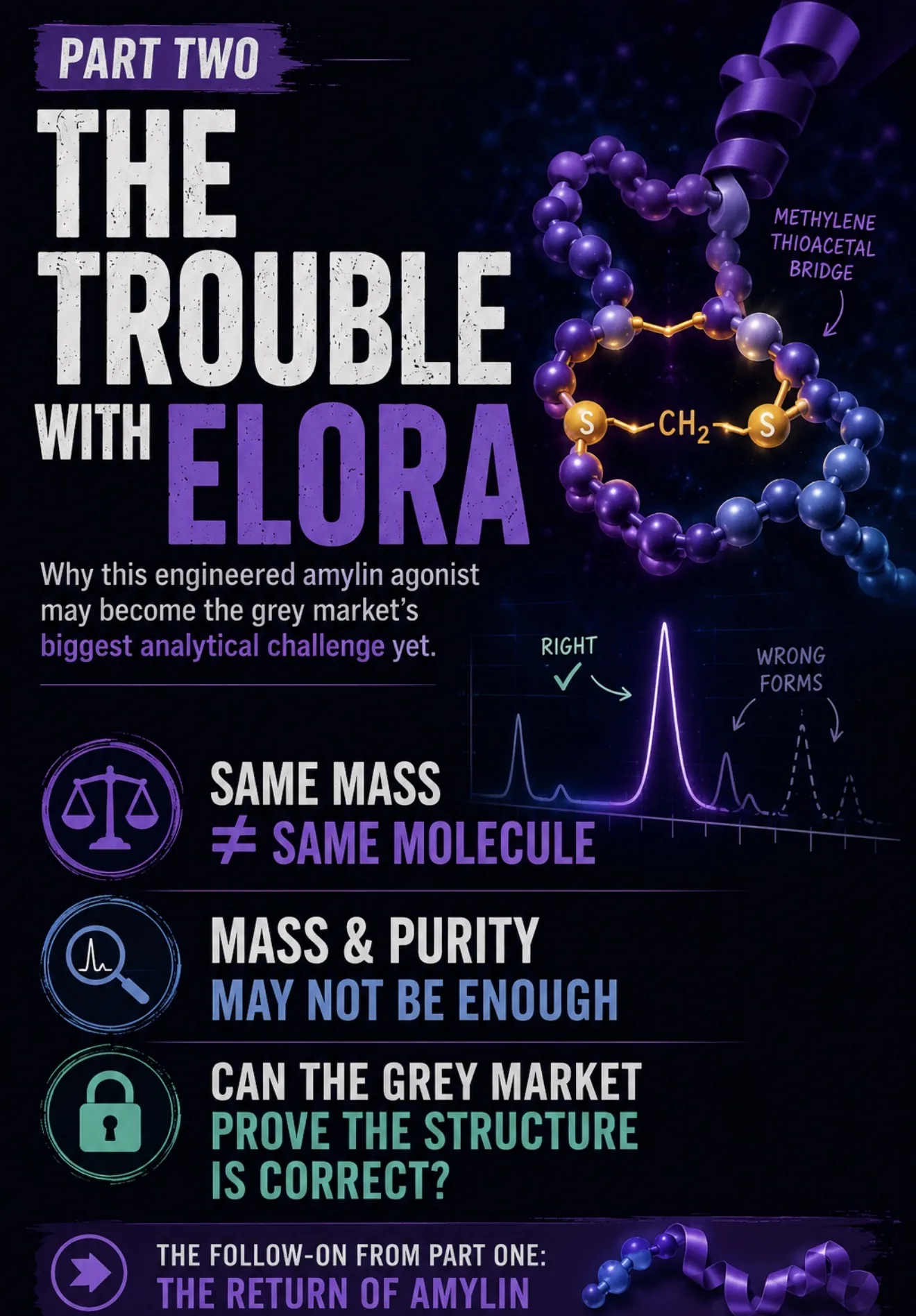
But Eloralintide is different. It’s still a 37-amino-acid peptide, but it belongs to the amylin family, not the GLP-1 family and it’s biological behaviour depends much more heavily on a specific ring structure near the N-terminus. Native amylin contains a disulfide bridge between two cysteines. Eloralintide replaces that natural disulfide bridge with a more stable methylene thioacetal bridge -S-CH_2-S- shown in the red circle in the diagram below;

That bridge locks part of the molecule into a cyclic shape. This isn’t just decorative chemistry. The ring helps force the peptide into the correct three-dimensional shape needed to fit the amylin receptor, like a key fitting into a lock. It affects the molecule’s three-dimensional shape, how it binds to the amylin receptor, its receptor selectivity, stability and likely its tolerability profile. That’s the crucial difference.
With many GLP-style peptides, verifying the amino acid sequence and molecular mass gives a reasonable level of confidence that you’re looking at the intended molecule. But with Eloralintide, the question is more complicated. You’re not just asking “Is the chain present?”, you’re also asking, “Is the chain present, modified correctly, bridged correctly, folded correctly, and free from structurally similar wrong-ring contaminants?” That’s a much higher bar. A peptide can have the right ingredients on paper but still not be structurally equivalent. Same amino acids doesn’t always mean same molecule and the same mass doesn’t always mean same biology.
That’s why Eloralintide isn’t simply “another peptide arriving on the grey market.” It’s a more structurally demanding molecule entering a testing ecosystem mostly built around simpler, more linear GLP-style drugs.
Why Lilly Thinks Eloralintide May Cause Fewer GI Side Effects
The idea behind Eloralintide isn’t to simply “activate amylin harder.” It’s to “activate the right amylin pathways while avoiding the pathways more associated with nausea and GI intolerance.” That’s why the term selective amylin agonist matters. Amylin signalling is more complicated than GLP-1 because the receptors are mixtures of the calcitonin receptor, or CTR and the receptor activity-modifying proteins, or RAMPs. These combinations create different amylin receptor subtypes, AMY1, AMY2 and AMY3. Cagrilintide and older amylin agonists hit these receptors more broadly and also interact significantly with calcitonin-related signalling.
Lilly appears to believe some of the unpleasant side effects, particularly nausea, visceral malaise, food aversion, GI discomfort and the general “feeling sick” effect, are driven more heavily by non-selective activation involving calcitonin receptor pathways rather than pure satiety signalling itself. Eli Lilly specifically focused on strong AMY1 activity and reduced CTR-related signalling. They believe AMY1 signalling gives more of the appetite-suppression and body-weight effects, while calcitonin receptor-related activity contributes more to nausea, emesis and aversive effects. Their theory is essentially this,
You want the satiety signalling without triggering the “poison response” circuitry as strongly.
Neurologically, much of this appears tied to the area postrema and nucleus tractus solitarius in the hindbrain. These regions are heavily involved in nausea, vomiting, conditioned taste aversion, visceral discomfort and appetite signalling. The area postrema is especially important because it’s one of the few brain regions that can directly monitor circulating hormones, metabolic signals and toxin-related signals in the bloodstream. It plays a major role in nausea, vomiting and aversive “feel sick” responses. Excessive activation of this circuitry is thought to contribute to the nausea and food aversion associated with some obesity drugs and it’s likely that they produce weight loss partly because they make eating less rewarding or more aversive. Lilly’s apparent goal with Eloralintide is to separate satiety from aversion.
That’s why people are excited about the possibility of less nausea, less food disgust, less GI shutdown and less fatigue while still maintaining strong appetite suppression. Whether that fully translates clinically long-term is still unknown. Early data is promising, but pharmaceutical companies always present mechanistic theories in their best possible light. Real-world populations are messier than receptor diagrams.
Why Testing Grey-Market Eloralintide Will Be Tricky
This is where Eloralintide becomes very different from the usual grey-market peptide. With many simpler GLP-style molecules, standard mass and purity testing can give a reasonable level of confidence that the correct peptide chain is present, but Eloralintide needs a much higher bar. The issue isn’t simply whether the correct amino acid sequence exists, it’s whether the molecule has been synthesized in the correct three-dimensional structure, especially around the methylene thioacetal ring:
-S-CH_2-S-
A product could potentially pass standard mass and purity testing while still failing to prove that the ring structure is correctly formed or that structurally similar wrong-ring species are absent. If those wrong forms exist, the consequences are uncertain. They may bind weakly, interact differently with receptors, contribute to side effects, or simply behave nothing like Lilly’s clinical material.
That’s why Eloralintide can’t be treated as just another “mass and purity” peptide. The key question is no longer simply: “Can a lab detect a peptide with the right mass?” It becomes “Can the lab prove the correct linker is present, the ring is intact, the topology is correct, and the proportion of properly cyclized versus incorrectly cyclized material is known?”
Why “Mass and Purity” May Not Be Enough
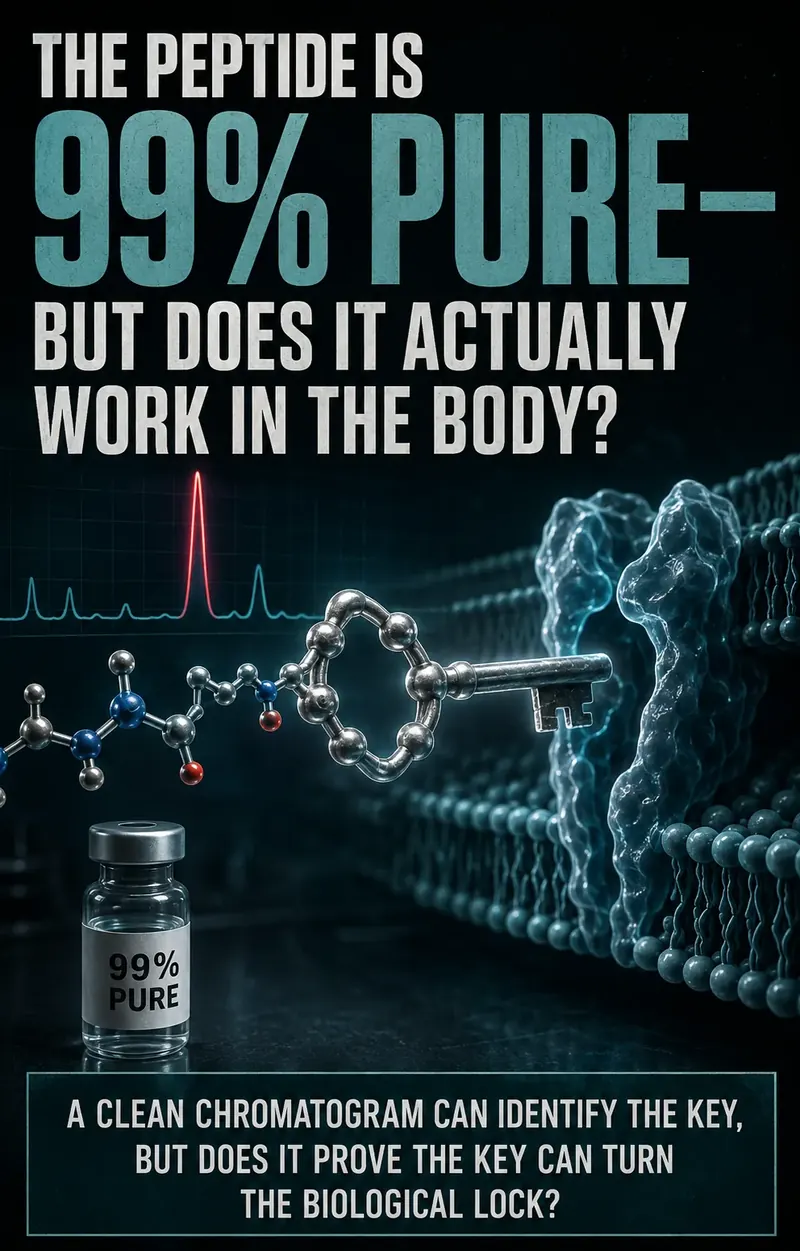
Standard peptide testing usually means checking molecular weight and chromatographic purity, then assuming the product is probably correct if both look clean. With Eloralintide, that assumption becomes much less reliable.
The methylene-bridged thioacetal linkage must form in the correct position and orientation. If it’s missing, partially formed, incorrectly connected or improperly cyclized, the peptide may not adopt the same three-dimensional structure. Some obvious failures may create detectable mass shifts. But the more difficult problem is structural variation and wrong topology. Potentially incorrect forms could include, wrong-ring topologies, stereoisomers, incorrectly cyclized species, uncyclized or partially cyclized material, closely related hydrophobic variants or co-eluting impurities hidden beneath the main HPLC peak.
In practice, that means an impurity may effectively hide underneath the dominant signal while the chromatogram still appears clean.
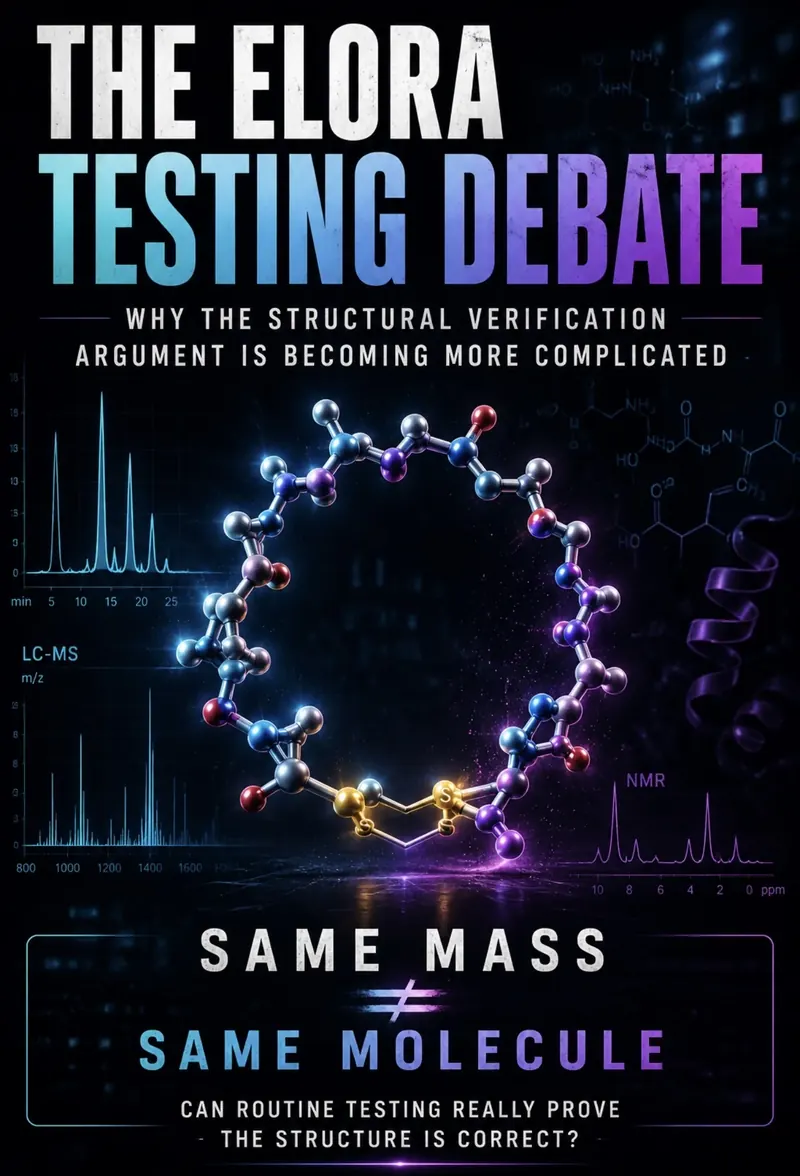
Some of these forms may retain extremely similar molecular weights or elute so closely chromatographically that routine HPLC-UV purity testing could still appear deceptively convincing. As a result, LC-MS may confirm the expected mass while still failing to fully prove the correct structure.
This is why the Eloralintide discussion quickly moved beyond routine “M&P” testing and toward pharmaceutical-style structural characterization, using MS/MS fragmentation mapping, impurity profiling, theoretical fragmentation modelling and potentially 2D NMR, to verify whether the molecule is actually assembled correctly.
UZORAK’s Opinion on Testing Eloralintide
One of the more interesting responses during the Eloralintide discussions came from Alex UZORAK regarding whether the molecule can realistically be verified analytically. His answer was essentially, Yes, but not with simplistic “mass & purity” testing alone. UZORAK agreed that a correct molecular mass by itself doesn’t prove the structure is correct. He outlined a much more advanced workflow for structural verification involving:
accurate mass measurement
MS/MS fragmentation analysis
theoretical fragmentation modelling
matching experimental fragmentation patterns to the expected structure
searching chromatograms for alternate forms
structurally characterizing those alternate forms
That’s a far higher analytical standard than the routine “M&P” reports commonly seen in grey-market peptide communities.
The Hardest Part May Be Quantifying the Wrong Forms
One of the most difficult problems may not be detecting incorrect forms, but quantifying them properly. The real risk may not be a completely failed synthesis, but a mixed bulk product containing a mixture of correctly cyclized material, partially cyclized material, incorrectly linked ring structures and uncyclized contaminants, all together. That creates a serious analytical challenge because some structurally incorrect forms may retain very similar molecular weights, elute extremely close to the main peak and potentially evade standard UV purity workflows entirely.
2D NMR was put forward as one of the few techniques capable of helping distinguish properly formed versus improperly formed ring structures, but NMR is expensive, difficult to interpret, slower than routine peptide workflows and likely impractical for standard grey-market batch testing.
Quantifying how much of the peptide has the properly formed ring versus incorrectly formed contaminants may be the hardest part of the testing and that may ultimately become the central analytical challenge surrounding grey-market Eloralintide, not merely detecting the peptide in the vial, but proving how much of it is structurally the correct molecule.
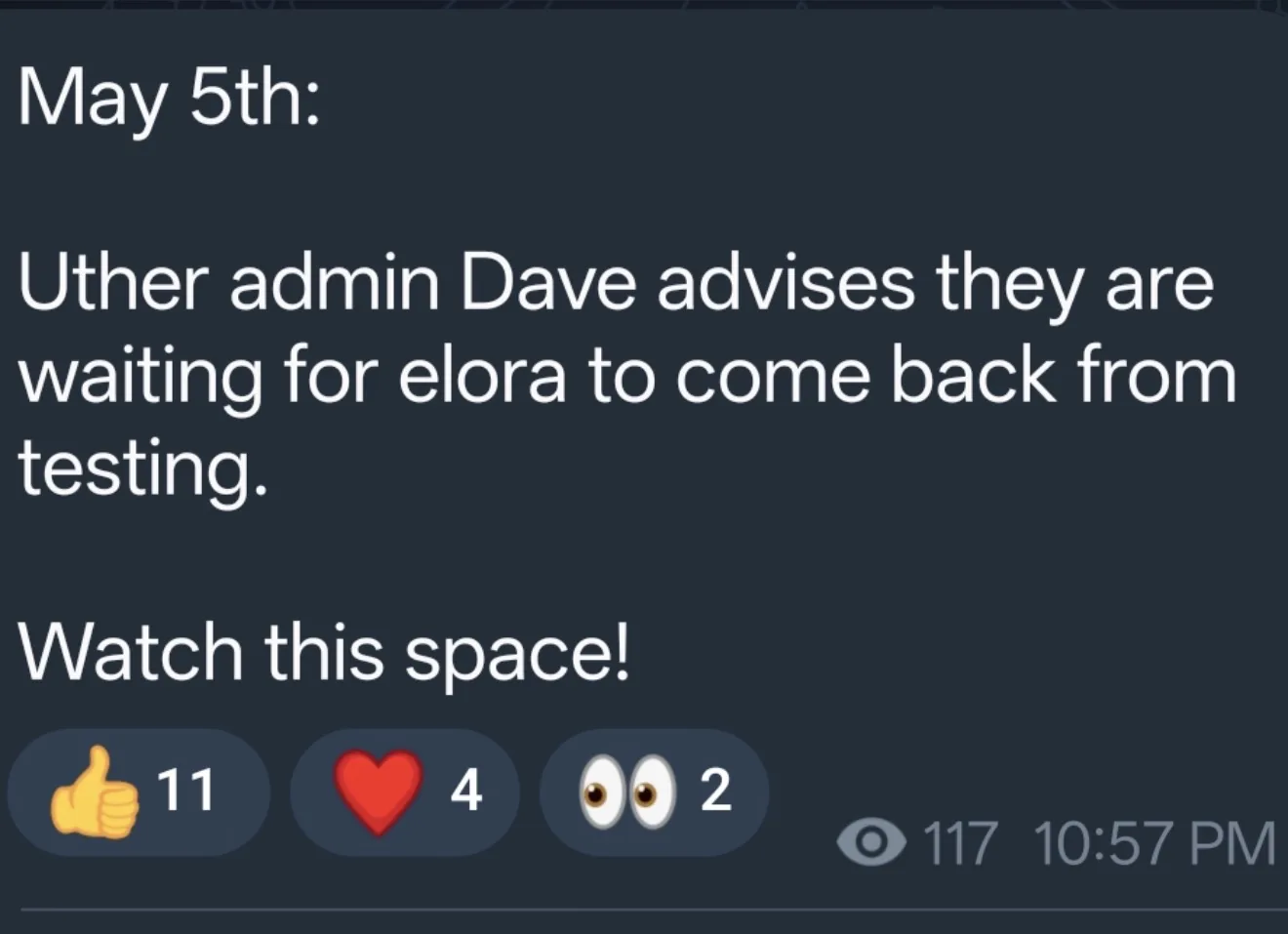
Currently the only vendor selling Elora is Uther at $350 for 10mg, and he’s sent it off to Janoshik for testing but we’ve heard nothing since. Aaron Biochemapi can offer it for $480 per kit. Also the increased cost of testing it must also be factored in.
Comments