
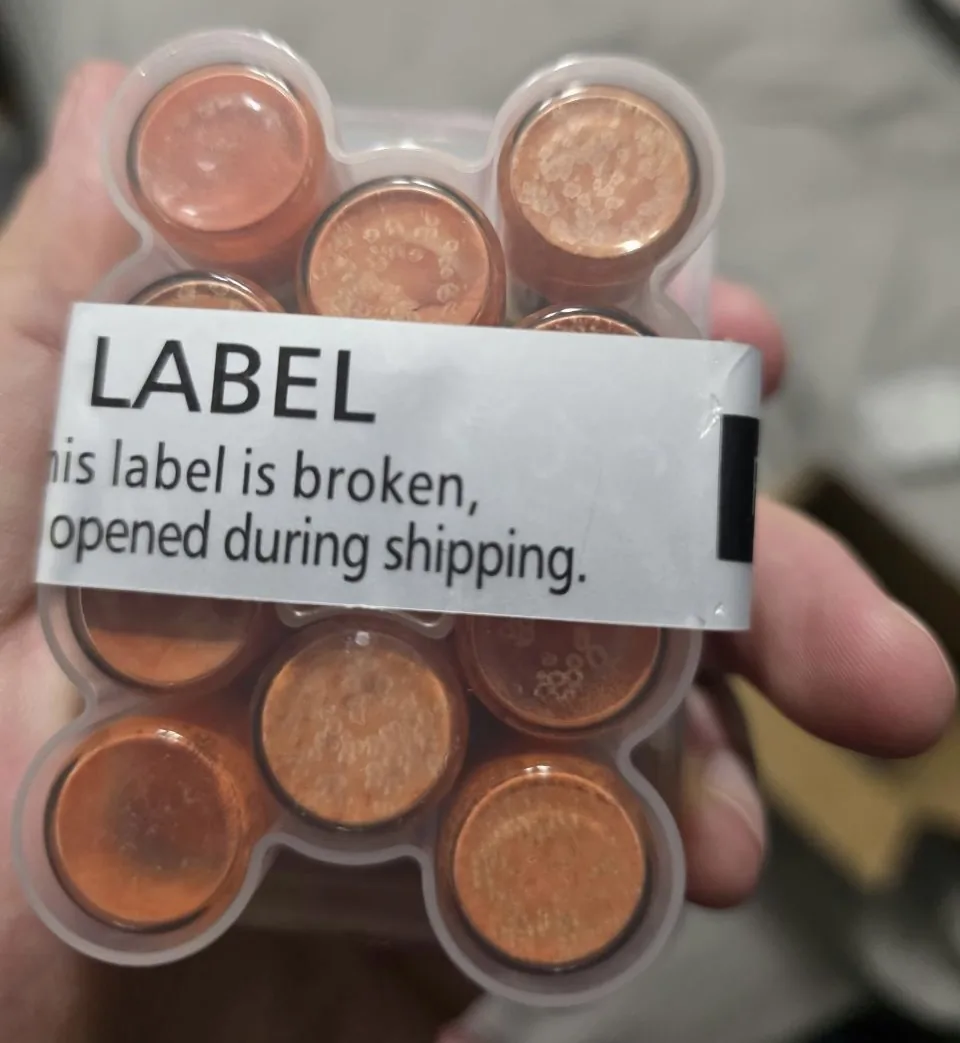
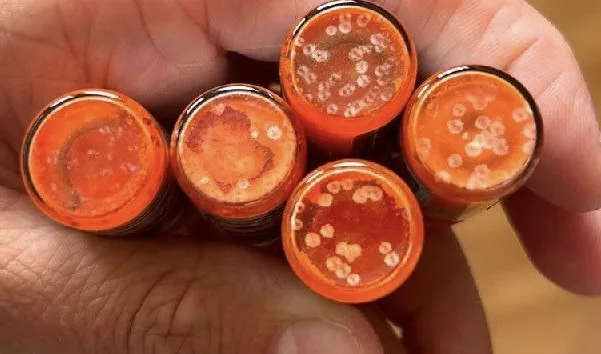
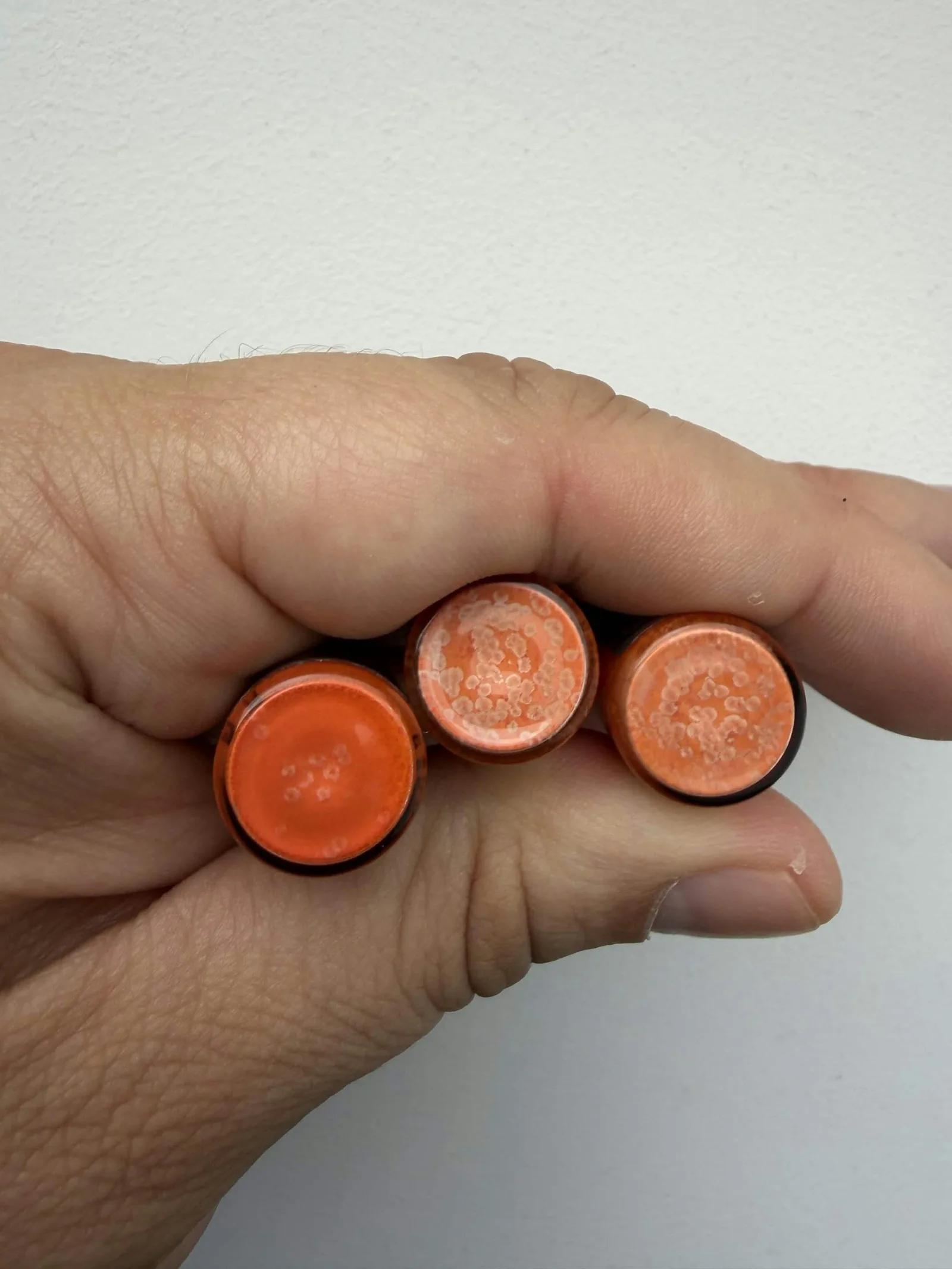
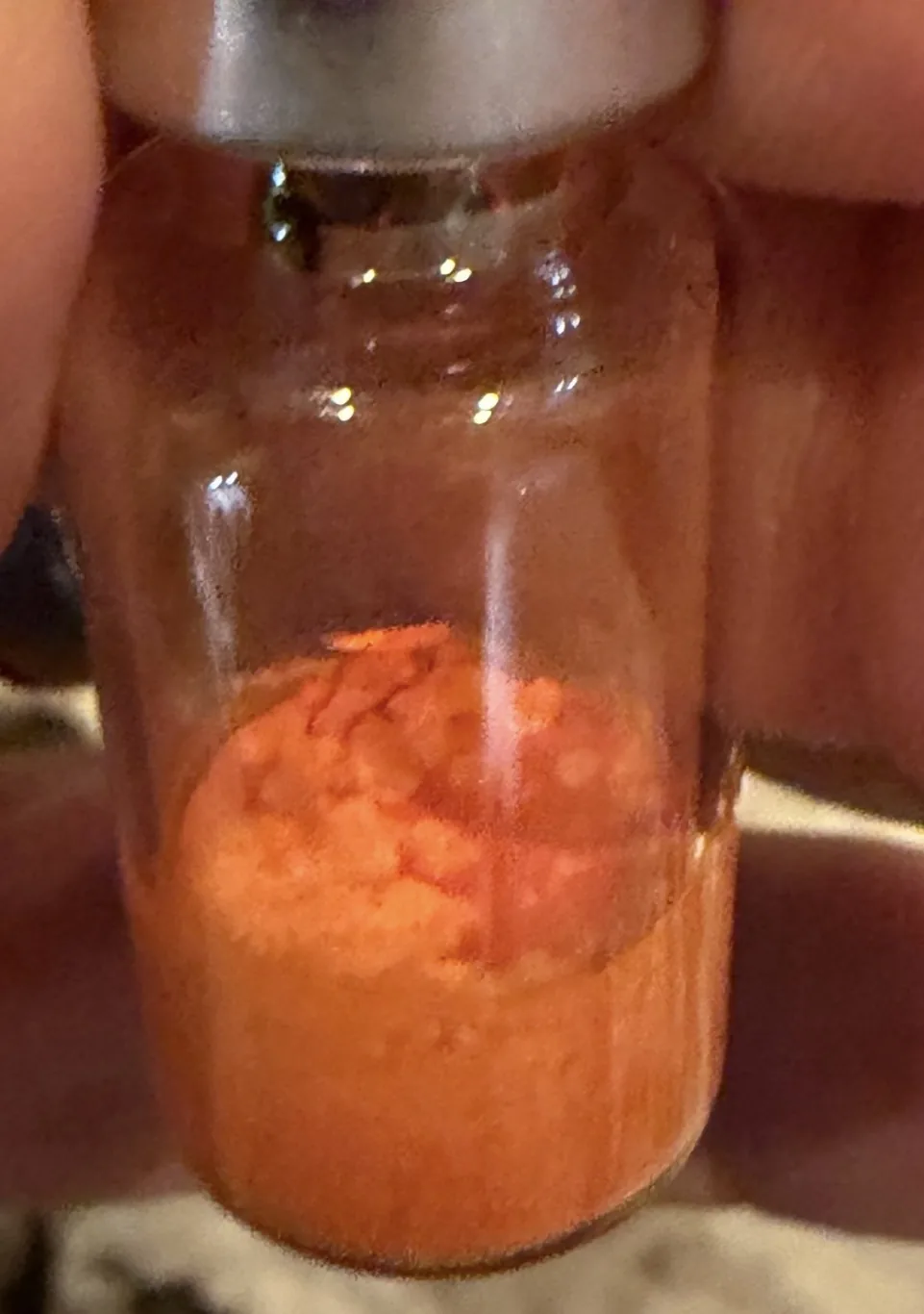
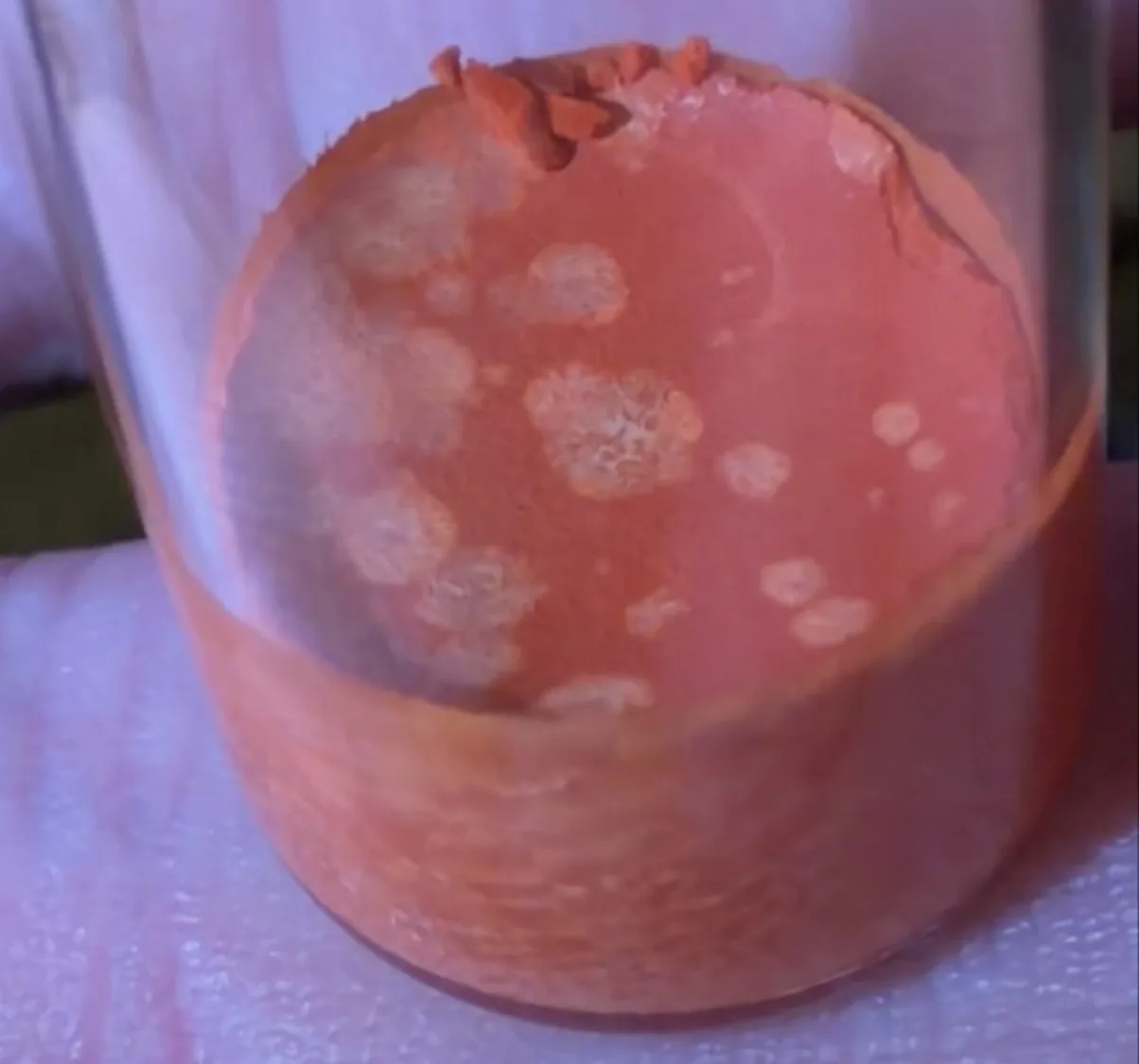
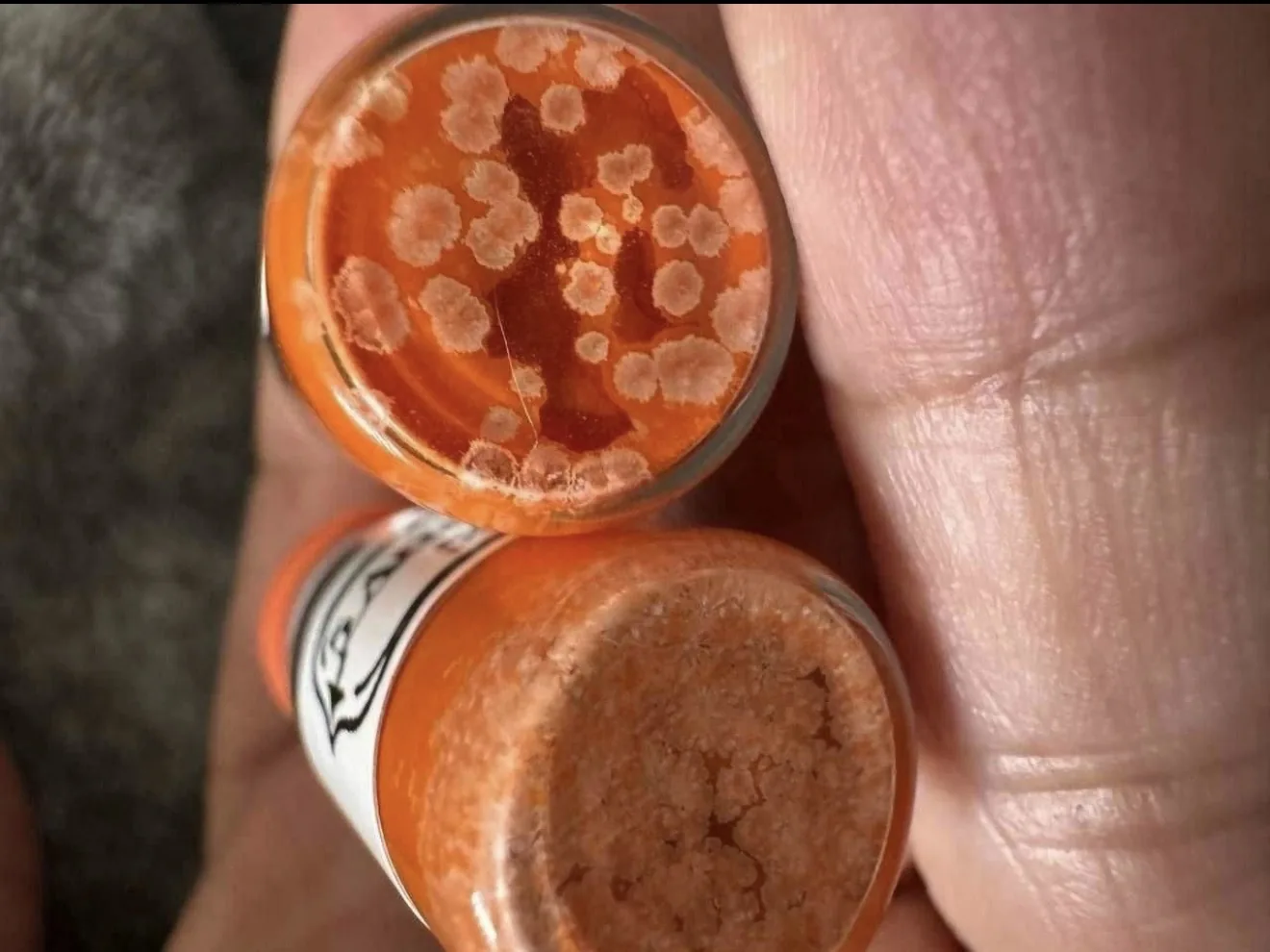
Those pale white circles turning up across orange/red 5-Amino-1MQ cakes aren’t a new problem, and they’re not confined to one supplier. Examples can be traced back to at least December 2025, when 5-Amino from QYC was photographed with the same dense, flower-like rings across the cake and another orange vial with pale circular markings appeared in January 2026.
By July, several more examples were being circulated. Multiple Uther 5-Amino vials showed pale circular spots, other photographs showed the more dramatic flower-like pattern, and by late August another set showed extensive spotting across ten vials. So whatever is causing this, it appears to be a recurring 5-Amino cake abnormality seen over many months and across more than one supplier.
Uther’s explanation: bubbles
One of the clearest examples appeared on 19 July 2026. Several orange/red 5-Amino-1MQ vials had small pale circular marks across the bottoms. The customer asked whether they were good to go, and while another member thought the appearance looked like growth and questioned whether heat might have damaged the product, Uther’s response was;
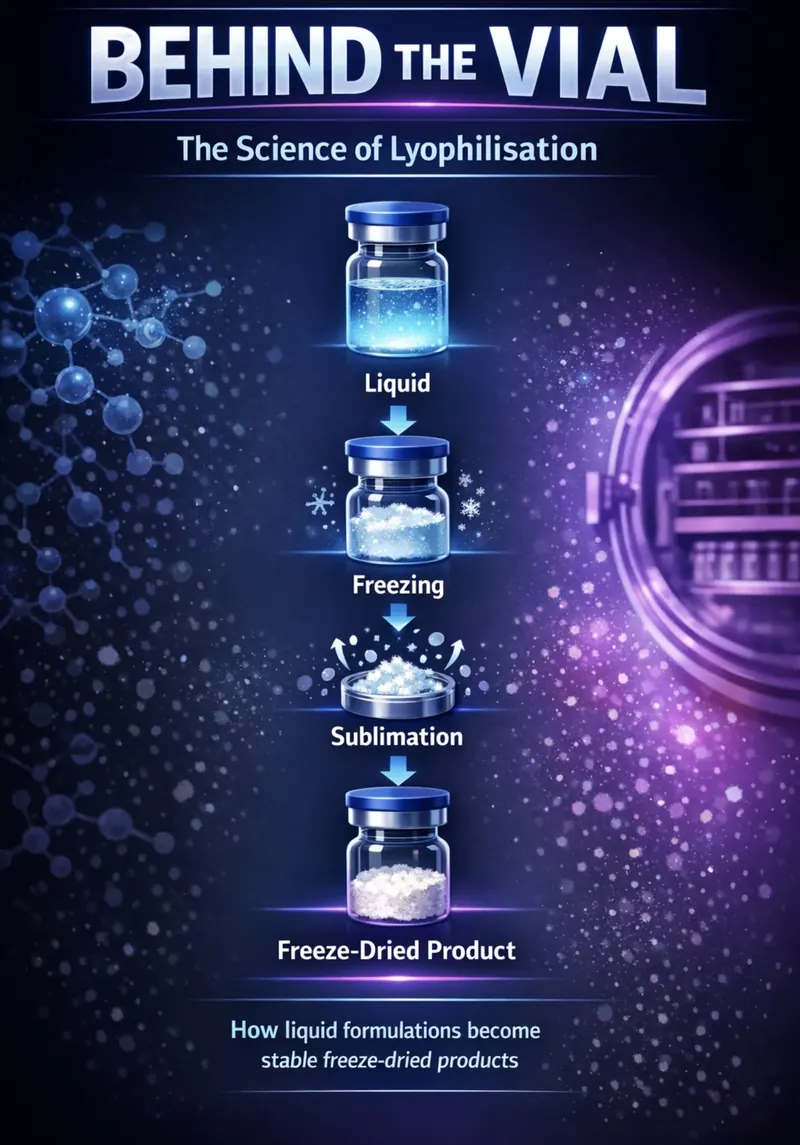
“This is normal. When the liquid is converted into powder, it doesn’t dry up completely before the vacuuming starts. The powder will bubble up, just like boiling water. Then you’ll get these bubbles left over”
That’s Uther’s explanation. And there is a technical phenomenon that looks a lot like what he was describing.
Puffing
In pharmaceutical freeze-drying literature, puffing describes a cake defect involving bubbles or remnants of bubbles at the dried surface. Freeze-drying involves removing water under very low pressure. Under the wrong conditions, gas expansion, local collapse or melting and pressure changes can produce bubbling or even boiling-like behaviour. Once the material finishes drying, those structures can remain behind in the cake. Experimental work has separately demonstrated bubbling and blow-up during vacuum-related stages of freeze-drying, with formulation and degassing affecting whether it occurs. That makes the basic mechanism behind Uther’s explanation technically plausible.
It also fits the appearance reasonably well: circular marks, craters, irregular cavities and, in more extreme examples, material that looks puffed or foamed rather than forming a neat solid cake. But there’s an important limitation. Nobody has demonstrated that these particular white rings are puffing.
Crystallisation has also been suggested
When another particularly dramatic 5-Amino sample was shown to Dustin at Vanguard Laboratory, his response was:
“i would guess crystallization?”
Guess being the important word. No analysis was performed on that sample.
Other explanations have included crystallisation of salts or excipients, uneven distribution of product and excipients, cryoconcentration and moisture-related changes. Cryoconcentration is particularly relevant to freeze-drying. As water freezes, dissolved substances can become concentrated into the remaining unfrozen regions rather than staying perfectly evenly distributed. Depending on the formulation and freezing conditions, that can leave different regions of a dried cake looking different. But again, nobody has taken one of these white rings and established what it actually contains. There has been no microscopy, spot-specific chemical analysis or residual-moisture measurement capable of distinguishing bubble remnants from crystalline material or unevenly distributed excipients.
One of the spotted Uther batches actually was tested
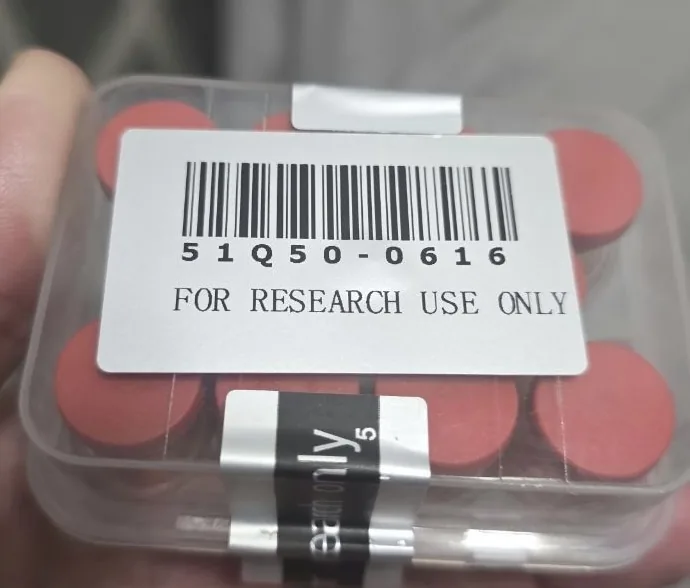
There’s an important piece of evidence that changes the picture somewhat. The 19 July spotted Uther kit can be tied to batch 51Q50-0616. The batch number is visible in another photograph from the same discussion. That batch had already been tested by Janoshik.
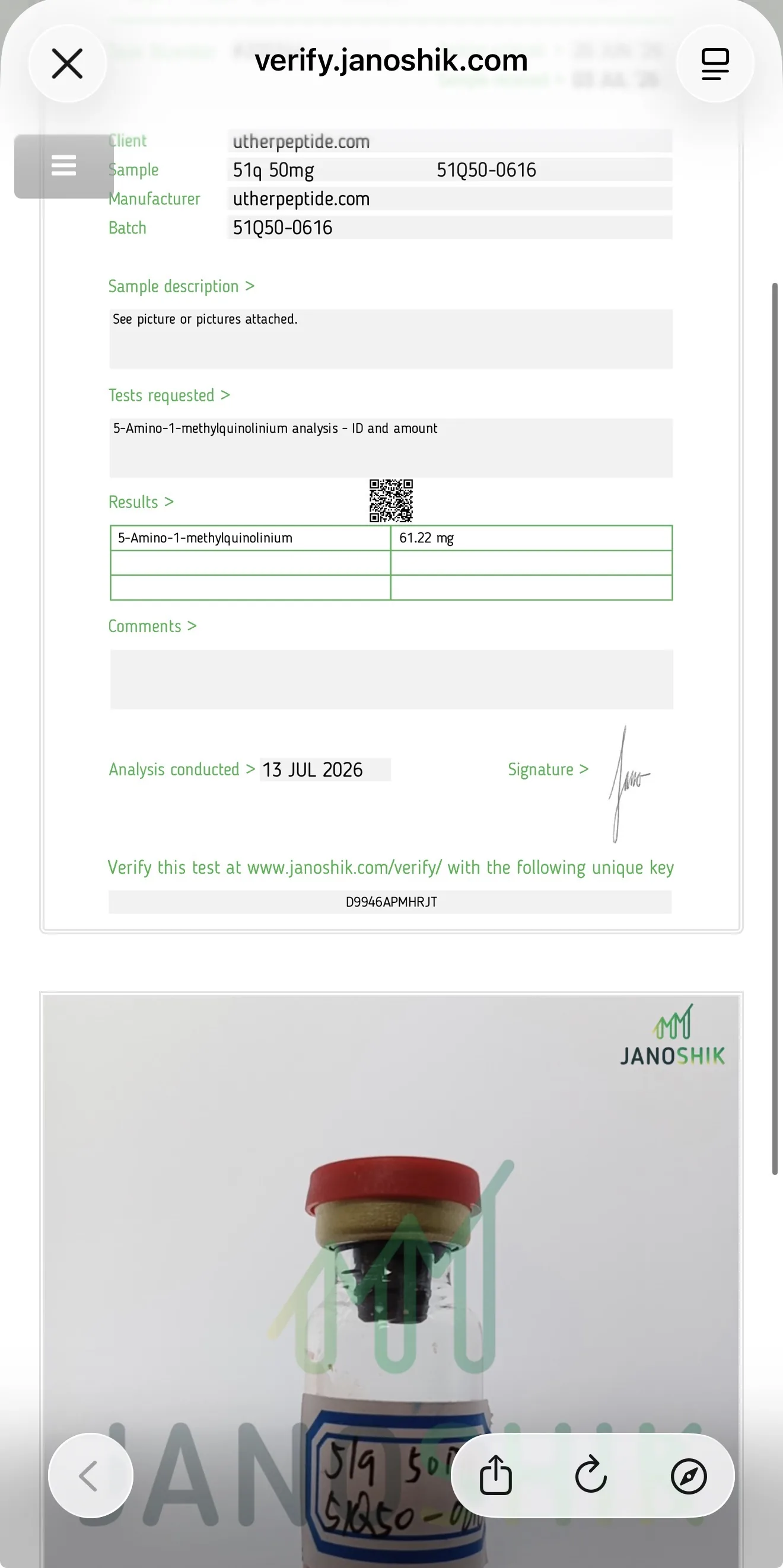
Janoshik #200344, analysed on 13 July 2026, measured 61.22 mg of 5-Amino-1MQ in a nominal 50 mg vial. So this wasn’t simply an unidentified orange powder with an odd appearance. At least one clearly spotted kit belonged to a batch for which the expected compound had been quantitatively measured.
What that test doesn’t establish is just as important.
There’s no evidence that the particular vial sent by Uther was one of the visibly spotted vials. The analysis didn’t examine the pale rings or establish whether they were bubbles, crystals or something else. And no sterility/microbial or endotoxin result has been linked to that 0616 spotted kit. The COA therefore answers only one question: Was there actually 5-Amino in the batch? Yes. It doesn’t answer: What are the white rings?
Are they safe to use?
Uther called the appearance “normal.” In a later discussion, when someone specifically asked whether 5-Amino with these white dots was still good, Dave answered “Yes” and pointed back to Uther’s explanation. Another person reported that their similarly affected Uther 5-Amino appeared fine after reconstitution. That tells us what people familiar with the product thought about the appearance. Nothing in the photographs establishes that the spots are mould. Mould, crystals and bubbles can’t be reliably distinguished from these pics alone.
So what is most likely causing it?
Bubbling/puffing during freeze-drying is currently the strongest explanation.
There’s now quite a bit pointing in that direction: The appearance repeatedly involves circular, bubble-like structures. Uther independently described bubbling under vacuum. Pharmaceutical literature recognises puffing and retained bubble structures as freeze-drying defects. Related experimental work shows that pressure changes can produce bubbling and blow-up during freeze-drying. And the same general problem has appeared in 5-Amino from different suppliers over a period of months.
But there is still a line we can’t cross. Nobody has analysed one of the pale rings and proved what it is so we don’t exactly know for sure. For now, the best description is simpler:
They most likely represent a freeze-drying defect involving bubbling or puffing, but exactly what produces the distinctive pale rings in 5-Amino remains unconfirmed.

Comments