
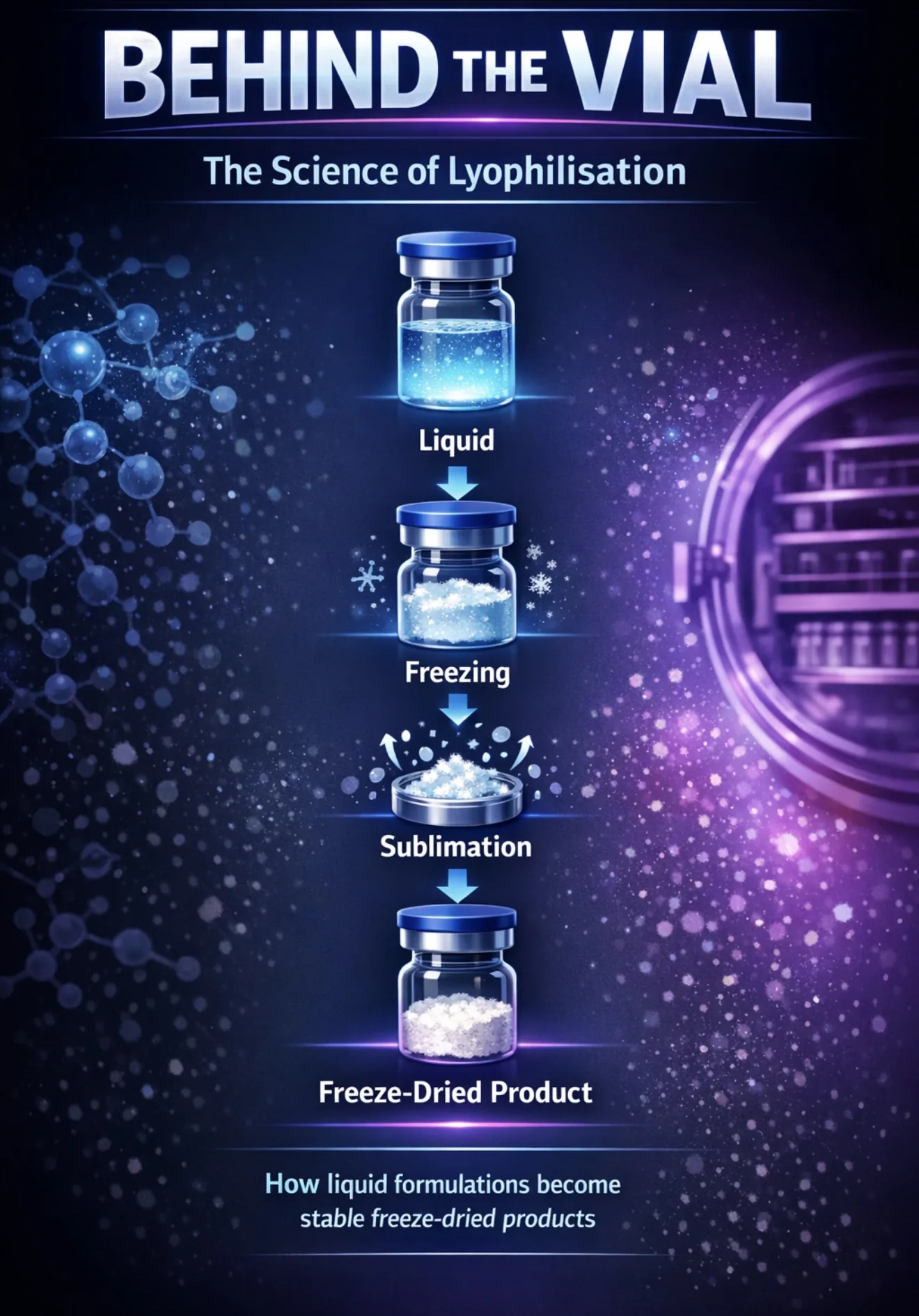
Behind the Vial
Most people only ever see the finished vial.
This “behind the vial” series looks at everything that happens before that point.
Using real factory footage, we break down each stage of peptide production; from cleaning and filling to freeze-drying and final sealing, and explain the science behind the process.
A huge thankyou to Aaron Biochemapi Peptides for providing me with the footage all taken from his factory
Freeze Drying 101: Why Lyophilisation Works (and What “Sublimation” Actually Means)
When you look at your vial and see a neat white “cake” at the bottom, you’re looking at the end result of freeze drying (also called lyophilisation).
A lot of people talk about lyophilised products, but few know the exact process that is involved and why it’s done so in this article I’ll try to explain exactly what freeze drying is and why it’s done.
History
Early freeze drying was used to preserve food by utilising cold and dry weather conditions often found at high altitudes
Ancient South American civilisations would preserve their potatoes high in the Andes
The Vikings would preserve cod fish in the cold dry arctic conditions
Presently, freeze drying is used extensively in the following industries:
• Pharmaceuticals
• Diagnostics
• Food
Freeze drying is the process of isolating a solid substance from solution by freezing the solution and subliming the ice away under vacuum
Many biologics, peptides and vaccines are unstable in liquid form. Freeze drying allows these compounds to be stored as a dry solid and then reconstituted with water before use.
The main principle involved in FD is SUBLIMATION which is the passage of water directly from solid state - ice - to vapour without passing through liquid
Freeze drying involves
1. Freezing the solution
2. Pulling a vacuum
3. Removing ice as vapour (instead of liquid water) by a process called sublimation
Sublimation is the passage of water directly from:
solid (ice) → vapour (gas)
without passing through the liquid phase.
This is important because melting the ice would collapse structure, cause pooling, and can destabilise sensitive compounds.
Freeze drying keeps the product in a stable solid form while water is removed
Why freeze dry at all?
Freeze drying is used because it can give:
Longer shelf life
More stability for sensitive materials
A uniform “cake” or powder
Faster reconstitution (because the dried structure stays porous)
Better batch to batch consistency (when properly controlled)
The three big stages of a freeze drying cycle
1)Freezing
2).Primary drying (sublimation)
3) Secondary drying (desorption
To better explain this process, I’ll use illustrations of a freeze dryer ( below)
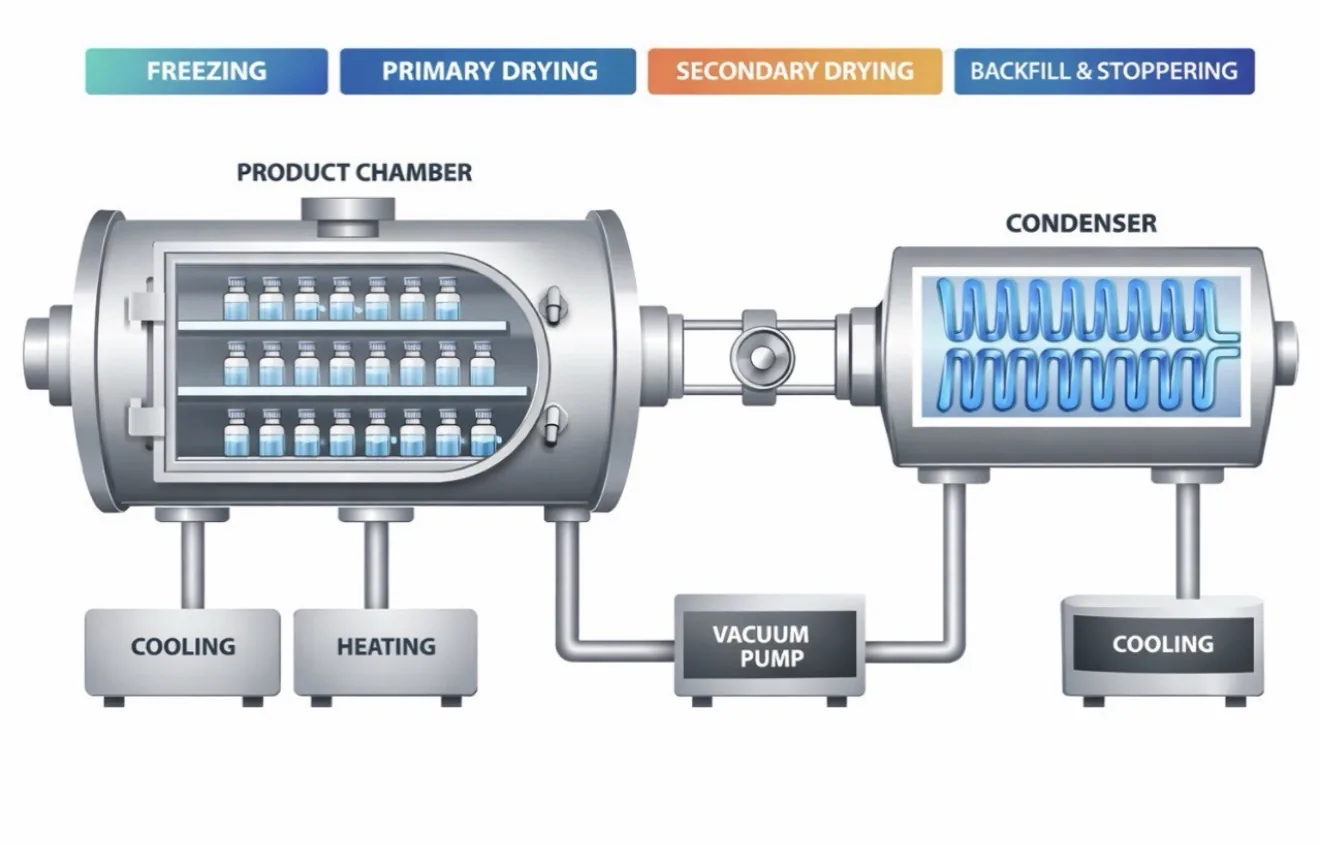
A freeze dryer consists of three main components
Product chamber
(where the vials sit on temperature controlled shelves)
Condenser
(a very cold surface that traps water vapour)
Vacuum and temperature control systems
Together these components allow the product to pass through four stages.
The exact temperatures, pressures and timing depend on the formulation, and a full cycle can take anywhere from several hours to several days
Stage 1: Freezing
The first step is freezing the solution inside the vial
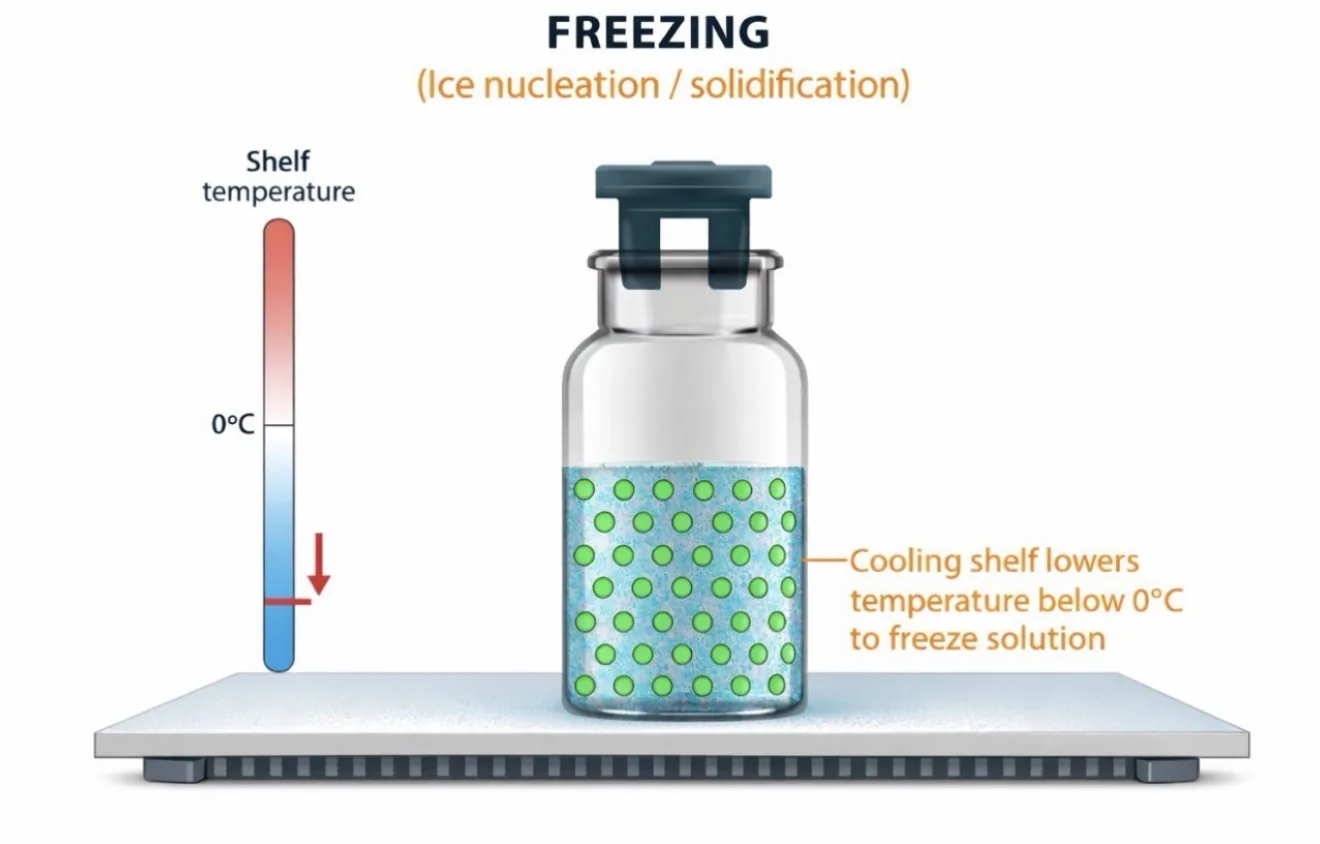
In lyophilisation lines the vials normally enter the freeze dryer with the rubber stoppers only partially inserted (loosely seated) This is to allow the water vapour to escape during sublimation
Inside the product chamber, the shelf temperature is lowered until the solvent freezes. In pharmaceutical formulations the solvent is usually water.
Because dissolved compounds lower the freezing point, the shelves are cooled even further until the entire solution is completely frozen.
While this is happening, the condenser is simultaneously cooled to an even lower temperature.
This prepares the system for the next stage.
Stage 2: Primary Drying (Sublimation)
Once the product is frozen, primary drying begins.
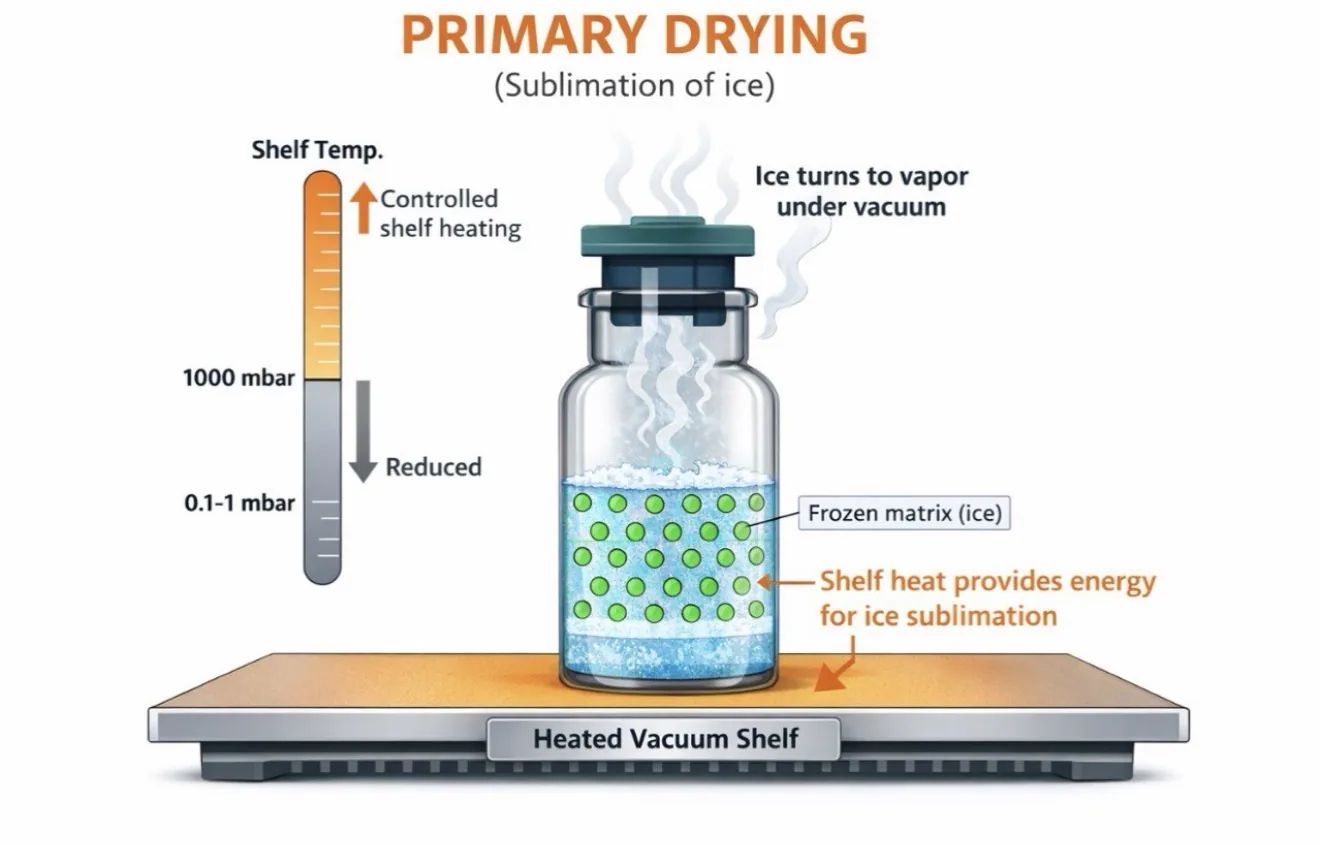
The isolation valve opens and a vacuum pump removes air from the chambers. When the pressure drops sufficiently, the shelf temperature is slowly increased.
At this point, instead of melting, the ice turns directly into water vapour
This is sublimation, solid to gas.
The water vapour leaves the frozen product and rises out of the vial, leaving behind a porous solid structure known as the dried product matrix
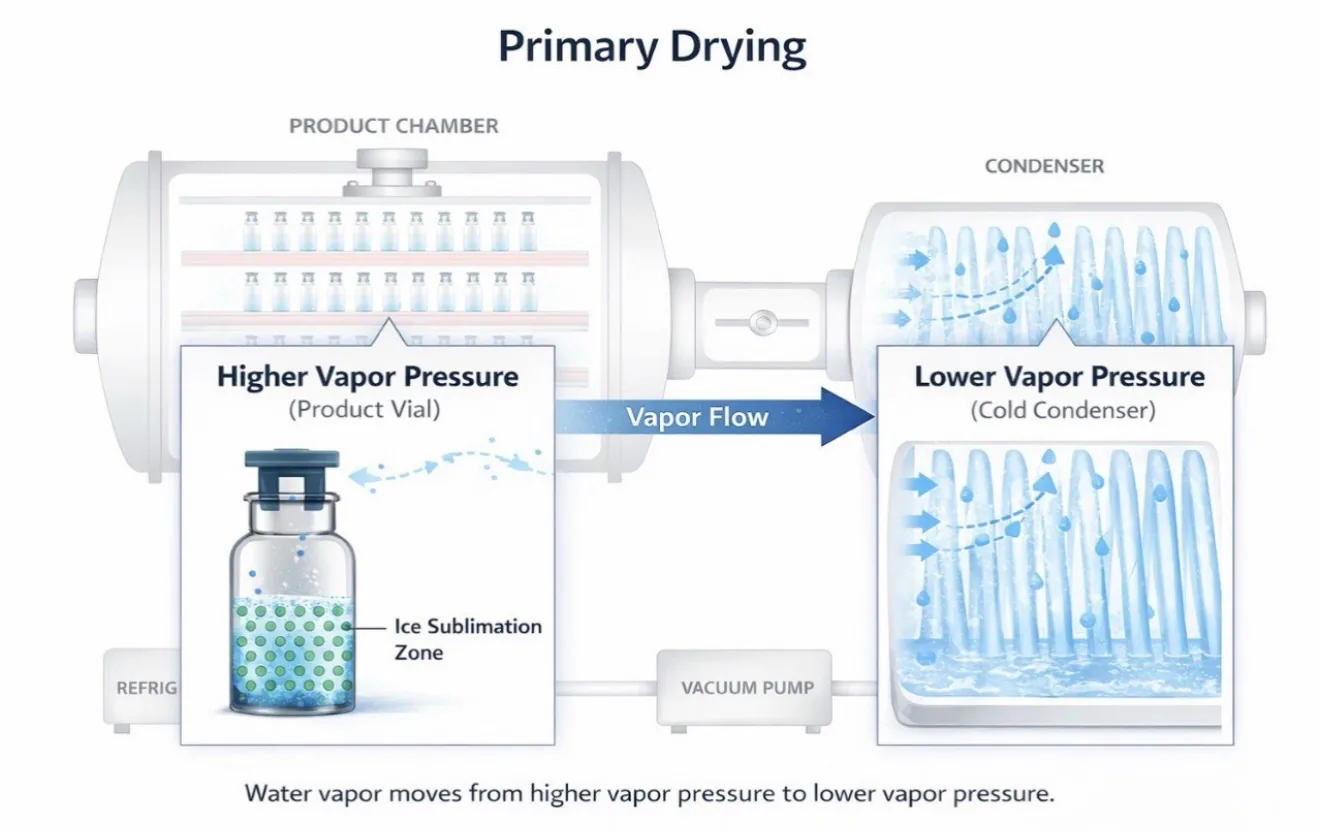
The vapour travels through the chamber and becomes trapped on the extremely cold condenser coils, where it refreezes.
Vapour naturally moves from areas of higher pressure (the vial where sublimation occurs) toward areas of lower pressure (the condenser).
By the end of primary drying, about 90% of the water has been removed.
Stage 3: Secondary Drying
Even though most water has been removed, the product is not completely dry.
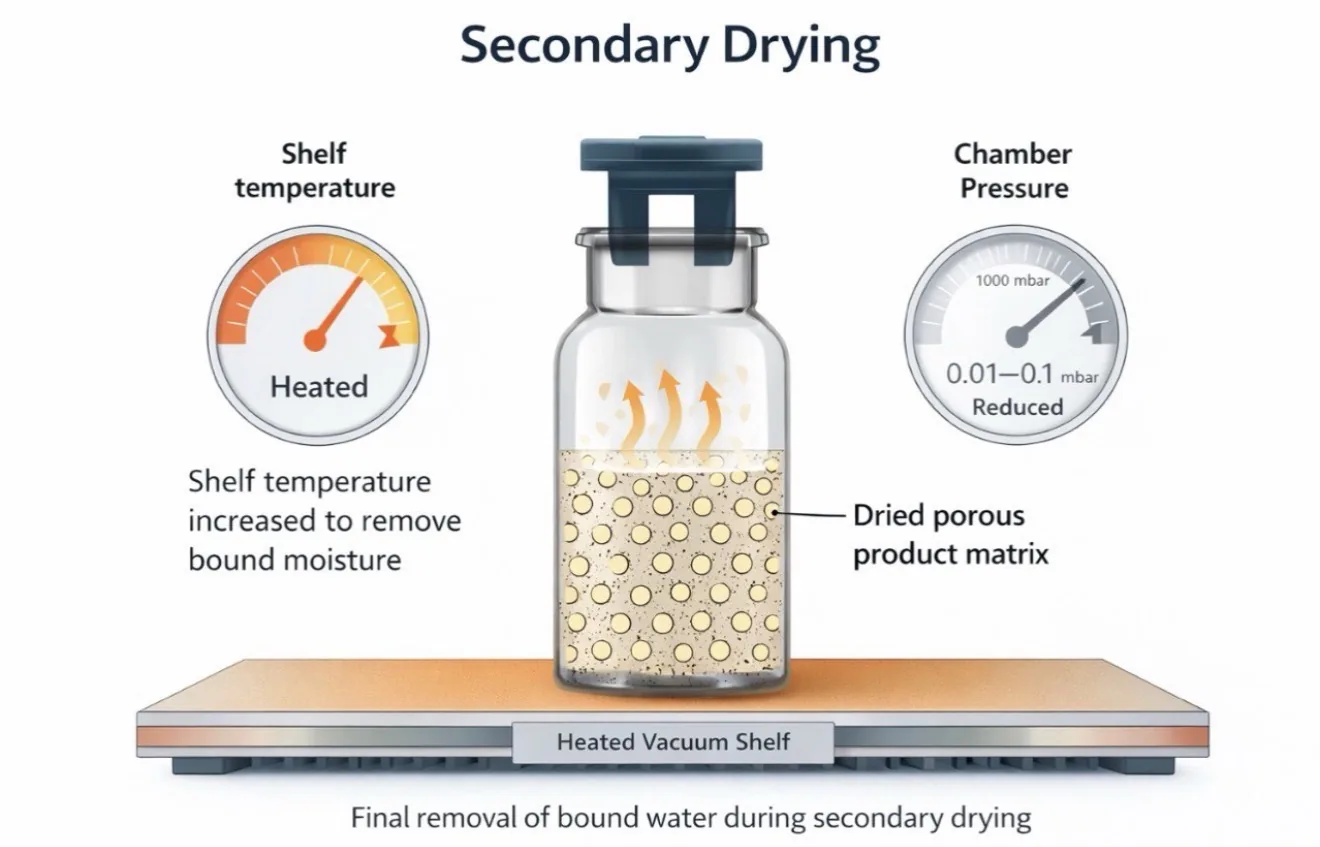
Some water remains bound to the molecular structure of the product.
Removing this bound moisture requires additional heat.
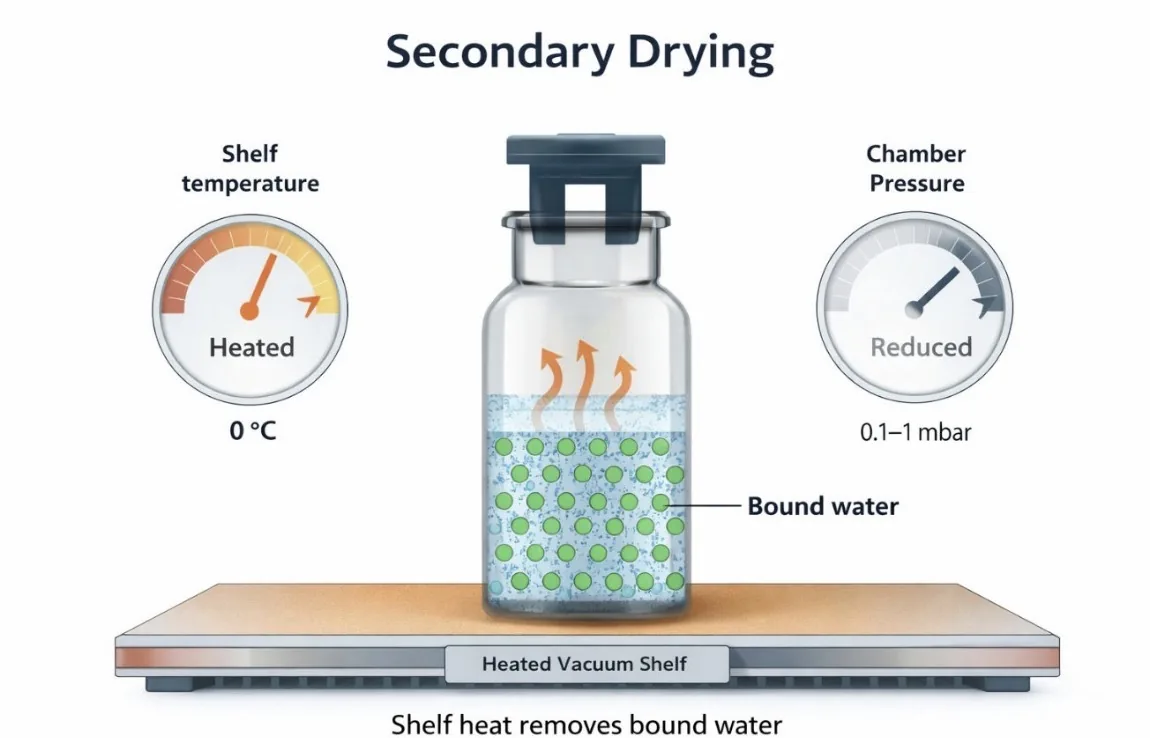
During secondary drying, the shelf temperature is slowly increased further while the vacuum is maintained.
This drives off the remaining bound water molecules, leaving behind a fully dried solid matrix.
Stage 4: Stoppering and Sealing
After drying is complete, nitrogen is introduced into both chambers to remove the vacuum and return it to normal pressure.
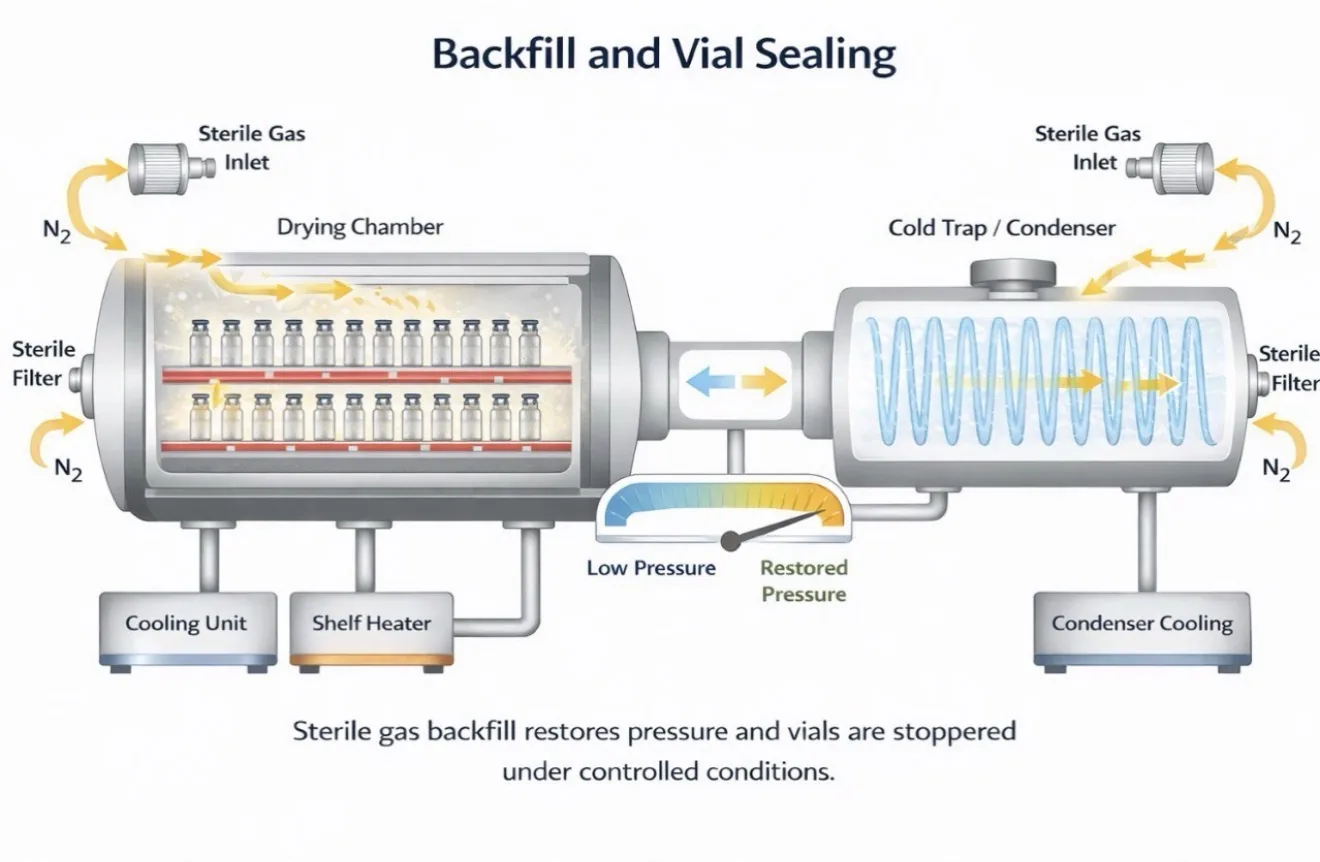
The shelves are then programmed to collapse downward, pushing the rubber stoppers fully into the vial openings.
This seals the vial under sterile conditions.
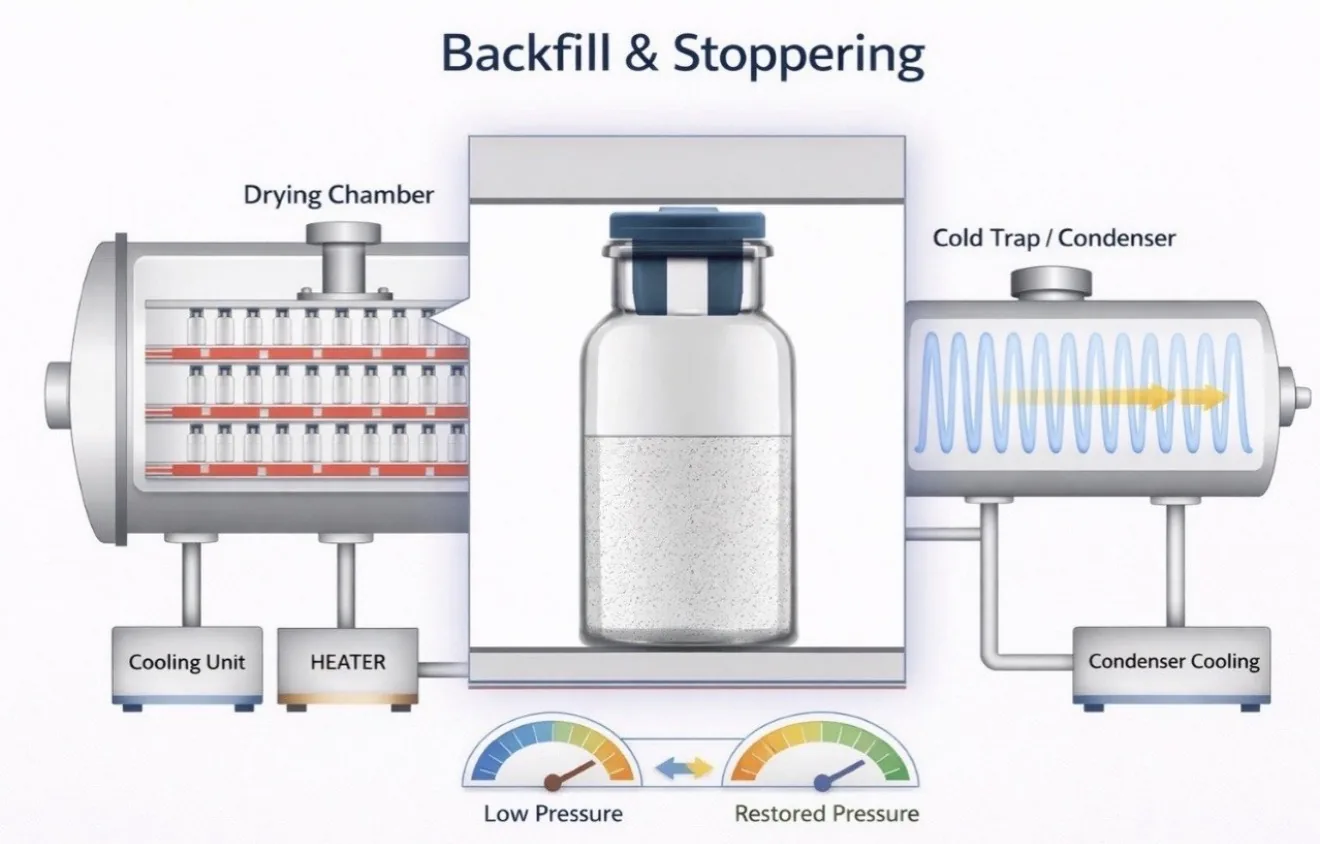
Finally, an aluminum crimp cap (overseal) is applied over the stopper to secure the closure.
The finished vials are then packaged and shipped.
Before use in a clinical setting, the dried product is reconstituted with sterile water.
Now that we understand how lyophilisation works, we can look at real footage of the process inside Aaron Biochemapi facility
Stay tuned for the next episode
Comments