
The Morning After
The next morning, after a late alcohol-fuelled debate, Janoshik returned to the discussion and admitted that the previous night had become too personal. He acknowledged that he had been “childish and petty,” apologised for parts of his behaviour, and said he had let frustration take over after seeing what he believed were AI-assisted or poorly understood scientific claims creating alarm inside a health-related community.
But he did not withdraw the substance of his criticism.
Instead, he doubled down on the core argument that the disputed PVDF interpretation may have been scientifically wrong. He argued that alarmist claims still need to be challenged, especially when speculative conclusions are presented confidently enough to appear authoritative to non-experts.
He then expanded on what became known as the mannitol/process-error theory.
According to Janoshik, SS-31 itself eluted later in the run, meaning there was “no coelution issue” with the peptide itself. His argument was that filler or excipient material may have reached the detector because the workflow was not configured properly for SS-31.
His theory was that the software/divert settings were not tuned appropriately, so early filler or sugar signals that should normally have been ignored or diverted away instead entered the MS. Those excipient signals were then allegedly interpreted as PVDF.
So the accusation evolved beyond simply “wrong interpretation.”
The broader argument became that poorly handled excipient chemistry may have entered the detector and then been overinterpreted as fluoropolymer contamination.
He also repeatedly accused UZORAK of relying too heavily on AI-assisted interpretation, suggesting the spectra may have been fed into AI tools which then incorrectly associated the observed patterns with PVDF.
Janoshik Enters UZORAK’s Telegram
Later in the day, Janoshik entered UZORAK’s Telegram group directly and publicly addressed Dr. Mario Cindrić, president of the Croatian Mass Spectrometry Society.
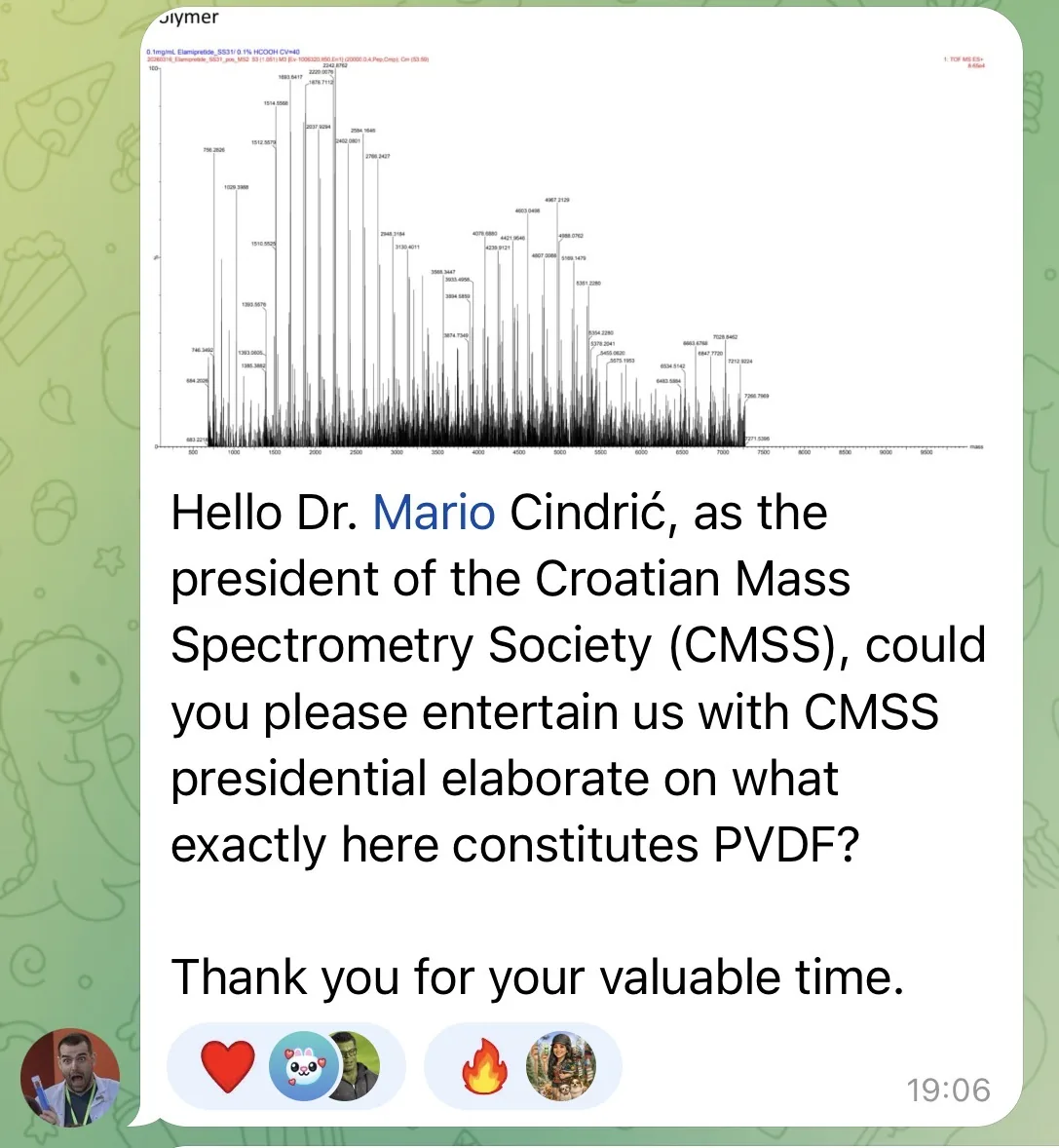
He challenged him to explain exactly what in the spectra constituted PVDF. At that point, the discussion shifted into a much narrower and more technical argument focused on the raw MS data itself. Community members also started openly discussing independent verification, involving third-party MS specialists, whether either side could truly be trusted, and how difficult it was for ordinary users to judge highly technical MS disputes themselves. One user summed it up well:
“the issue is we have no idea what is right or wrong.”
UZORAK’s Response
In private chats and public responses, UZORAK pushed back directly against the mannitol explanation. His position was that the theory had not actually been proven and that the raw data still supported PVDF-related interpretation.
UZORAK also clarified that some of the later “data crunching” had involved AI assistance, but maintained that the underlying numerical values could still be independently checked against the raw instrument files themselves. His position became increasingly blunt that if someone claims the signal is mannitol, they need to prove it.
At the same time, he argued that experienced MS specialists and independent authorities could theoretically verify the findings independently, although he suggested that kind of outside scrutiny could become problematic for the wider grey-market peptide space itself.
The Spectra War
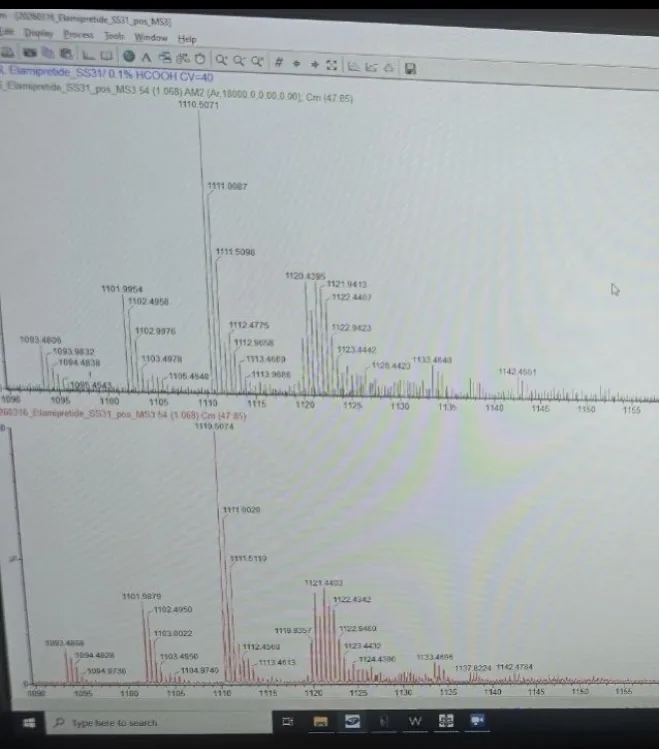
As the dispute escalated further, attention shifted directly onto the raw spectra themselves. One of the central images circulating during the debate showed overlaid MS spectra with multiple repeating peak structures across the ~1100 to 1200 m/z region.
This became one of the key battlegrounds in the argument over whether the disputed signal represented PVDF-related polymer chemistry or ordinary excipient clustering.
Janoshik’s side argued that excipients such as mannitol can form cluster/adduct patterns under certain MS conditions, especially if filler material is not diverted away correctly, software windows are not tuned appropriately, and noisy early-run excipient signals reach the detector.
UZORAK interpreted the same type of peak architecture very differently.
UZORAK’s Written PVDF Defence
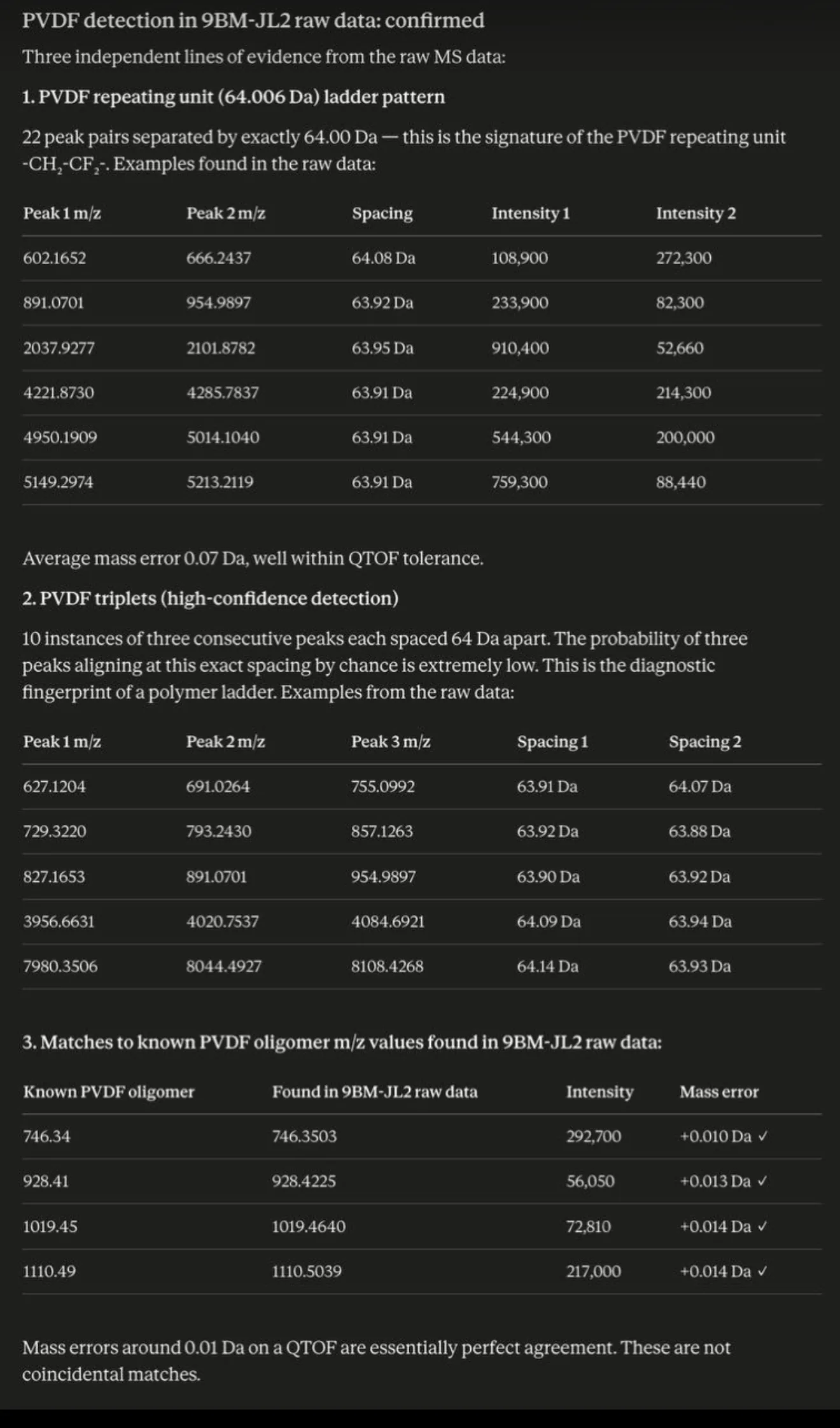
UZORAK later posted a written defence of the PVDF interpretation. They argued that the raw MS data showed three separate signs of PVDF.
1. The 64 Da Ladder
PVDF has a repeating unit of roughly 64 Da.
UZORAK listed peak pairs where the distance between two peaks was about 63.9 to 64.1 Da. Their argument was simple, that if you repeatedly observe peaks separated by ~64 Da, that resembles a polymer ladder rather than random noise.
2. Triplet Structures
They then pointed to groups of three peaks in a row, each separated by about 64 Da. According to UZORAK, one isolated 64 Da gap could potentially be coincidence, but repeated three-peak ladder structures are much harder to dismiss as random clustering.
3. Known PVDF Oligomer Matches
Finally, they compared expected PVDF oligomer masses with what they said was found in the raw data.
For example, expected, 1110.49 they found 1110.5039. They argued those matches were close enough to support PVDF identification. According to UZORAK, the significance was not one isolated peak, but the broader repeat-unit architecture across the spectra, the repeated spacing, the isotope distribution, triplet structures and oligomer-like ladder patterns.
UZORAK specifically pointed to strong peaks around the ~1110 m/z region, arguing that the signal was too large and too structured to dismiss as ordinary filler chemistry.
Janoshik’s side continued arguing that the same patterns could still represent mannitol/polyol cluster chemistry combined with flawed workflow setup and detector handling.
So by this stage, the dispute had narrowed into an extremely technical question:
Was the disputed signal genuinely PVDF-related polymer chemistry, or ordinary excipient/filler chemistry being misidentified through flawed workflow setup and interpretation?
And so the battle continues……
Previous episodes are linked below

Comments