
Introduction
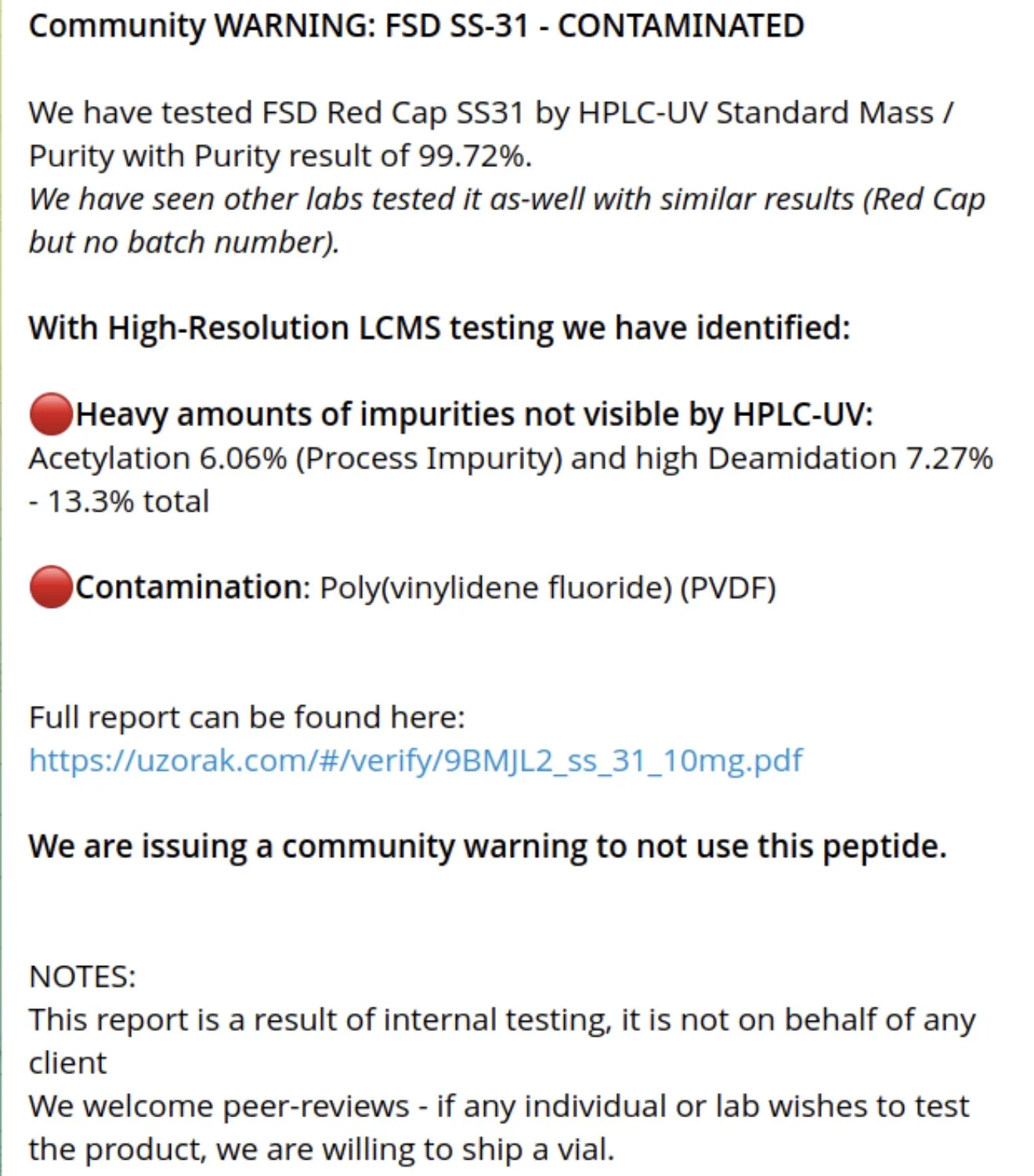
Recently, Uzorak Lab issued a community warning about FSD SS-31, claiming the product was contaminated.
https://uzorak.com/verify/9BMJL2_ss_31_10mg.pdf
On the surface, the case looked simple.
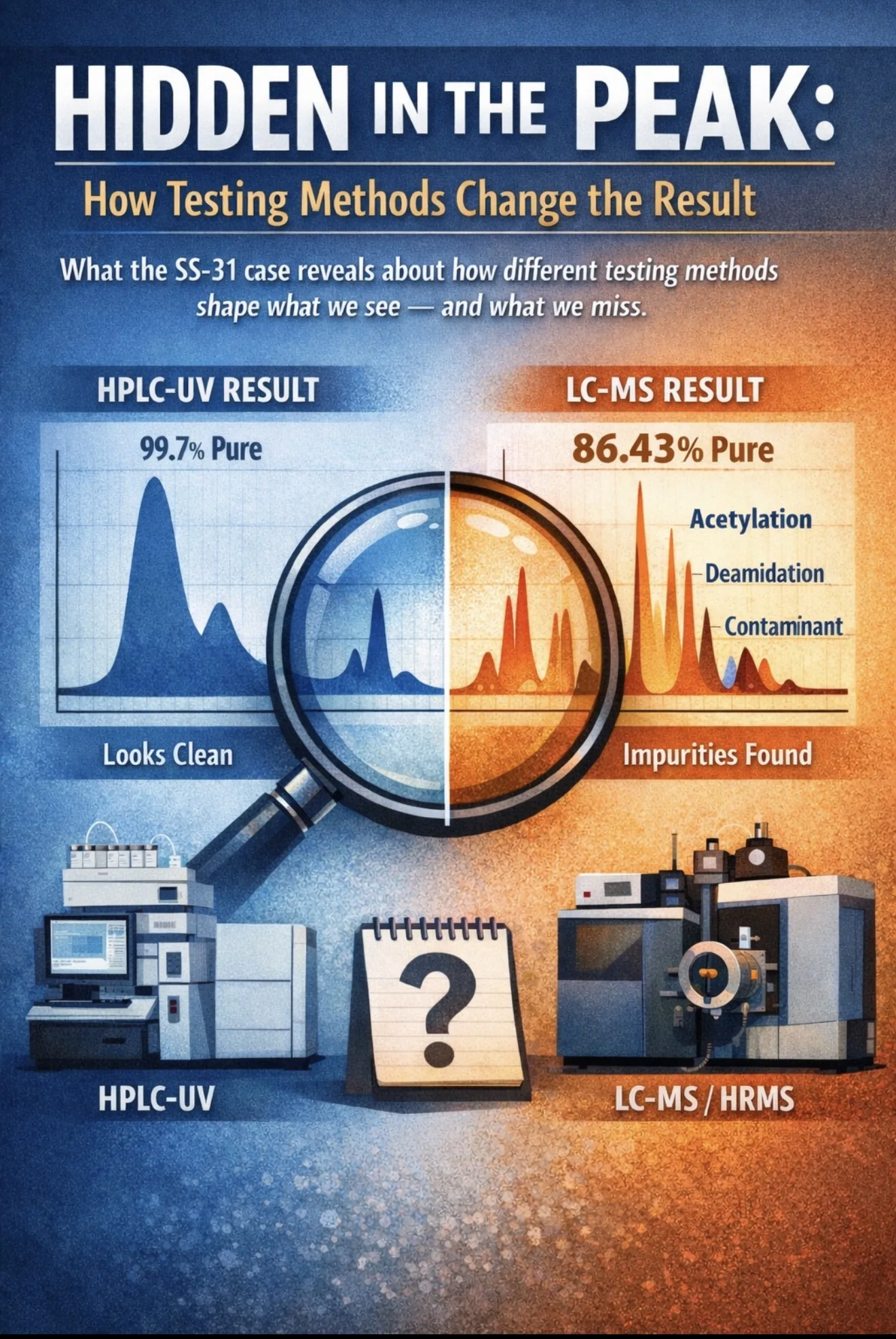
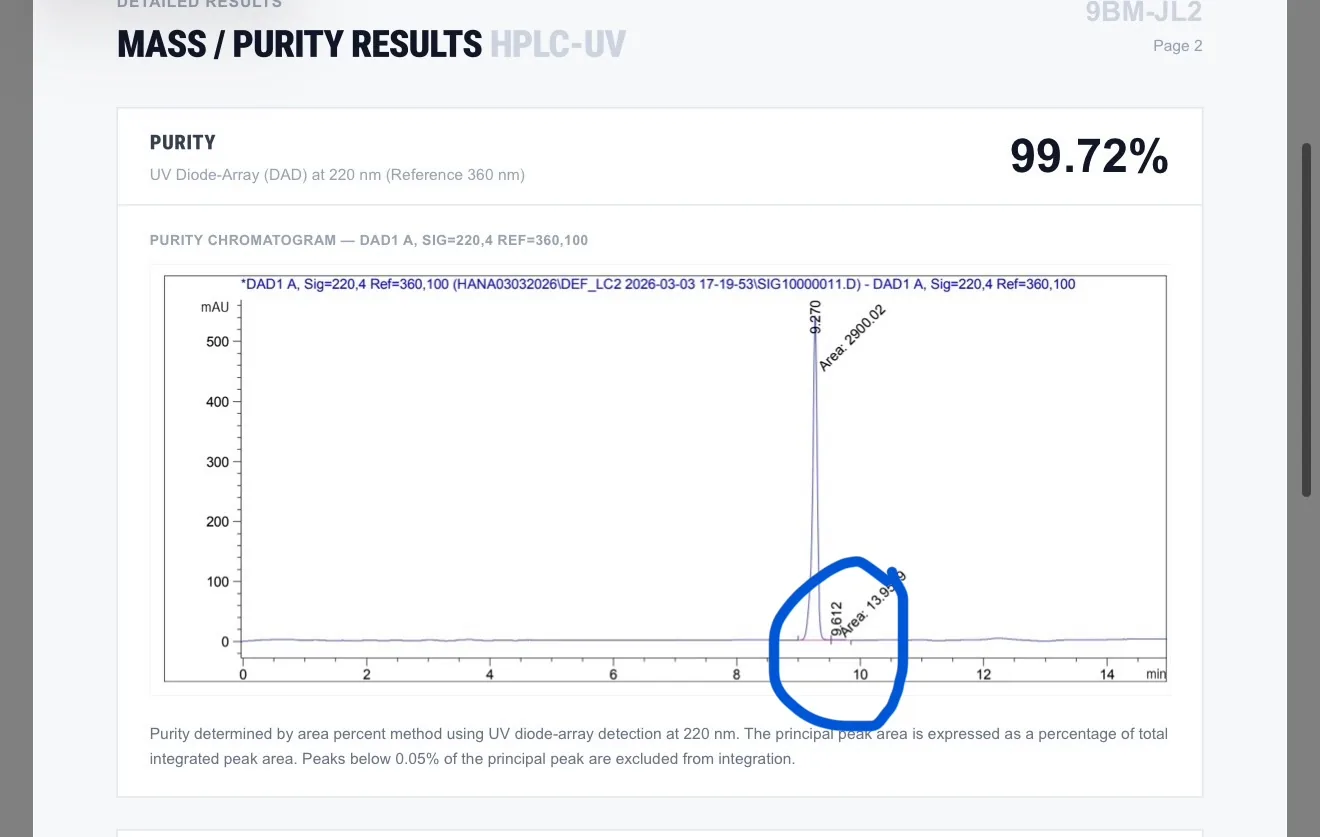
Using standard HPLC-UV purity testing, the sample returned a result of 99.72% purity, a number that would typically be interpreted as high purity.
But when the same sample was analysed using high-resolution LC-MS the picture changed.
According to Uzorak, the advanced analysis identified significant impurities that were not reflected in the standard result, including:
Acetylation: 6.06%
High deamidation: 7.27%
Total impurities: ~13.3%
plus a reported PVDF contamination
With a purity of 86.43%
That is not a small discrepancy.
It is the difference between a sample appearing almost perfectly pure, and one containing a double digit percentage of chemical modification.
Unsurprisingly, the claim triggered concern.
But the reaction did not come only from worried users.
Other labs quickly stepped in, not to dismiss the findings outright, but to question how those findings were being interpreted, and what the difference between the two results actually meant.
And that is where this case becomes far more interesting.
Because this is not just about one peptide.
The Technical Clash Between Labs
What started as a disagreement over one SS-31 result quickly turned into something much bigger: a dispute over what different testing methods can actually show, what they cannot show, and how far any lab should go in interpreting the difference.
At the centre of the argument was Uzorak’s claim that the FSD SS-31 sample appeared highly pure under a standard HPLC-UV purity test, but revealed significant acetylation, deamidation related changes, and a fluoropolymer contaminant when analysed using a more advanced chromatographic and mass spectrometric workflow.
At first glance, the story seemed simple:
routine testing missed something important; advanced testing found it.
But once people looked more closely at the original data, the picture became more complicated.
Uzorak’s Position
Uzorak’s argument is built around a key idea:
Standard HPLC-UV purity testing is not designed to reveal everything in a sample
In their view:
routine HPLC-UV methods are primarily used to estimate purity of the main compound
closely related peptide variants can merge into the main peak
some contaminants may not be visible at all under standard UV detection
there is no universal HPLC-UV method capable of detecting every possible impurity in a single run
Instead, they argue that meaningful impurity screening requires:
higher-resolution chromatography
(typically slower gradients and more efficient columns)
followed by mass spectrometry, which can:
isolate specific masses
identify what each peak actually represents
From their perspective, this is not just a small technical difference. It’s a fundamentally different way of looking at the sample
A high UV purity number does not guarantee a clean sample
They also emphasised that their “Standard” and “Advanced” tests are different products, using different workflows, and therefore should not be treated as equivalent.
Where the Pushback Began
Other labs did not reject advanced testing.
What they challenged was how Uzorak framed the result.
The strongest objection was this:
In Uzorak’s own material, the impurity does not appear to have been completely invisible on the original HPLC-style report.
Critics pointed out that the original chromatogram already appeared to show:
a dominant main SS-31 peak
and a distinct smaller secondary peak at a different retention time
That matters, because it weakens the simplest version of the story.
If a separate impurity peak was already present in the original report, then the issue is not:
“MS revealed something that standard HPLC-UV could not see at all.”
Instead, the issue becomes
“How much of the impurity picture was already visible on the routine method, and how much extra did the advanced workflow genuinely add?”
That is a much narrower and more precise argument.
The Small Peak Problem
This point becomes even more important when you read the note on the original HPLC-UV report itself.
The report says that:
peaks below 0.05% of the principal peak are excluded from integration
In other words, extremely tiny peaks are ignored when calculating the purity number.
But the small secondary feature shown beside the main SS-31 peak does not look like a meaningless invisible blip. It is visible on the chromatogram and marked by retention time, which is exactly why critics argued that at least some impurity was already apparent on the original UV run.
That does not automatically prove the full Uzorak impurity claim was visible in the original test. But it does mean the cleaner headline version, that the sample looked essentially spotless until advanced testing exposed everything, is too simple.
A fairer version is this:
the routine HPLC-UV result may have shown part of the problem, but still understated its full extent
The Chromatography Point
Uzorak’s Technical Explanation
Uzorak’s response to this criticism was more detailed than simply saying “MS sees more than UV.”
Their explanation was that the difference comes from three combined factors:
Column efficiency
The advanced LC-MS workflow uses a higher efficiency column (smaller particle size), which increases resolving power and allows closely related species to separate more clearly.
Gradient design
The LC-MS method uses a longer, shallower gradient optimised for impurity profiling, which spreads peaks apart over time. By contrast, routine HPLC-UV purity methods often use shorter, steeper gradients that compress retention times and can cause related compounds to co-elute.
Detector behaviour
UV detection measures total absorbance at a single wavelength. If two species overlap, they contribute to the same peak. Mass spectrometry, however, can isolate specific masses, meaning it can distinguish compounds even when they are not fully separated chromatographically.
From this perspective, even if an impurity is partially visible as a small secondary peak, a significant portion of it may still remain merged within the main peak under routine HPLC-UV conditions
Their conclusion is that:
good separation on an advanced LC-MS setup does not guarantee a clearly visible additional peak on a standard HPLC-UV chromatogram
This is the strongest version of Uzorak’s technical defence, and it reframes the issue from “visibility” to “resolution.”
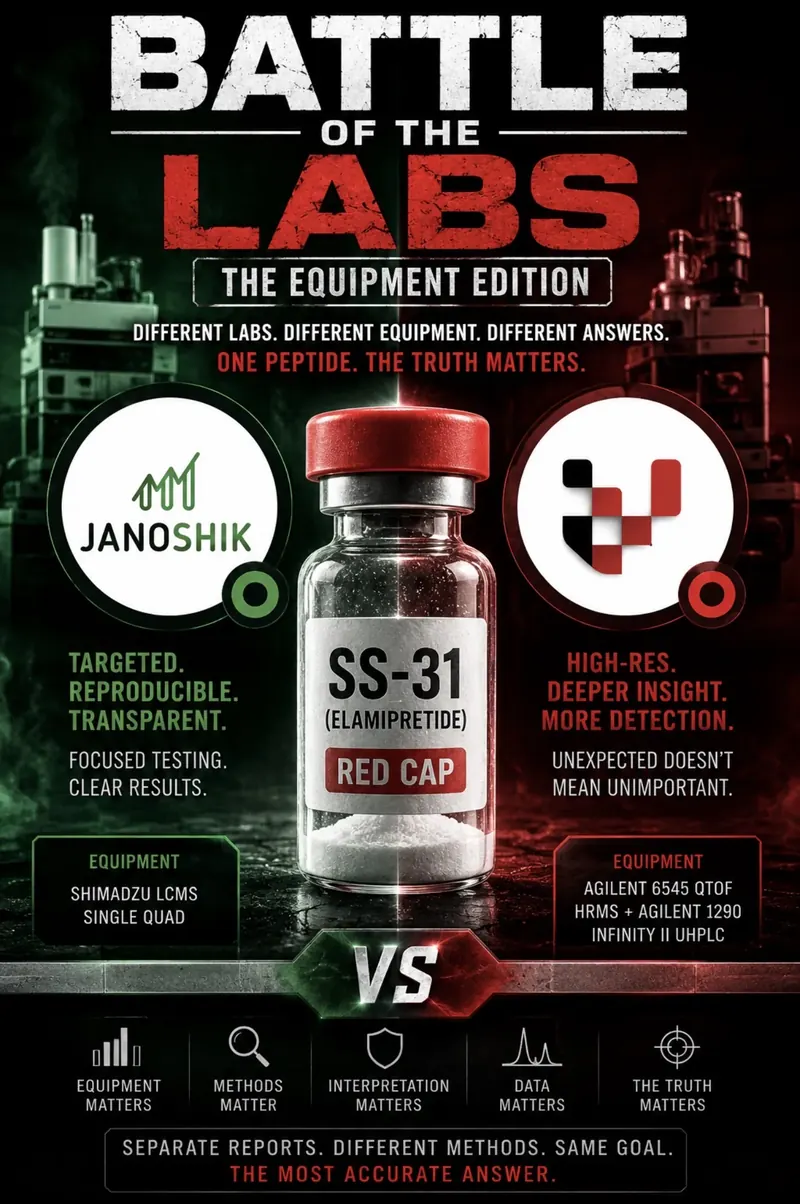
Where Janoshik Pushed Back
This is where Janoshik’s criticism became especially sharp.
His point was that if the impurity peak is already separated in time from the main peak, then that separation happened in the chromatography step.
In other words:
the separation was not created by MS
the mass spectrometer did not, on its own, create the separation
chromatography had already done at least part of the work
Once that is true, the argument changes.
The criticism becomes:
this is not purely a UV vs MS issue
it is a method design and chromatographic resolution issue
and once something is separated chromatographically, a UV detector could, in principle, also detect it
So the pushback was not “mass spectrometry is useless.”
It was
“Don’t present a chromatographic separation as if it were uniquely an MS discovery.”
What Uzorak’s Defence Became
Uzorak’s later defence did not really deny that chromatography was doing the separation.
Instead, the argument shifted to something more specific:
the routine HPLC-UV run and the advanced LC-MS / HRMS run were not the same workflow
the advanced method used a more resolving chromatographic setup
that setup allowed related species to separate more effectively
MS then helped identify what those separated or partly co eluting species actually were
So the more accurate version of Uzorak’s position is not:
“The impurity only appeared because of MS.”
It is closer to:
“The routine purity method understated the extent of the problem. The advanced workflow gave better separation, clearer identification, and a broader picture than the original UV result alone.”
That is a much more precise and defensible claim.
The Key Clarification
If the original HPLC-style report already showed a distinct secondary impurity peak, then the advanced method was not revealing something completely invisible from nothing.
Instead, it may have been doing several things at once:
showing that the visible secondary peak mattered more than the original purity number suggested
assigning that peak more specifically
detecting additional related species still sitting under or near the main peak
identifying non-UV-visible contaminants that routine UV would not show
That is a real contribution.
But it is different from saying the original method showed virtually nothing.
Where the Argument Split
At that point, the disagreement becomes two different readings of the same situation.
Uzorak’s view
routine HPLC-UV purity methods are too blunt
even when a small impurity peak is visible, the total picture can still be understated
advanced workflows reveal a broader, more detailed chemical profile
so a high UV purity number can still be misleading
Other labs’ view
the original report was not as blind as Uzorak implied
some impurity was already visible on the chromatogram
the later separation shown is fundamentally chromatographic
the real difference is method design and purpose, not simply “UV missed it, MS found it”
That is why the dispute stopped being a detector fight and became an interpretation fight.
A third perspective added more balance ( from Matt, owner of the testing lab, Testides)
They argued that Uzorak was likely overgeneralising from one dramatic SS-31 case.
Their position was that:
most common peptide impurities, such as truncations, deletions, and oxidation products, typically differ enough from the target peptide to separate on standard LC-UV
co-elution happens, but it is not the norm for everything
HPLC-UV remains a valid, practical, industry standard tool, especially in a grey market context where cost matters
At the same time, they acknowledged that:
LC-MS does add valuable information
deeper testing can reveal things routine methods may miss
But they also pointed out that MS has limitations of its own:
quantification can be difficult
same-mass impurities can be misread or missed
lack of authentic impurity reference standards can make precise percentages look more certain than they really are
Their conclusion was not “UV good, MS bad.”
It was:
the best practice is a combination of LC-UV and LC-MS
LC = Liquid Chromotography
At the same time, this more measured critique did not dismiss Uzorak outright. Matt’s view is that he may be using an edge case to overstate the limits of routine LC-UV testing, while also making a technically valid point about where routine purity screening can fall short. Credit where it is due: he is pushing the conversation forward in a field that badly needs higher analytical standards.
That is probably the most balanced position to emerge from the dispute.
The Practical Reality
That brings in a question most of the technical debate avoids.
Even if combined LC-UV and LC-MS gives the most complete picture
is that realistic in the grey market?
Comprehensive testing is expensive.
Most buyers are not going to spend hundreds of dollars verifying every batch.
So even if the ideal answer is “use both,” the practical answer for many people is less perfect.
That is where the criticism of Uzorak’s framing lands hardest:
if one dramatic case is used to suggest routine LC-UV testing is broadly inadequate, what is the realistic alternative for most buyers?
Where This Leaves Us
By the end of the dispute, the argument is no longer about whether advanced methods can reveal more.
They clearly can.
The real disagreement becomes much narrower:
was the original HPLC-UV result hiding everything important
or was it already showing part of the problem
and how much additional value did the advanced workflow actually add
That is the real technical clash.
Not:
“UV versus MS.”
But:
“How much was already visible, how much was newly resolved, and how far either side is stretching that difference into a bigger claim.”
Because in the end, the sample did not change.
What changed was:
the method
the level of detail
and the story each lab believed the data supported
Comments