
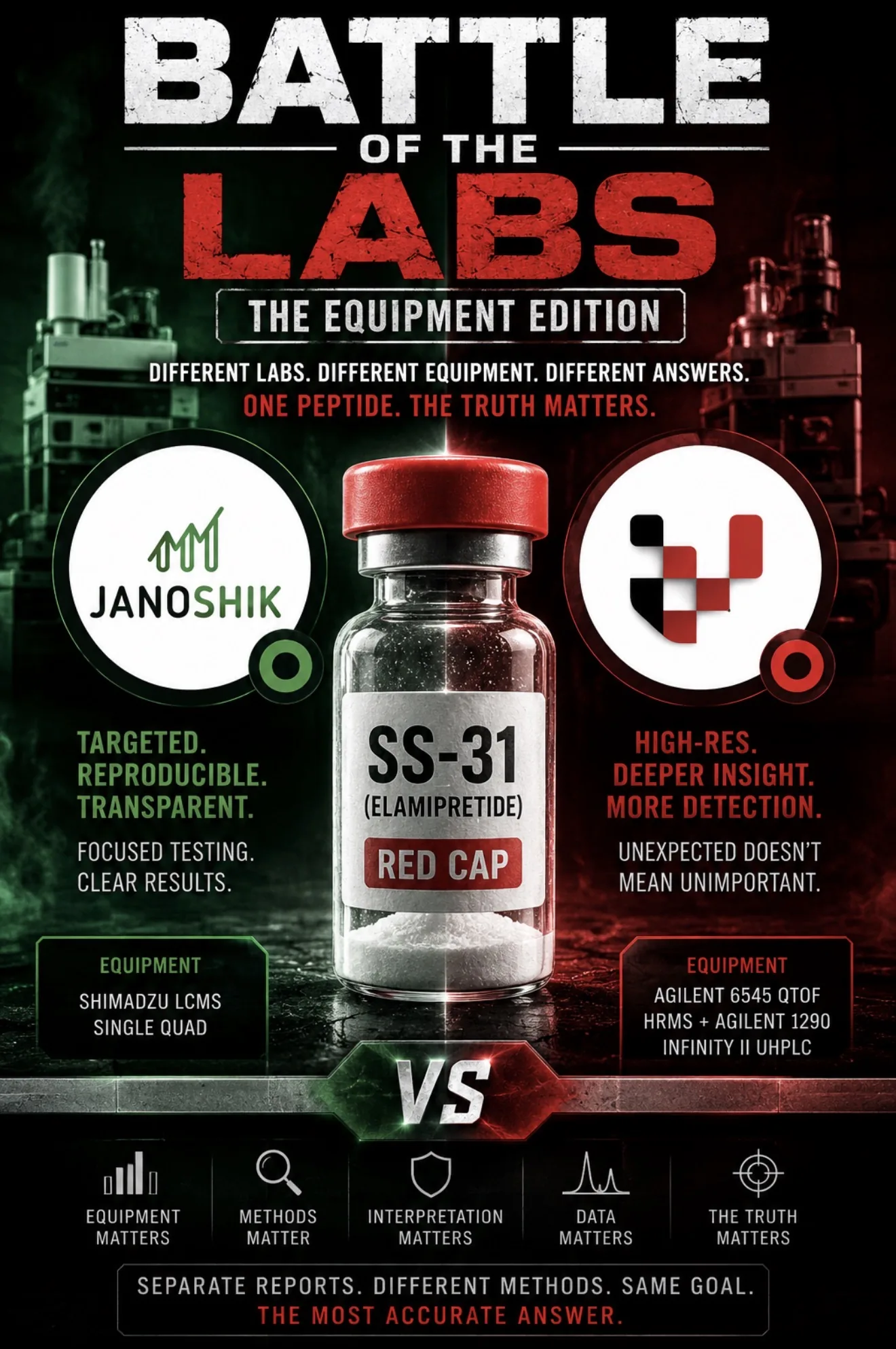
“SS-31 gate” has now resurfaced.
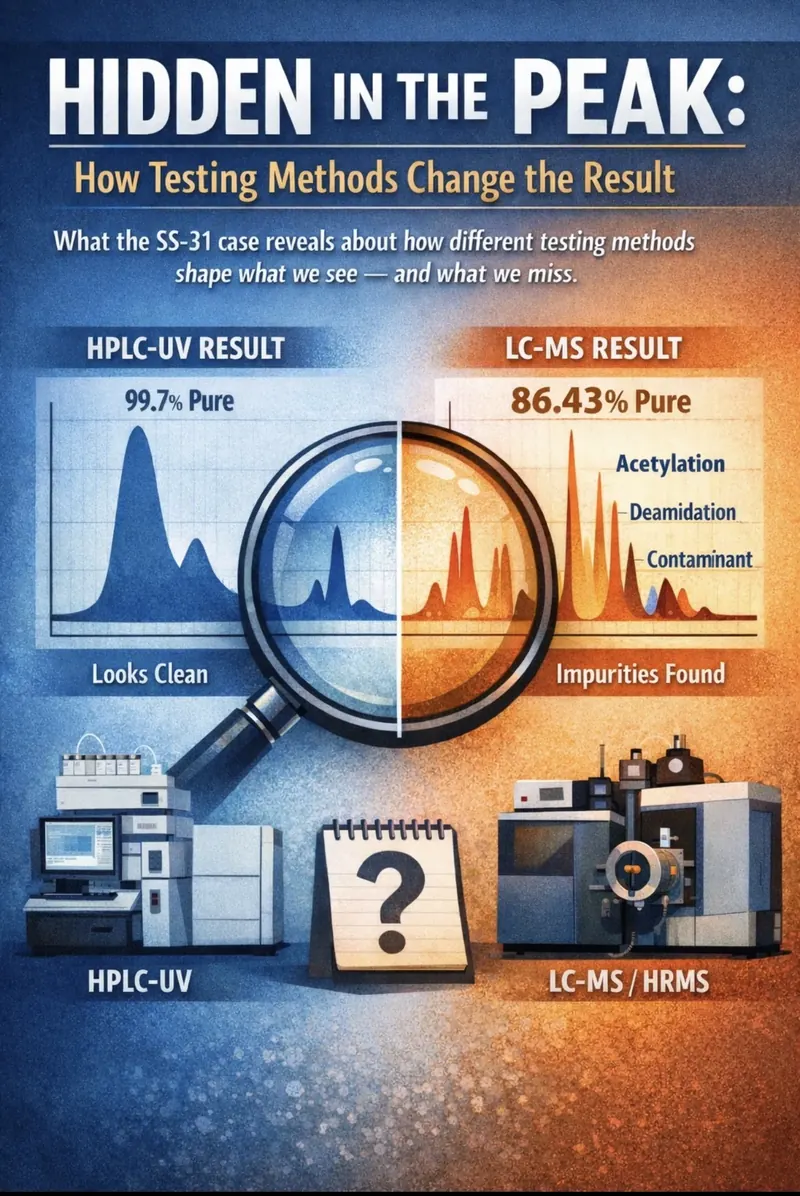
UZORAK has released 3 additional advanced HRLC-MS reports showing PVDF-related contamination findings in further SS31 samples. The new reports include, 2 ERP SS31 samples and 1 HYB sample (Hangzhou Yichenkang Biotechnology Co., Ltd). All 3 samples still showed very high standard HPLC-UV purity, 99.22%, 99.57% and 99.75%, but the reported HRLC-MS purity dropped significantly to 84.67%, 85.02% and 75.04%.
UZORAK also again reported PVDF-related contamination findings, acetylation / degradation issues and impurity burdens not reflected in the standard UV purity numbers.
At this point, according to Uzorak, this is no longer a single-vial anomaly.
On the same day, Janoshik released his own testing of 5 FSD red-cap SS31 samples from the same batch using standard HPLC-UV analysis alongside targeted LCMS screening specifically looking for deamidation, acetylation and PVDF. His reported results were PVDF not detected, deamidation <0.1% and acetylation <0.1%
This clearly conflicted with Uzorak’s earlier HRLC-MS report, so at this stage the discussion shifted from “is this peptide contaminated?” to “how can two labs look at similar material and come back with such different conclusions?”
The Equipment Difference
Part of the argument comes down to equipment. Uzorak’s reports list an Agilent 6545 QTOF high-resolution mass spectrometer paired with an Agilent 1290 Infinity II UHPLC system. QTOF means quadrupole time-of-flight. In simple terms, it’s a high-resolution mass spectrometer, which is useful for accurate mass measurement, untargeted screening, isotope pattern work, and identifying unknowns.
So the crux of Uzorak’s argument is that they are using higher-resolution equipment that can see and interpret things routine methods may miss.
Janoshik uses a Shimadzu LCMS system operating in single quadrupole mode, at least for some of the targeted checking. A single quad is not HRMS. It doesn’t have the same unknown-discovery power as a QTOF system. But Janoshik’s counterargument is also important. He argues that once a contaminant has already been named, you don’t necessarily need untargeted HRMS to look for it. In other words;
Uzorak says QTOF is better for finding unknowns.
Janoshik says once those unknowns are claimed, targeted LCMS should still be able to reproduce them if they are genuinely present at meaningful levels.
And that’s the core of the dispute.
The Deamidation Argument
A lot of the technical argument is centred on deamidation. Deamidation produces a mass shift of about +0.98 Da. Because that’s very close to a normal +1 isotope shift, one side argued that it might be difficult to clearly separate without high-resolution MS, but Janoshik pushed back on this. His point isn’t that a single quad can perfectly distinguish every tiny mass difference, rather that if 7% of the peptide really had shifted by about +1 Da, the overall isotope pattern should still visibly change.
He explained it using isotope abundance. Molecules naturally contain isotopes. Carbon, for example, is mostly carbon-12, but a small percentage is carbon-13. Because of that, mass spectra naturally show small higher-mass peaks. But if a large percentage of the peptide has undergone deamidation, those higher-mass peaks should become unusually large. Even if the instrument cannot perfectly separate 0.98 Da from 1 Da, it should still see the increase in abundance. In other words, if as much as 7% of the sample has shifted, it shouldn’t just vanish into the main signal, which is a fair argument.
This doesn’t automatically disprove Uzorak, but it does mean the “single quad can’t see it” explanation is not enough by itself.
The Acetylation Argument
Acetylation is a different matter because the mass shift is much larger, around +42 Da. Janoshik argued that this should be easy to detect even on a single quad. A +42 Da shift is not subtle in the same way deamidation is. So if Uzorak reported acetylation at around 6%, Janoshik’s position is that a targeted method should have seen it clearly.
This is one of the stronger criticisms. If a reported impurity is both known and allegedly present at several percent, then failure to reproduce it across multiple samples and multiple runs is significant.
But What About PVDF?
PVDF is the most unresolved part of the SS-31 dispute. It’s not a peptide degradation product. It’s not a small mass shift or a routine impurity. It’s a polymer/material contamination claim, which makes the interpretation much more complicated.
If PVDF were present as intact solid plastic particles, Janoshik’s criticism makes sense. Large insoluble particles should normally be trapped during sample preparation, fail to dissolve properly, clog, or not pass cleanly through an LCMS system. So the real question isn’t simply “Was plastic present?”, but “What exactly did Uzorak detect?”
Was it intact PVDF particulate contamination? Was it dissolved, suspended, degraded, or solvent-leached fluoropolymer-related material? Was it a polymer-related background signal? Or was it a misidentification?
That distinction is important because LCMS generally requires the detected material to pass through sample preparation and the LC system. PVDF itself isn’t water-soluble, but HPLC methods don’t run on pure water. They use solvent gradients, often involving acetonitrile or methanol with modifiers. Solvent exposure can change what’s extracted, suspended, leached, or carried through the system. But importantly, this doesn’t necessarily mean intact solid PVDF particles are fully dissolving. A more chemically plausible explanation would involve fluoropolymer-related residues, degraded fragments, oligomers, or solvent-leached material associated with PVDF-containing components rather than literal chunks of plastic cleanly passing through the LCMS system.
One source I spoke to suggested the source could be plastic contact materials in manufacturing, such as filtration membranes, tubing, seals, filter housings, cartridges, or single-use assemblies. They also raised the possibility that other solvents used during manufacturing, such as DMSO, could interact with plastic components differently. But this remains chemically unclear. Acetonitrile may be a poor solvent for PVDF, and without raw data, method details, and repeat testing, it’s impossible to say whether the reported signal represents genuine PVDF-related contamination, leached fluoropolymer residues, sample-prep contamination, background polymer signal, or misidentification.
That’s why this part of the dispute cannot be settled by screenshots of data.
Uzorak says PVDF-related signals were detected in multiple SS-31 samples across more than one vendor. Janoshik says they specifically looked for the reported issues but couldn’t reproduce them.
Both claims need the same thing now: raw data, full method details, and ideally blind repeat testing.
The Column and Method Issue
Another useful point raised was HPLC method development. HPLC is not one universal test. The result depends on the column, wavelength, mobile phase, gradient, and chemistry used. One analyst pointed out that Janoshik’s chromatogram appeared to be shown at 280 nm, and said they would also want to see it at 215 or 220 nm. That matters because peptides often absorb strongly around 215 to 220 nm, while 280 nm depends more on certain amino acids such as aromatic residues. So a clean chromatogram at one wavelength doesn’t always tell the full story.
Column choice also matters. Reverse-phase HPLC is commonly used for peptides, often with C18 or C8 columns, but the exact column chemistry can change what separates and how well it separates. This doesn’t decide who’s right, but it reinforces the wider point, that a purity number is not independent of the method used to generate it.
The MS Purity Problem
This may be the most important analytical limitation in the entire discussion. Uzorak reports both HPLC-UV purity and “MS purity.” That suggests they are using HRLC-MS impurity profiling to identify impurity species and estimate an adjusted purity figure. The issue is that mass spectrometry is excellent for identifying compounds, but far less straightforward for quantifying them. Different molecules ionise differently. A trace impurity can sometimes generate a very strong MS signal, while a larger amount of another compound may produce a weaker one. So because of that, converting MS signals into a numerical purity percentage depends heavily on method setup, calibration, response factors, standards, and interpretation. This is one of the major criticisms raised against Uzorak’s approach.
The criticism isn’t that HRMS is useless, far from it. HRMS can be extremely powerful for detecting unexpected compounds, hidden impurity patterns, isotope shifts, and structural abnormalities. The debate is whether those findings can then be translated into an exact numerical “purity” percentage as cleanly as a validated HPLC-UV area-percent method.
So the disagreement is no longer just “did the machine detect something?” but it’s also “how should those findings be interpreted quantitatively?”
Raw Data Matters
This is why the raw-data issue matters so much. Uzorak says they’re willing to release full machine raw files. These are not screenshots or summary reports. They are the direct instrument files, often hundreds of MB to over 1GB, which allow another analyst to reprocess the data. That would allow independent reviewers to inspect the extracted ion chromatograms, isotope patterns, background signals, integration, calibration, method settings, mass accuracy and processing choices.
Janoshik has shared his spectra and says they couldn’t reproduce the findings across multiple samples and runs. But selected spectra are not the same as full raw files. So the cleanest way forward would be to obtain full raw data from both labs, same sample or retained vial, blind repeat testing, method disclosure where possible and independent review by a third lab with HRMS capability
Because right now, both positions contain valid points.
Uzorak may be right that advanced HRMS sees things routine methods miss and Janoshik may be right that several-percent impurities should still be reproducible if they are really present.
Both can be true, depending on the sample, method, and interpretation.
Food for thought
The useful lesson here isn’t “Uzorak is right” or “Janoshik is right.” It’s that peptide testing isn’t as simple as people want it to be. A clean HPLC-UV chromatogram doesn’t necessarily prove a vial is clean and a high-resolution MS report doesn’t automatically mean every numerical purity estimate is beyond question. Single quad LCMS is not useless and QTOF HRMS is not magic.
And purity is not a single universal truth floating above the method, It’s a result produced by a specific method, on a specific sample, with specific assumptions.
That is why this dispute is worth paying attention to.
Not because it gives us an easy answer, but because it exposes the exact problem in this market, that people want one number to tell them whether something is good or bad. But the deeper you look, the more obvious it becomes that the number is only the beginning.
Update after publication:
Uzorak has now clarified that their PVDF/polymer detection relies partly on their LC-MS/MS workflow and the use of a trapping column. His argument is that non-peptide components such as PVDF, microplastics, polymers, oils, silica, sugars, polyols and aggregates may not be visible by UV/FLD if they don’t carry a strong chromophore, and that MS/MS is needed to identify them properly.
He also argues that without a trapping column, polymer-related material may not be separated cleanly from salts and early-run matrix components at the beginning of the chromatography run. In other words, Uzorak’s position is not simply “our machine is better,” but “our method is set up to capture and separate these non-peptide contaminants before MS/MS identification.”
That doesn’t fully settle the dispute, but it adds an important missing detail. The disagreement is now even more method-specific: Janoshik says the claimed contaminants should be reproducible by targeted LCMS, while Uzorak says the Janoshik setup may not be analytically appropriate for this type of polymer/non-peptide detection.
Uzorak says they will publish method, conditions, results and raw data next week. That is now the key thing to watch.
Comments