
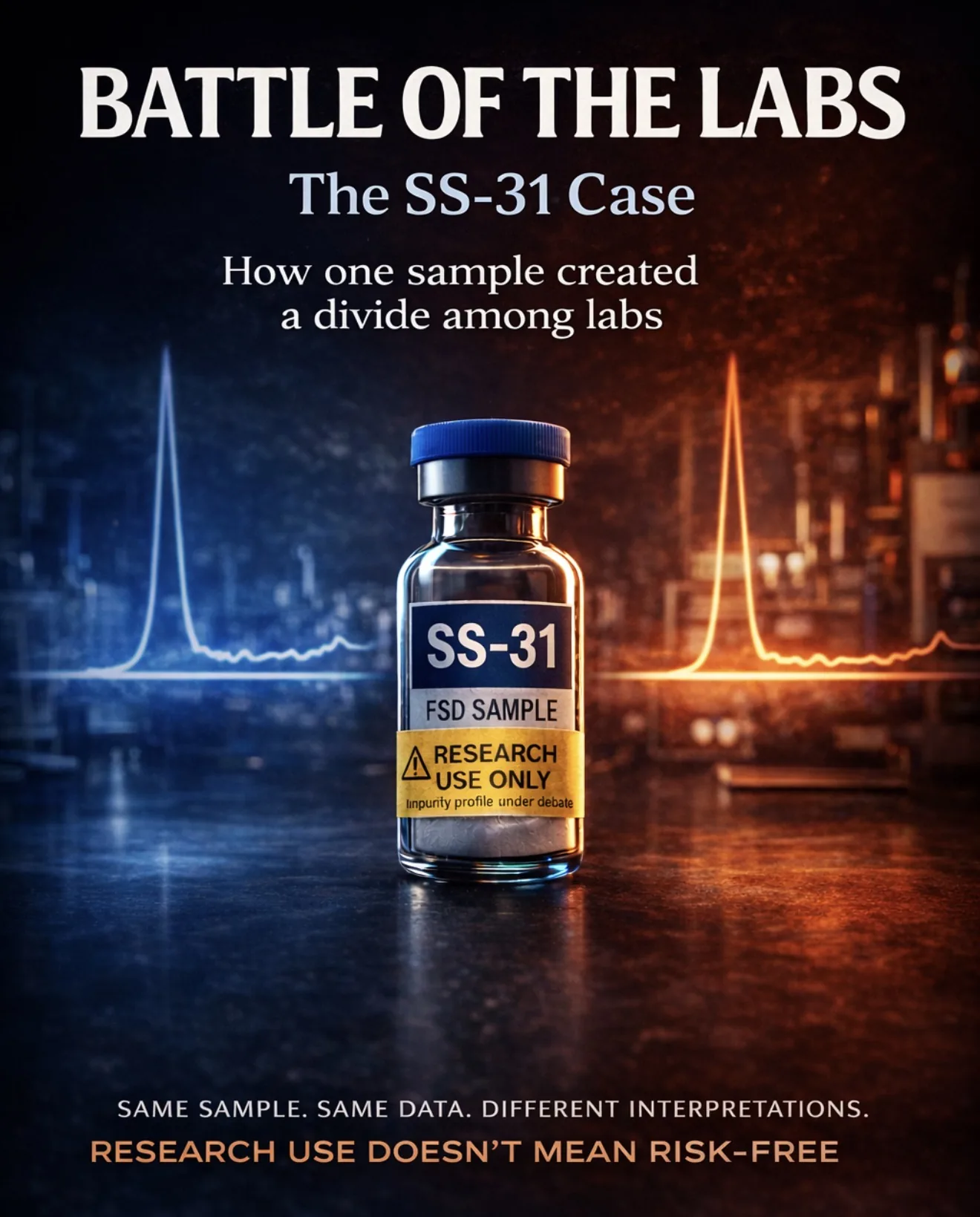
Every so often, a lab testing discrepancy kicks off debate in the community.
For people who have been around a while, this may bring back memories of the “formylated tirzepatide” dispute from over a year ago, when Trust Pointe was consistently testing tirzepatide at sub-99% purity, while other labs, especially Janoshik, were testing those same batches at over 99% purity. Their explanation was that the presence of formylated tirzepatide was causing the discrepancy and that other labs failed to detect it. They even went as far as sending a sample to Creative Proteomics for another opinion.
I reported that case extensively, as there was never a fully convincing explanation for how formylated tirzepatide could find its way into so many samples, across different vendors, and even across different manufacturing countries.
Now we have another case that has caused divided opinion among the labs.
How a vial of SS-31 from FSD exposed the divide
To recap, Uzorak tested a sample of SS-31 from FSD.
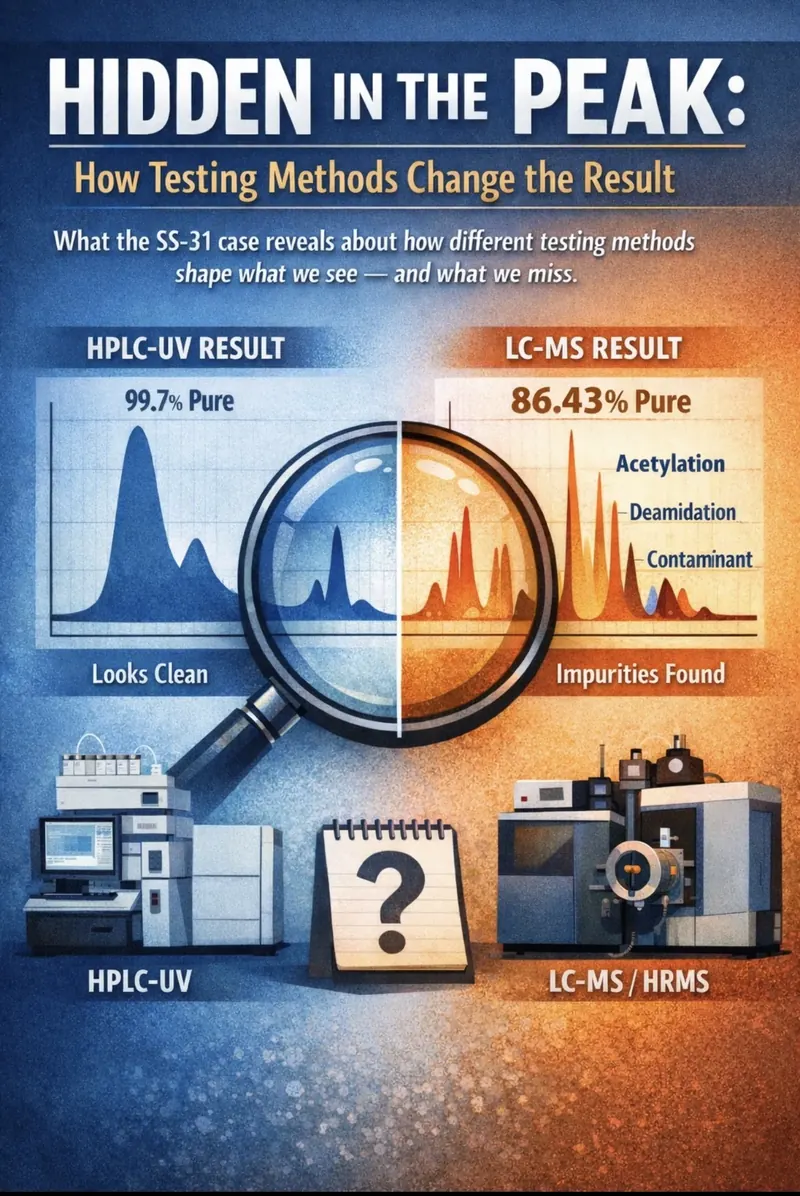
Using standard HPLC-UV, it came back at 99.72% purity.
But when that same sample was tested using LC-MS, the reported purity dropped to 86.43%, with high levels of impurities identified as acetylation and deamidation, along with additional PVDF contamination.
They then issued a warning that this peptide should not be used.
Uzorak’s core claim
Uzorak’s argument was that standard HPLC-UV is not sufficient on its own to detect these impurities, and that LC-MS is required and should be done more regularly as part of peptide testing.
Pushback from other labs
The pushback from other labs was not simply that Uzorak found nothing.
It was that the impurity was not completely invisible on the original standard HPLC report.
A second, smaller peak was already visible on the original HPLC chromatogram and, in their view, should have been investigated.
So the argument became less:
“LC-MS found something totally hidden”
and more:
“part of the problem may already have been visible, but the standard method did not fully resolve or identify it.”
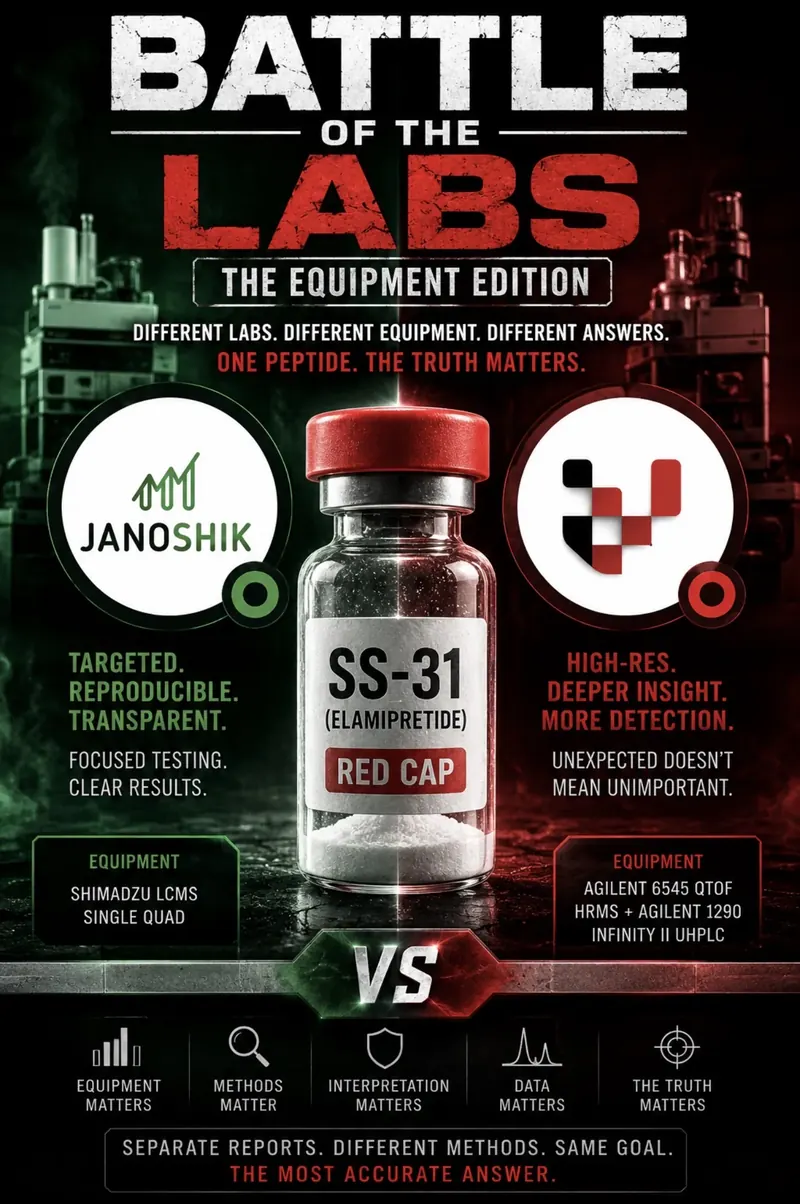
Uzorak explained that their advanced workflow used a higher-resolution chromatographic setup, allowing more effective separation of closely related species.
The argument settled into a stalemate: it was generally accepted that LC-MS provides more detail than HPLC-UV, but that the original HPLC-UV trace had already shown a small secondary peak that warranted further investigation.
Since then, Uzorak has reportedly tested two other SS-31 samples from different vendors, which they say also came back with high impurity levels.
This shifts the discussion from detection to manufacturing quality, specifically, how thoroughly the final product has been purified after synthesis.
Uzorak’s view is that after peptide synthesis you are left with very dirty material, and that multiple filtration and chromatography steps are normally needed for purification. In most cases, they say this involves ion chromatography, whereas the SS-31 currently on the market appears either not purified at all or poorly purified, possibly using flash chromatography, which is more commonly used in small-scale peptide production.
They argue that with the addition of another purification step, SS-31 could become a decent product.
What concerns them most is that, in their view, the full extent of the impurity profile was not recognised by other labs.
Their position remains that PVDF contamination is the most concerning finding, while the acetylation and deamidation-like degradation reflect insufficient purification rather than a fundamental issue with the peptide itself.
Uzorak claim to have done 30 to 40 preparative purification methods and have seen all of these types of modifications before.
Their bottom line is that the SS-31 currently on the market should be removed, because it contains teflon-like polymers and is reportedly 5 to 10% acetylated.
We now have a further response from BT Labs.
BT Labs argues that SS-31 cannot undergo classical deamidation, because it does not contain Asn or Gln, the amino acids normally required for deamidation to occur.
BT Labs also says there is a major difference between how pharmaceutical companies like Lilly and Novo make their GLPs, and how most peptides are actually made in practice.
However, BT Labs does agree on one important point that the small peak seen on the original LC trace should have been investigated.
Uzorak’s revised position
In response, Uzorak does agree that SS-31 does not contain Asn or Gln, and therefore cannot deamidate at those sites.
Their argument is that the molecule may still undergo a different structural change that produces the same mass-shift effect, and that they used the word “deamidation” as a shorthand to describe the observed degradation pattern.
They now say that “chemical synthesis error” would actually be a better description, and probably the most correct one.
Where the dispute now stands
So the disagreement has narrowed.
It is no longer really about whether SS-31 contains the residues required for classical deamidation. The real dispute is whether the observed signal reflects a genuine synthesis or purification problem, and whether “deamidation” is the correct label for it.
That is why this case has divided opinion among labs.
At this point, the argument is no longer just about detection, but about interpretation.
Another Point of Disagreement
A separate point raised in the discussions was the role of D and L amino acid isomers and how significant they are in grey market peptides.
These are mirror-image forms of the same amino acid that share the same mass but differ in 3D structure.
It was noted that specialised techniques, such as chiral chromatography, ion mobility, or NMR, are required to differentiate them, but these are not part of routine testing.
This sparked further disagreement about what analytical methods can reliably detect.
This point sits slightly outside the main SS-31 debate, but it highlights a broader issue that even advanced methods have blind spots, and different labs place different weight on those limitations.
What I’ve jokingly called a “battle of the labs,” should also be seen as a sign of progress. The debate has pushed labs to speak more openly about what different testing methods can and cannot detect, where their limits are, and how interpretation shapes the final result. If nothing else, it has made clear that peptide testing is not just about generating data, but about understanding what that data actually means.
I’m sure there will be more to come ……
Comments