
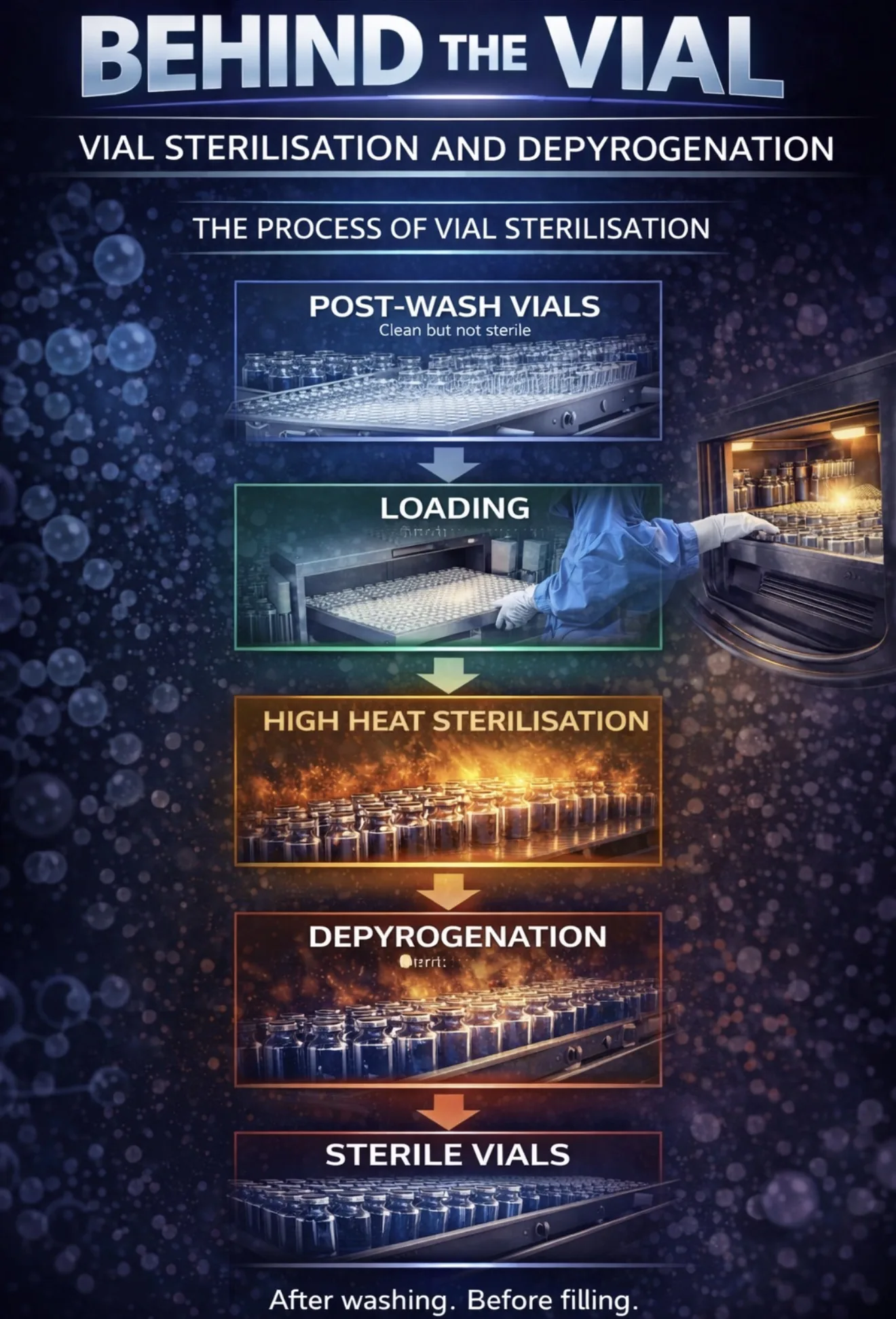
The washed vials are gathered into trays and moved into a controlled environment.
This prevents recontamination after the washing stage and prepares them for high-temperature processing.
Loading into the sterilisation unit
The trays are placed into a sealed stainless steel chamber.
This unit is designed to:
maintain controlled temperature
ensure uniform heat exposure
isolate the vials from the external environment
The enclosed design is critical for consistent sterilisation across the entire batch.
High-temperature sterilisation
Inside the chamber, the vials are exposed to elevated dry heat.
This stage is used to:
destroy microorganisms
eliminate bacterial contamination
Unlike washing, which removes visible debris, this step removes contamination that cannot be seen.
Depyrogenation
In addition to sterilisation, the vials undergo depyrogenation.
This involves exposure to higher temperatures to destroy endotoxins (pyrogens), heat-stable toxins that remain even after bacteria are killed.
This is a critical step for any product that will later be used in sterile or injectable applications.
Cooling and controlled handling
After the heat cycle, the vials are allowed to cool inside a controlled environment.
They remain protected to prevent recontamination.
At this stage, the vials are:
sterile
depyrogenated
ready for aseptic handling
Ready for filling
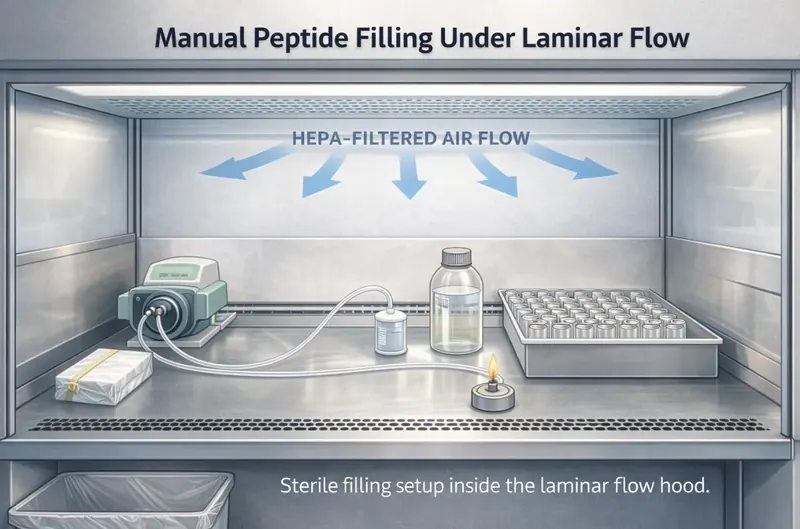
Once this stage is complete, the vials are ready to be transferred into:
laminar flow hoods
aseptic filling stations
where the peptide solution will be introduced.
Comments