
A series of laboratory reports posted by Chromate has opened another argument over what the percentage labelled “purity” on a peptide COA actually represents. The examples included both BPC-157 and a Semax/Selank blend. What connects them is Chromate’s claim that benzyl alcohol is appearing in lyophilised peptide vials, and that failure to identify or properly separate it can produce much lower chromatographic results.
The discussion that followed showed that the situation is more complicated. Vanguard said he’s been identifying and reporting benzyl alcohol in lyophilised vials for more than a year, while Janoshik said he’s also seen the peak. The disagreement therefore became less about whether benzyl alcohol can be present and more about how it’s identified, separated and treated in the final calculation.
The BPC-157 example
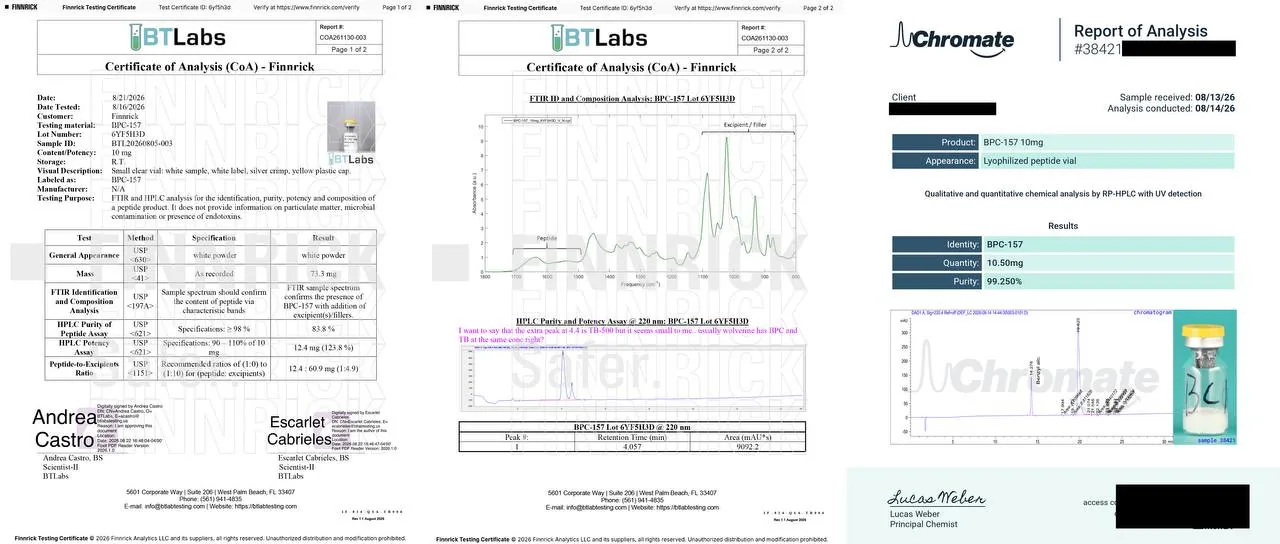
The first comparison involved BPC-157 lot 6YF5H3D. BTLabs tested a sample labelled BPC-157 10 mg and reported:
12.4 mg BPC-157
83.8% HPLC purity
Their chromatogram shows the main BPC-157 peak and another substantial peak at approximately 4.4 minutes. A note added to the BTLabs chromatogram says:
“I want to say that the extra peak at 4.4 is TB-500 but it seems small to me... usually wolverine has BPC and TB at the same conc right?”
The note suggests TB-500 as a possibility, but doesn’t establish the identity of the second peak. Chromate tested BPC-157 material shown alongside it and reported:
10.50 mg
99.250% purity
Chromate later used the BTLabs chromatogram as an example while criticising attempts to assign chemical identities to peaks without adequate identification. The extra peak on the BTLabs report wasn’t identified as benzyl alcohol, so we can’t say for certain that this is what caused the difference
A separate Semax/Selank comparison
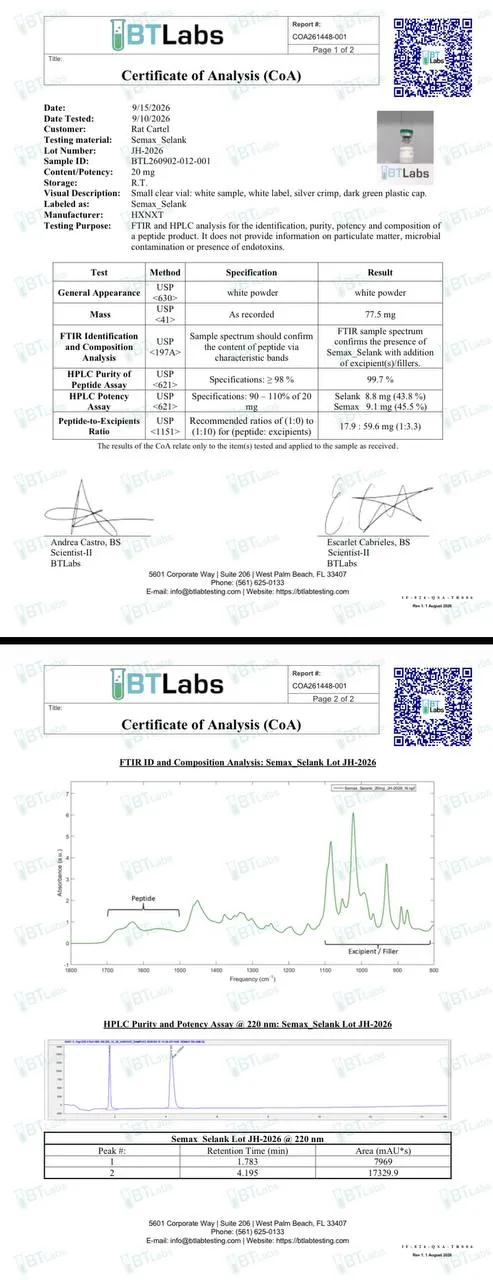
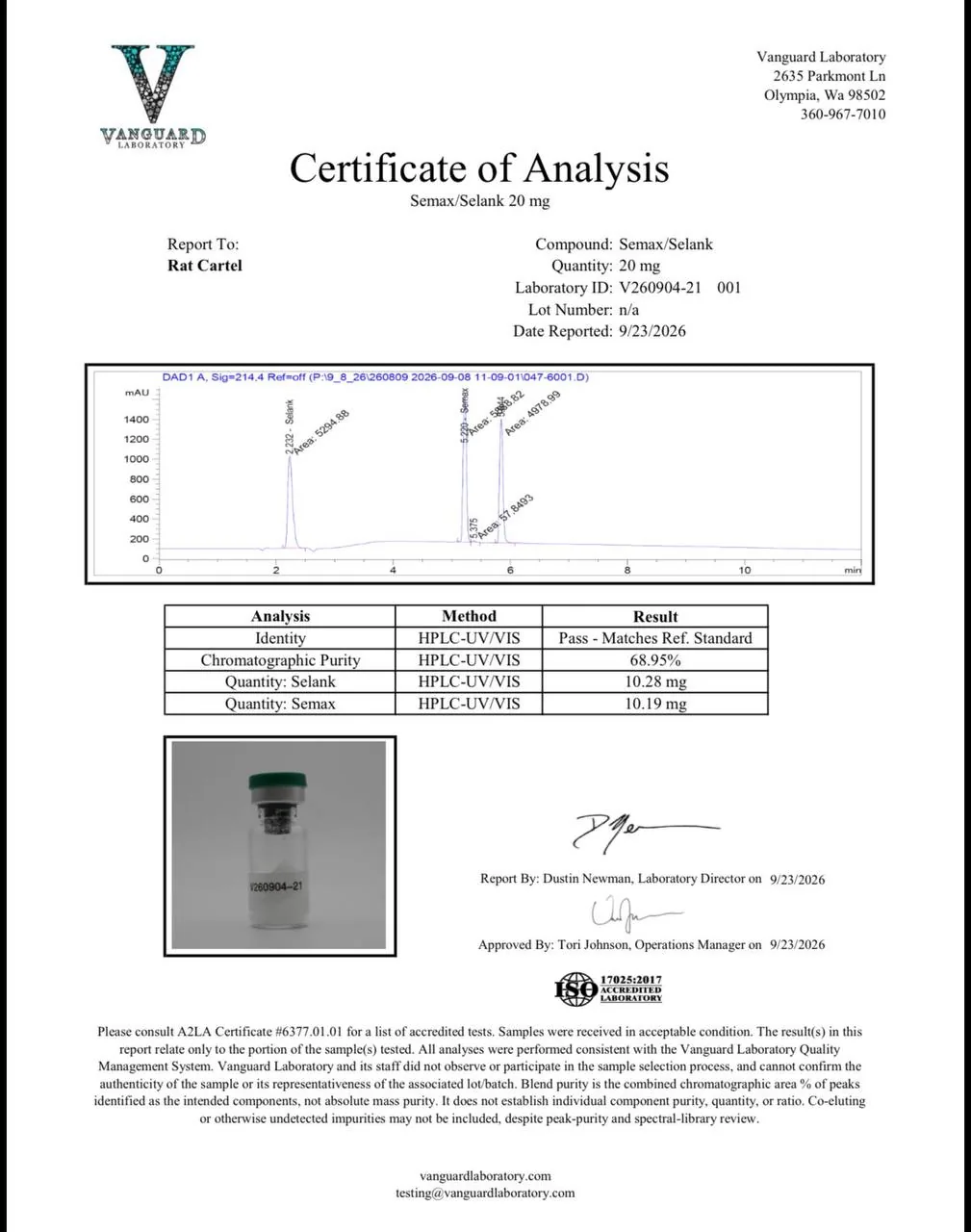
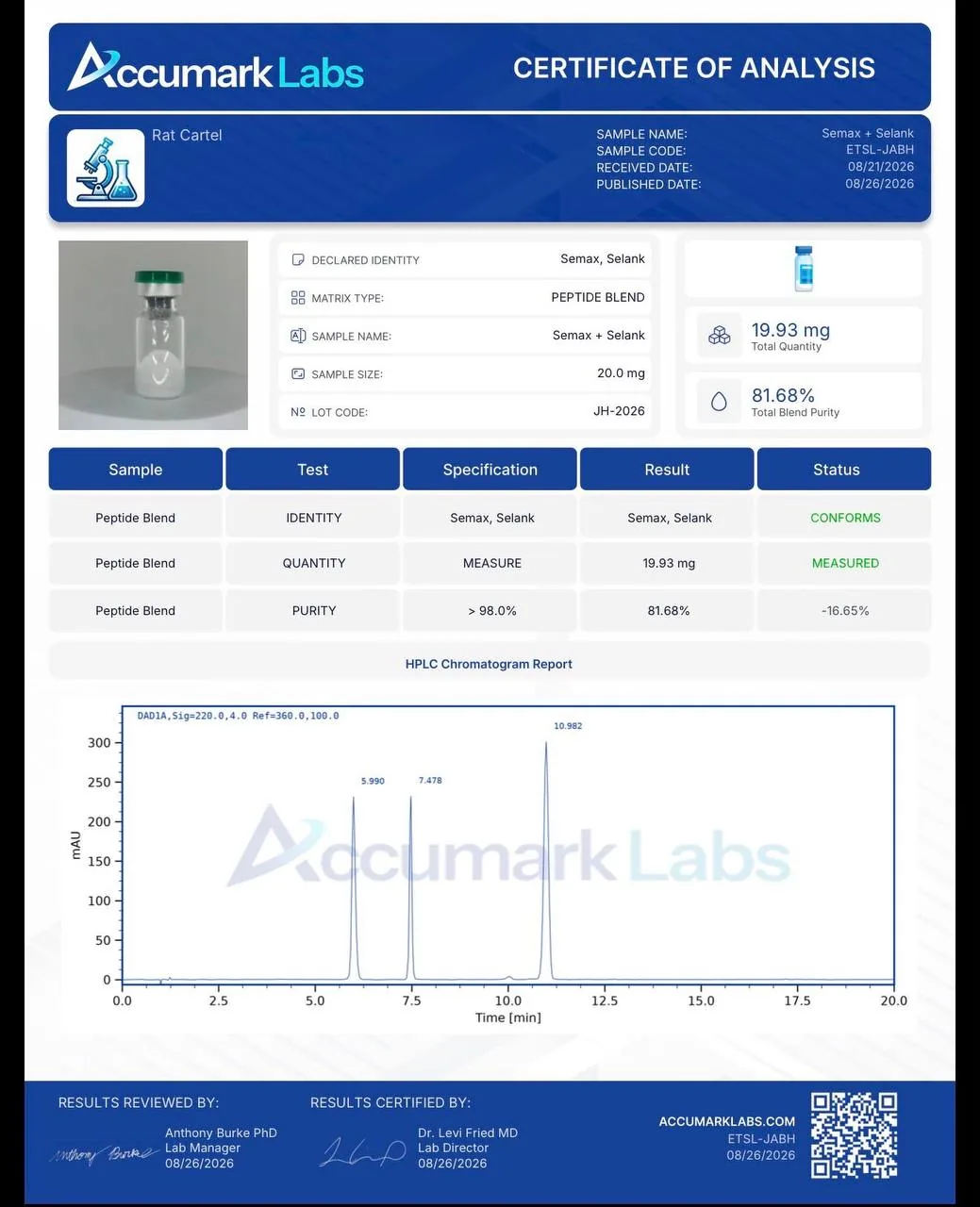
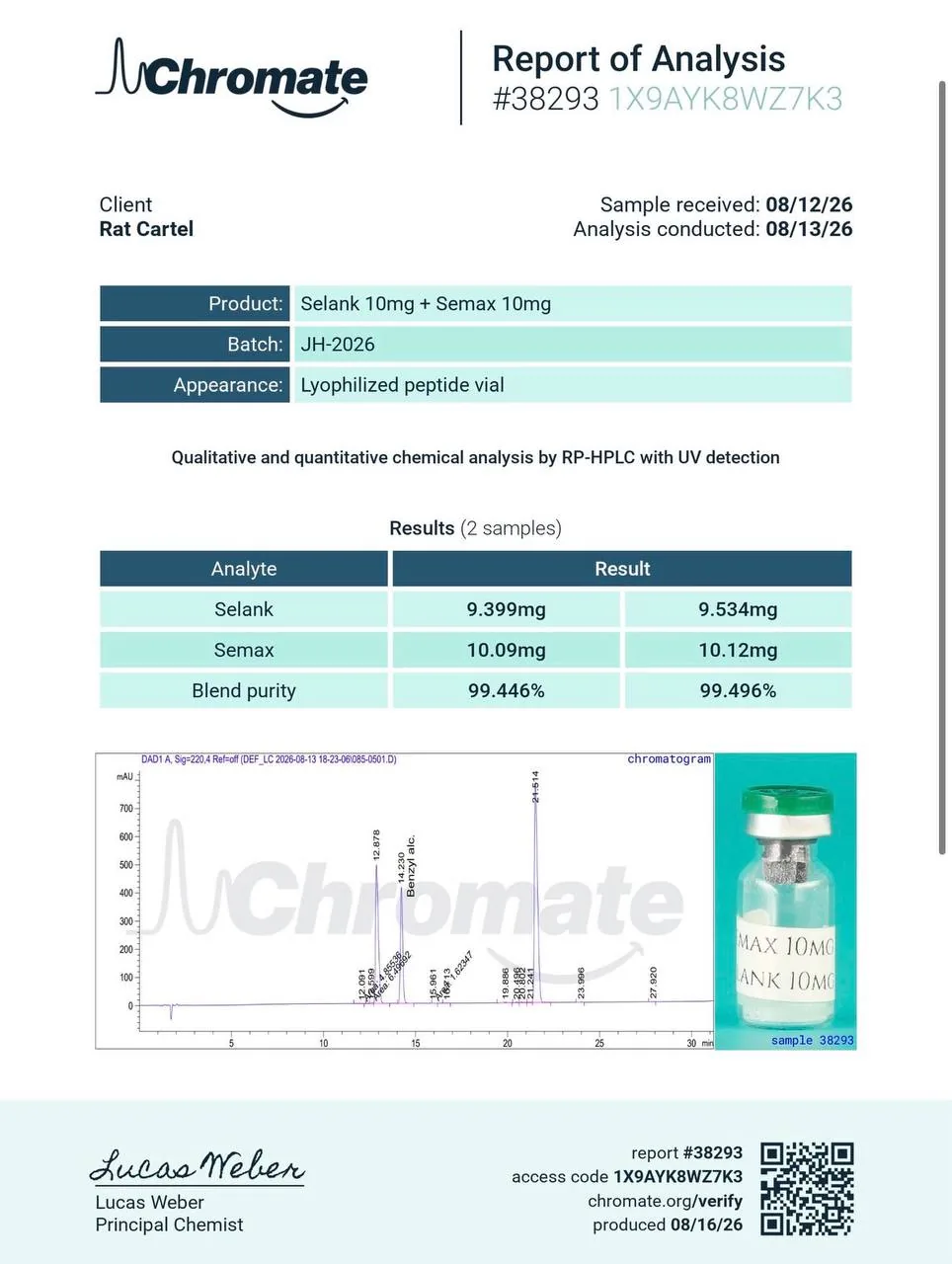
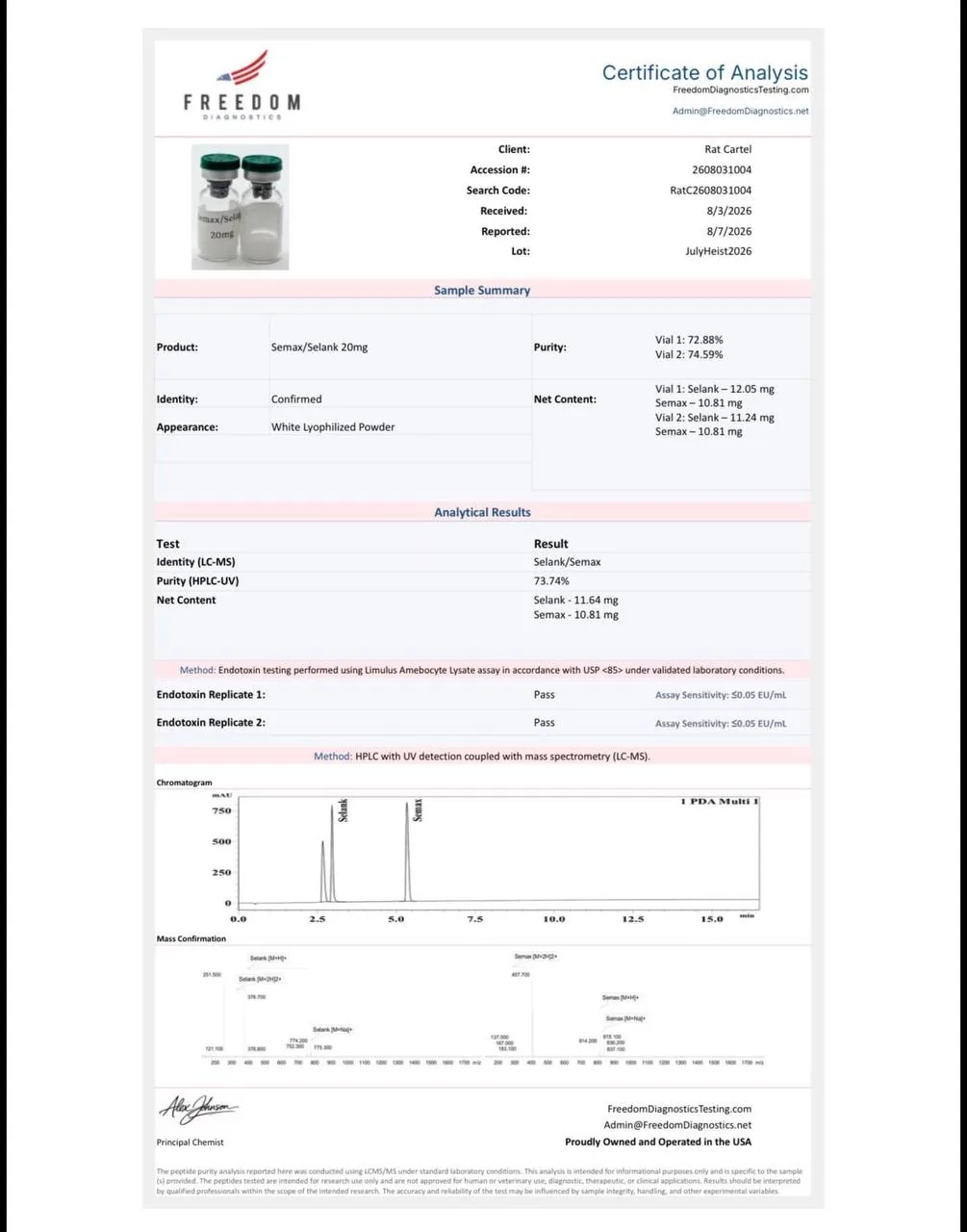
Chromate also posted reports for Semax 10 mg + Selank 10 mg, lot JH-2026, tested by several laboratories. This produced another striking set of results.
Chromate tested two samples and reported:
Selank: 9.399 mg / 9.534 mg
Semax: 10.09 mg / 10.12 mg
Blend purity: 99.446% / 99.496%
BTLabs reported:
Selank: 8.8 mg
Semax: 9.1 mg
HPLC purity: 99.7%
Accumark reported:
Total quantity: 19.93 mg
Total blend purity: 81.68%
Freedom Diagnostics tested two vials and reported:
Purity: 72.88% / 74.59%
Selank: 12.05 mg / 11.24 mg
Semax: 10.81 mg / 10.81 mg
Vanguard reported:
Selank: 10.28 mg
Semax: 10.19 mg
Chromatographic purity: 68.95%
So in this comparison, BTLabs was actually much closer to Chromate on HPLC purity.
Chromate’s explanation
Chromate said he first detected benzyl alcohol in a lyophilised sample around three months ago. He said the compound subsequently began appearing with some regularity and suggested it might originate as an additive from a common fill-finish factory. Chromate’s larger argument was that labs could produce misleadingly low chromatographic results if benzyl alcohol was present but not recognised or properly separated. Alongside the five-lab material, Chromate specifically wrote: “In this case, it appears that BT labs did not separate the Benzyl alcohol peak”
Vanguard pushes back
Vanguard then challenged the suggestion that benzyl alcohol in lyophilised vials was something other laboratories had failed to recognise. Dustin said Vanguard had been seeing, identifying and reporting it for months
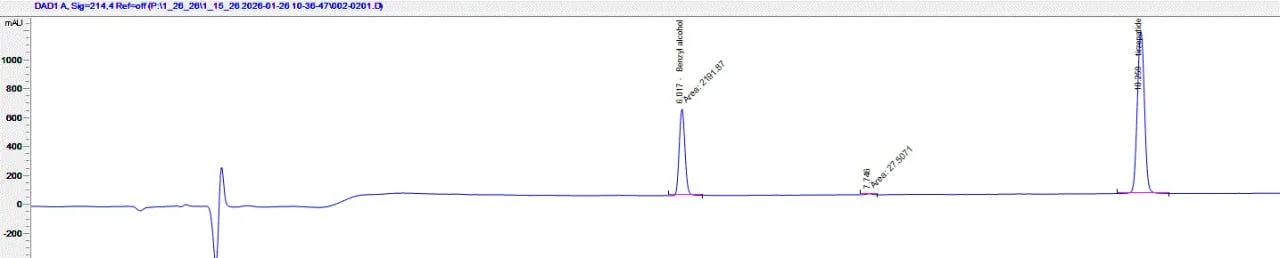
He subsequently posted a chromatogram run in January 2026 and said Vanguard had actually been seeing and reporting it for more than a year. Although Vanguard agreed that the peak was benzyl alcohol, the disagreement was over whether it should be excluded from the peptide impurity calculation.
Should benzyl alcohol count against the peptide?
Vanguard said that when he sees benzyl alcohol, he asks whether the manufacturer knowingly added preservatives or manufacturing aids. According to Dustin, most clients come back saying the manufacturer didn’t. Vanguard therefore doesn’t automatically assume that an unexplained benzyl-alcohol peak belongs in a lyophilised vial. If the manufacturer confirms it was intentionally added and Vanguard verifies the peak against his own reference standard, he identifies the benzyl alcohol on the chromatogram and excludes it from the peptide impurity calculation. But if its presence remains unexplained, Vanguard doesn’t simply remove the peak from the calculation. That distinction is central to understanding why apparently similar tests can produce very different headline percentages.
Identifying an additional compound and deciding whether it should count against the peptide are two different decisions.
Vanguard’s 1.1 mg benzyl-alcohol example
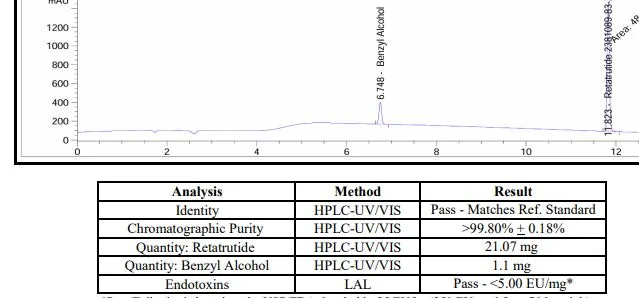
Vanguard also supplied a particularly useful example involving retatrutide. His report showed:
Retatrutide: 21.07 mg
Benzyl alcohol: 1.1 mg
Chromatographic purity: >99.80% ± 0.18%
The chromatogram separately labels the benzyl-alcohol peak. That demonstrates that a vial can contain a measurable quantity of benzyl alcohol while the peptide itself is still reported at greater than 99.8% chromatographic purity when the benzyl alcohol is identified and treated separately.
Janoshik had seen it as well
Peter from Janoshik said they also see the peak but had generally assumed it was benzyl alcohol or phenol rather than formally identifying it. He also questioned Chromate’s explanation that benzyl alcohol was difficult to detect because it is a poor ioniser. Chromate clarified that it meant under ESI conditions, while Peter argued that benzyl alcohol’s volatility was the more relevant issue for the LC-MS analysis. There was also a technical disagreement over Chromate’s mass-spectrometry evidence.
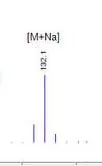
Peter questioned a displayed m/z 132.1 [M+Na] assignment, noting that a molecular mass of approximately 108 plus sodium at approximately 23 would give approximately 131. Chromate accepted that this peak could be an isotope or unrelated, while maintaining his identification of benzyl alcohol from the wider analytical evidence.
These are not controlled inter-laboratory studies
There’s another important limitation. The reports posted together don’t establish that a single homogenised sample was divided and blindly distributed between all of the labs under identical conditions. Even within the Semax/Selank material, matching product and lot information doesn’t establish that every vial had an identical composition.
These are useful real-world comparisons, but they are not controlled proficiency studies.
The bigger problem is “purity”
The most useful part of the dispute is what it exposes about the word itself. A consumer sees 68.95%, 81.68%, 99.7% and 99.496% and reasonably assumes those numbers can be compared directly. But the reports show why that can be dangerous.
A laboratory may detect an additional peak but not identify it. Another may identify it as an excipient. Another may exclude a confirmed manufacturing additive from its peptide impurity calculation. Different chromatographic methods may also separate components differently.
Blends add another complication because labs can report individual peptide measurements, combined peptide area and overall sample composition in different ways. Reading only one percentage without understanding what it represents would completely change the interpretation of the result.
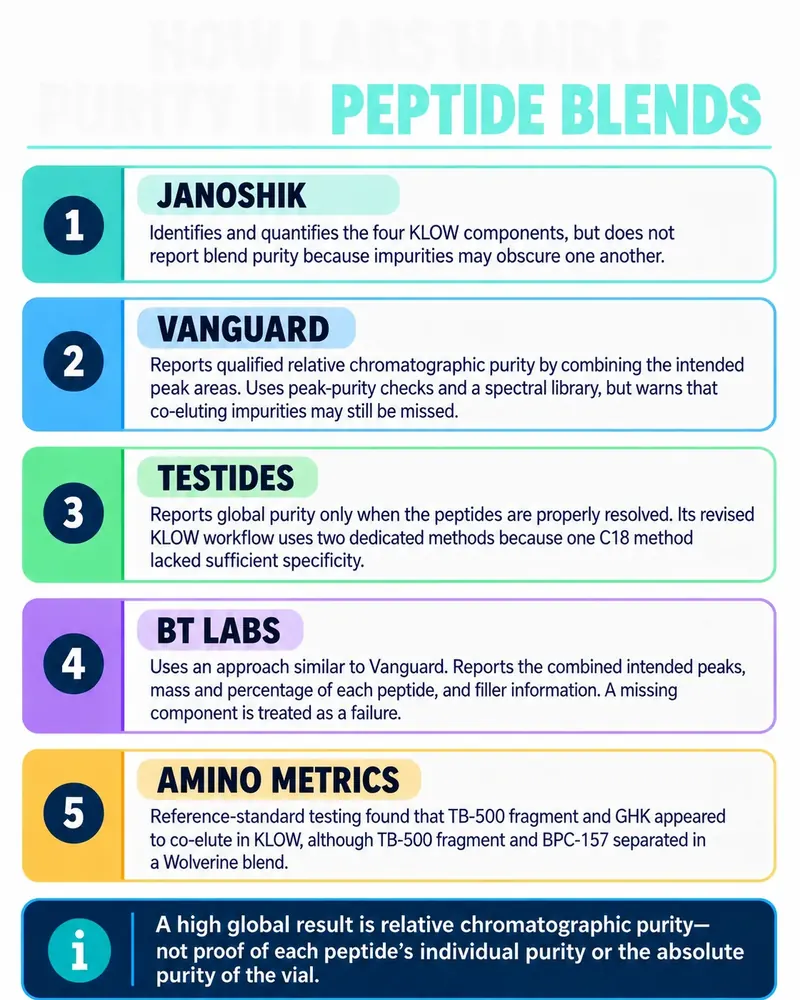
Five labs, five approaches to the unknown peak
Chromate later summarised how he believed each lab had handled the additional peak. Some parts of that summary are Chromate’s interpretation rather than statements made directly by the labs, so they need to be separated.
BTLabs: In the BPC-157 example, the additional peak wasn’t identified. A note on the chromatogram suggested it could be TB-500, while questioning that possibility because of its relative size. It remained part of the impurity calculation. This is consistent with the BTLabs report itself: it reported 83.8% HPLC purity, but didn’t identify the additional peak as benzyl alcohol.
Freedom Diagnostics: According to Chromate, Freedom treated the additional peak as unknown and asked for MS evidence before accepting its identification as benzyl alcohol. Chromate also argued that Freedom’s LC-MS method wasn’t well suited to identifying benzyl alcohol at the concentration involved, saying the compound was unlikely to produce a useful response under those conditions. Freedom’s own full explanation of its method wasn’t included in the material posted, so this remains Chromate’s account of the disagreement
Accumark: The laboratory said its low result was driven by an unidentified peak at 7.412 minutes. If that peak were confirmed as an excipient or bulking agent, Accumark said the purity would rise to over 99%. It treats unknown peaks as impurities until they are identified, while recognised excipients including histidine, glycine and benzyl alcohol are excluded. Accumark said additional mass-spectrometry testing would be needed to identify this particular peak.
Vanguard: Vanguard knew the peak was benzyl alcohol but deliberately didn’t automatically exclude it. Dustin said an unexplained compound remains part of the impurity calculation unless the manufacturer confirms it was intentionally added and Vanguard verifies it against its reference standard. Only then does Vanguard identify it separately and exclude it from the peptide impurity calculation.
Janoshik: Peter said Janoshik sees the peak but had generally assumed it was benzyl alcohol or phenol rather than formally identifying it. Chromate subsequently argued that phenol could be distinguished because it retains longer and has substantially different absorbance characteristics under its TFA conditions.
Chromate: Chromate identified the compound as benzyl alcohol and didn’t count it as a peptide impurity.
That produces a much better explanation of the disagreement than simply saying five laboratories obtained different results.
What remains unanswered
The biggest unanswered question is why benzyl alcohol is present in some lyophilised peptide vials at all.
Chromate says he first encountered it in this form around three months ago and suggested a possible common fill-finish source. Vanguard says he has examples going back more than a year and that most manufacturers asked about preservatives or manufacturing aids say they were not deliberately added.
The lab comparison also shows why the headline percentage can’t be read in isolation. Accumark said its 81.68% result would rise to over 99% if its large unknown peak were confirmed as an excipient or bulking agent. Vanguard will exclude benzyl alcohol when its intentional use is confirmed, while Chromate identified and excluded it.
The source of the benzyl alcohol remains unresolved. What is clear is that how a laboratory identifies and treats one additional peak can dramatically change the result printed on the COA.

Comments