
Benzyl alcohol is turning up often enough in lyophilised peptide samples that several testing laboratories now recognise the peak, but what they do with it once they find it is another matter.
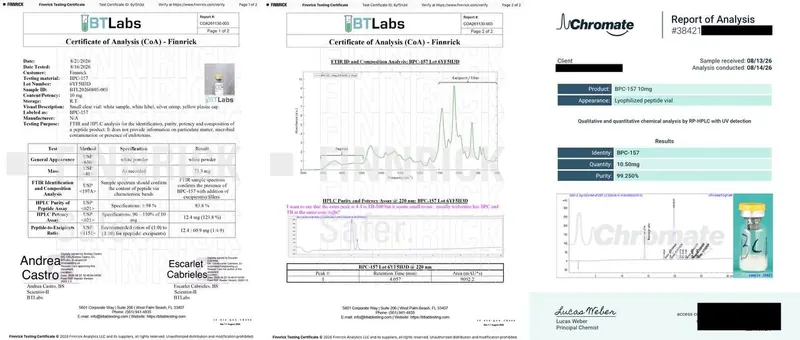
The discussion between Chromate, Vanguard Laboratory, Accumark Labs and BTLabs exposed a more fundamental problem with the percentage reported as peptide “purity”: two labs can recognise the same substance and still produce very different numbers because they disagree over whether that substance belongs in the calculation.
The first question, however, remains unanswered. Why is benzyl alcohol in a lyophilised peptide vial at all?
It is no longer an isolated finding
Chromate argued that benzyl alcohol has now appeared repeatedly enough that its presence can’t simply be dismissed as an unusual one-off. His position was that after seeing lyophilised vials containing benzyl alcohol for the “nth time in a month”, it becomes increasingly reasonable to consider whether its been intentionally added.
BTLabs said they were also seeing benzyl alcohol and other unknown fillers regularly:
“We see them everyday but don’t take the time to always ID or report.”
Vanguard went further and put a rough number on what he was seeing. Dustin said benzyl alcohol had suddenly started appearing in around 10% of samples. But Vanguard reached a different conclusion from Chromate. For Dustin, finding the same substance repeatedly is a reason to investigate its origin, not a reason to automatically classify it as an excipient. He compared it with sodium saccharin: if that suddenly appeared in 10% of peptide vials, Vanguard wouldn’t assume it was intentionally added or remove it from the purity calculation simply because it’s an accepted excipient in other products.
So why is it there?
Nobody has established why benzyl alcohol is appearing in these particular grey-market vials. But there is evidence that its presence in a lyophilised product is technically possible and isn’t necessarily the analytical oddity it first appeared to be. Benzyl alcohol has established pharmaceutical uses as both a preservative and solubilising agent. There are also pharmaceutical patents in which it’s deliberately added before lyophilisation, including peptide formulation patents that contemplate preserved formulations being freeze-dried. More importantly, freeze-drying doesn’t necessarily remove all of it. In one peer-reviewed experiment involving heparin, benzyl alcohol fell from 10.4 ± 0.5 mg per vial before drying to 0.9 ± 0.5 mg afterward. Most disappeared, but a measurable amount remained.
That doesn’t tell us why it is appearing in grey-market peptides.
I also asked a grey-market fill-finish manufacturer what he thought was happening. His first thought was that some operations could be preparing peptide solutions ahead of time with benzyl alcohol already added as a preservative and then lyophilising them later. The literature makes that sequence technically plausible, but doesn’t establish it as routine peptide manufacturing practice. Manufacturing guidance recognises that bulk solutions may be held before filling, although those hold times should be defined and validated. The research found no validated example in which benzyl alcohol was specifically being used to preserve peptide bulk for an extended period before later lyophilisation.
The fill-finish manufacturer also didn’t think benzyl alcohol would be an obvious choice specifically to improve lyophilisation. He raised concerns about its effect on the drying process and considered whether it might instead be helping poorly manufactured peptides into solution, but thought a purpose-made surfactant such as Tween 20 would make more sense if solubility were the objective.
The published evidence supports being cautious about some of those concerns. Benzyl alcohol’s effect on peptides and proteins appears to be formulation-dependent. In one study, it increased the physical stability and solubility of a proprietary 31-amino-acid palmitoylated peptide under salt stress, but the same behaviour wasn’t seen consistently in two structurally similar peptides. Other studies found destabilising effects in particular proteins. Its effects on collapse temperature and freeze-drying behaviour are plausible concerns, but there isn’t enough evidence to assign a universal effect to peptide formulations.
There is also evidence against treating benzyl alcohol as an obvious ingredient of a lyophilised formulation. Some licensed biologics keep the benzyl alcohol in the separate reconstitution diluent rather than the cake, and pharmaceutical literature has specifically noted that adding preservative before lyophilisation can be impractical because it evaporates during drying.
Another theory raised in Lab Chat was that increasing pharmaceutical demand could be squeezing the supply of higher-quality raw material available to the grey market. If finishers are receiving poorer-quality API with greater contamination, could some be adding benzyl alcohol during fill-finish as a cheaper way of controlling microbial contamination rather than relying on more expensive filtration?
There is currently no evidence showing that this is happening. In regulated manufacturing, preservatives are not a substitute for appropriate bioburden control or sterile processing. But it provides another possible explanation worth investigating for why benzyl alcohol is now being detected so frequently in grey-market lyophilised vials.
Chromate: an excipient isn’t a peptide impurity
Chromate’s position is the least ambiguous. Excipients are not peptide impurities. His argument is that once a peak has been identified as a common excipient such as benzyl alcohol, allowing that peak to substantially depress the reported peptide purity gives a misleading impression of the peptide itself. Chromate questioned the logic of waiting indefinitely for manufacturer confirmation when benzyl alcohol is being found repeatedly and reliable formulation information may be unavailable.
His suggested direction was broader than benzyl alcohol: common excipients shouldn’t automatically be treated as peptide-related impurities once they’ve been identified. But Chromate also acknowledged that identification comes first. His criticism was partly that benzyl alcohol itself appeared to be causing difficulty for several laboratories.
Vanguard: identification doesn’t prove intentional addition
Vanguard draws a harder line between identifying a compound and deciding why it’s there. Dustin said Vanguard can identify the benzyl alcohol peak and quantify it. What he won’t do is conclude that the compound was intentionally added simply because it’s appearing frequently.
If the client or supplier confirms that benzyl alcohol was deliberately included as an excipient, Vanguard identifies it as such and excludes it from the peptide-related impurity calculation. If the supplier says that no undisclosed excipients or processing aids were used, Vanguard treats the unexplained benzyl alcohol as an impurity and leaves it in the chromatographic purity calculation.
There is another option. If the client specifically asks Vanguard to exclude it, the laboratory can report purity without it, but Dustin said the report would still identify the benzyl alcohol, report its area percentage and state that it was excluded at the client’s request.
His reasoning was straightforward: Vanguard is an analytical laboratory, not the formulator. The laboratory can establish what it sees, but cannot establish from frequency alone that the manufacturer deliberately put it there.
Accumark: without formulation evidence, it is a contaminant
Accumark (who have also just joined lab Chat) took a broadly similar position. Levi said that without vendor or manufacturer specifications showing benzyl alcohol was used for stability or formulation, Accumark views benzyl alcohol in a lyophilised peptide as a contaminant. They don’t make assumptions based simply on its presence. But that changes when benzyl alcohol is expected as part of the formulation. Levi gave finished peptide products in solution as an example. Where benzyl alcohol is commonly used in the solution, or the vendor specifies it as part of the formulation, Accumark doesn’t count that benzyl-alcohol peak against the peptide.
The distinction is therefore not whether benzyl alcohol can ever be an excipient. Everyone accepts that it can. The disagreement is whether identifying benzyl alcohol is enough to establish that it’s functioning as an excipient in that particular lyophilised vial.
BTLabs: seeing the same thing, but not always identifying it
BTLabs added another wrinkle. They agreed that the laboratory sees benzyl alcohol and other unknown fillers frequently, but said BTLabs doesn’t always spend the time required to identify or report them. That matters because an unidentified additional peak can remain part of the chromatographic calculation even when another laboratory testing comparable material might identify it as a non-peptide component.
The disagreement can therefore begin before anyone even reaches the question of whether to exclude an excipient. First the peak has to be recognised and identified.
What are labs actually calling “purity”?
The discussion eventually moved beyond benzyl alcohol altogether. Chromate criticised the idea that benzyl alcohol could reduce a peptide’s reported purity by more than 20% simply because it hadn’t been formally declared as an excipient.
Dustin then challenged Chromate from the opposite direction. If Chromate identifies every peak and excludes anything it decides is not peptide-related, he asked, what exactly is the final percentage measuring? His point was that such a result would be peptide-related purity, rather than total chromatographic purity, and that the COA should make that distinction clear.
This is an important distinction because a result can change dramatically depending on whether the calculation includes every detected chromatographic component or only those classified as peptide-related.
What remains unanswered
What we still don’t know is who is adding the benzyl alcohol, at what stage, and why.
The evidence shows that benzyl alcohol can be present before lyophilisation and survive the drying process. What it doesn’t show is which manufacturing route explains its appearance in these grey-market vials. Until that is established, the argument over whether it should be treated as an excipient or impurity remains unresolved.
And that distinction can materially change the purity printed on the COA.
Comments