
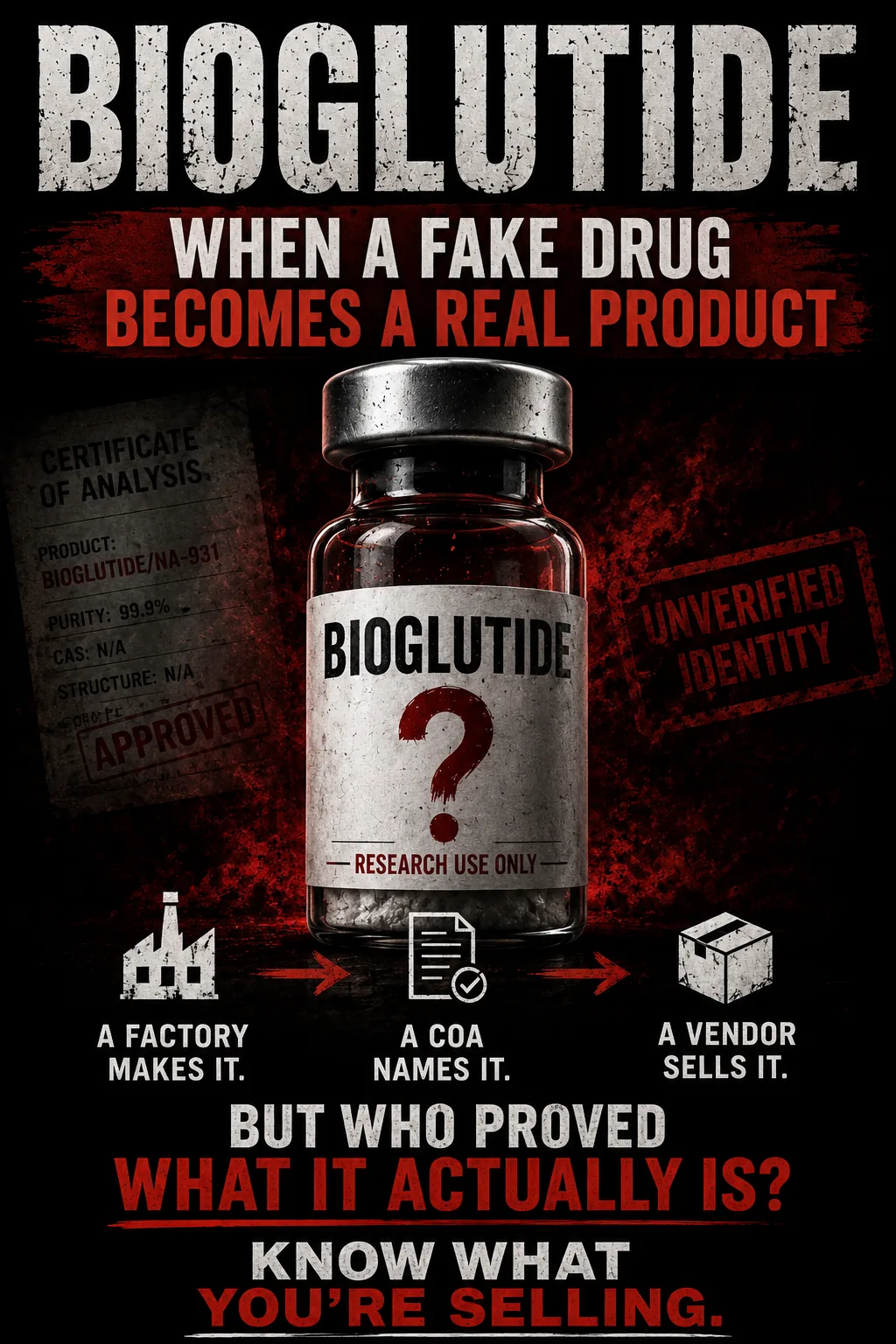
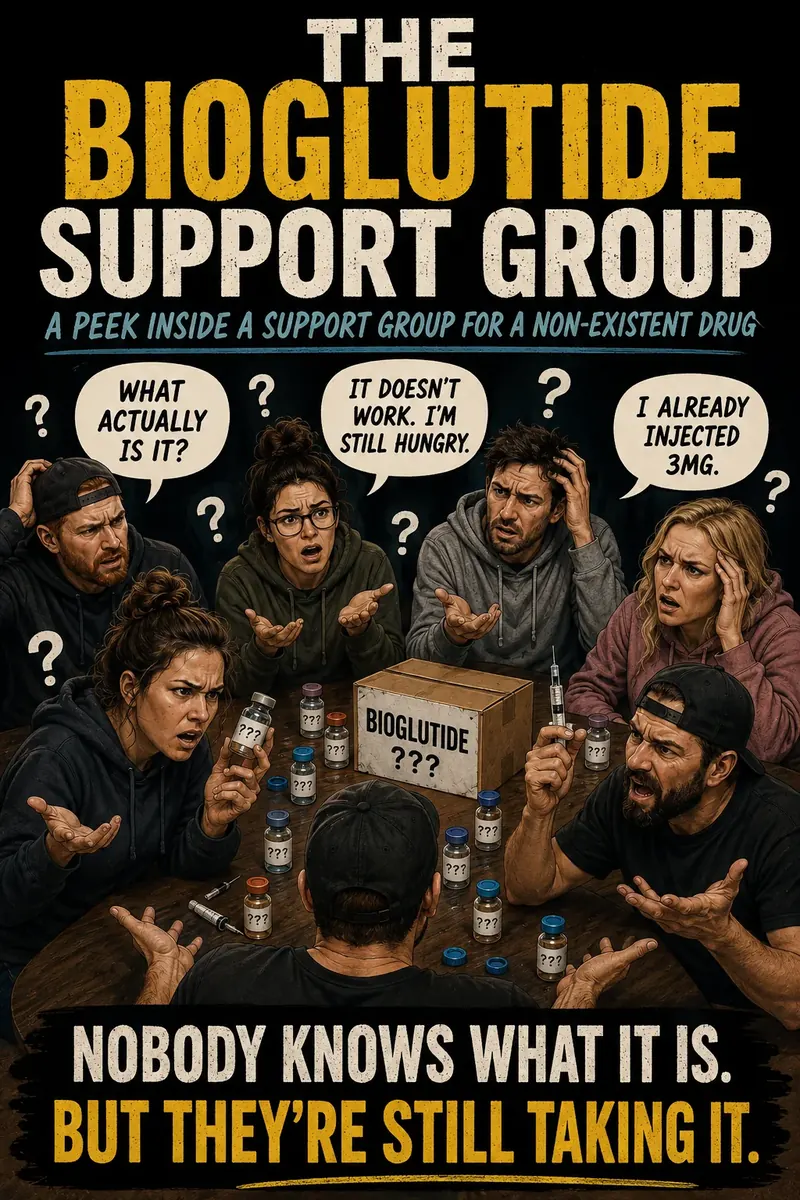
Considering Bioglutide is a fake drug, it’s generated a tremendous amount of debate in K-Hole, especially in the QWB and JBG channels, where it’s appeared on price lists. But the debate has raised a much bigger question than Bioglutide itself: What responsibility does a vendor have for understanding what they’re actually selling?
We’re now coming up to close to a year since the Bioglutide story initially unravelled and Chinese manufacturers are still producing something under the Bioglutide name, issuing factory COAs for it and supplying it to vendors who may genuinely believe those COAs prove the product is real. Personally, I don’t think these vendors are necessarily deliberately setting out to sell a fake drug. I think the problem is more complicated than that.
They trust the factory.
A manufacturer offers “Bioglutide” raw material. A COA arrives calling it Bioglutide/NA-931. It has a purity figure, molecular weight, perhaps a formula, a batch number and a factory stamp. To the vendor, that looks like confirmation. But there’s a fundamental problem:
What exactly did the factory manufacture, and who decided that whatever they manufactured should be called Bioglutide?
I’m not going to rehash all the evidence surrounding Bioglutide here. My previous articles cover the disputed clinical claims, copied trial material, contradictory timelines, supposed quadruple-agonist pharmacology and the other problems surrounding NA-931. This article is about what happens after a drug story like that enters the supply chain, because eventually somebody has to manufacture it. And if the drug being requested was never coherently established as the molecule it was claimed to be, what exactly does the factory manufacture?
The Problem Starts Upstream
Chinese peptide vendors generally aren’t developing these drugs themselves. They source raw materials, arrange production and respond to demand already developing in the market. So if customers begin asking for something called Bioglutide and an upstream manufacturer says it can supply the raw material, complete with a COA, the downstream vendor may reasonably assume the factory knows what it is making. But who established that identity in the first place?
The Bioglutide patent application describes NA-931 as cyclic prolyl glycine /cPG, yet the public Bioglutide story described a quadruple agonist acting across IGF-1, GLP-1, GIP and glucagon pathways. Those are clearly not the same claim. A factory COA can’t resolve that contradiction simply by putting “Bioglutide/NA-931” at the top.
A COA Cannot Create a Chemical Identity
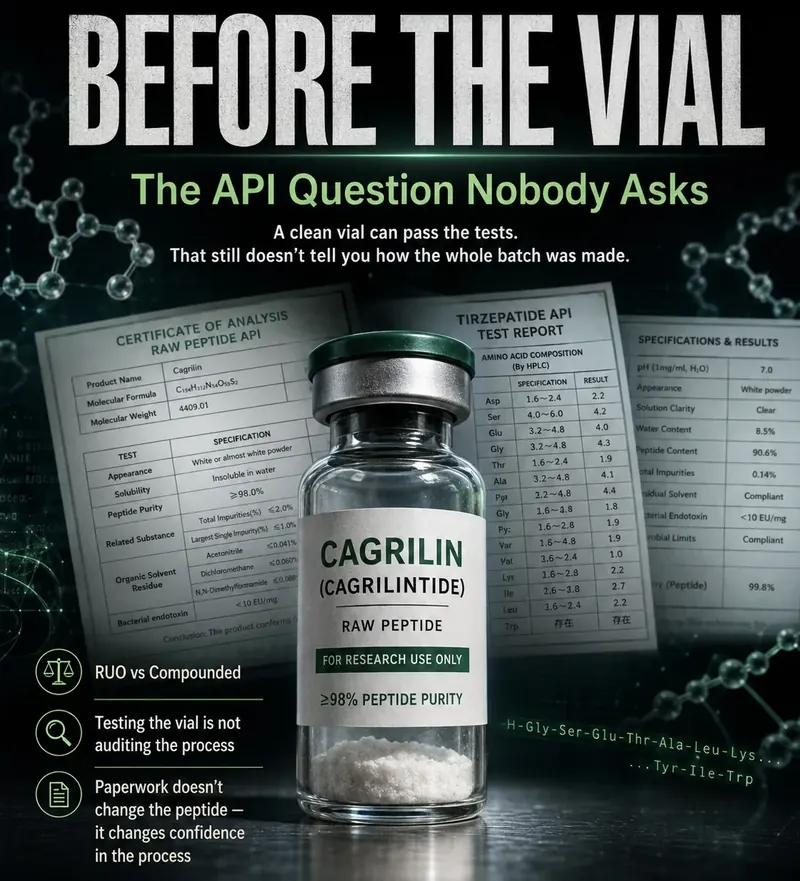
This is where I think many vendors genuinely misunderstand what a COA proves. If a factory manufactures compound X and HPLC reports it as 99.9% pure, that may tell us something useful about the purity of compound X under that analytical method. But it doesn’t establish that compound X is Bioglutide simply because somebody typed “Bioglutide/NA-931” onto the certificate.
The COAs I’ve now seen illustrate the problem perfectly. One factory COA supplied for “Bioglutide; NA-931” gives:
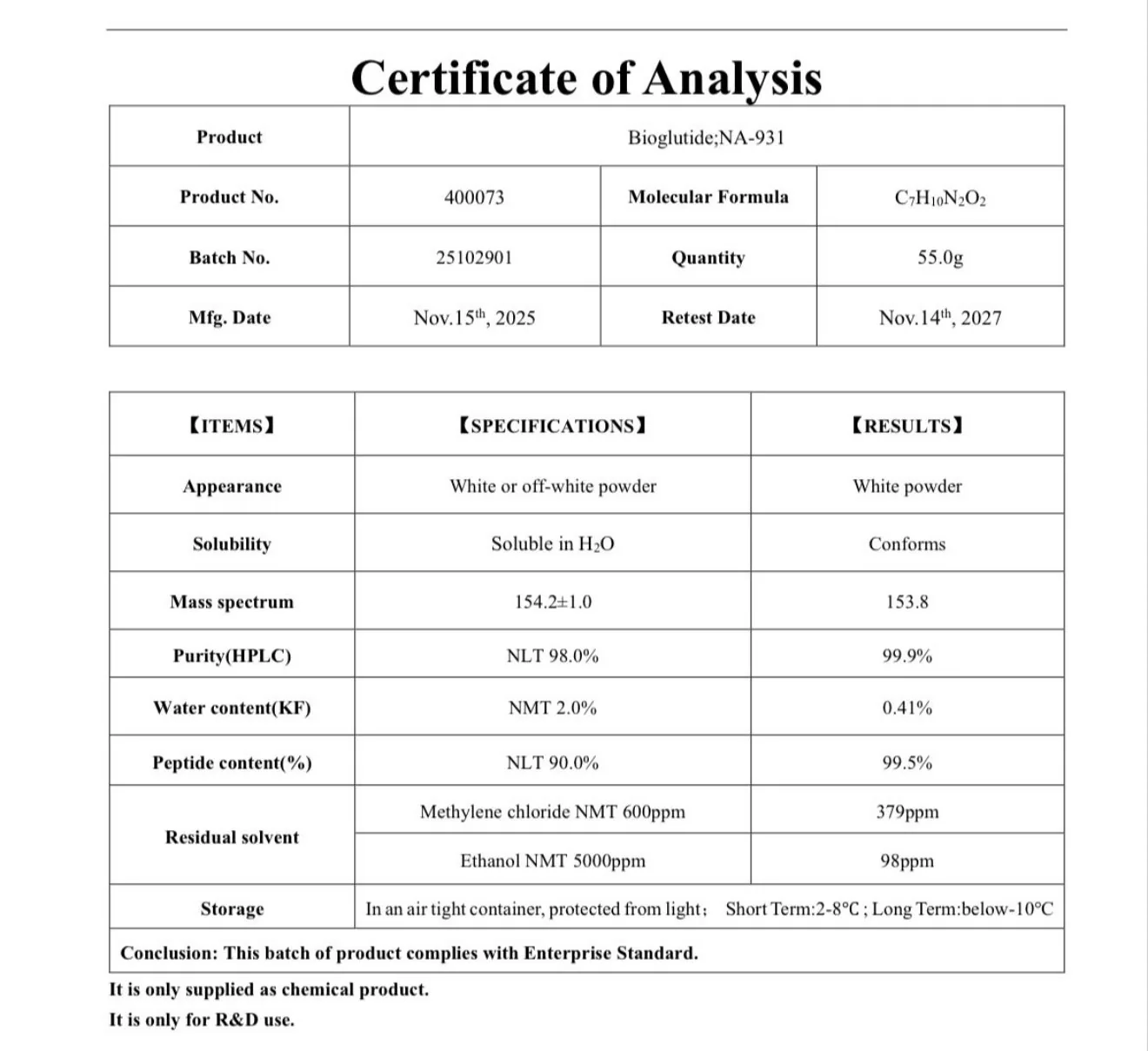
Molecular formula: C₇H₁₀N₂O₂
Expected mass: 154.2 ± 1.0
Mass-spectrum result: 153.8
HPLC purity: 99.9%
Peptide content: 99.5%
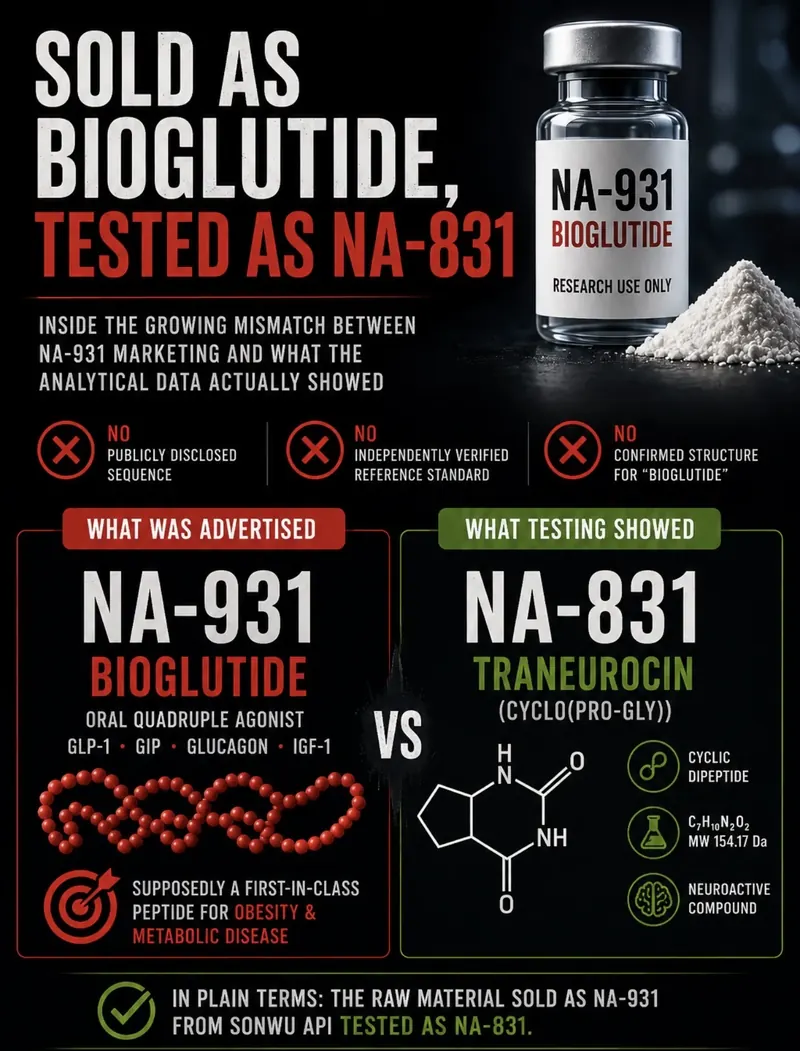
The molecular formula and mass are compatible with a very small cyclic dipeptide. What the certificate doesn’t contain is receptor-binding data or functional assays demonstrating that this material is the supposed GLP-1/GIP/glucagon/IGF-1 drug described in the Bioglutide story.
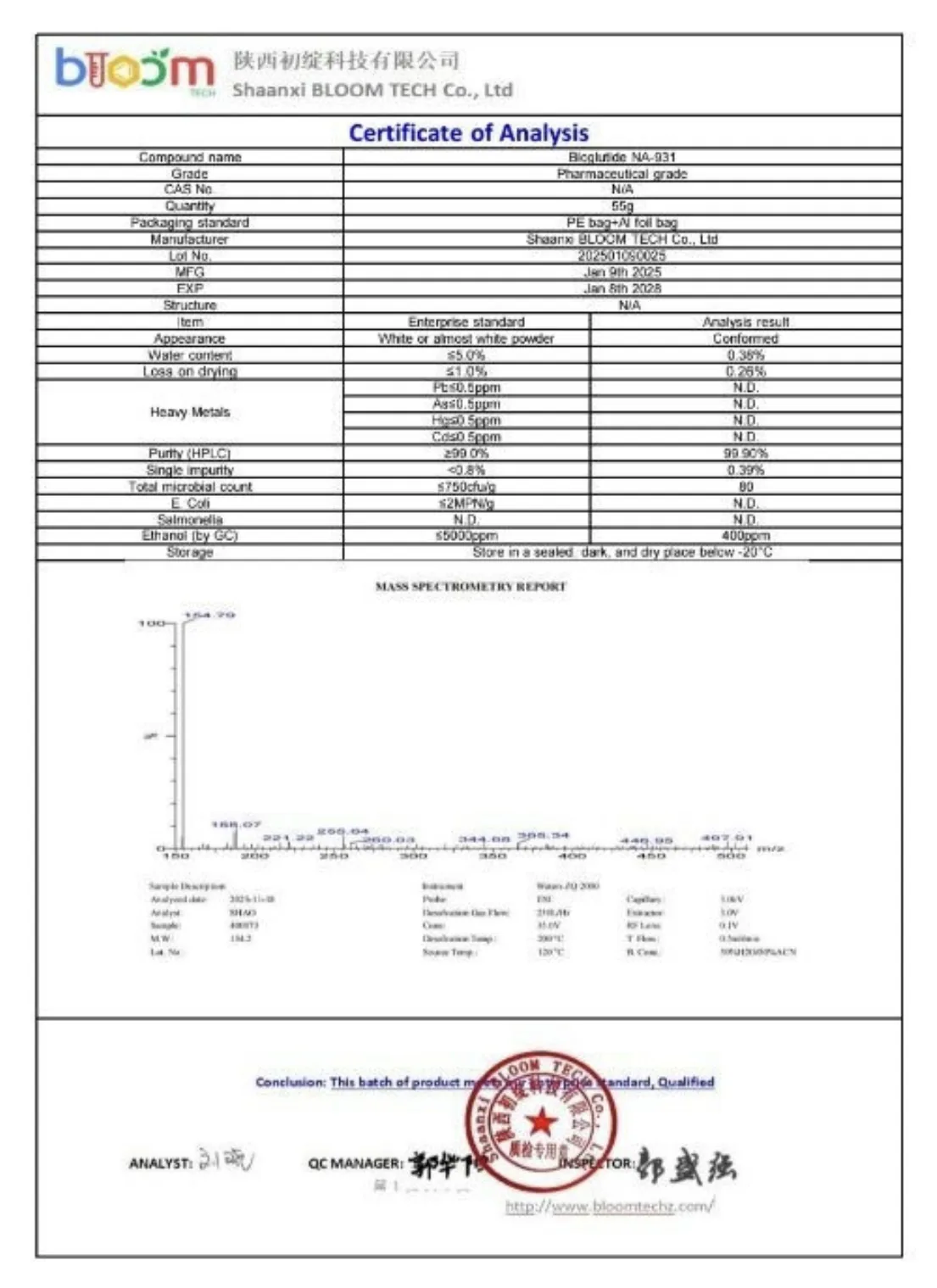
Another manufacturer’s COA takes a different approach. It calls its product: “Bioglutide NA-931.” But underneath it says CAS number: N/A and Structure: N/A. It nevertheless reports 99.90% HPLC purity. Again, 99.90% pure what? If the structure itself is listed as N/A, what precisely has been established?
Then It Gets Stranger
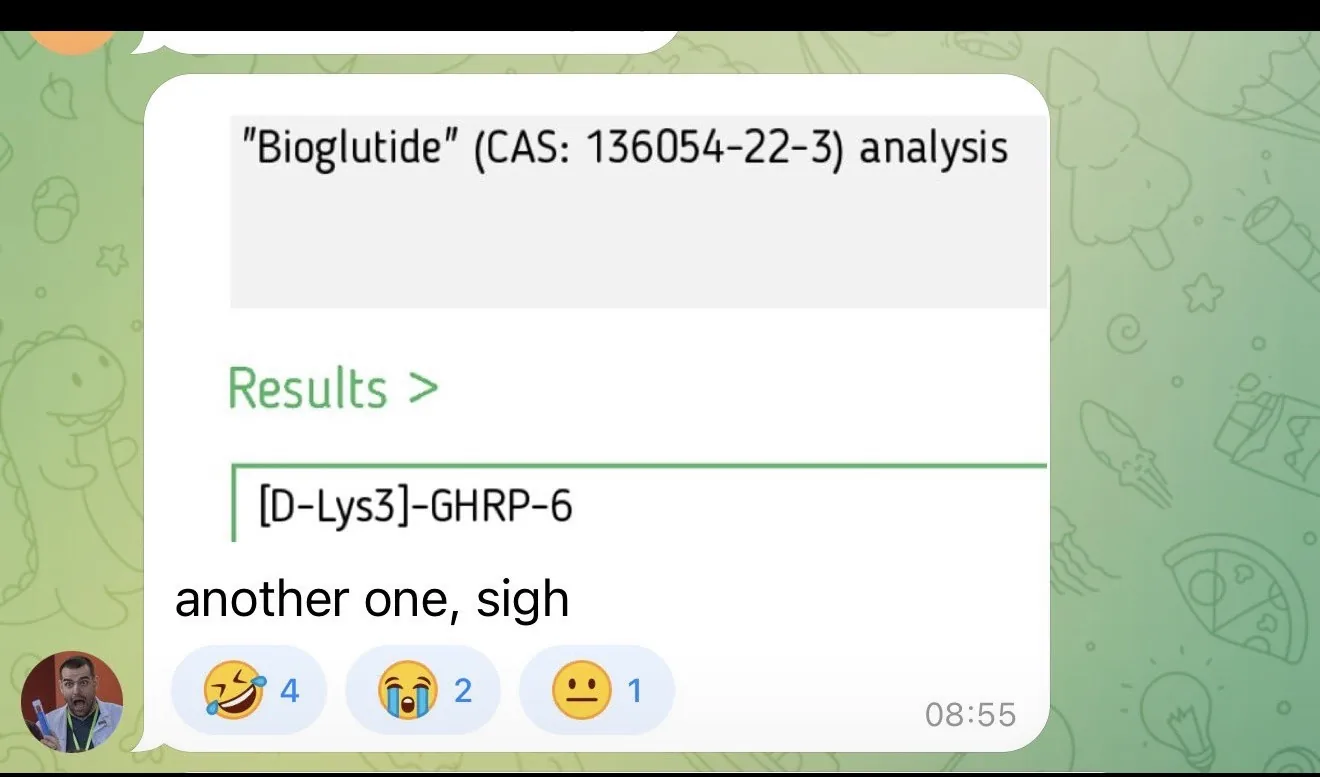
Another sample submitted for analysis as “Bioglutide” carried CAS 136054-22-3. The analytical identification came back, [D-Lys³]-GHRP-6. At first glance, that looks like another supposed Bioglutide sample unexpectedly containing a completely different peptide. But there’s an even more fundamental problem. CAS 136054-22-3 is already associated with [D-Lys³]-GHRP-6. So the chemical identifier attached to the supposed “Bioglutide” was pointing towards a different known compound before the laboratory even analysed it. That shows exactly what can happen when a product name begins circulating without a consistently established chemical identity behind it.
We’ve Already Seen This Happen
This isn’t merely theoretical. Previous products sold as “Bioglutide” have been independently identified as a mixture of retatrutide and cagrilintide. Separate raw material represented as NA-931 was analysed and identified as NA-831 by Kimera Chems. Now we have documentation associating the Bioglutide name with still other chemical information. None of this means that Bioglutide itself is Reta+Cagri, NA-831 or GHRP-6. Quite the opposite.
It demonstrates what happens when different manufacturers start assigning different chemistry to the same disputed drug name. The name stays the same. The substance underneath it changes.
A Fake Drug Can Become a Real Product
And this is the part I find fascinating. You don’t necessarily need a dishonest vendor for this to happen. Imagine the chain.
A drug is promoted online > Influencers discuss it > Potential customers become interested > Demand reaches peptide vendors > Vendors ask manufacturers whether they can supply it > A manufacturer says yes > Somebody upstream assigns a substance to the name > A COA is produced > The vendor sees the COA and assumes the factory has established the identity > The raw material gets filled > The kits are labelled and added to a price list > The customer buys it > At the end of that process, there is now a physical product called Bioglutide.
But manufacturing something and calling it Bioglutide doesn’t retroactively establish that the original drug exists as advertised. The market has turned a name into a product and that’s not the same thing as turning a drug candidate into a verified molecule with the claimed pharmacology.
So Who Is Morally Responsible?
This is where it becomes less black and white. If a manufacturer knowingly puts one substance into a vial and deliberately sells it as a completely different molecule, that’s straightforward misrepresentation. But what about a vendor who genuinely believes the factory? A salesperson isn’t necessarily a pharmacologist. A vendor carrying dozens of research products may reasonably assume that the manufacturer supplying the API understands the chemistry better than they do. I can understand how it happens, but ignorance can only take you so far. Once serious questions are raised about the identity of the product, the moral position changes., At that point, “my factory says it’s real” is no longer enough.
The Manufacturer Carries the First Responsibility
The greatest initial responsibility lies with whoever assigns a chemical substance to the name. If a manufacturer sells something as Bioglutide/NA-931, it should be able to establish why that particular material is Bioglutide/NA-931. There should be an independently defensible chemical identity. And if extraordinary pharmacological claims are being used to define the drug, there should be evidence connecting that molecule to those claims. Otherwise the factory isn’t reproducing an established drug, it’s deciding what the drug is and that’s a very different activity.
But Responsibility Eventually Reaches the Vendor
I don’t expect a vendor to investigate the entire scientific history of every product on a 100-item price list. That’s unrealistic. But once the vendor has been shown that the identity is disputed, that supposed Bioglutide materials have produced incompatible analytical findings and that factory documentation itself contains conflicting chemical information, the vendor knows there’s a problem. From that moment, continuing to sell it without resolving the identity becomes much harder to defend. At minimum, I would expect the vendor to stop selling it temporarily and go back to the manufacturer and if the factory claims that it’s the extraordinary quadruple agonist associated with the Bioglutide story, ask for the evidence demonstrating that pharmacology. The burden shouldn’t be transferred to the customer.
“Buy It and Test It” Gets the Responsibility Backwards
On one side of the argument is that customers can simply buy a vial and independently test it. The vendor says “I’m selling X”, but when customer asks, “How do you know it’s X?”, the answer becomes “Buy it and prove it isn’t”
That’s backwards. The person making the positive claim that a product is Bioglutide should have reasonable evidence supporting that identity before taking money for it. Customers shouldn’t have to purchase mystery substances and pay analytical labs to discover what the manufacturer has decided “Bioglutide” means this week. Testing remains extremely valuable. But independent testing should verify a supplier’s claim. It shouldn’t be required to discover what the supplier is actually selling in the first place.
“Research Use Only” Doesn’t Fix It
Nor does putting R&D use only on a COA solve the problem. Research chemicals still require identity. In fact, accurate identity is fundamental to research. If the label says retatrutide, the material should be retatrutide. If it says GHRP-6, it should be GHRP-6. And if it says Bioglutide, the supplier should be capable of explaining what Bioglutide chemically is and how it established that the material corresponds to it. Otherwise, “research use only” has become a disclaimer attached to an unidentified substance.
Buyers Aren’t Completely Innocent Either
There is responsibility on the other side. If someone knows this history, understands that the identity is disputed and still decides to purchase something labelled Bioglutide, that’s their decision. The grey market can’t operate on the assumption that buyers have no agency whatsoever. Two things can be true simultaneously: Buyers have a responsibility to investigate what they purchase and vendors have a responsibility not to sell something under an identity they cannot substantiate.
Where Is the Moral Line?
We can’t expect every salesperson to understand receptor pharmacology and I don’t automatically assume a vendor is acting dishonestly simply because a factory has sold them something under the wrong or unsupported name. Everyone downstream assumes someone upstream must have verified it. But perhaps nobody ever did. That’s how a drug that may never have existed as advertised can end up sitting in a real vial, on a real price list, being sold to a real customer. And that is where this stops being just a Bioglutide story. It’s a supply-chain problem.
I have a feeling this isn’t the last Bioglutide article I’ll be writing either
Comments