
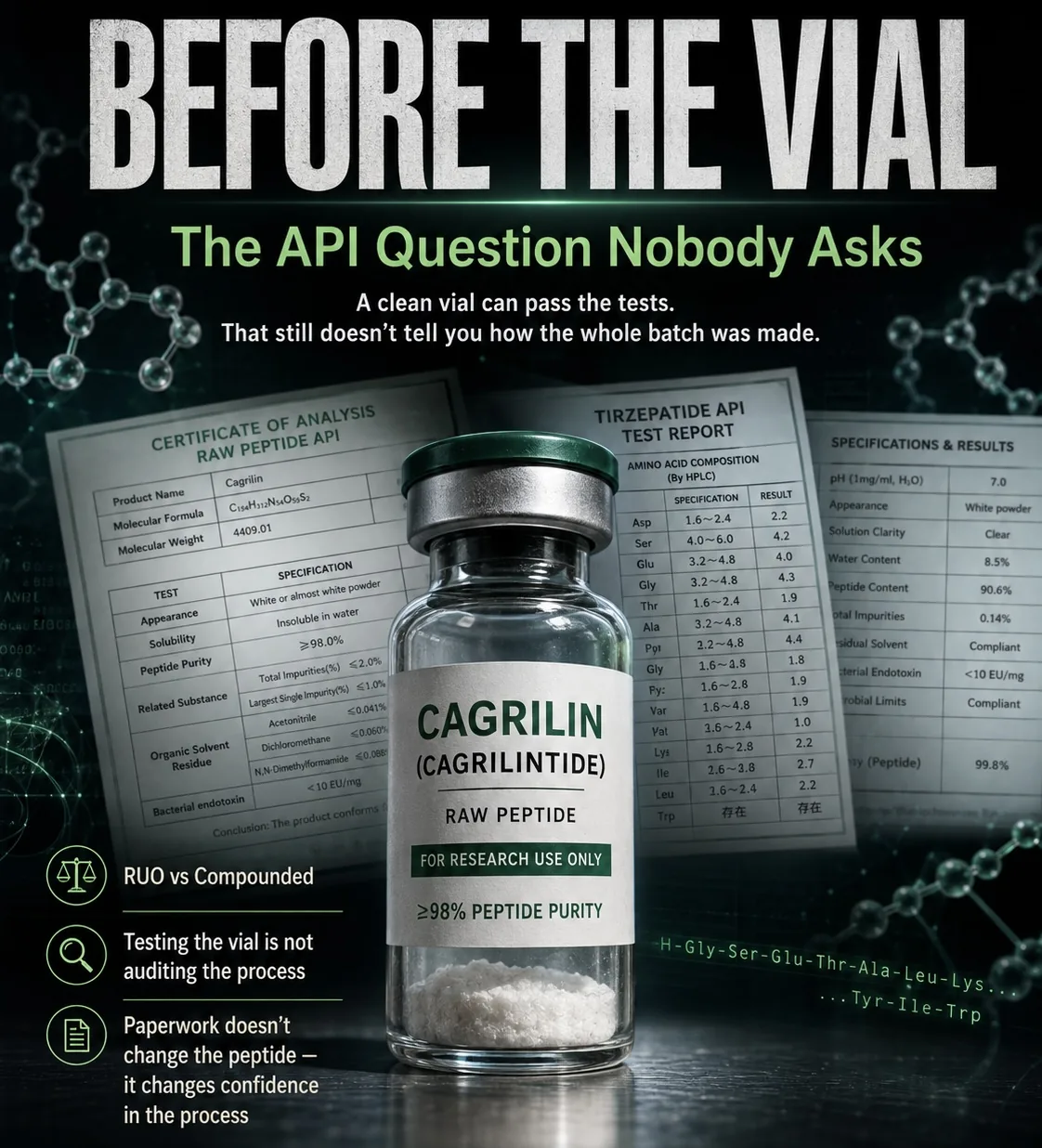
A question came up in the K-Hole lab chat that sounds simple enough:
What is the actual difference between an RUO peptide and one supplied by a compounding pharmacy?
If an RUO vial contains the correct peptide, the expected quantity and high purity, then passes endotoxin and sterility testing, how different is the substance inside from a compounded product? The answer is more complicated than RUO bad, pharmacy good. To understand why, we need to start before there is even a vial.
RUO Is Not a Quality Grade
“Research Use Only” describes the intended use and regulatory positioning of a product. It doesn’t tell us whether the peptide inside is 80% pure, 99.8% pure, correctly dosed, contaminated or completely bunk. Two products carrying exactly the same RUO label can be manufactured to completely different standards.
Likewise, calling something an API doesn’t automatically make it pharmaceutical grade. API simply means active pharmaceutical ingredient: in this case, the peptide material that will eventually be turned into a finished product. So perhaps the better question isn’t Is this RUO or pharmacy? It is: Where did the API come from, what specification was it manufactured against and what was actually tested before anyone put it into a vial?
Before the Vial Comes the API
The lyophilised puck most researchers eventually see is much further down the manufacturing chain. Somebody first had to manufacture the peptide. Depending on the material and the specification it is being released against, API testing can examine identity, assay or peptide content, chromatographic purity and related substances, water content, residual solvents, elemental impurities, microbiological quality and other product-specific characteristics.
Compare that with what usually happens in the grey market. A finished vial is sent to a third-party laboratory and comes back with, for example: Correct identity. 30.4 mg. 99.5% purity. Increasingly, endotoxin and sterility are added as well. That gives us useful information about the vial tested, but surprisingly little about the material before it went into that vial.
We spend enormous amounts of time scrutinising the COA for one tiny finished vial while almost nobody asks to see the COA for the hundreds of grams of API from which thousands of those vials may have been made. Was the incoming API independently verified? Were impurities and residual solvents monitored? Was the manufacturer identified, or was the material accepted because a bag arrived with “99%” written on its paperwork?
For much of the RUO market, we simply don’t know. A supplier could turn a large quantity of API into thousands of vials and send only one or two finished vials for testing. Those samples may come back beautifully, but we have started our investigation almost at the end of the process.
What Does an API COA Actually Look Like?
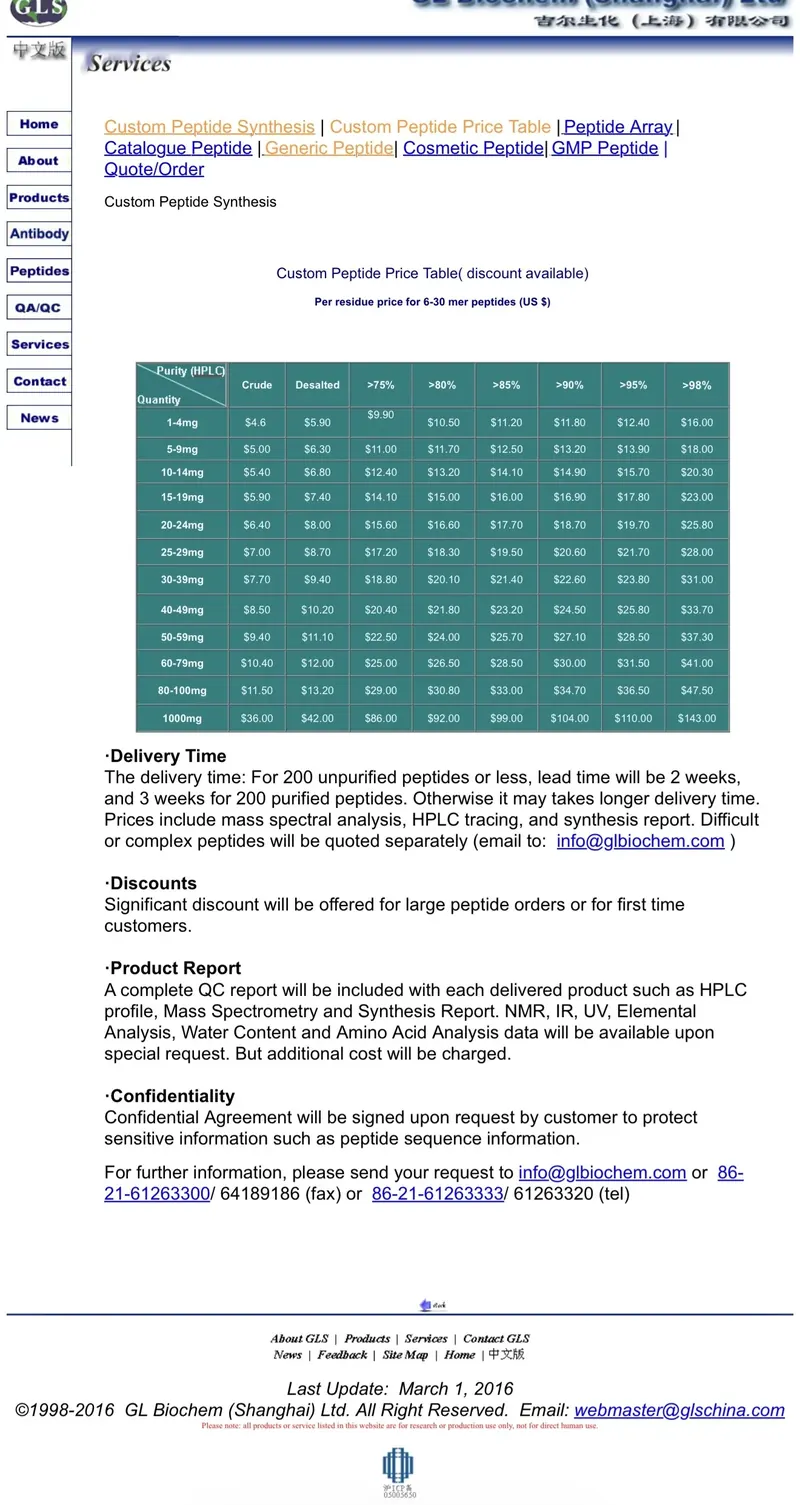
These are examples of COAs supplied for bulk peptide API before it has been turned into the finished vials customers eventually see. They look at considerably more than the familiar identity + quantity + HPLC purity combination.
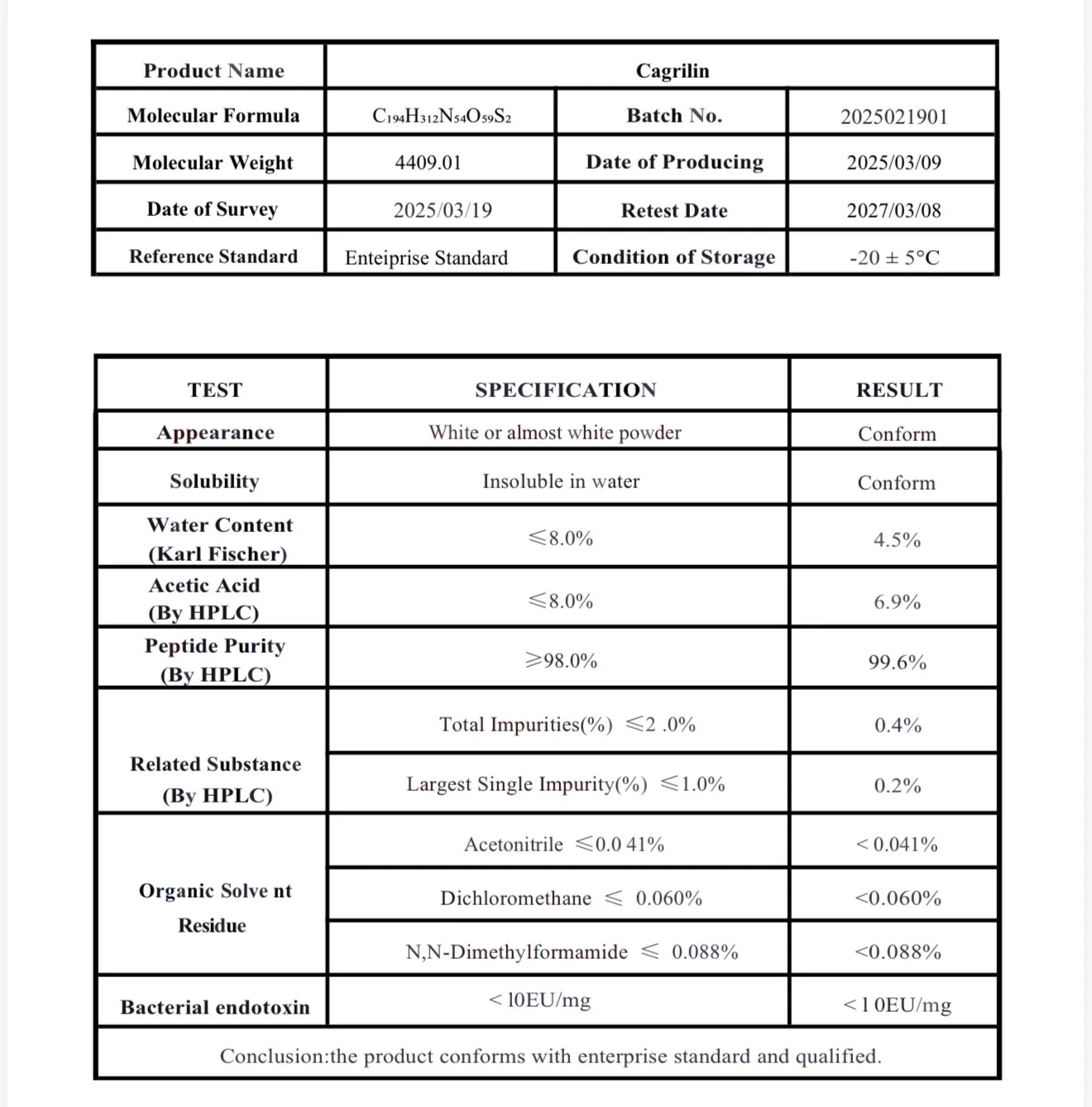
One Cagrilintide API COA reports:
Water content by Karl Fischer: 4.5%
Acetic acid: 6.9%
HPLC purity: 99.6%
Total impurities: 0.4%
Largest single impurity: 0.2%
Residual acetonitrile
Residual dichloromethane
Residual DMF
Bacterial endotoxin: <1 EU/mg
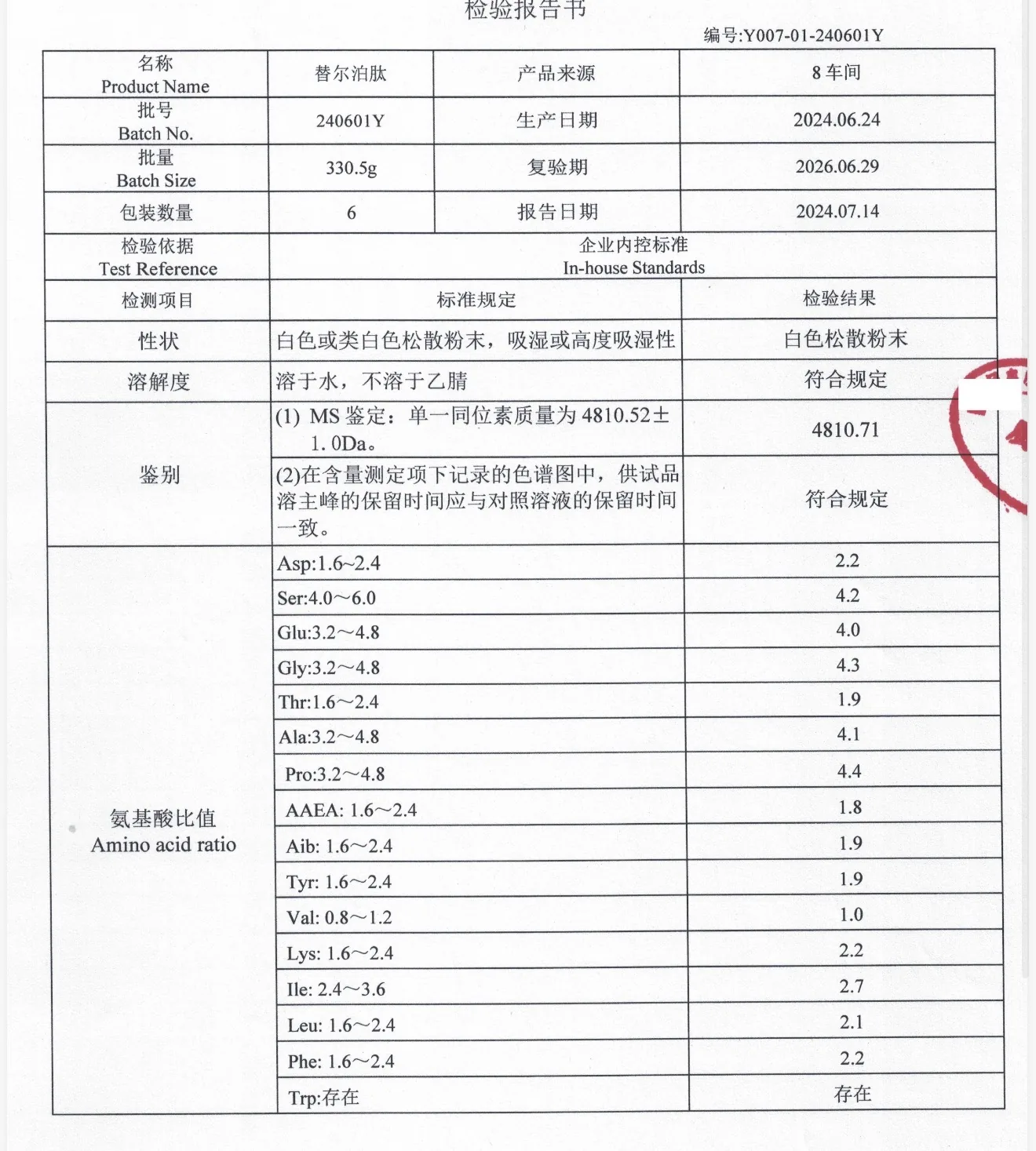
Another API COA, for a 330.5 g batch of tirzepatide, goes further. It includes identity by mass spectrometry, HPLC comparison against a reference, amino-acid ratios, pH, water content, peptide content, chloride, phosphate, sodium and ammonium, polymeric protein, related substances, multiple residual solvents, bacterial endotoxin, microbial limits, absence of E. coli and assay.
That is a very different level of testing from sending one finished 30 mg vial to a laboratory to confirm it contains tirzepatide and calculate what percentage of its HPLC peak area is the main peptide.
Purity, Assay and Peptide Content Are Not the Same Thing
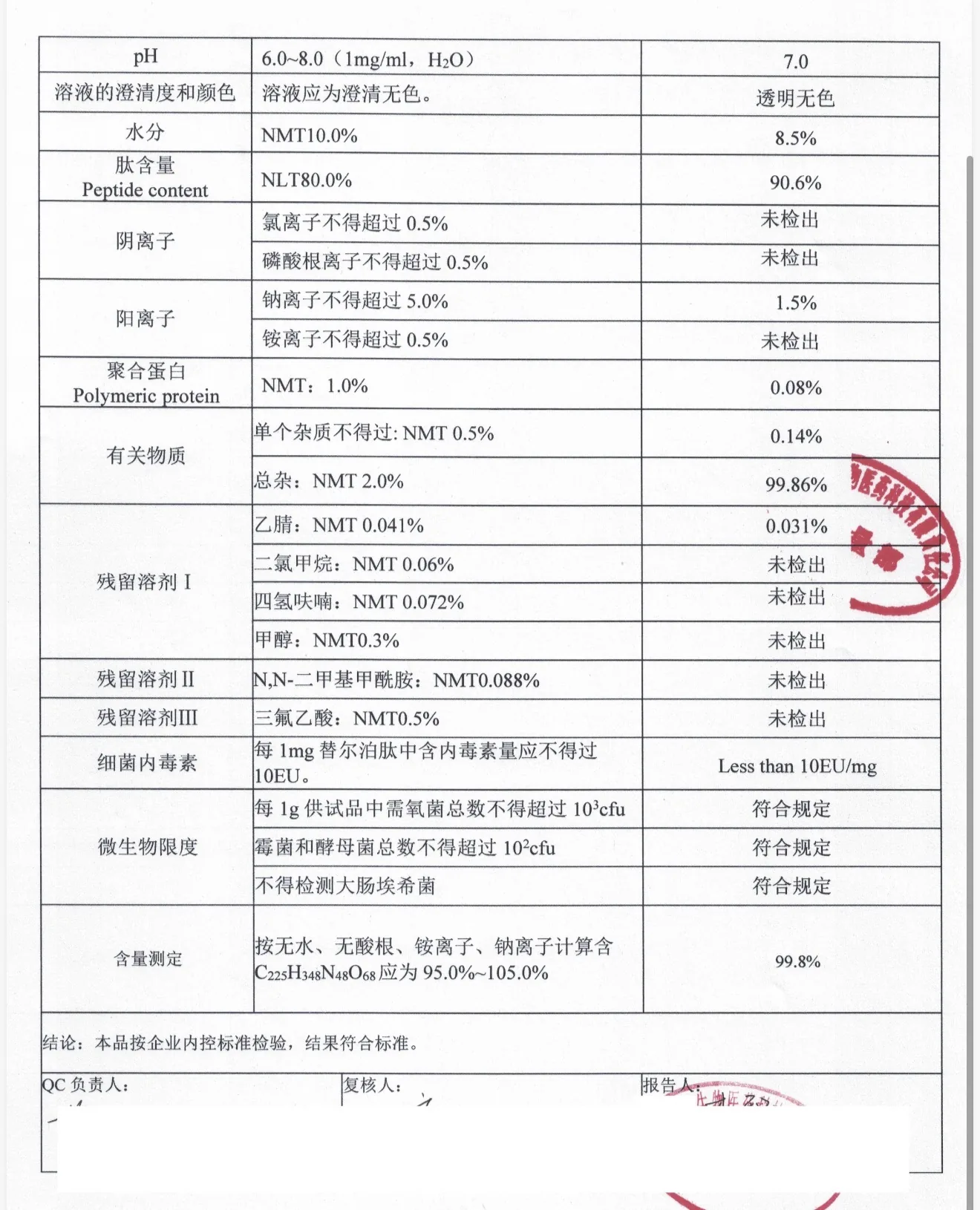
One of the tirzepatide API reports gives:
Water: 8.5%
Peptide content: 90.6%
Assay: 99.8%
At first glance, those numbers look contradictory. How can the material contain only 90.6% peptide but have a 99.8% assay?
Because they are measuring different things. Think of 100 mg of API powder. The peptide-content result indicates that about 90.6 mg is peptide material, while around 8.5 mg is water. The powder can also contain counterions and other non-peptide components.
The 99.8% assay doesn’t mean that 99.8 mg of every 100 mg of powder is tirzepatide. It measures tirzepatide against the analytical basis used for that assay, which may be corrected for water or salt/counterion content depending on the method. That’s why a headline figure of “99.8%” can’t be read on its own as “this powder is 99.8% peptide by weight.” It’s also why API COAs separate water, peptide content, assay and chromatographic purity instead of treating them as one number.
But the API COA Stops at the API
Even if these COAs are completely genuine, they relate to the raw peptide powder, not the finished vials eventually sold to customers. The powder still has to be weighed, formulated, dissolved, filtered, filled, lyophilised, sealed and stored. Concentrations can be calculated incorrectly, fill volumes can vary, the peptide can degrade, contamination can be introduced and batches can be mixed up.
An API COA and a finished-vial COA therefore answer two different questions. The first may provide evidence about the starting material. It can’t prove that the final vial contains the correct peptide or quantity, retains the same purity, passes endotoxin and sterility testing or can genuinely be traced back to that API batch.
There is also a limitation within the documents themselves. Their test references include “In-house Standards” and “In-house specification/Protocol specification.” That isn’t inherently wrong, but it means the manufacturer defined the specifications against which the API batch was released. It raises questions about who established them, whether the methods were validated, whether the testing happened and whether the COA is authentic.
Even perfect answers would only strengthen the evidence for the raw API. They wouldn’t prove what happened between that bag of powder and the finished vial.
Liquid Versus Lyophilised Is Not the Real Difference
People sometimes describe pharmacy peptides as “liquid” and RUO peptides as “powder” as though they began as completely different products. Usually, both start with peptide API that’s put into solution. A typical lyophilised research peptide is formulated in solution, filled into vials and freeze-dried, leaving the puck that the buyer later reconstitutes. Many compounded injectable peptides are instead dispensed as finished liquids, with the concentration already established by the compounder.
For a compounded sterile preparation, the pharmacy takes the API, verifies the starting material, calculates and prepares the required formulation, processes it under controlled sterile conditions, fills and seals the vials, and assigns the appropriate storage conditions and beyond-use date. Depending on the operation and product, additional release testing may also be performed. So the pharmacy isn’t simply taking peptide powder and adding water. It’s responsible for turning the API into the final sterile preparation.
The API COA only tells you about the starting material. Once that API has been formulated and filled, the finished product introduces new questions about concentration, sterility, endotoxin, stability and consistency.
That’s the real difference.
A dry puck isn’t evidence of poor quality, and a liquid vial isn’t evidence of high quality. Lyophilisation can provide stability advantages for peptides that are less stable in solution. The important difference is who takes responsibility for turning the API into the final preparation.
With a compounded sterile product, that responsibility sits with the compounder. With a typical RUO lyophilised peptide, the seller stops at the dry vial. Someone else chooses the diluent, decides how much to add and performs the reconstitution, introducing another opportunity for error or contamination.
What If Both Products Used the Same Chinese API?
Compounding pharmacies don’t usually manufacture peptide API themselves. They buy bulk drug substances from external manufacturers, many of them in China. In the US, qualifying bulk substances used under sections 503A and 503B must meet specific sourcing conditions, including being accompanied by a valid COA and manufactured by an FDA-registered establishment. There are also restrictions on which bulk substances can legally be used for compounding.
Could a compounder and an RUO seller ultimately source peptide from the same Chinese manufacturer? Potentially, yes. “Compounded in America” doesn’t mean every raw material originated there. But without identifying the manufacturer and relevant batches, it’s all the same Chinese API anyway remains an assumption.
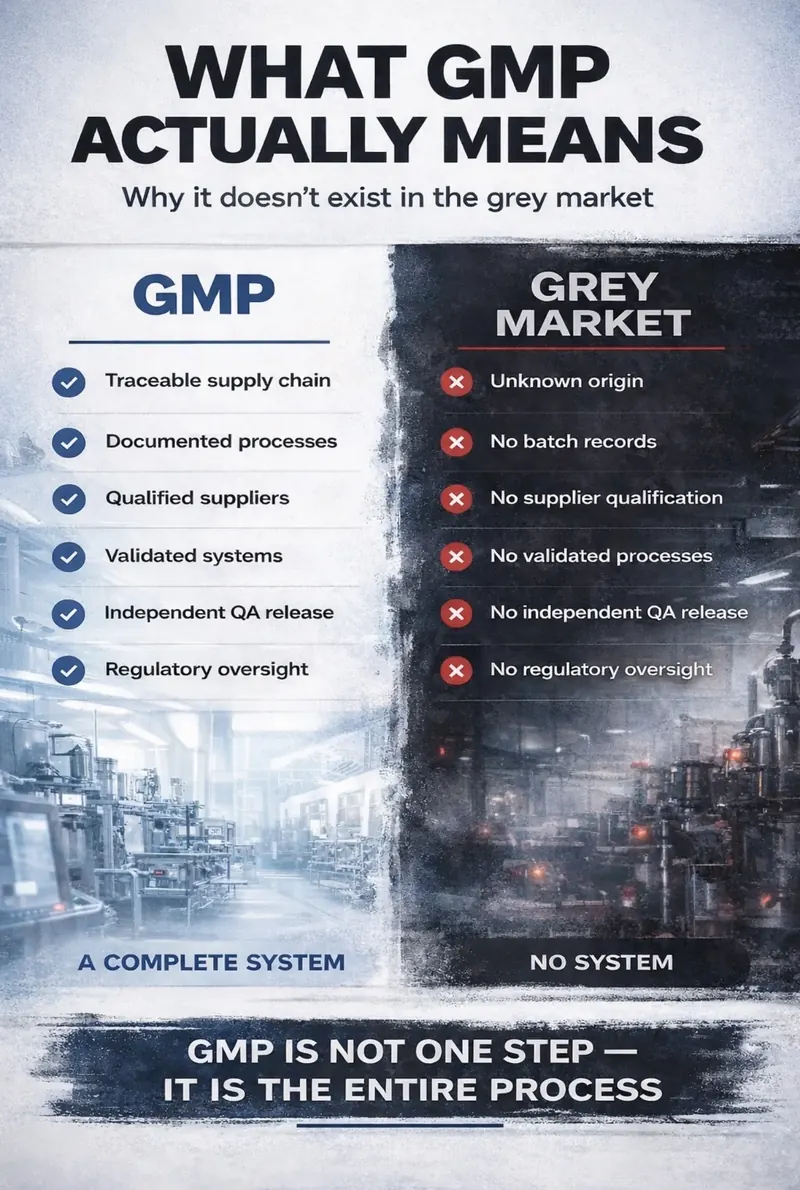
Even if the API really were identical, the finished products wouldn’t automatically be the same. One might pass through documented receiving, supplier qualification, incoming-material controls, formulation records, controlled sterile processing, environmental monitoring, batch documentation and defined release procedures. The other might be filled and lyophilised by a facility about which the customer knows almost nothing before a couple of vials are sent for third-party testing.
The Pharmacy Side Isn’t One Single Standard Either
“Compounding pharmacy” is often discussed as though it describes one uniform regulatory system. It doesn’t. In the US, 503A pharmacies and 503B outsourcing facilities operate differently.
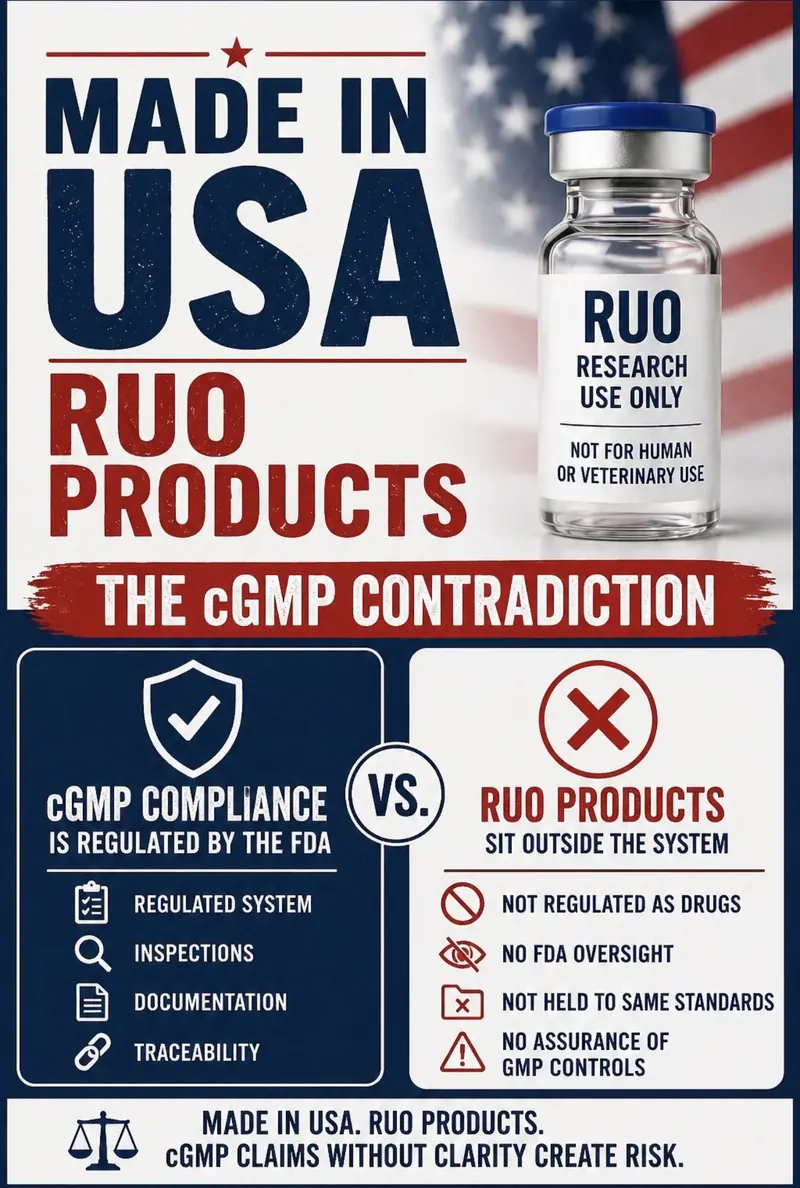
503A generally involves compounding based on prescriptions for identified individual patients and, when the statutory requirements are satisfied, the compounded drugs are exempt from federal CGMP requirements. 503B outsourcing facilities can compound sterile drugs without patient-specific prescriptions in the same way and are subject to federal CGMP requirements.
Compounded drugs are also not FDA-approved drugs. FDA does not review each one for safety, effectiveness and manufacturing quality before marketing as it does an approved drug. So it came from a pharmacy shouldn’t end the investigation either.
A Full RUO Testing Panel Makes This More Interesting
Suppose an RUO vial returns the correct identity and quantity, excellent purity and passing endotoxin and sterility results. Perhaps several vials are tested across multiple batches. At what point does it become analytically distinguishable from a compounded product producing the same results?
On the parameters measured, it may not be. A chromatograph doesn’t know whether the vial came in a pharmacy box or a Chinese kit. A mass spectrometer doesn’t award extra points for a prescription label, and an endotoxin test doesn’t care which Telegram group sold the vial. If two products produce equivalent results using appropriate validated methods, the analytical evidence for those attributes may look extremely similar.
But testing a product isn’t the same as auditing the process that produced it. A vial passing sterility doesn’t reconstruct the environment in which 5,000 others were filled. A 99.8% purity result doesn’t show how consistently previous batches were manufactured, and a perfect quantity result doesn’t reveal whether the filling equipment was qualified.
Sterility makes this particularly clear. Good API can still be contaminated during formulation, filtration, filling, stoppering or storage. Conversely, one finished vial passing sterility tells us that sample passed the test; it doesn’t prove the entire manufacturing environment was perfect. More samples across more batches provide stronger evidence, but finished-product testing can never completely reconstruct a factory nobody has inspected.
This is why the response in the lab chat, unless you go and audit the Chinese lab, you can’t make that assumption, matters. Not because Chinese manufacturing is automatically bad, but because without information about the process, there are things we simply don’t know.
The Questions We Should Be Asking Vendors Next
Grey-market peptide testing has moved forward enormously. People are comparing labs, checking quantity, scrutinising chromatograms, demanding endotoxin testing, ordering sterility tests and comparing batches. Perhaps the next step is to move backwards through the supply chain and ask:
Who manufactured the API?
Do you have the original API manufacturer’s COA?
What tests were performed on the raw API?
Was incoming API independently verified?
What specification did it have to meet?
What happened between receipt of the API and the finished vial?
What testing was performed after filling or lyophilisation?
Those are much harder questions, which is probably why we hear far less about them.
So Is the Compounded Product Actually Better, Safer or Cleaner?
Not automatically. If by cleaner we mean fewer impurities, lower residual solvents or higher chromatographic purity, that has to be shown by testing. A pharmacy label doesn’t prove it. If by better we mean the peptide itself, again, not automatically. The molecule doesn’t become better because it passes through a compounding pharmacy.
And there can absolutely be cases where an RUO product tests better than a compounded one on particular analytical measures. An RUO vial could show higher purity, more accurate quantity, lower endotoxin or simply a cleaner impurity profile than a compounded sample. The label tells you where the product sits in the supply chain; it doesn’t predetermine the analytical result.
But where a properly run compounding operation should have an advantage is in the process around the product.
That includes things such as API sourcing and verification, formulation, sterile processing, environmental controls, filling, batch records, release procedures, storage and beyond-use dating. That’s where the documentation and manufacturing system come in. But the paperwork itself doesn’t improve the peptide. It doesn’t make it purer, cleaner or more potent. What it gives you is more evidence about how the product was made, whether the API was checked, whether the batch was traceable and whether the same process was meant to be followed consistently.
In Summary
A compounded peptide isn’t automatically cleaner or chemically superior, and an RUO product can test just as well or even better on particular measures. What a properly run compounding operation should add is greater control and traceability around how the product was made.
Comments