
For several days, customers had been asking the same question: what had happened to Mia from Changsha Xijun Technology?
Her Telegram group had been paused, joining links had expired, new members were being refused access and customers were struggling to get replies. Some had outstanding orders. Others had received products that raised questions about stock, labelling and production quality.
Mia did eventually come back. Not with a general update for the customers trying to find her, but with a request for me. She wanted her interview channel deleted. A day later, she asked me to retract “Changsha MIA.” She didn’t identify anything factually wrong with it or provide a correction, she simply wanted it gone.
Was Changsha ending direct sales?
The confusion began around 11 July when a customer asked whether Changsha had stopped selling directly to retail buyers and was redirecting them to a US reseller. Mia said it was only a recommendation. She described the reseller as one of her large-volume clients and explained that, because most of her customers were in the US, buyers could order through him instead. She also clarified that this was not a US warehouse. Within days, members were asking whether her group had been “nuked.”
They were initially told that Mia had been overwhelmed by messages and that there was no replacement group. By 14 July, the group was reportedly muted. By 15 July, the invitation link had expired.
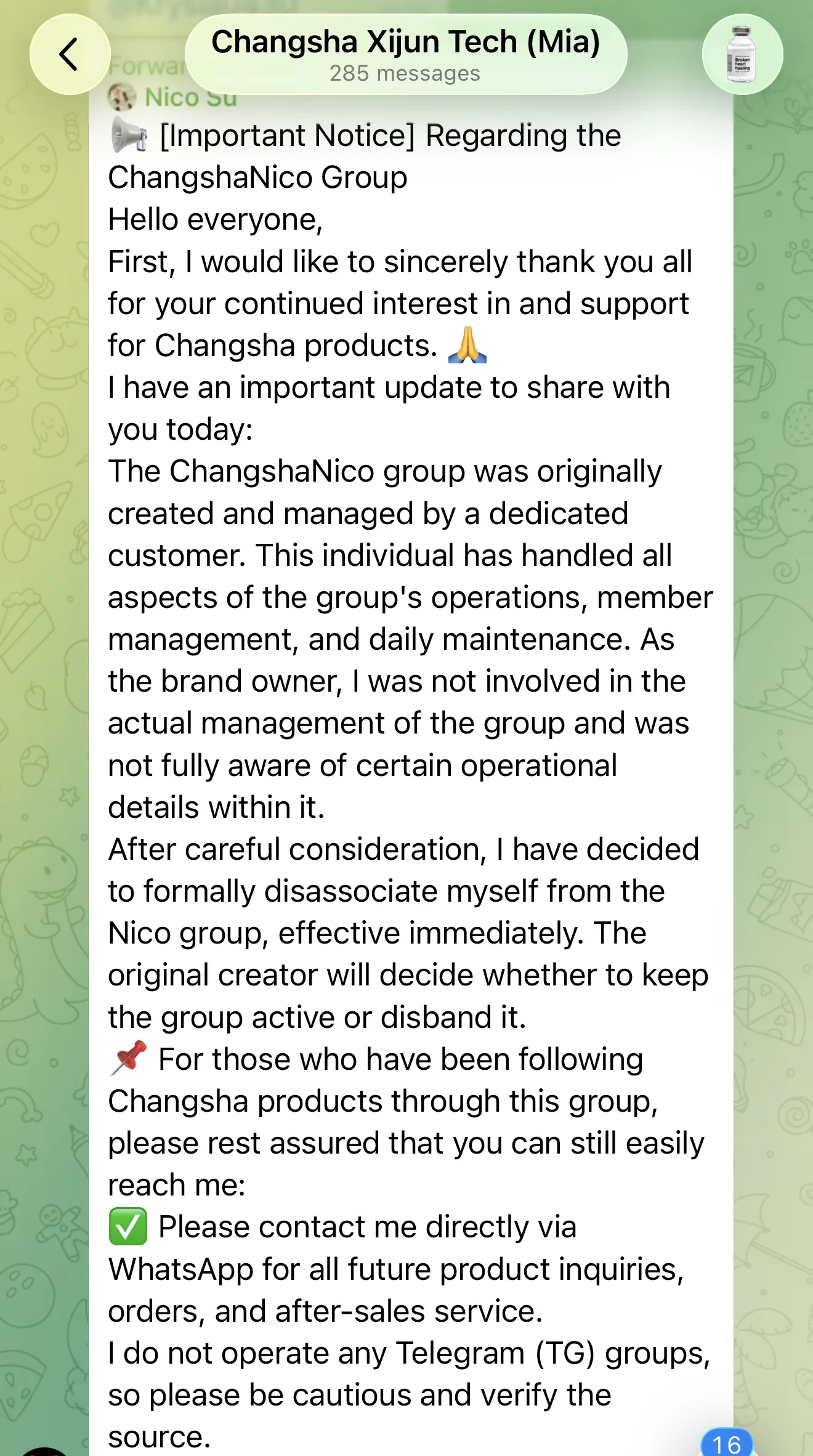
On 15 July, an announcement was made by Nico Su, who claimed to be the brand owner, saying that the group had been created and managed by a dedicated customer. He claimed not to have been fully aware of its operational details and formally disassociated from it. Customers were told to contact Nico directly through WhatsApp instead.
It was beginning to look less like Changsha had stopped selling and more like its public sales groups were being dismantled while business moved into private messages.
Customers could not get an answer
On 16 July, one customer said she’d messaged Mia about placing an order. Mia had seen the message but didn’t reply. Another customer reported the same experience the following day and said they eventually contacted Vivian, another Changsha representative. Vivian replied, and the order arrived within seven days. Members continued searching for Mia’s WhatsApp group. Some were told she was still selling and had only paused the group, but customers couldn’t find a working link.
On 20 July, a remaining Telegram member gave a clearer account. Mia had reportedly paused the group several days earlier, restricted members’ ability to post and said that many users would be removed. Those still inside could apparently do little more than post GIFs.
When someone asked for a link later that day, the answer was simple:
“It’s closed right now.”
Mia subsequently confirmed that restricting access had been deliberate. She blamed the number of people and her limited “personal bandwidth,” adding that anyone with questions could message her privately. One member immediately replied that they were unable to message her.
Then the product complaints appeared
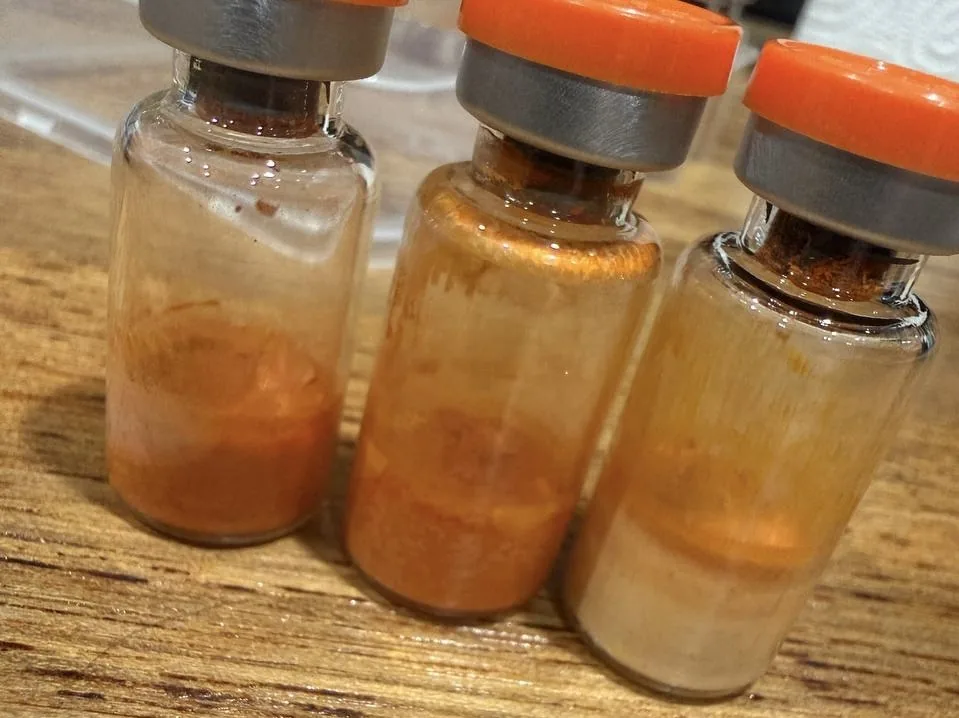
While the group was restricted, a customer posted photographs of products they said had arrived from Mia that day. The orange 5-Amino vials didn’t all look alike. Some appeared darker, some lighter and some had material splattered around the inside. The customer also posted GHK-Cu vials with visible differences in colour and cake appearance. They said around 70% of the 30 5-Amino vials appeared to have been affected by moisture to varying degrees and warned others not to order until Mia resolved the issue.
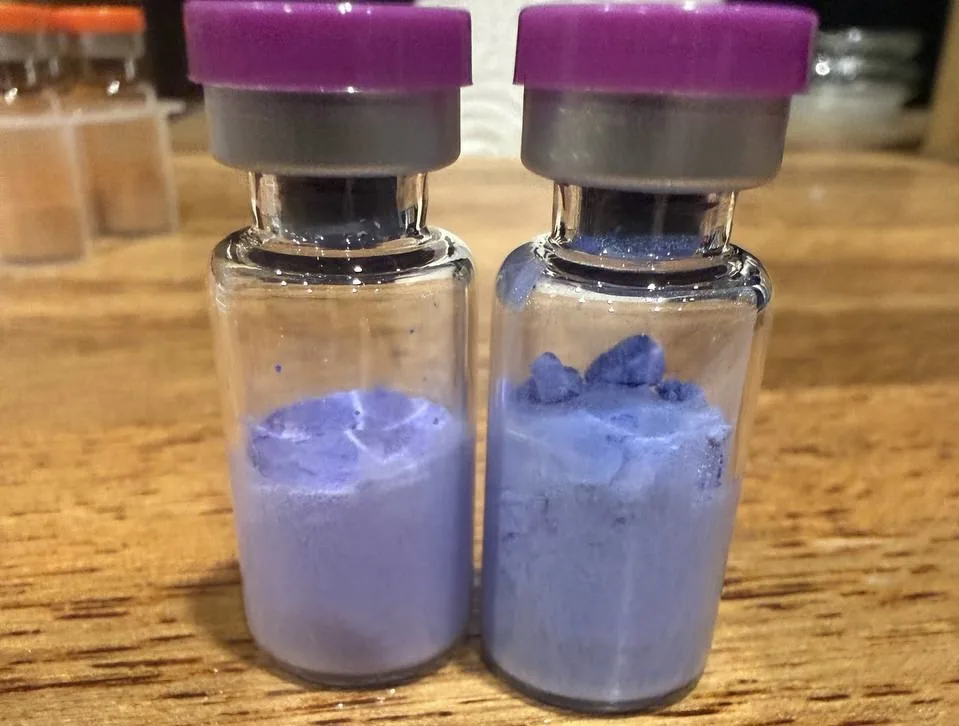
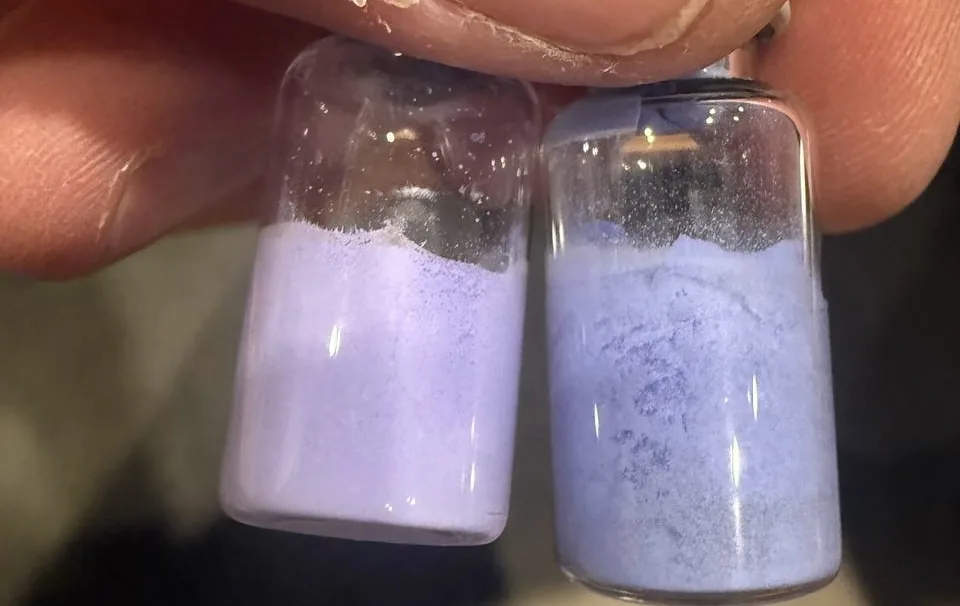
Another customer also received 100mg GHK-CU kits which were different to the rest of the Changsha GB and KLOW kits that arrived without labels and appeared to have adhesive residue where diamond-shaped stickers had been removed. He said that three different batches of KLOW had now appeared and he also received boxes of TSM20 with different caps and packaging. Unusual black-capped TSM20 bearing a spade symbol had been sent out with the expected red cap TSM20.
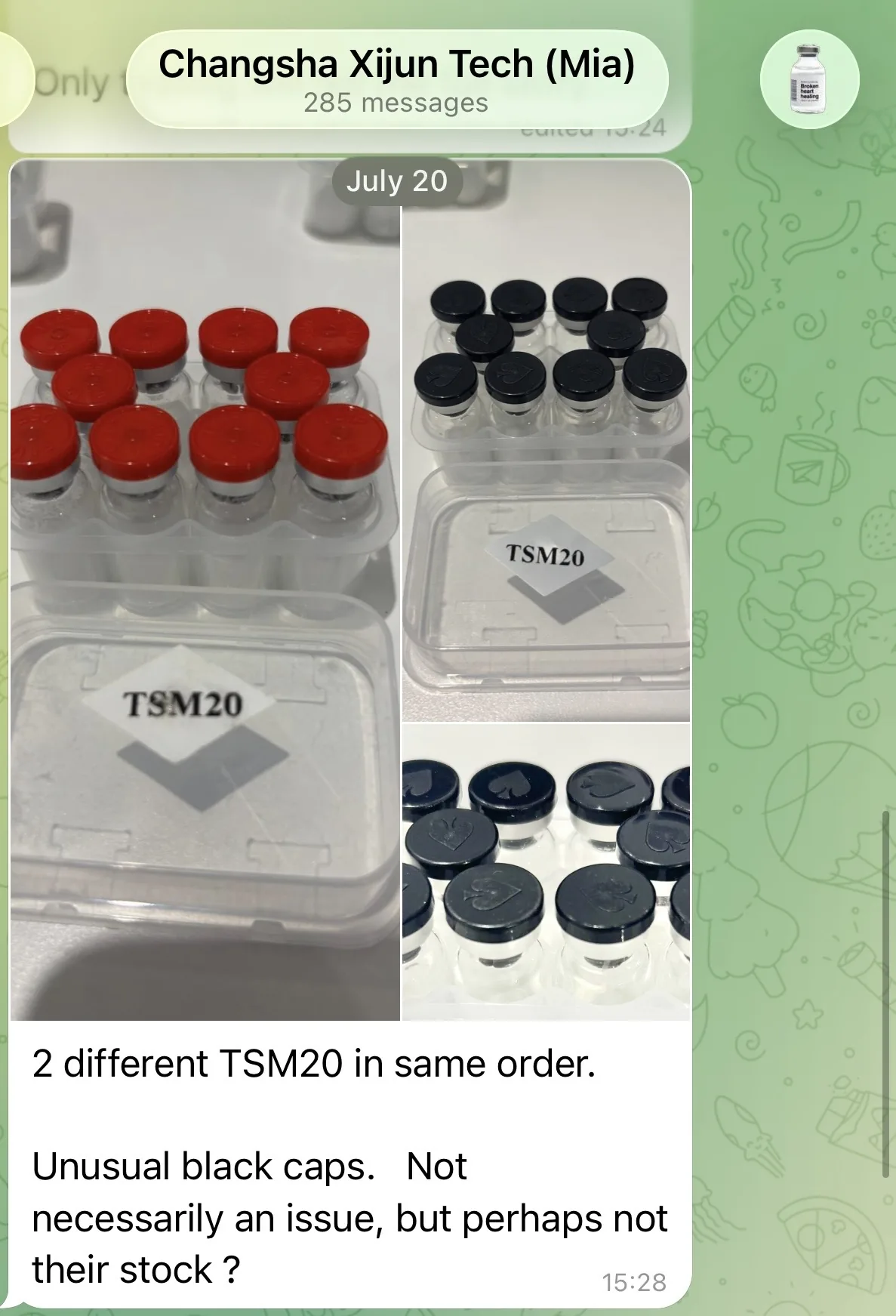
Mia confirmed that Changsha had been short of TSM20 stock when the order was filled, but insisted both kits came from the same batch.
“Because you ordered 2 boxes of TSM20, and we happened to be short of stock. However, these are from the same batch. We are really sorry.”
The different packaging raises the suspicion that the kits came from different batches and explains why customers started asking whether Changsha had sourced outside stock to fill orders it couldn’t complete from its own inventory. When the customer pushed back with the information he’d received that the black cap TSM20 had also been sent to another GB that purchased 50 boxes, Mia responded with a “????” and said “same beatch”
Several explanations for the same products
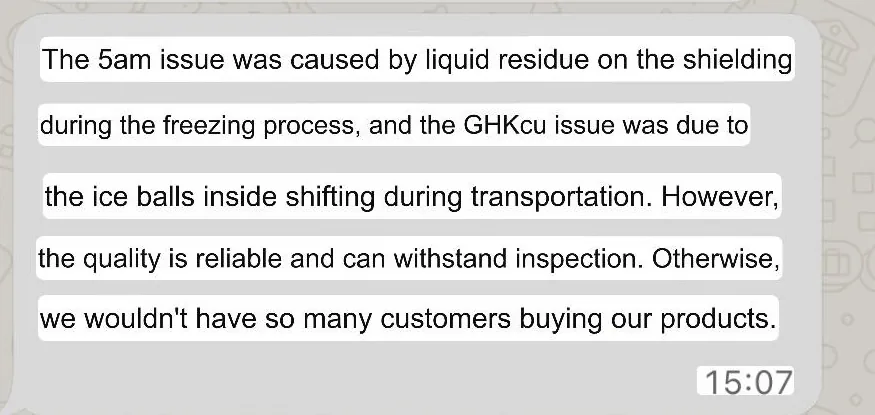
The initial Changsha response was that the 5-Amino appearance resulted from liquid residue on shielding during the freezing process. The GHK-Cu differences were attributed to “ice balls” shifting during transportation. The statement was ended with the sentence;
“However, the quality is reliable and can withstand inspection. Otherwise, we wouldn’t have so many customers”
The customer said Mia initially suggested that they must have introduced moisture into the vials themselves. They rejected that explanation, particularly after three other people reportedly experienced similar problems.
Mia then publicly acknowledged a production issue:
“Yes, it’s true that the excipients were not fully homogenized, but you can be assured. Feel free to send it for testing, the purity of this batch is quite high, and we also overfilled the vials during filling to compensate.”
She claimed that a large quantity of the batch had been produced, that all units were the same and that the warehouse would prepare a dissolution video.
Mia later posted a BioViridian certificate for an orange-capped 5-Amino sample and said the product could be used with confidence. The visible certificate appeared to show a result of approximately 47.51 mg against a 50 mg specification and around 99.9% purity.
The demonstration used a different-looking vial
Mia provided a video showing a factory worker reconstituting a vial, apparently to demonstrate that the product was acceptable. The customer thanked her for making the effort but said the vial in the video didn’t resemble the ones they’d received. The labelling, product presentation and powder colour were different. The customer therefore remained none the wiser about whether their own vials were good or bad.
According to the customer, Mia refused to refund, replace or otherwise remedy the disputed 5-Amino and GHK-Cu products. Mia did send alternative items in place of four KLOW kits that had never been supplied because Changsha had run out of stock. However, the customer clarified that this was not compensation for the disputed products. It merely replaced products that were already missing from the order.
“Please do not spread this here”
Mia also addressed the KLOW shortage publicly. She said demand from an Australian group buy had left stock extremely limited and that only a small number of customers had received their orders so far. She told members that the remaining shipments would be sent gradually over the following days before adding:
“If you have any concerns, please feel free to contact me directly. Please do not spread this here. Klow is also perfectly fine.”
That is an interesting instruction to give inside her own channel. Customers were being told to contact Mia directly, but some direct messages had already gone unanswered and when concerns were raised publicly, they were asked not to spread them there.
A Retatrutide Vial in an MT2 Kit
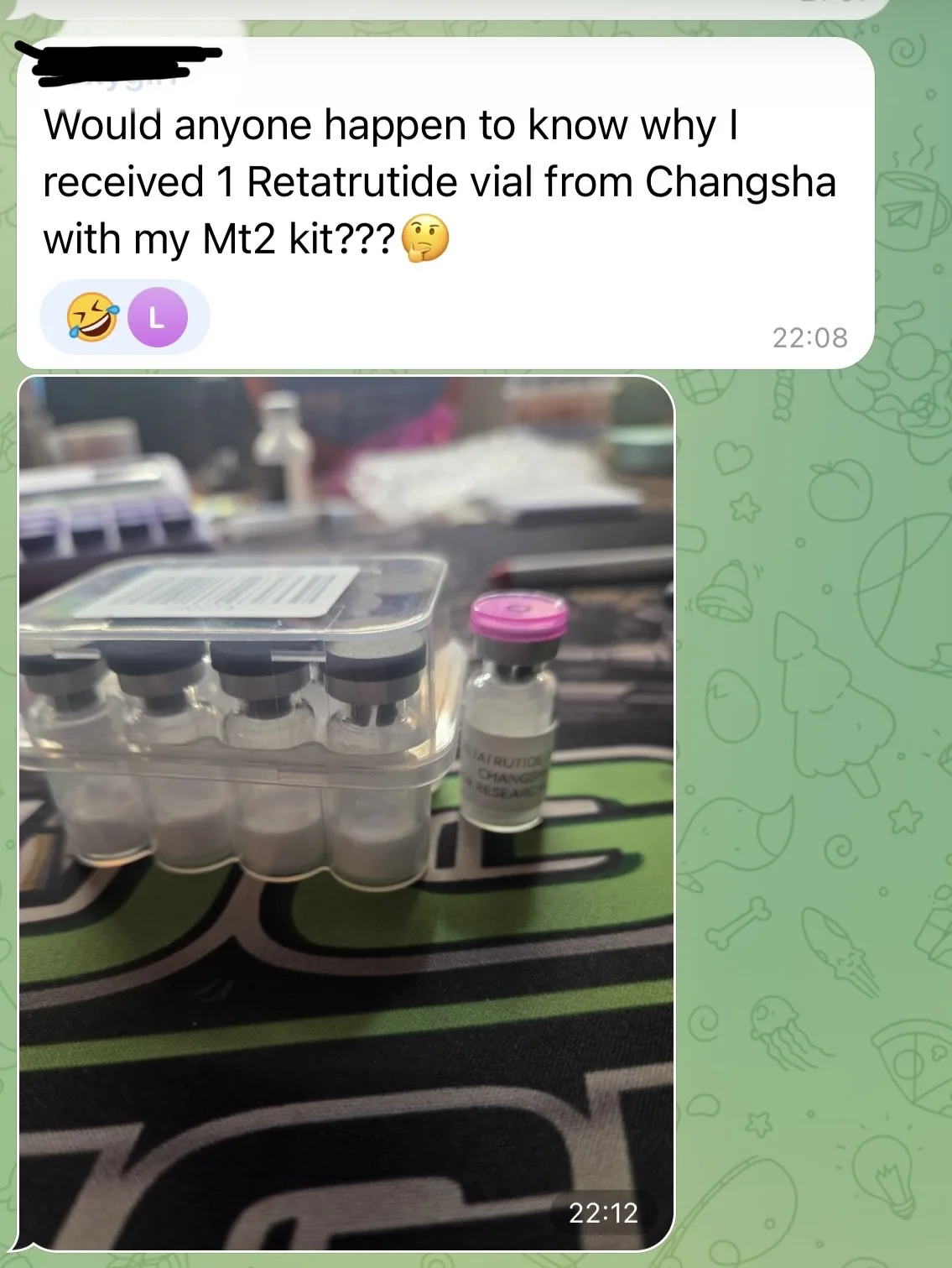
Another customer then reported receiving a single Retatrutide vial from Changsha inside what was supposed to be an MT2 kit.
The photograph showed one pink-capped vial labelled Retatrutide sitting beside the remaining grey-capped vials in the kit. The customer appeared unaware of any reason for the substitution and asked the group why it had been included.
Changsha Dropped From Elora Group Buys
A group administrator reported that Changsha increased its Elora price after over-promising a discount and was subsequently dropped as the supplier. Organisers had to switch to Uther, leaving buyers to either pay the difference or request a refund.
The order the warehouse forgot
A separate customer then described their experience with another group buy.
They had ordered on 13 June and accepted the disclosed production delay. Their complaint was about the weeks of silence afterwards. Requests for updates and tracking went unanswered. The customer later posted their direct-message history. The eventual explanation wasn’t that the parcel had been delayed by a courier or held at customs. A translated message stated:
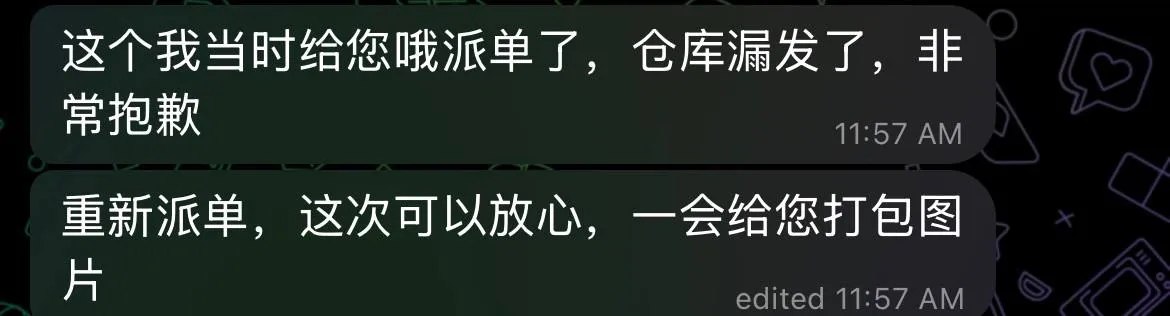
“I originally assigned you this order, but the warehouse forgot to ship it. I’m very sorry. I’ll reassign the order, so you can rest assured this time. I’ll send you the packaged pictures shortly.”
The warehouse had forgotten to send it. The customer also alleged that a screenshot containing their full name, address and telephone number was passed to the group-buy organiser without permission. In regards to this alledged “doxxing”, some members argued that organisers routinely receive customer details to process group buys and they have no issue with them seeing it.
The customer became the problem
Once the complaint was posted, much of the discussion shifted away from the missing tracking and towards the customer’s behaviour. One member suggested that suppliers respond better when customers are respectful, kind and diplomatic,
“stop talking to your supliers like they your bro”
The customer responded by posting the message history, which showed repeated but polite requests for tracking.
On 7 July, they asked when they would receive tracking.
On 10 July, they asked again whether there was a problem with the product or company.
On 17 July, they requested another update.
On 18 July, Mia finally replied with “hi,” “yes” and “sorry late.”
Another blamed the group-buy organiser and suggested Mia had been overwhelmed by as many as 1,500 buyers. It later emerged that people appeared to be discussing two separate group buys and that this customer wasn’t part of the large Australian one.
After the warehouse admitted missing the order, another member told the customer that Mia was human, was dealing with hundreds of messages and had apologised. The customer was accused of being the only person “full blown complaining” and told that everyone else was happy. The response then moved into grey-market intimidation:
“You’re in the grey market world go report Mia to the authorities oh wait that would mean you’d have to tell the AFP you’re buying peptides in large quantities.”
That comment didn’t come from Mia. It does, however, support the customer’s complaint that reasonable questions were met with ridicule and attempts to make the complainant the issue.
Mia explains why she is leaving
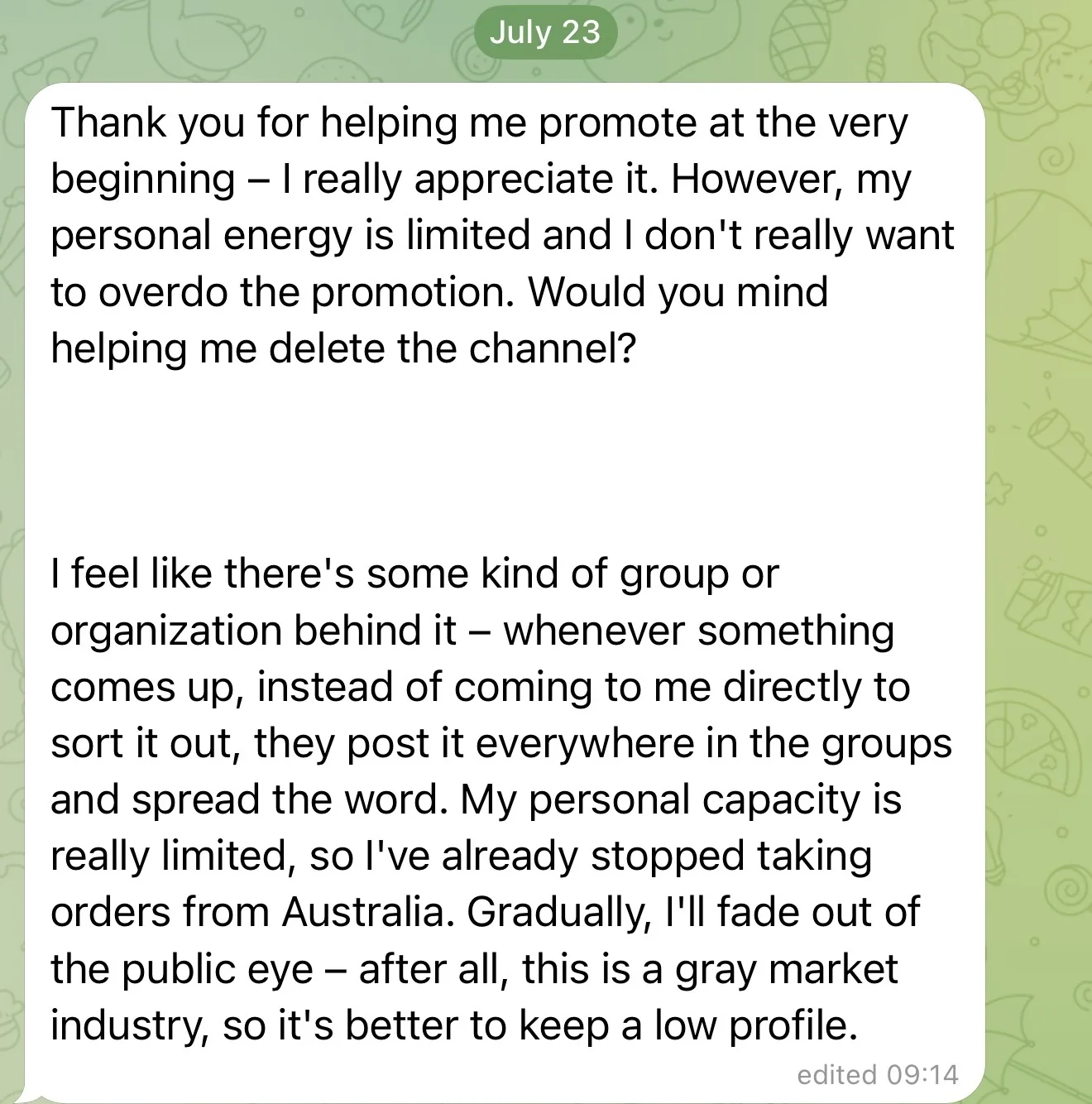
On 23 July, Mia contacted me directly. She thanked me for helping promote her “at the very beginning” but asked me to delete the channel. She said her energy was limited and she no longer wanted to promote herself so heavily. Mia believed there was some type of group or organisation behind the criticism:
“Whenever something comes up, instead of coming to me directly to sort it out, they post it everywhere in the groups and spread the word.”
She said she’d already stopped accepting orders from Australia and intended gradually to fade from public view.
“After all, this is a gray market industry, so it’s better to keep a low profile.”
The problem with that explanation is that customers had approached her directly. They’d asked for tracking, they’d messaged about placing orders. One customer had waited days for a reply before learning the warehouse had never sent the parcel. Another had tried to resolve the 5-Amino and GHK-Cu complaint privately before posting the photographs.
Meanwhile, Mia’s Telegram group had been restricted, new members were blocked and customers raising concerns inside the group were told not to spread them there. On 24 July, Mia sent one more message:
“Could you please retract the Changsha MIA?”
And then the group disappeared
By 25 July, members were again asking what had happened to Mia’s group. This time, it appeared to have been deleted entirely. One member believed it had been deleted by its owner rather than removed by Telegram because there was no terms-of-service violation notice. Either way, the progression was complete: paused, restricted, closed to new members and then gone.
The company had also previously listed several authorised representatives, including Mia, Nico, Vivian, Alala and Jenny. The disruption appeared to concern Mia and Nico’s public groups rather than the entire company.
One mystery closes as another one opens
As Mia’s Changsha group disappeared, another newly created supplier called XBT began attracting attention. Its domain had been registered on 11 July, the same day questions began appearing about changes to Changsha’s direct sales. XBT then launched with representatives calling themselves Mia and Nico, promoted familiar products such as GLOW and KLOW and presented itself as a new Chinese operation.
Members immediately questioned whether Changsha’s missing representatives had resurfaced under a new name. XBT Nico denied being the same person, and at that stage there was no evidence connecting the two businesses beyond the names, products and suspicious timing.
Then, as I was writing this article, it all kicked off inside XBT’s own channel.
A person identifying himself as Pepe announced that he had created XBT with the help of others. He admitted that he had deliberately avoided running it under his existing name because buyers were more attracted to sellers who appeared closer to a Chinese factory. He also acknowledged that the project had lacked transparency.
According to Pepe, the plan was to create a bot-driven Chinese seller group offering cheap products, automated ordering and testing of every batch. A Chinese contact named Jay was supposed to manage freight-forwarding and warehouse relationships, but the relationship allegedly broke down within days amid arguments over money, orders and how quickly the business should begin operating.
Pepe said XBT had not yet started accepting orders and that factory relationships and pricing were still being negotiated. He nevertheless promised to continue the operation under a new China warehouse channel.
That disclosure answers one question: XBT wasn’t simply an unknown Chinese supplier that happened to emerge with some remarkably familiar names at a remarkably convenient time. It was a deliberately separated operation whose real organiser chose not to disclose his involvement at the beginning. What it doesn’t explain is who was operating the Mia and Nico accounts, what connection XBT had hoped to establish with Changsha, or why buyers were allowed to believe they were dealing with an independent Chinese business.
Those questions now belong in the next article.
Back to Mia
Whatever was happening behind XBT, doesn’t change what happened inside Mia’s own operation. Customers approached her directly about missing tracking, delayed orders and disputed products. One order hadn’t been delayed in transit at all; the warehouse admitted it had forgotten to ship it. Mia acknowledged that excipients in the disputed 5-Amino hadn’t been fully homogenised, while the customer said no remedy was offered for the questioned 5-Amino and GHK-Cu.
As those complaints emerged, her group was restricted, closed to new members and eventually disappeared. Mia then blamed people for spreading problems instead of contacting her privately, asked for the promotional channel to be deleted and requested the retraction of “Changsha MIA” without identifying one factual error.
As of now, i haven’t deleted her channel. And as for XBT, that new act has now produced an entirely separate story.
I don’t think anyone can say life in the grey market is ever dull.

Comments