
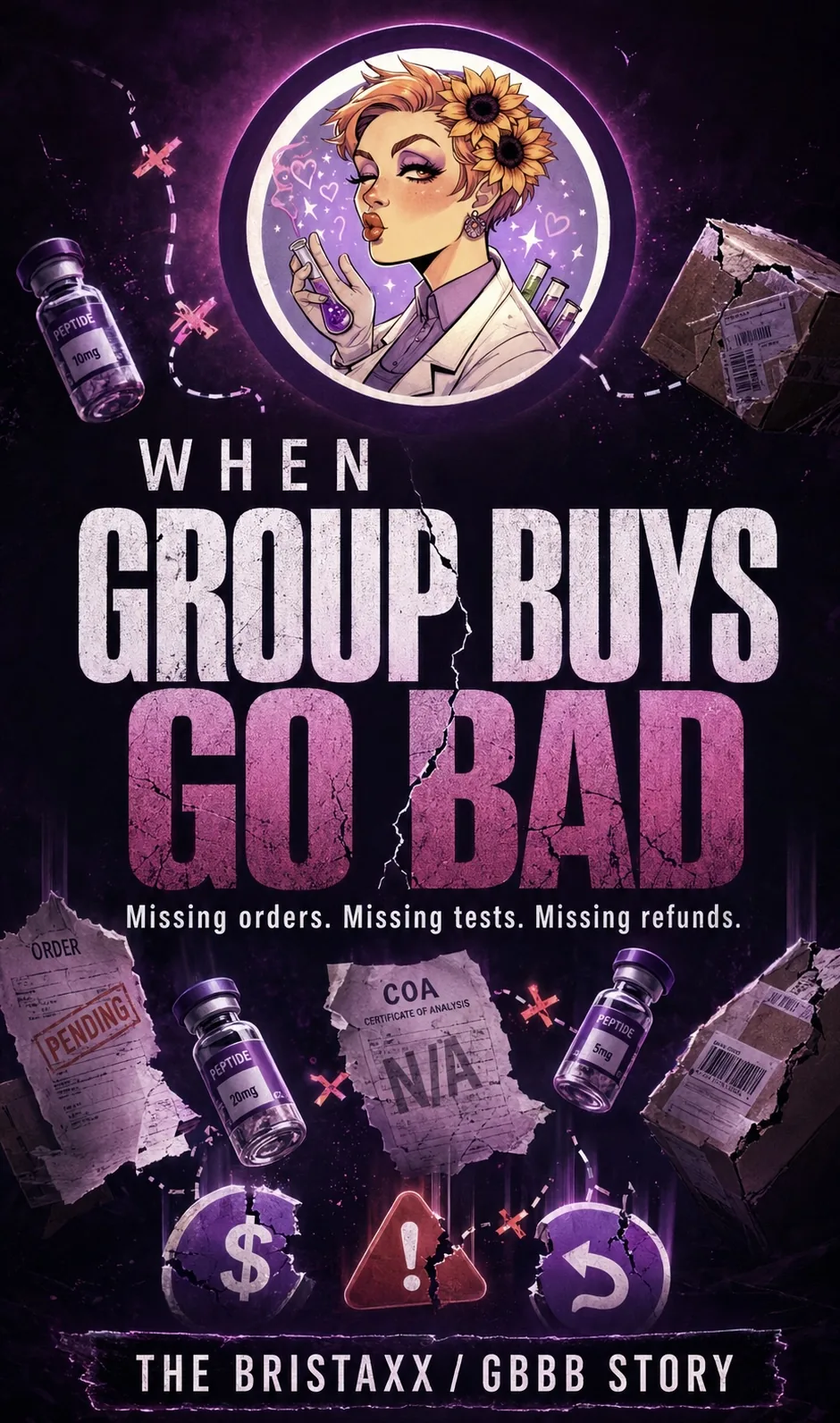
Group buys are built almost entirely on trust. One person collects the money, deals with the supplier, organises testing, receives the stock and distributes everything to dozens, sometimes hundreds, of buyers. When it works, the community gets lower prices and the organiser earns a reputation for making it happen.
When it goes wrong, everyone discovers how much money and control they handed to one person.
That is what former customers of BriStaxx, also known as Group Buy By Bri or GBBB, say has happened to them.
This isn’t the story of an unknown organiser who appeared, collected payments and immediately vanished. Bri had been running peptide group buys since 2024 and was widely liked and even considered a friend to many. Customers described her early service as responsive, helpful and well organised. Orders arrived, products tested well and people recommended her to friends. That successful history is what makes the subsequent decline worth examining.
From trusted organiser to unanswered questions
According to customers, the problems became more noticeable after Bri’s Discord server was removed and GBBB moved to its own Discourse platform. Updates became less frequent. Testing was delayed or never published. Orders took increasingly long to complete, while questions about shipping, refunds and laboratory results allegedly went unanswered for extended periods. By April 2026, the warning signs were already visible.
On 2 April, Bri published an announcement titled: “Shipping is probably in the worst condition it’s been.”
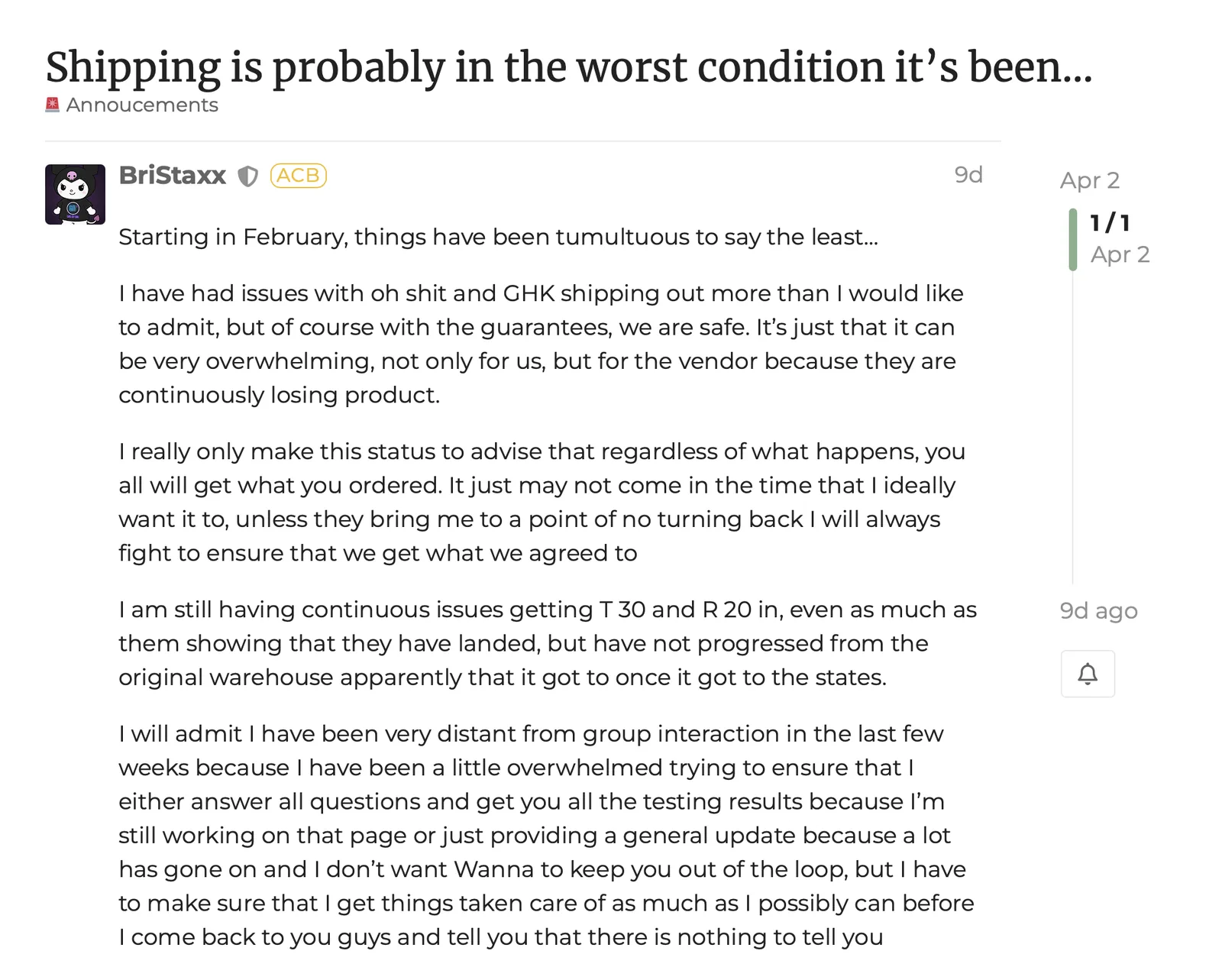
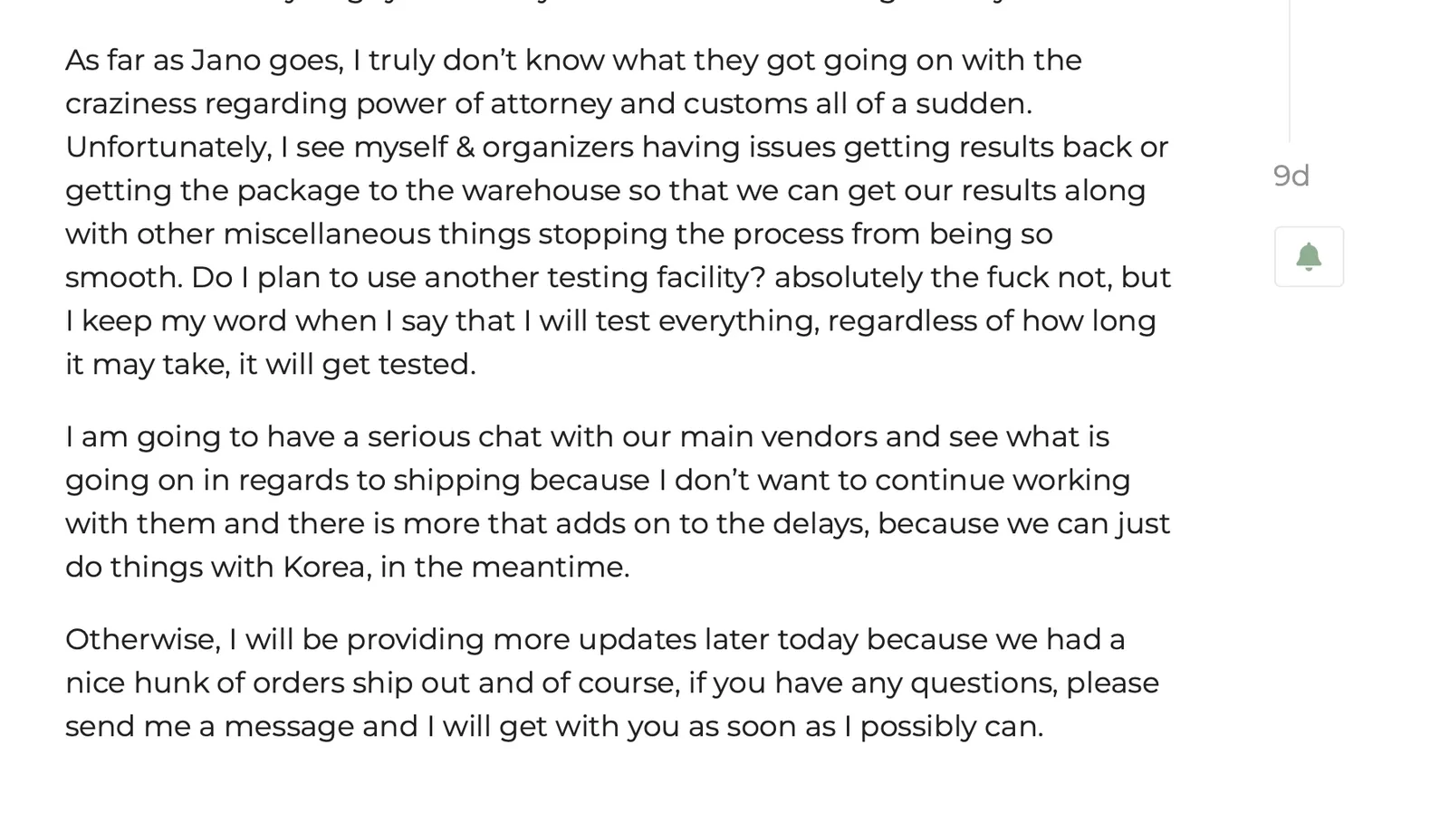
She described circumstances since February as “tumultuous” and acknowledged problems with several products. She blamed quarantines, vendors repeatedly losing stock and shipments that appeared to have reached the United States but had not moved beyond the original warehouse.
Bri assured customers that they would eventually receive what they’d ordered. She also addressed delays in laboratory testing, saying organisers were experiencing problems getting packages to Janoshik and receiving results. Despite those difficulties, she refused to consider another testing facility and promised that everything would eventually be tested. This concerned members as the other GB organisers were receiving regular results from Janoshik without similar delays.
Nine days later, a customer posted a polite request for information.
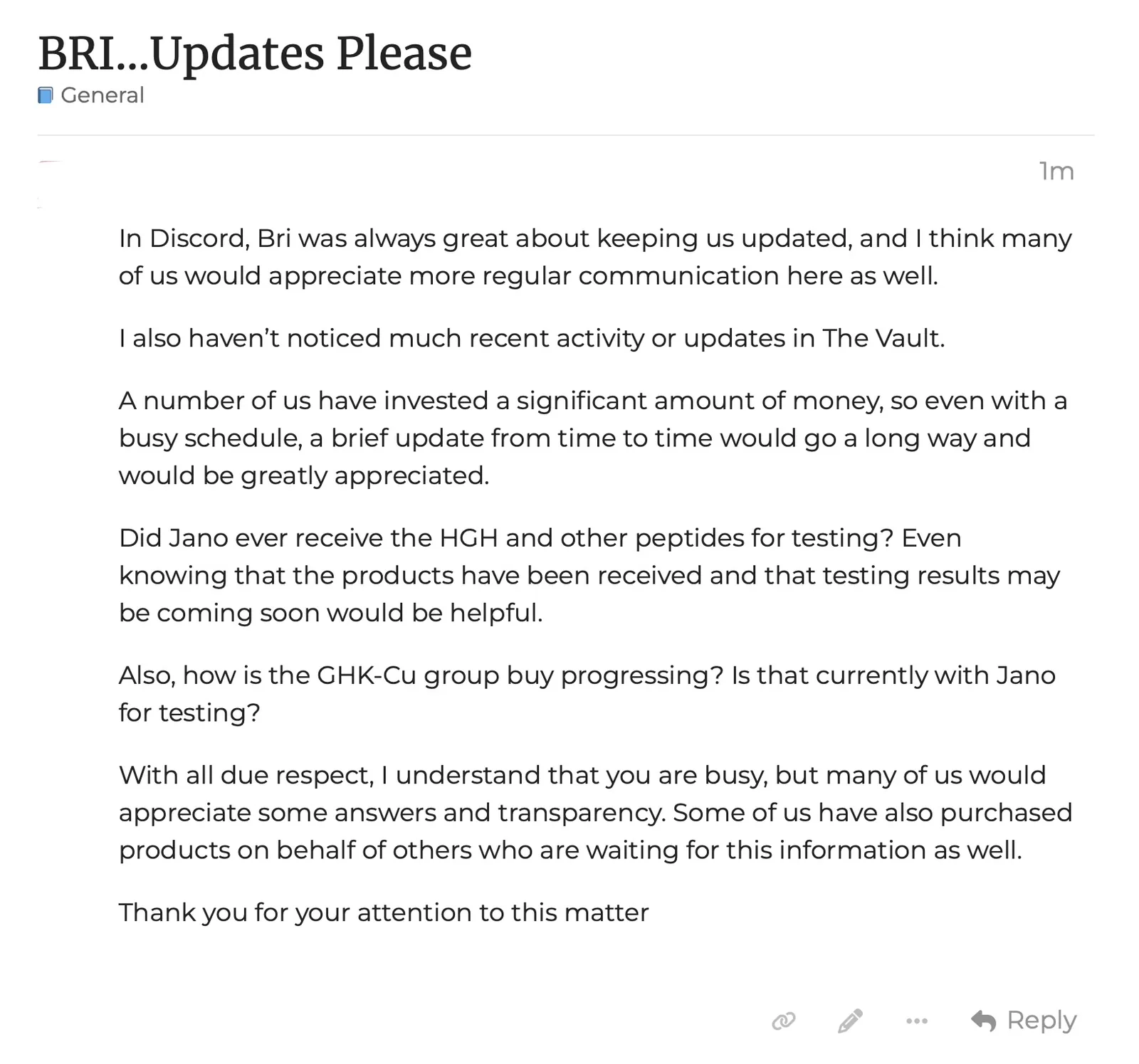
They asked whether Janoshik had received the HGH and other peptides, what had happened to the GHK-Cu buy and why there had been so little recent activity in The Vault. They explained that members had invested significant sums and that some had bought products on behalf of other people who were also waiting for answers.
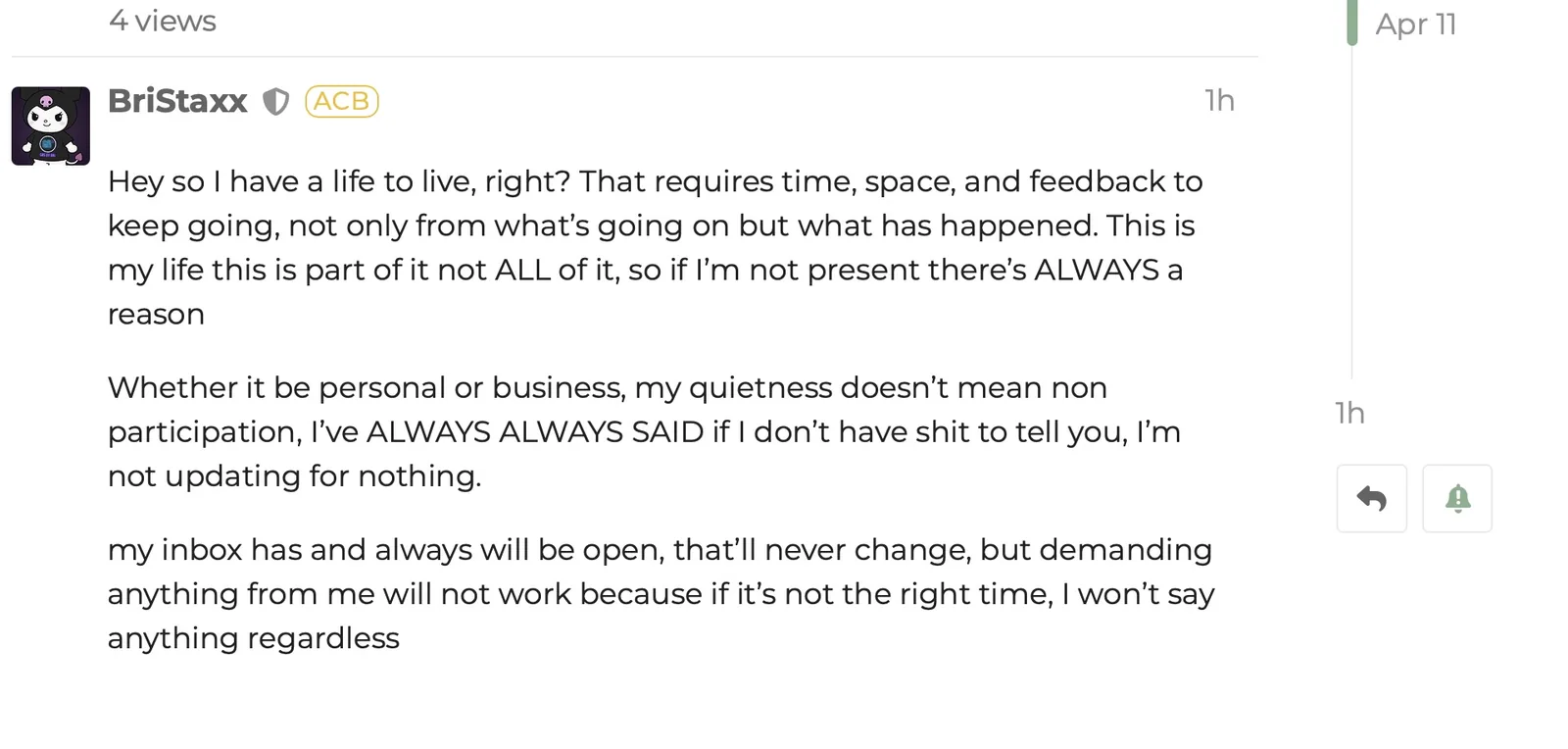
Bri’s response began:
“Hey so I have a life to live, right?”
She said her absence didn’t mean she’d stopped working and that if she had nothing new to report, she wouldn’t post an update simply for the sake of it. She added that demanding information from her wouldn’t work if she didn’t believe it was the right time to respond.
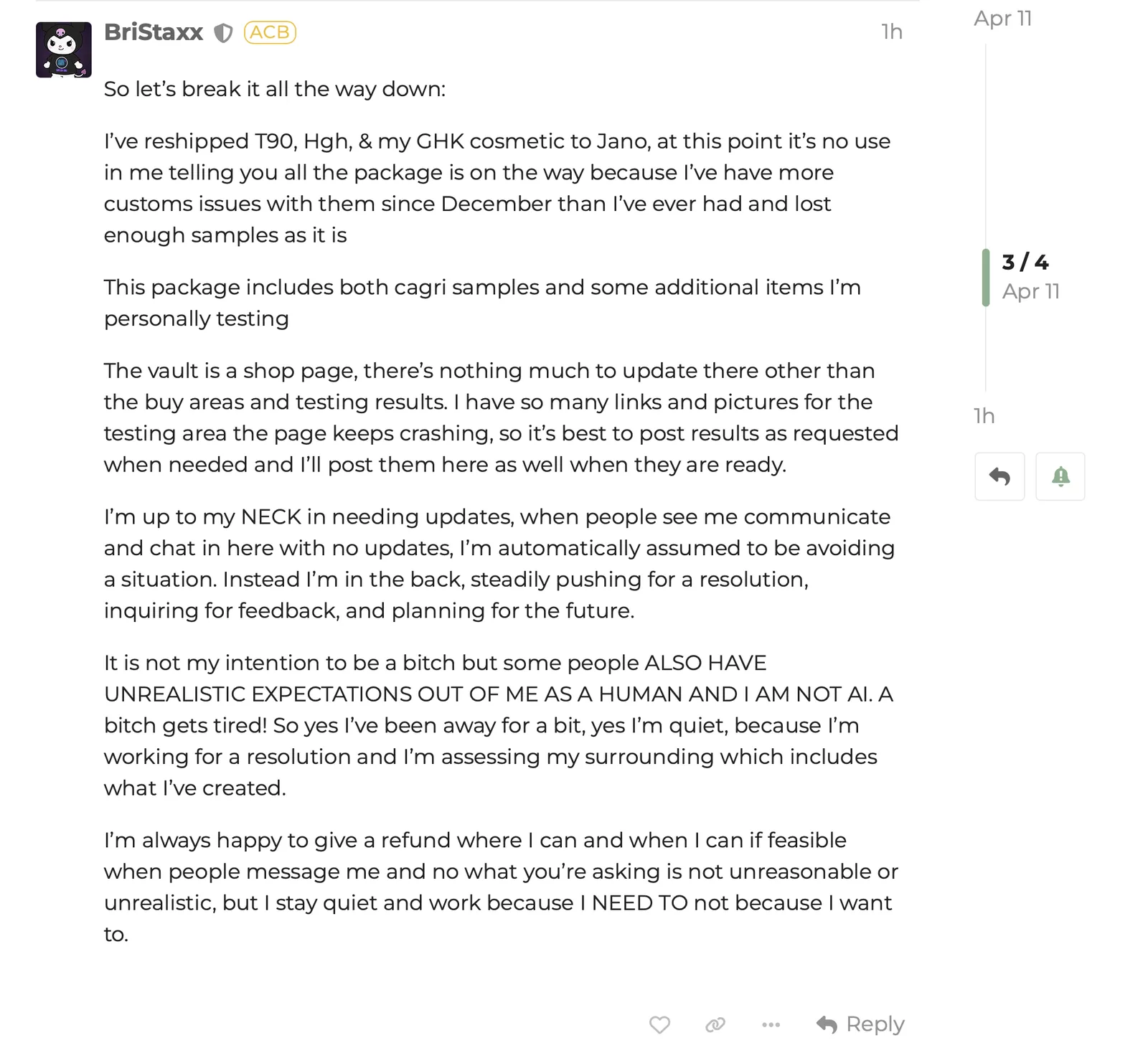
Bri then said she’d reshipped T90, HGH and GHK cosmetic samples to Janoshik after encountering more customs problems since December than she’d previously experienced. The package reportedly contained two Cagrilintide samples and other products for testing. She attributed the lack of published results partly to The Vault’s testing page crashing because it contained too many links and photographs. She also said refunds were available “where I can and when I can if feasible.”
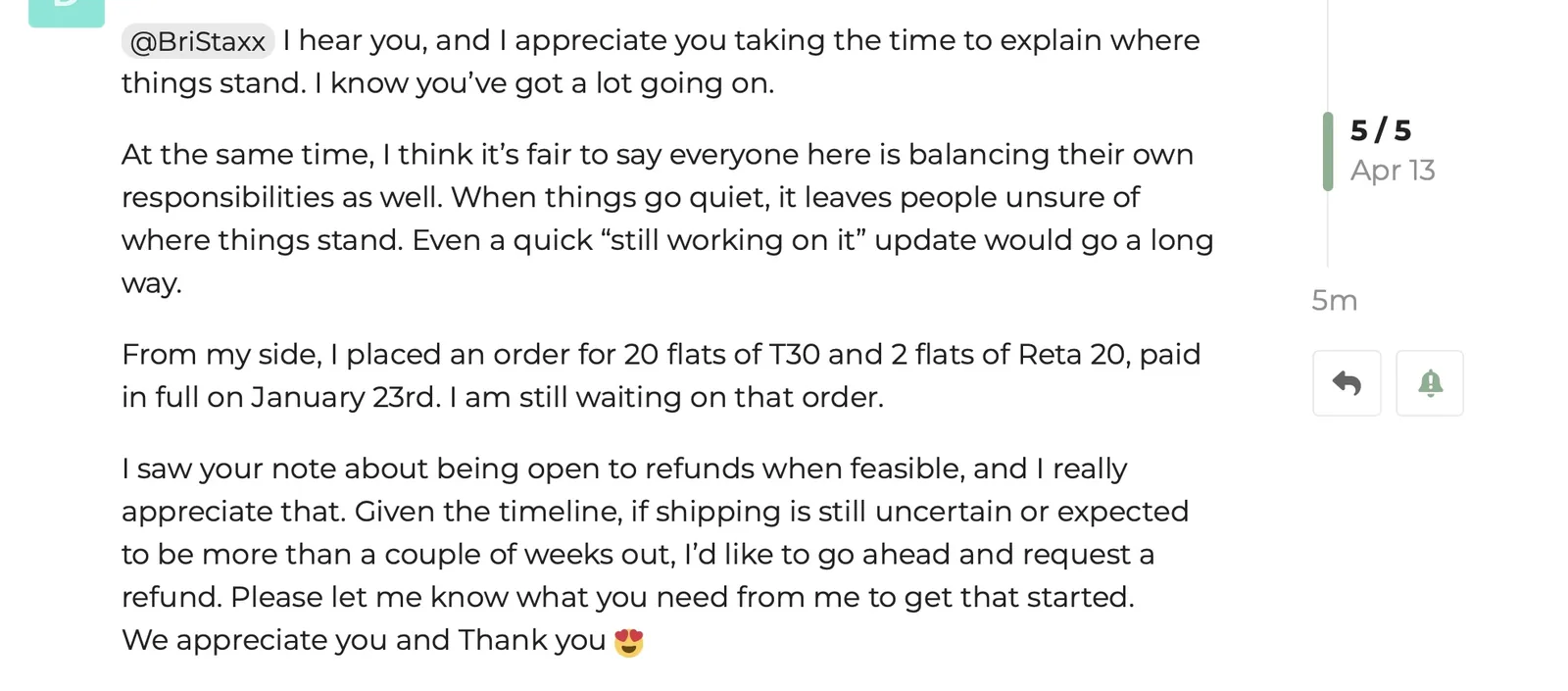
Another customer explained that they’d paid in full on 23 January for 20 flats of T30 and two flats of Reta 20 and were still waiting. They requested a refund if delivery remained uncertain or more than a couple of weeks away. Bri replied:
“And this is the first you’ve asked me lol.”
She said she was happy to arrange the refund now that the customer had contacted her directly. The money didn’t immediately follow.
Concerns raised privately
On 13 April, one GBBB member contacted me privately. They said they’d purchased from Bri since early 2025 and had previously found her consistently responsive and pleasant. Since the move away from Discord, however, they believed her communication had changed dramatically. Updates were now infrequent and questions were sometimes met with responses they considered dismissive or hostile. They also worried that members couldn’t privately message one another through the platform, making it difficult to compare experiences without Bri seeing the discussion. The member said they’d become hesitant to ask too many questions because they feared being removed from the group.
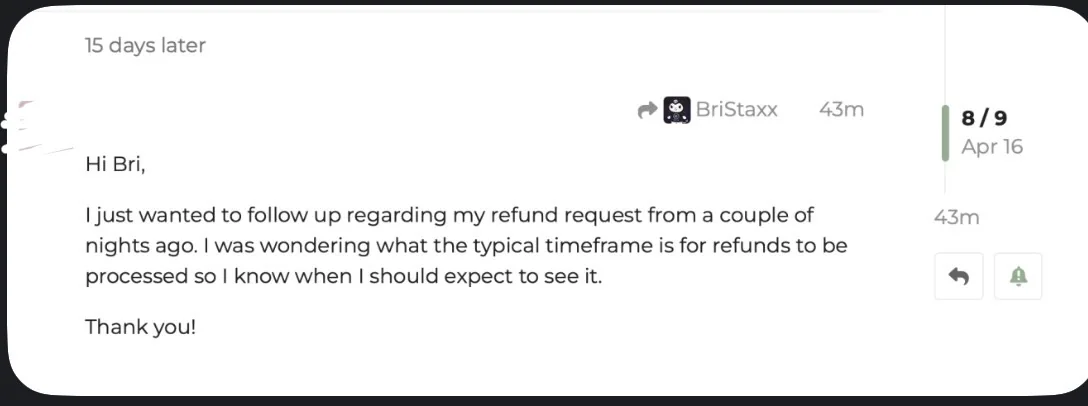
On April 16, that customer asked Bri how long refunds normally took to process. By 2 May, they said they were still waiting for the $340. The refund finally arrived later that day, approximately three weeks after Bri had publicly agreed to return it. Bri did repay this customer, but only after repeated follow-up and a feeling that maybe Bri had somehow found out that I was being contacted about this issue.
Over the following weeks, other customers began contacting one another. One was reportedly waiting for ten kits of T30. Another account concerned an order placed in July 2025 that had never been fulfilled. According to the customer, Bri said the supplier hadn’t reimbursed her and offered replacement products instead, but those products also failed to arrive. What appeared to each customer to be an individual problem was beginning to look like part of something much larger.
One complaint became many
When a detailed warning about GBBB was eventually published publicly, customers began adding their own experiences. The original poster said Bri had once been a trusted member of a small private group of friends who pooled their money to purchase peptides for themselves and their families. The group operated as a non-profit cooperative, separate from Bri’s public GBBB business.
According to the post, Bri coordinated a private buy that was cancelled after the supplier said it couldn’t guarantee the requested quality. Bri allegedly told the participants that the supplier had refunded her, but she didn’t immediately return their money. The group said it was owed several thousand dollars.
Bri reportedly explained that her accounts were restricted and that she could only move small amounts at a time. After two months without further updates, the group offered to accept a cheque but allegedly received no response. Some participants recovered their money after repeated follow-up, while others said they were still owed hundreds of dollars.
The same group described an earlier bulk purchase of Hospira bacteriostatic water. Bri allegedly took 20 cases and began selling them through her own site at a 100% markup before paying the person coordinating the purchase. Another participant reportedly covered Bri’s payment to the supplier and then spent two months seeking reimbursement. Again, restricted accounts were allegedly given as the explanation.
One participant accepted peptides as partial repayment, but said receiving them required further chasing. The promised laboratory results were also not provided. Bri allegedly first said the Janoshik link didn’t work and later said she couldn’t take a screenshot. When an enquiry was made directly to Janoshik, the laboratory could only confirm that it had no pending results under Bri’s name. That doesn’t prove that a sample was never submitted under another name, but it did little to reassure those waiting for evidence that the products had been tested.
Different buys, similar problems
Once customers began comparing experiences, similar complaints appeared across several unrelated orders. One customer said a Hospira water order never shipped. When they placed another order and asked for the two to be combined, the package arrived without the Hospira. Bri reportedly offered her own bacteriostatic water as a replacement, but the customer had already sourced Hospira elsewhere and asked for a refund. They said the money was returned only after they sent a formal payment request.
Another customer said they were promised a refund for an amino buy but received no response after contacting Bri through email, Discord and Telegram. Others said they never received capsule or amino orders at all. A customer involved in the January “Oh Shit” buy said the peptides took five months to arrive and still had no COA.
Another had bought two S10 kits in January and had effectively accepted that they were never coming.
One participant said their early orders went well enough that they referred a friend. Their own later Hospira order never arrived, some products were still missing promised test results and the friend they referred was allegedly still waiting for a refund more than a year after paying. The warning had become a roll call of people discovering they weren’t the only one.
When refunds became credits
Several complaints involved unresolved money being moved into later group buys rather than returned. One participant said they were still owed a refund from the “GLP Madness” buy and used part of the amount as credit towards a Cagrilintide order. According to their account, the later batch produced poor testing, the kit was discarded and a promised replacement never arrived. They also claimed several buyers didn’t receive the Survodutide or Cagrilintide they’d originally ordered.
Another customer said they’d bought heavily through Bri because earlier products came with COAs and had tested well. They eventually stopped buying as the operation became increasingly unstable, but not before paying for amino products they said were never delivered or refunded.
This is one of the most dangerous stages of a failing group buy. A refund becomes credit. The credit enters another buy. That buy develops a problem, so a replacement is promised. Before the original obligation has been resolved, new money continues arriving for new orders. The debt doesn’t disappear. It simply changes names.
Missing and disputed testing
Testing became another recurring source of concern. Some customers said products arrived without the results that had been promised. Others were told that samples were delayed by customs, lost in transit or still awaiting analysis. One member alleged that an Epitalon buy arrived with two different cap colours. According to their account, one tested at 99% purity and the other at 98%. They claimed the 98% stock was distributed to group-buy participants while the 99% stock was sold separately through Bri’s on-hand store.
With confidence in the original testing history deteriorating, customers are now arranging independent testing of GBBB products, including some they didn’t personally purchase.
An operation where everything appeared to go wrong
No single shipping problem proves dishonesty. Parcels are seized. Suppliers fail. Tracking numbers disappear. Laboratories experience delays. The concern arises when every part of an operation appears to suffer a different exceptional failure at the same time. Various customers described explanations involving restricted accounts, customs, missing tracking numbers, lost packages, suppliers, laboratory delays, website crashes and family emergencies.
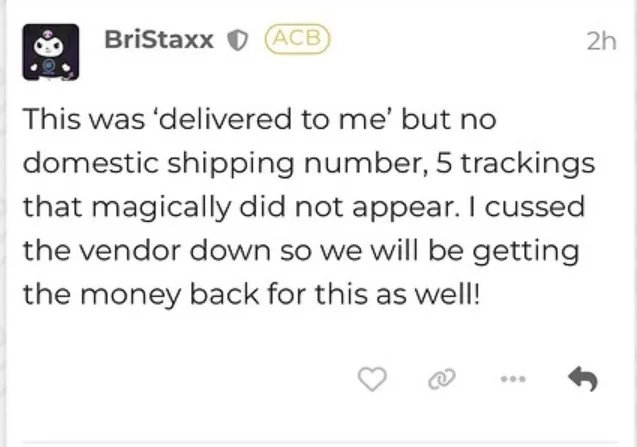
In one later GBBB update, a customer asked about a semaglutide shipment they’d been told cleared customs on 16 June. Bri replied that it had supposedly been delivered to her, but there was no domestic tracking number and five tracking numbers had “magically” failed to appear. She said the vendor would return the money.
Customers began asking how so many shipments could stop reaching the same address and why so many testing samples appeared unable to reach Janoshik. Members also questioned a family emergency involving Bri’s sister-in-law.
Old obligations, new group buys
Perhaps the greatest concern wasn’t only that earlier orders and refunds remained unresolved, but that Bri was reportedly promoting new group buys elsewhere. Customers claimed she’d largely abandoned her own Discourse platform apart from occasional lengthy updates, while remaining active in a smaller private Telegram group populated mainly by group-buy organisers and moderators. According to members, she was chatting regularly and continuing to run buys there.
The reputation that kept people waiting
Many former customers weren’t simply angry. They were genuinely upset because they’d liked Bri. They remembered her early communication, successful testing and the personal touches included with orders. Some said her products had helped them achieve major weight-loss results. Others described her as fun to be around and one of the few group-buy organisers they’d trusted.
One customer said they’d used Bri almost exclusively for two years. When complaints first emerged, loyal members allegedly attacked those asking questions. That customer was now left with two unfulfilled orders and no idea who else to trust.
A successful history may explain why customers trusted Bri, but it can’t guarantee what happens to the next payment.
Group buys rarely collapse all at once
The GBBB complaints don’t describe one dramatic moment. They describe a gradual deterioration. Completion times increased. Testing took longer. Updates became less frequent. Delayed orders became credits towards later buys, while refunds were offered only “when feasible.” Customers began to feel demanding or disloyal simply for asking where their money or products had gone.
Perhaps Bri will still complete the missing orders and repay everyone. Several former customers openly hope she does. Even so, the situation has exposed the weakness at the heart of the group-buy model.
Once payment is sent, participants depend on one organiser to manage the supplier, tracking, testing, accounting and distribution. They may have no way of knowing how much has been collected, whether each buy’s funds are held separately or whether new payments are being used to settle older obligations.
In this case, one person was waiting for Hospira, another for amino products and someone else for a missing COA. One customer had transferred an old refund into a new buy, while members of a private group said they were collectively owed thousands. Each believed they had an individual problem. The wider pattern emerged only when they began comparing experiences.
Group buys run on trust, but trust cannot replace records, transparent accounting, independent testing and the freedom to ask where your money went. By the time GBBB’s customers started putting the pieces together, some had already been waiting for more than a year.



Comments