
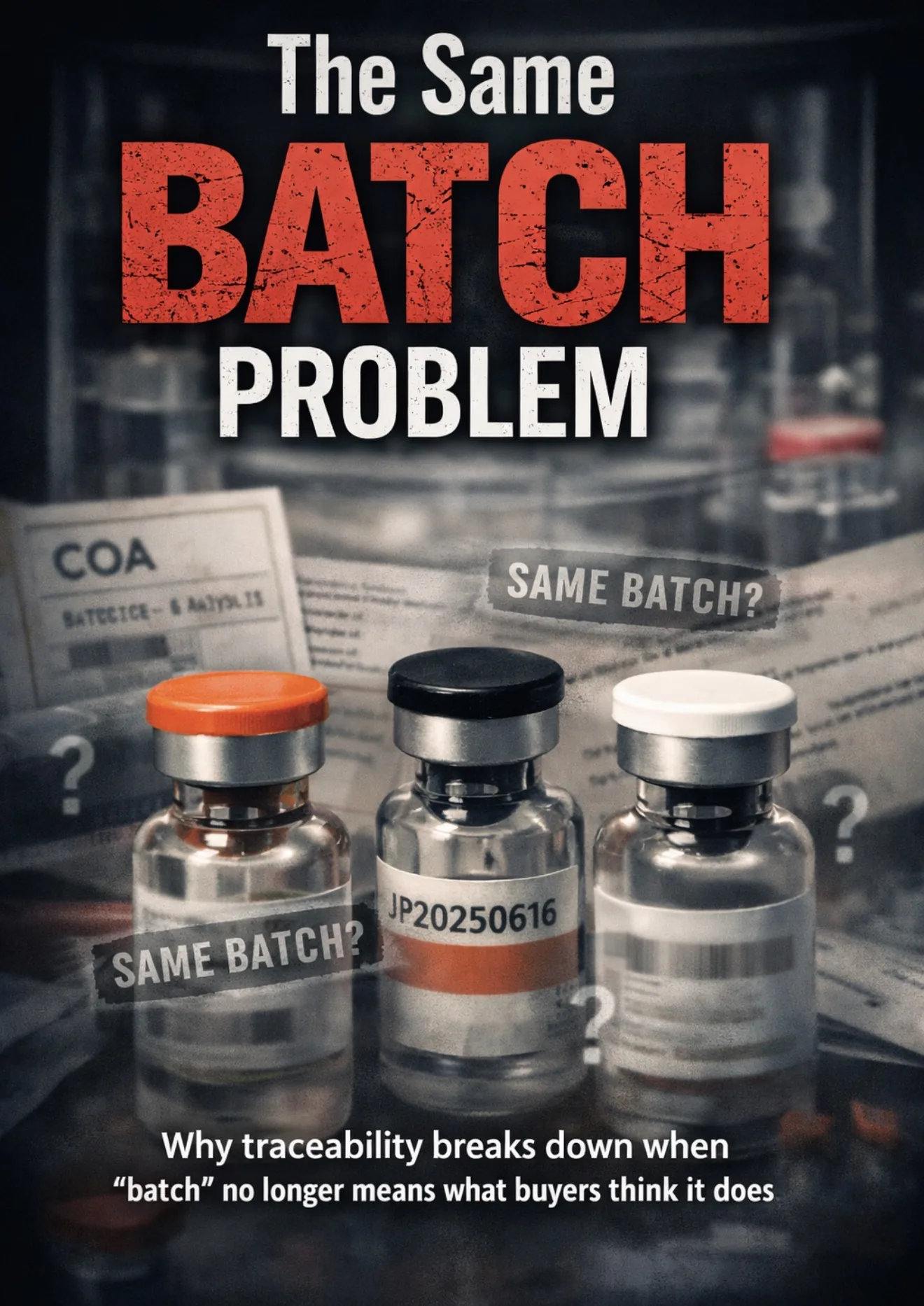
What actually defines a batch?
One of the recurring criticisms of Jeep has been their use of batch numbers, and the growing lack of confidence in what those numbers are actually supposed to represent. So it’s worth rewinding and asking a more basic question:
what exactly is a batch?
Most people assume it’s something simple, one single run through the lyophiliser, one defined production event with a clear start and finish, all with identical cap colours.
But that is likely too simplified. There are several ways a batch can be defined.
According to one industry source, some Chinese manufacturers do not always use “batch” in the strict sense of one clearly defined production run. Instead, products may be treated as the “same batch” if they come from the same raw material source, even if they are produced, packaged, or labelled at different times. In such cases different strengths, such as T30 and T15, could be treated as the same batch and I have seen vendors claim that a COA for one particular strength is also valid for another strength of the same product.
In other cases, a batch may be tied to a specific stage of the process, such as solution preparation, a filling run, or a lyophilisation cycle.
When I asked a source connected to a Chinese manufacturer, they confirmed that a batch number is assigned when goods are produced, but they were unsure whether that assignment is tied to the preparation of the solution or to a later stage, such as removal from the freeze-dryer.
That lack of clarity isn’t insignificant. It suggests there may not be a single, consistent definition of what a batch actually is across the grey market. Each factory may be applying its own logic, particularly where documentation standards are limited.
What a batch means in pharma
In a pharmaceutical setting, a batch is usually far more tightly defined than most buyers in the grey market realise. It generally refers to one clearly defined production event with a clear start and finish, carried out under the same controlled conditions and tied to one full manufacturing record.
That means a proper batch number should allow you to trace a product back to the materials used, the production run, the dates of manufacture, the processing steps and the testing and release records linked to that specific lot.
In other words, a pharma batch number is meant to function as a precise traceability tool, not a loose label for product made from the same raws or given the same presentation.
That contrast matters, because many buyers assume batch numbers in the grey market carry that same level of precision when, in practice, they are unlikely to.
Where assumptions start to break down
This becomes more important when you look at how buyers interpret cap colours. Cap colours fall into the same category. They may often be consistent across batches for practical reasons, and if a factory runs out of a particular colour cap, they will use whatever is available. So while cap colour can often help distinguish batches, it should not be treated as a 100% reliable batch identifier on its own.
Sometimes, when the cap colour does not match the COA, vendors will say the kit came from leftovers from a customised batch and that only the cap differs, not the batch itself.
My industry source has told me that some vendors send samples for testing and then ask for later products to be produced with the same cap colour. Cap colours may also be kept consistent simply because brokers do not want to pay for repeated testing on every new run. That changes how those colours should be interpreted. What buyers often assume is a fixed sign of batch identity may instead be part of the presentation, helping to explain why the same cap colour can persist over time, why the same COA may be reused for months, and why the idea of “same batch” becomes stretched.
The same applies to production dates. A factory is unlikely to produce new batches of the same product on two consecutive days as labels may sometimes suggest. What is more likely is that if lyophilisation space is limited, part of the same run may be moved into the next day for freezing. On top of that, different people may record different dates, for example the person in charge of production may record when the product comes out of the lyophiliser, while warehouse staff may record when it enters the warehouse, and printing instructions can introduce further recording errors. That ambiguity isn’t trivial. It suggests there may not be one universally understood definition in the grey market of what a batch actually is, or even one single date that always means the same thing.
Where this leaves trust
The whole point of having batch numbers is so that people can be reassured that other products from the same batch will be similar in make-up. But if some manufacturers are using the definition of batch loosely, that becomes far less reliable.
When people see their kit arrive with a batch number, they are given a level of reassurance because it appears to tie the product to a specific COA. But that reassurance still depends heavily on trust in the vendor, because a batch number only means something if it has been applied honestly and accurately.
My industry insider also told me that the US bulk buyers often prefer to assign their own batch numbers to products. One of the stated advantages of buying from US resellers is that they provide batch numbers linked to COAs. But again, this requires trust that the link is genuine, because the same system could be used to assign whatever batch number fits the COA being presented.
When someone is paying high prices for a single vial from a website, they are unlikely to test it themselves. That is part of what they are paying for, the assumption that testing has already been done. Even if the cost per vial matches a kit of ten from China, the justification is that testing and reassurance are included.
While I am not saying all website resellers are dishonest, it is fair to question what incentive exists for complete transparency in a market where most buyers are not independently verifying products. Most resellers will not issue refunds simply because a customer claims something is not working, so the buyer is left relying on the label and the COA. We are placing a significant amount of trust into that system as well, especially when some resellers present very old COAs for products.
To improve this, labs such as Janoshik have since last year, started including vial images on COAs, which allows for some level of cross-checking. But even this is not fool proof. In fact, I have heard stories about one US website reseller who allegedly changes the caps of her products to match her COAs.
Final thought
This all comes back to one thing: trust, and how much we can actually trust our vendors. It is already well known in the grey market that vendor-provided COAs should not be blindly trusted, but used as a guide. The same should apply to the reassurance offered by website resellers.
I have no doubt that some are honest. But in a market built around profit, and one where many buyers will never independently test a single vial, it would be naive to assume they all are. If the buyer cannot independently confirm what they are holding, and if the labels, batch numbers and COAs all depend on the vendor’s honesty, then the entire reassurance model is still built on trust, just packaged more neatly.
Personally, I would rather pay less for a kit of ten vials and use the difference to test the product myself, so I know exactly what is being analysed.


Comments