
This isn’t the post I planned to write.
I’d intended to write my usual investigative report on this shipment seizure, and I still probably will. But on Substack I like to go one layer deeper, into the psychology of trust in the grey market. How vendor reputations get built. How “vetted” becomes shorthand instead of a process. And how fast a community can swing from certainty to panic.
Because this case didn’t stay a shipping dispute for long.
What started as a simple question, “will the vendor honour the reship guarantee?” turned into something messier, a social fracture. A loyalty test. A quiet war of insinuation and received wisdom, where people stopped debating facts and started defending identities.
How it started: a vendor with a good name
A community member organised a first group buy with a vendor, Maggie Zhao. At the time, Maggie had a good reputation in parts of the community. People had ordered from her before. Some had received products without issue. She was friendly, responsive, and repeated the line everyone wants to hear, that she would stand by customers.
So when the first group buy was coordinated, it didn’t feel like a gamble. Not yet.
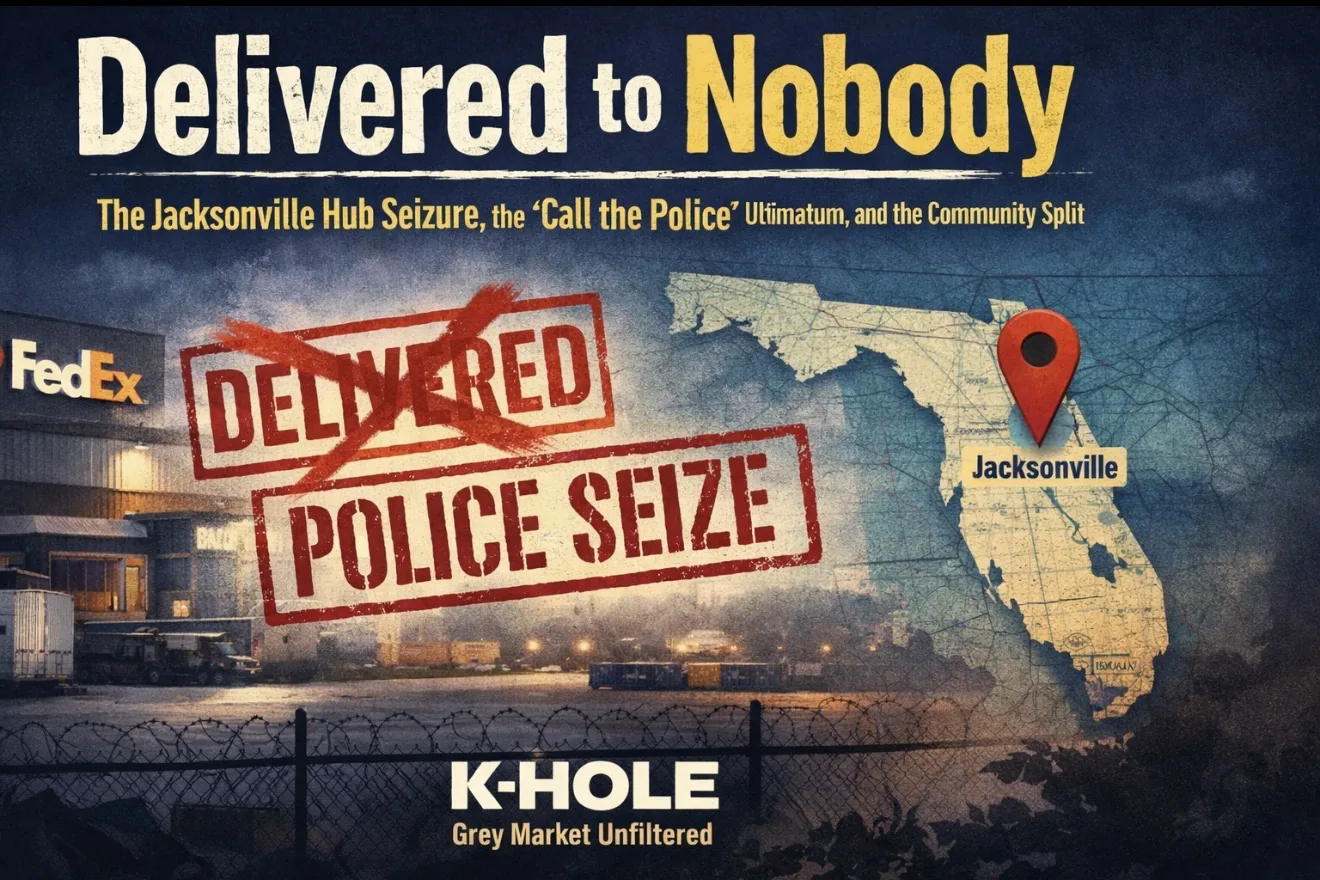
The plot twist: “delivered” but “signed for by: POLICE SEIZE”
This wasn’t a standard “stuck at the border” seizure. The tracking showed delivered, but also carried the kind of wording that makes a group buy organiser go cold: signed for by “POLICE SEIZE.” FedEx later confirmed the package was being held at the Jacksonville hub.
That combination, delivered, but not delivered, is exactly the kind of grey market nightmare that reveals whether a “reship guarantee” is a real policy, or just comforting marketing.
The question nobody wants to ask out loud: what does “reship guarantee” actually cover?
This is where the sides formed.
Most vendors will offer some version of: “we reship if seized by customs.”
But this case wasn’t neatly labelled “customs seizure,” and it didn’t happen at the border in the way people imagine. It happened deeper in the chain.
So the guarantee became a semantic fight:
Does “reship if seized” mean only a border customs seizure?
Or does it cover any authority hold along the route?
And if it doesn’t cover this… what exactly does it cover?
This is the moment people realise the grey market’s fine print often stays invisible until something goes wrong.
This is also the lesson I’m taking forward. From now on, the question isn’t just “do you reship if seized?” It’s: what do you count as a seizure, and what will you do as the shipper when tracking goes weird? Will you contact the courier/logistics provider yourself, open a trace, and request the shipper only report, or will you push the buyer to chase FedEx, or worse, to “call the police”? Seizures happen. The difference is what happens next.
The real fracture: fear, silence, and the social cost of speaking
As the situation escalated, what stunned me wasn’t only the vendor’s handling, repeatedly pushing the organiser to contact police, it was the community response around it.
The organiser’s members were fully behind her. But when they tried to warn another group that was actively running a group buy with the same vendor, the response wasn’t gratitude. People were blocked and removed. The other group’s framing was that the warning was “barging in” and should have been handled privately, one on one, not in front of a whole group where it could trigger panic. They may have a point there, although I only have their version of how it was handled.
Even a few vendors who were present in the organiser’s community tried to step in and advise Maggie on proper procedures. They were blocked too.
And of course, none of this stays contained to Telegram. It migrates to TikTok, where reputations are louder, loyalties are stronger, and nuance dies quickly.
So now you have sides, the group buy organiser and her members, the vendor and her supporters, and the rest of the community caught in the middle. And then I get pulled in as an outsider trying to document it.
Why people are scared
It’s easy to say: “Why are people scared? It’s online.” But in this space, fear is rational.
The fear of doxxing is real. Character assassination is common. And the threat of servers being nuked, through mass reporting, coordinated pile ons, or other retaliation, is not hypothetical.
When I started posting screenshots, I assumed I’d redacted them well enough. I ended up reposting them three times, because even the faintest remnant of a profile picture felt like too much visibility for people who didn’t want to be associated.
Silence in these communities isn’t always agreement. Sometimes it’s self protection.
When your entire market runs on private chats, informal reputations, and soft power, accountability doesn’t fail all at once, it fails quietly, as people learn there’s a price for saying the wrong thing in the wrong place.
Where I landed, and what I can say without “picking a side”
I like to think of myself as a neutral party. I’m sure plenty would disagree. But here’s what I know from the evidence and the behaviour:
A vendor advising a group buy organiser to contact the police about a shipment they never received is not okay.
FedEx opened a case; there is an email trail and a case number; and “POLICE SEIZE” is not a normal delivery outcome.
Instead of taking shipper side responsibility to obtain further documentation, the vendor repeatedly pushed the organiser to do it, and when she wouldn’t, the tone shifted into suspicion.
That leaves the community stuck in a pressure cooker logic because the logistics tracking still reads “delivered”: either the organiser is lying, or the courier stole it, a framing that conveniently avoids the most basic expectation buyers actually care about, resolution.
“She’s always done the right thing” vs “This is happening now”
Another layer that always appears in vendor disputes is the character witness chorus:
“I’ve ordered from her loads of times, she’s kind and sweet.”
“She always does the right thing.”
“This isn’t her fault.”
And I’m not dismissing those experiences. They’re real.
But they’re also beside the point when you’re holding a live case in your hands.
Because good history isn’t the same as good response under pressure. The real test of a vendor isn’t when everything is smooth, it’s when a shipment goes wrong, and the vendor has to choose between protecting customers or protecting themselves.
This case showed how quickly a “good vendor” narrative can become a shield, not for customers, but for avoiding uncomfortable questions.
When it becomes personal
At some point, the focus shifted away from the packages and onto the organiser.
Suddenly the organiser was being interrogated:
Why won’t you call the police?
What are you afraid of?
Why can’t you prove what happened?
That’s when a shipping dispute becomes a pressure campaign. And now the organiser isn’t just handling logistics, she’s defending her character in front of people who are financially stressed, emotionally primed, and watching every move.
And that’s how communities implode, not through one dramatic betrayal, but through slow reputational erosion, whispered doubt, and the quiet decision to stop speaking up.
The takeaway
This case isn’t only about a vendor. It’s about the ecosystem. It’s about how trust gets outsourced to hearsay, not documentation. How fast trust becomes tribal when money is on the line. What happens when a guarantee is phrased like a promise but treated like a loophole. And how quickly a community can fracture into factions when resolution is unclear and emotions run hot.
In the grey market, the product isn’t the only thing being tested.
The community is
Comments