

If you read my first post, you already know the core contradiction: “delivered” on tracking, but not delivered in real life.
This post is what happened because of that contradiction, the looping DMs, the “call the police” pressure, the faction split, and the way the community dynamics became the real story.
What this is (and what it isn’t)
This is a full write up of the case as it unfolded across public group chat + private DMs + spillover into other communities and TikTok, using the screenshots as the spine of the timeline.
It’s not just “a shipment seizure story.” It’s the social mechanics that kicked in the moment the tracking stopped making sense: factions, fear, blocking, narrative control, and the quiet way people learn that speaking up has a cost.
How it started: a vendor with a good name (until she wasn’t)
End of Oct 2025: Wende, the GB organiser was introduced to Maggie Zhao through a referral chain (member to member, via Lemon8). For months, her reputation was “safe”:
People ordered through Maggie and were happy.
She was responsive.
She repeatedly said she’ll “stand by each customer.”
That’s how trust forms in this space: not through policy, but through repetition + social proof + a few successful deliveries.
So when Wende ran her first group buy with Maggie, it didn’t feel like a gamble.
The shipment: nine packages, one address, one predictable risk
Late Jan 2026: Wende ran the GB. Nine packages were shipped to one recipient/address (Wende). It was a large order of several thousand dollars territory.
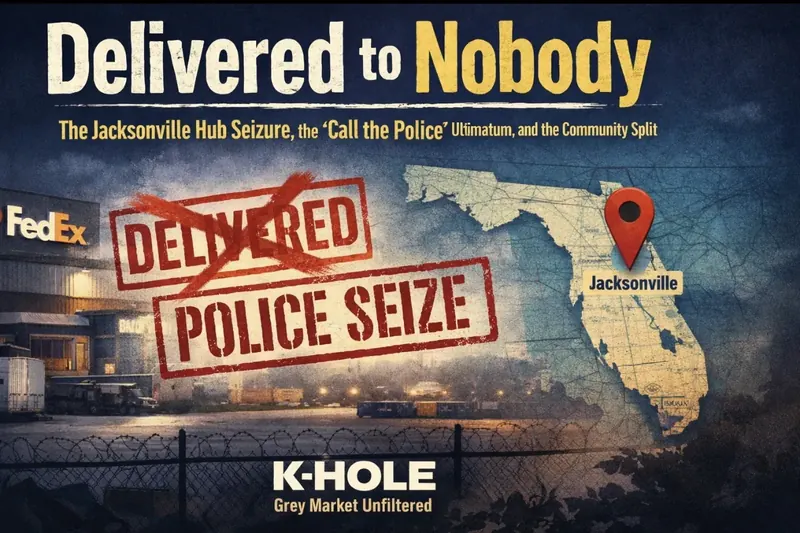
The plot twist: “Delivered” but “Signed for by: POLICE SEIZE”
Jan 29, 2026: Tracking showed “delivered,” yet also showed “signed for by: POLICE SEIZE.” FedEx later confirmed the packages were held at the Jacksonville hub, specifically tied to the FedEx location at 7490 Commonwealth Avenue, Jacksonville, FL 32220.
This is the nightmare combination:
Delivered in the system
Not delivered in reality
Custody/authority language attached
And the recipient can’t access the shipper level trace details
This was the point where a “reship guarantee” stopped being comforting marketing and became a test.
First responses: confusion, then a framing war
In the public chat, Maggie entered with a line that became a repeating theme:
“The product is legal and compliant… there’s no reason to seize it.”
She also framed it as not customs, but “local authorities.
She asked for “FedEx’s explanation.”
The problem is the framing. In practice, holds and seizures can show up at hubs well past the border, and tracking/phone reps often use broad shorthand (“police,” “authority hold”) instead of naming the agency. The operational reality is simple:
If the shipment is stopped and never reaches the recipient, the shipper/label purchaser is the party who can pursue the full trace/hold documentation and deliver an actual resolution.
Instead of moving into that role, Maggie started pushing the burden outward.
The first loop: “Contact FedEx” (already done)
Wende did what recipients can do:
called FedEx
opened a case
shared the case number and closure email
FedEx’s boundary was consistent: details go to the shipper / label purchaser, not the recipient.
In the public chat, Maggie said variations of:
logistics shows “delivered but seized”
Wende should contact FedEx again
Wende replies were always consistent, she’s already done it, and that the shipper needs to pull the shipper only documentation.
Feb 2: The pivot, “Marked address,” “contact police,” “everyone is a victim”
Next Maggie introduced a new claim:
logistics “detected” that Wende’s address information may have been detected/marked by police and that Wende should contact police or the express company
This was a major pivot
It replaced refund/reship with “go to police.”
The blowback: blocking, bans, and the price of warning others
As Wende’s group tried to warn another community currently running a GB with Maggie, the response was not “thanks.”
It became,
“You barged in”
“You should have done it privately”
blocks and removals
Even vendors present in Wende’s space tried to advise Maggie on how seizures/trace requests normally work.
They got blocked too.
This was where fear showed up in the behaviour;
people hesitated to comment
people worried about being targeted, doxxed, or dragged into the wrong “side”
Silence isn’t agreement in these communities. Sometimes it’s self-preservation.
On Feb 4, Maggie was finally booted from the group
The DMs: Groundhog Day, running alongside the public chat
While the public chat was active, the private DMs became a loop:
Maggie anchored everything to “delivered” and treated the delivery as “done.”
She insisted it’s “impossible” to be seized locally.
She repeatedly demanded Wende contact police.
When Wende refused (reasonable legal
risk boundary), Maggie treated the refusal as suspicious
By early February the story escalated;
“Either you stole it or the courier did.”
“If you keep demanding a refund, that’s harassment.”
“What are you afraid of?”
“We suspect you manipulated everything.”
One line even went theatrical: “call the police to find the murderer and the thief.”
That’s the moment the DMs stopped being about tracking and became about leverage:
a standard customer request was rebranded as wrongdoing, and “call the police” became the gate to resolution.
The smear phase: “apparently” becomes a verdict
This is where the dispute stopped being about the shipment and started being about reputations.
A third party reached out for a Telegram link, and in the same breath dropped;
“Apparently Wende is into illegal stuff… it didn’t get seized at customs… it got seized by police in Florida.”
That single message does a lot of damage without proving anything:
it planted suspicion (“illegal stuff”)
stated an alternative narrative as fact (“not customs”)
pushed blame onto the organiser
And it landed on a community already stressed, already primed, already looking for someone to blame.
Proof arrives: the seizure letter (Feb 12)
Wende spent days collecting evidence:
case numbers
emails
recorded confirmation that the shipment was held in Jacksonville
Feb 12, 2026: The customs/seizure letter arrives.
In a normal world, this is where it ends:
proof arrives → vendor resolves → community breathes again.
But this case didn’t end.
When proof isn’t enough: Maggie’s “new solution” (paperwork)
After the letter, Maggie introduced a new “resolution”:
Not money.
Not replacement.
Paperwork.
She sent a zipped packet and told Wende to submit it in response to the seizure letter, to CBP/customs as the listed point of contact.
Inside an invoice included details that could raise scrutiny, though it’s not confirmed these caused the seizure, such as:
a declared value of $2
a product description that didn’t match what
was being shipped
Wende refused. Her reasoning was simple:
Submitting documentation you believe is inaccurate to a government agency can create serious legal risk.
And this is the final pivot:
the burden is no longer on the shipper to resolve a seizure
it’s on the recipient to sign off on paperwork she didn’t create and doesn’t trust
That is not a remedy. That is risk transfer.
Where the case stands right now
As of now, the timeline is current through the seizure letter arriving and Maggie’s paperwork based “solution”
There is still no clear standard remedy on the table, no refund, no reship, and no credible alternative resolution that doesn’t shift risk onto the recipient.
What repeats in both the public chat and the DMs is the same pattern:
“Delivered” was treated as the end of the story, despite the seizure/hold context.
Police contact was positioned as the gate to any next step.
Suspicion (“you stole it / the courier stole it / your address was marked”) replaced resolution.
Accountability was deferred to “my boss,” “logistics,” or the recipient completing high risk steps.
Meanwhile the conflict continues outside Telegram (TikTok and other groups), where the dispute becomes less about what happened and more about who gets believed.
The practical lesson;
If we take nothing else from this case, it’s this:
Stop accepting “reship guarantee” as a vague comfort phrase. Make it definitional. Make it operational.
Before money moves, ask vendors to answer clearly:
What do you count as a “seizure” (border, hub, authority hold, carrier security)?
If tracking shows “delivered” but the recipient didn’t receive it, what happens next?
Will you (as shipper) contact the carrier/logistics, open a trace, and request shipper level documentation, or will you push that onto the buyer?
What is your actual remedy policy: refund, reship, credit, partial, timeframe?
Seizures happen.
The difference is what the vendor does next, and whether the community’s trust system can survive the stress test.

Comments