

This story was never about a single missing package, nor was it about one angry customer. What unfolded around YD Peptides and Lady Ka Ka became something much larger: a slow-motion collapse of trust inside a grey-market ecosystem built almost entirely on reputation, communication, and the belief that vendors would eventually make things right.
Unlike a classic overnight exit scam, this situation deteriorated gradually. At first, customers defended the vendor. Then they became concerned. Then frustrated. Then exhausted. And by the end, even relatively small refunds had turned into weeks or months of chasing, public warnings, accusations, bans, and customers openly questioning whether the operation itself was still functioning properly.
The Rise Of Lady Ka Ka
We first connected back in September 2025 through TikTok. She found my account and messaged me directly. One thing I noticed immediately was how concerned she seemed about being labelled a scammer. During one of our earliest conversations, she even video called me as an attempt to prove this.
What I saw was a young Chinese woman who spoke good English and appeared eager to prove she wasn’t a scammer, while also trying to integrate into the peptide community. I eventually introduced her to Pepchat admin to help get her server organised.
In October and November, Lady KaKa also tried to gain access to STG’s recommended vendor list, but was told twice that STG had paused new vendors.
Despite that setback, things initially went well. She joined community discussions, became active in the vendor space, and quickly built visibility. She sold peptides, oils, and tablets, which helped her gain attention quickly. In interviews and conversations, she described YD as a “raw manufacturer.”
There was also a softer side to my early interactions with her. She was friendly, responsive, sent me a personalised Christmas message, and even shared photos from a concert she had attended.
That is part of what made the later collapse feel sharper. This was not a random vendor I had watched from a distance. It was someone I had personally interacted with, helped introduce into community spaces, and initially believed was trying to do things properly.
Early Warning Signs
Looking back, the warning signs were already there before most people realised how serious the situation would become.
By late November 2025, complaints had started surfacing around incomplete shipments, missing products, poor stock confirmation, and slow refunds. At the time, these looked like isolated problems. In hindsight, they were early versions of the same pattern that later became impossible to ignore.
One buyer reported receiving an incomplete order and asking for a refund on the missing items. Lady KaKa blamed the warehouse and shipping agent, saying availability had been confirmed before the order was placed.
But her own explanation pointed to something bigger than one mistake.
Warehouse communication was poor. Stock updates were delayed. Shipping agents made mistakes. Refunds were being handled manually. The sales team did not always have direct access to the money.
At one point, Lady Ka Ka herself described the internal situation as chaotic. She said the logistics inside the company were “a total mess,” that freight forwarders were slow, stock updates were always late, orders were going missing, and even partial refunds were becoming difficult to manage. She also admitted the warehouse would sometimes simply stop responding altogether.
That matters in hindsight because it shows the instability was already visible internally long before the wider public collapse. The operational confusion customers were reporting externally was apparently already being acknowledged behind the scenes.
The problem was not just that orders were delayed. It was that responsibility kept shifting between sales reps, unnamed management, “the company,” shipping agents, finance departments, and warehouses.
No single person ever appeared fully in control.
By December, the same issues were becoming more visible. Customers were still not describing a complete collapse, but the same warning signs kept repeating: delayed shipments, missing items, unclear stock, slow refunds, and vague explanations.
One buyer waiting on a shipment worth roughly $900 said they were being told only that there was a delay. Around the same time, YD appeared to be taking payment for items that were not actually available.
When customers asked for refunds, some were met with responses along the lines of this not being Amazon, or that they could apply for their own refund.
That tone mattered because once a vendor takes payment for stock it cannot clearly fulfil, the issue is no longer just shipping. It becomes a trust problem.
At first, customers dealt directly with Lady Ka Ka. Then Kris began appearing across Discord, Telegram, and WhatsApp. Later, customers were told there was a separate “boss” with direct access to suppliers.
The structure started to look less like a straightforward vendor operation and more like overlapping layers of intermediaries.
That is what makes the early complaints important. They were not separate scandals. They were the same cases developing over time: first as missing items, then delayed refunds, then public complaints, and eventually a broader collapse of confidence in YD and Lady Ka Ka.
The Customer Unboxing Problem
Around this period, another concern surfaced repeatedly.
Customers started noticing that many of the “customer unboxing” posts circulating in YD spaces did not appear to be posted directly by customers themselves. Instead, screenshots and videos were often reposted by internal staff or admins.
One customer privately pointed out:
“I don’t think I’ve found a single customer unboxing posted directly from the customer.”
That observation mattered because independent customer confirmations are one of the primary ways trust is built inside grey-market communities.
The Account Access Problem and Olympus Scam
One of the most controversial parts of Lady Ka Ka’s history was the Olympus scam, especially the claim that she had given the scammer access to her WhatsApp and vendor-facing accounts. That detail changed how many people viewed her.
Whilst some saw her as another victim who had been manipulated, others argued that even if she did not personally receive the money, her accounts still helped create the conditions for buyers to be misled and in grey-market communities, identity is trust. Customers are not protected by formal company structures, chargebacks, or legal safeguards. They are trusting usernames, Telegram accounts, WhatsApp chats, Discord reps, and familiar vendor identities. So when a vendor-facing account is handed to someone else, customers no longer know who they are really speaking to.
According to later explanations, Lady Ka Ka had been tricked into giving the scammer access to her accounts. That person then used those accounts to reroute buyer payments into his own wallets. That raised the obvious questions:
Who was sending payment instructions?
Who controlled the wallets?
Who had access to customer conversations?
And who was responsible when money disappeared?
That became the heart of the controversy. Not everyone believed Lady Ka Ka had intentionally orchestrated the Olympus fallout, but many argued that once a vendor hands over accounts tied to customer trust and financial transactions, responsibility does not disappear simply because someone else was typing. One line from the discussions captured the problem well:
“She may not have received the money, but her accounts helped move it.”
The technical explanation was also debated. Some questioned whether the WhatsApp access story fully made sense. Others felt the technical details mattered less than the broader issue: customers no longer knew who they were actually dealing with.
By the time later YD disputes began piling up, missing shipments, refund delays, quality complaints, and unclear wallet control, many buyers were already viewing the operation through that earlier account-access failure.
That is why Olympus became more than a separate controversy. It exposed the same weakness that later appeared across YD itself: blurred authority, unclear control, and no clean answer to who was actually responsible.
The Refund Spiral
This is where confidence really started to collapse. The original mistakes were bad enough: missing products, incomplete orders, stock that had not been properly confirmed. But what damaged YD more was what happened afterward.
Refunds became their own ordeal.
One customer documented an incomplete EC25 order where a refund was promised for a missing bottle. They provided a wallet address, then later received a screenshot claiming a 93 USDT refund had been sent.
The problem was that the refund was sent to the wrong wallet and when the customer challenged it the explanation was that it had apparently gone to the company wallet and that it needed to be resubmitted. That’s where the issue stopped looking like a normal delay and started looking structurally broken. Either the refund process was chaotic enough that money could be sent to the wrong place, or the explanation was being adjusted after the customer spotted the mismatch. Neither option restored trust. This customer's message captured the wider frustration:
“When I’m ordering, you want the money quick. But when you need to issue a refund for paid products you didn’t send me, I have to wait weeks.”
Even small refunds became prolonged battles. Customers chased for days, then weeks. Some claimed that when they called out the poor customer service they were removed from the group entirely.
By this point, the damage was no longer just about missing items. It was about the way complaints were handled.
The Exhaustion Phase
Eventually, the tone changed, customers were no longer just angry, they were tired too. The same phrases kept appearing across different conversations:
“tomorrow”
“waiting on management”
“refund processing”
“they didn’t release it”
“company wallet issue”
For buyers, each new explanation sounded less like an update and more like another delay. One customer wrote:
“My money’s gone. I’ll just keep making them lose customers daily.”
Another said:
“I’m convinced at this point I will not get my money back.”
The situation became more hostile on both sides. Customers became aggressive. Vendor replies shifted between reassurance, defensiveness, emotional appeals, and frustration.
One phrase from Lady Ka Ka appeared repeatedly:
“The company does not belong to me though.”
That distancing became one of the clearest signs of the collapse. Lady Ka Ka was still the face customers dealt with, but as pressure increased, she repeatedly separated herself from the company behind her. She represented YD when orders were being placed, yet when refunds stalled, shipments disappeared, or complaints escalated, responsibility shifted toward “the company,” “management,” or “the boss.”
For buyers, that distinction meant very little. Whether she personally controlled the money or not, she was still the person who had built the trust, handled communication, and represented the operation publicly.
By that stage, she remained the visible face of YD, still responding to customers and managing complaints, while also insisting she did not control the wallets, refunds, or management decisions.
At times, the distancing became even more blunt. When challenged directly, the response was not simply that refunds were delayed, but that the money had not been taken by her personally:
“I didn’t take your money, the company did.”
That may have been true in a technical sense, but it didn’t solve the buyer’s problem. To customers, the company was not an abstract entity, it was the account they spoke to, the rep they trusted, and the person who took the order. And when the system began failing, she became the only person left answering for it.
Product Quality Disputes
Refunds were not the only problem. By early 2026, product quality disputes were adding more pressure, and the biggest flashpoint was YD’s purple-cap H36 HGH.
A group had reportedly bought hundreds of kits. YD’s stated guarantee for HGH/H36 was purity above 96%, although members said it had previously been 98% before the bar was lowered. The group tested the product through Janoshik as YD initially said they will only accept reports from Janoshik. The first set came back at an average purity of 93.2545% and an average dimer of 0.969%
YD then shared a COA from another non Janoshik lab, which allegedly showed the product meeting the guarantee. That became the basis for denying the refund request. So the group paid to test two more vials through Janoshik and the second set came back even worse with an average purity of 92.968% and average dimer of 0.987%. A further Chromate result was said to be worse again with a purity of 90.967% and a dimer of 1.516%. The group asked for a just a partial refund, but the best offer described was 15% off a future order.
That is where the dispute became bigger than the numbers.
Buyers felt they had done exactly what a serious customer should do, test the product, produce repeat results, and take the findings back to the vendor. But instead of a meaningful refund, replacement, or clear acceptance of the guarantee, they were offered a discount on another order. One member summed up the wider mood:
“Product not received. Refund / reship not received. Guarantee not honoured.”
That became the shorthand for the whole YD collapse. The issue was no longer just whether one batch tested badly. It was whether YD’s guarantees meant anything once payment had already been made.
Brazil Shipment Complaint
One of the most detailed complaints came from a Brazilian customer. Unlike generic refund complaints, this buyer documented the issue extensively.
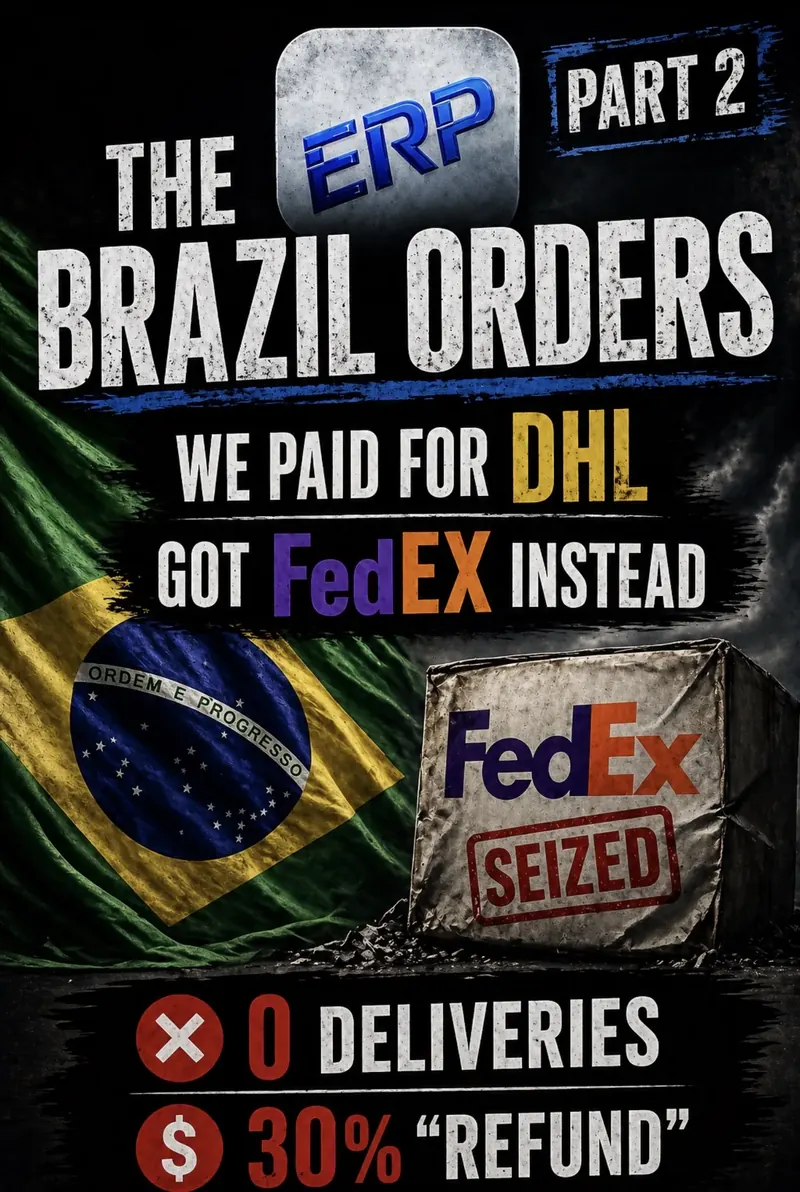
According to the complaint, detailed customs declaration instructions were provided before shipment. The customer repeatedly specified the declaration wording required, but the shipment was allegedly declared incorrectly as “small plastic particles.” Brazilian customs refused the shipment, and the package was returned due to insufficient or incorrect information.
The customer provided customs screenshots, tracking records, translated notices, communication logs, and direct tracking portal access for verification.
The complaint also alleged an out-of-stock FR10 item, denial of partial refund requests, communication breakdowns, and eventual removal from Telegram groups.
This case became important because it exposed a specific operational contradiction.
Brazilian buyers repeatedly argued that declaration wording, invoice values, and shipping descriptions are not minor details in Brazil. They are central to whether a parcel clears customs. The customer’s position was that these details had been discussed in advance because local buyers understood what was likely to pass.
But the response from the vendor side suggested something different: that shipping agents and freight forwarders ultimately controlled the declaration process, and that the sales reps could not force them to follow customer instructions exactly.
Hillary, was the sales rep the customer had originally placed the order through, but the customer ended up asking for intervention from Lady Ka Ka herself, as confidence in the situation deteriorated.
That matters, because if a vendor accepts an order on the understanding that specific declaration requirements will be followed, but the shipping agent later uses its own wording anyway, then the customer was not really buying the level of control they believed they were buying. One community member summarised the problem clearly:
“You have no control over what the shipping agent does. Perhaps this is the main point that needs to be clarified.”
That is the heart of the Brazil dispute. It wasn’t just customs risk, it was a dispute over whether the agreed shipping conditions were ever realistically enforceable.
The customer later pushed back again, arguing that the parcel was already registered in the system as being returned, while Hillary continued treating the issue as unresolved or still in motion. Others suggested the vendor should simply reship the in-stock items and refund the out-of-stock item. The response remained unclear.
At one point, Hillary replied that the replacement order had already been sent using a “special line” that was supposedly safer for customs, and that if customs detained it, the company had promised to refund or reship. But she also insisted she did not control the money or the carrier.
Again, the same contradiction appeared: the customer-facing reps were making assurances, while simultaneously claiming they did not control the shipment, refund process, money, or logistics decisions behind it. That pattern would repeat across multiple disputes.
Another Refund Timeline: Lucas
Another buyer, Lucas, showed the same slow refund loop in a simpler form.
His screenshots show a refund request submitted on March 30.
Over the following weeks, Lucas repeatedly asked for updates. On April 3, he asked for refund status. On April 7, he asked again. On April 10, he said he needed the refund and had to buy food for his sons. On April 14, he asked again and was told it was “not a scam.” On April 22, he asked whether the package could at least be resent. By April 26 and 27, he was still asking for updates.
Lady Ka Ka’s replies followed the familiar pattern:
“The company hasn’t issued your refund.”
“Let me chase up with that.”
“I have asked company to refund you.”
“I’m trying to get your refund this week.”
“The company haven’t refunded but I’m asking them.”
The issue here was not one delayed response.
It was the repetition of the same promise across weeks without resolution. At one point, Lady Ka Ka wrote that she wanted either the order shipped or the refund processed, and admitted that the warehouse shipping system was broken and the freight forwarder was not doing anything useful.
That message was revealing because it confirmed what customers were already feeling, the system behind the scenes was no longer functioning cleanly.
Feedbacks: The Collapse Becomes Public
By late April, the complaints were no longer isolated DMs, they were appearing openly in YD’s own feedback channels and in community chats. That shift matters because it shows the reputation damage moving from private frustration into public warning.
The complaints followed several repeating themes: orders paid for months earlier with no tracking, stock allegedly becoming available for newer buyers while older orders remained unresolved, refunds promised but not sent, reships promised but not confirmed, buyers being removed or ignored after pushing too hard, and confusion over whether the rep, warehouse, boss, company, or shipping agent was responsible.
One buyer described placing an order at the beginning of March and still being unable to get a clear response from the team by late April. Another said they had ordered in January and were still waiting for a resolution. Another wrote that they had been waiting for the rest of an order from January 29. Another said they had been waiting for a reship since February 3.
One buyer gave a timeline: February 28, paid for items listed as in stock; March 5, told some items were not in stock; March 8, replacements confirmed, but no tracking; March 30, told that if no shipment arrived within seven days, refund would follow; May 1, still no refund. That type of timeline is hard to explain away as one impatient customer. It shows a fulfilment and communication pattern. A different buyer described ordering tabs from China on March 9, receiving no updates or tracking by March 20, then buying domestically instead to avoid missing their cycle. By May 3, they still had no refund from YD.
Their conclusion was blunt, that by the time they had received a domestic shipment, a reship, and finished nearly a five-week cycle, YD still had not refunded the original order. That’s the kind of comparison that destroys confidence, because customers aren’t just asking whether delays happen in grey-market buying, they’re comparing how different vendors behave when delays happen.
New Orders, Old Orders, and the Stock Question
One of the most damaging themes was not simply that some orders were delayed, it was the perception that new buyers were receiving products while older unresolved orders were still stuck. People can usually understand an item being out of stock at the time of ordering, but what causes real damage is when stock appears later, new orders seem to be filled, but earlier buyers still cannot get tracking, refunds, or clear answers. One member put it plainly, the frustrating part was not just stock delay, but seeing newer orders filled while existing ones were not.
Another buyer said they were “dumbfounded” watching people claim they had received orders on the same type of items while their own order from two months earlier still had no response. That creates a specific suspicion, not just poor logistics, but selective fulfilment. Whether that suspicion is fair or not, the vendor’s communication did not resolve it and instead, the gaps remained.
Moderation, Silence, and Customer Removal
As complaints increased, another pattern appeared repeatedly, customers claimed they were removed from groups after raising concerns. One buyer stated:
“YD deleted me from the Telegram group without offering any solution.”
That behaviour matters psychologically. Customers can tolerate delays. They can tolerate mistakes. What they struggle to tolerate is feeling silenced. Once buyers believe criticism itself is being removed or controlled, the assumption of dishonesty spreads rapidly.
Community Reaction: From Patience to Exit Scam Talk
By early May, the language in the feedback chats had changed. People were no longer only asking where packages were. They were asking whether the whole thing was leading to an exit scam. Some still defended the sales reps, arguing that the real anger should be aimed at management, not the customer-facing people who were still around. Others pointed out that reps may have little control over the company, refunds, or shipping decisions, which may be true, but it didn’t solve the buyer problem.
Because from the customer’s side, the rep is the face of the company. The rep takes the order, gives the reassurance, passes on the payment instructions, and answers the complaint. If management disappears behind them, the rep becomes the only reachable target. That isn’t always fair, but it’s predictable.
Lady Ka Ka herself eventually appeared to recognise how bad things had become. In one message, she advised people not to place orders right now, said no shipments could currently be sent out, and told customers she did not own the company or their money.
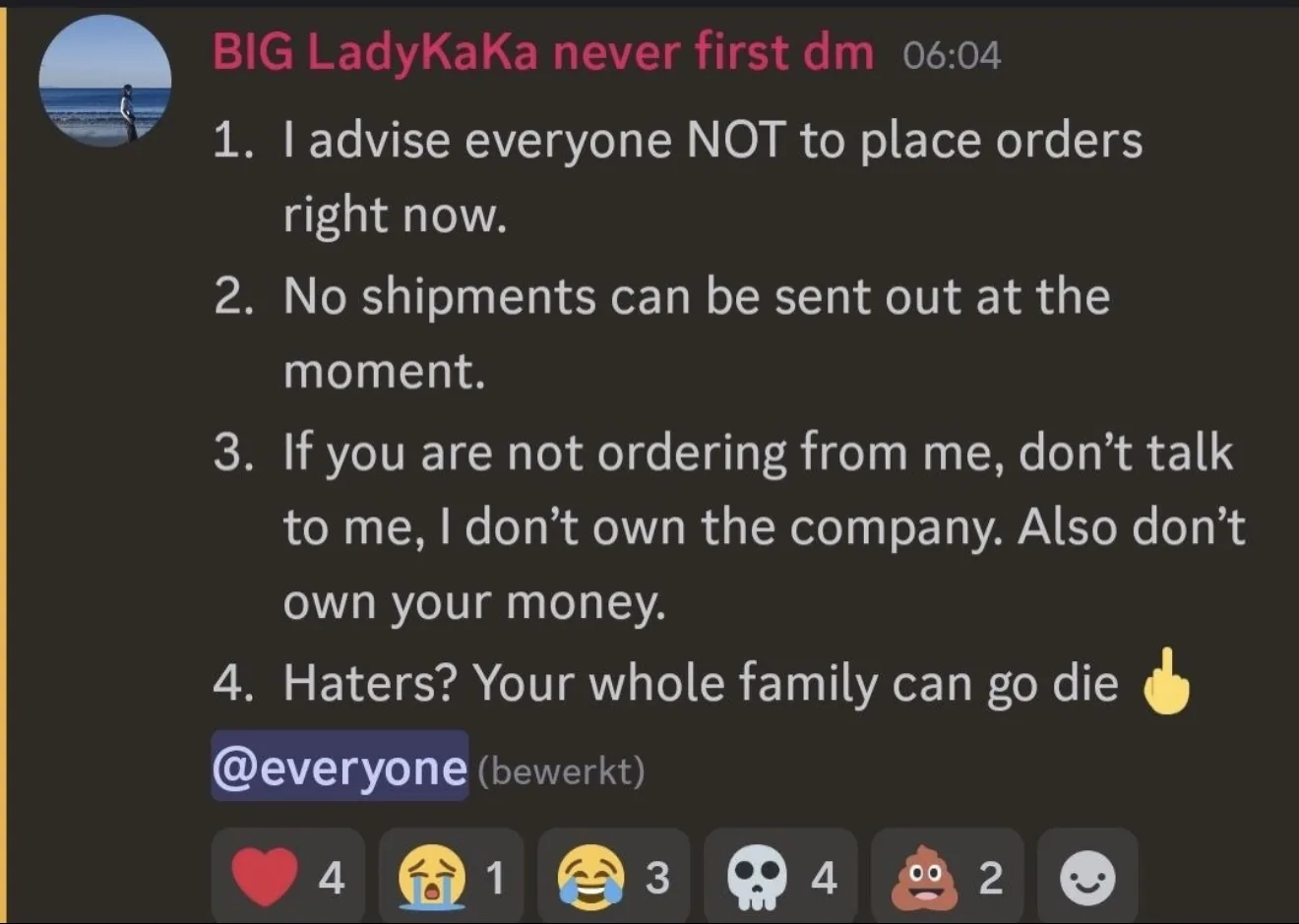
That message was both honest and damaging. Honest, because it acknowledged the practical reality that orders should not keep being taken if shipments cannot be sent and damaging, because it also confirmed that the person many buyers had trusted didn’t control the company, the refunds, the warehouse, or the money.
At that point, the brand was effectively split in two, the company holding the money, and the rep absorbing the anger.
The Psychology of Collapse
What makes this story interesting is that most of the disputes were not over massive sums of money, some refunds were for less than $300. But that detail actually makes the situation more revealing. Because once relatively small refunds become drawn-out disputes lasting weeks or months, customers begin questioning whether the underlying issue is financial inability, operational disorganisation, deliberate stalling, or some combination of all three. And once trust breaks inside grey-market communities, every delay starts looking suspicious. Even genuine operational problems become interpreted as deception. That is the phase YD eventually entered.
Not Every Scam Looks Dramatic
One of the most important lessons from this entire situation is that not every collapse looks like a classic exit scam. Sometimes it looks like delayed refunds, missing products, contradictory explanations, overcomplicated operational structures, constant “tomorrow” promises, finance departments nobody can verify, and customers slowly losing faith one interaction at a time. The collapse becomes cumulative, not explosive.
The Final Lockdown
By May 5, the situation had deteriorated beyond complaints about orders and refunds.
The chat itself began to collapse. As anger grew, people started posting porn and other filth into the group, apparently in an attempt to get it shut down. The group was eventually locked down. Lady Ka Ka’s final visible message on May 5 did not calm anything down. It read:
“Fuck you. What a slut. Hope your whole family die.”
That was the clearest sign that the customer-facing side of the operation had completely broken and by then, this was no longer just a vendor dispute. It had become a full community meltdown with unpaid customers, missing products, public accusations, harassment, sabotage, and a vendor rep openly losing control in the group she once used to build trust.
The Final Pattern
YD’s collapse was not one clean failure. It was a pile-up: the Olympus/Ziass fallout, the account-access controversy, unresolved refunds, missing and delayed orders, Brazil customs disputes, out-of-stock items, H36 testing failures, guarantee disputes, ignored complainants, reps claiming they had no control, unreachable management, and customers watching new orders or partial deliveries appear while older problems stayed unresolved.
Lady Ka Ka didn’t begin as the obvious villain. Early on, she looked like the helpful, approachable rep who responded, tried to smooth problems over, sent holiday messages, and kept complaints visible in the name of transparency. But once the structure underneath her started breaking, that visibility became a liability. Every unanswered refund, missing order, failed guarantee, “I asked the company” reply, and message saying she did not control the money made the same point, that she had become the face of a system she couldn’t fix.
And when a vendor-facing rep becomes the face of a broken system, the fall is usually ugly.
The Wider Grey-Market Context
YD wasn’t an isolated case. By this stage, many community members were already comparing it to a growing list of grey-market vendors that had disappeared, stopped communicating, collapsed operationally, or left customers unresolved.
Names repeatedly brought up included U Peptide, HYT, Semag, and Subi Peptides. That wider context shaped how people interpreted YD’s behaviour. In a normal retail environment, customers might assume delays are temporary, but in the grey market, repeated delays, disappearing staff, refund problems, and collapsing communication trigger a different fear entirely, that the vendor is becoming the next name on the ghosted-vendor list.
That doesn’t excuse what happened with YD, but it places the story in its real context.
This was not a normal retail dispute inside a normal supply chain. It was a grey-market operation functioning inside an ecosystem where vendors can vanish, factories can stop shipping, sales reps may have little authority, and buyers often have no enforceable protection once money has been sent. That’s why the old rule still applies:
Never spend more than you can afford to lose.
Final Observation
The rise of Lady Ka Ka was fast, the fall was slower, messier, and far more revealing.
Because it exposed the fragile reality underneath much of the grey market itself, large amounts of money moving through informal trust networks with limited safeguards, fragmented operations, unclear accountability, and communities forced to decide in real time who, if anyone, they still believed

Comments