
One of the more interesting developments in the peptide space recently has been the arrival of Drexa Labs, a new research peptide supplier that appears to have launched in May 2026.
https://drexalabs.com/
A Very New Company
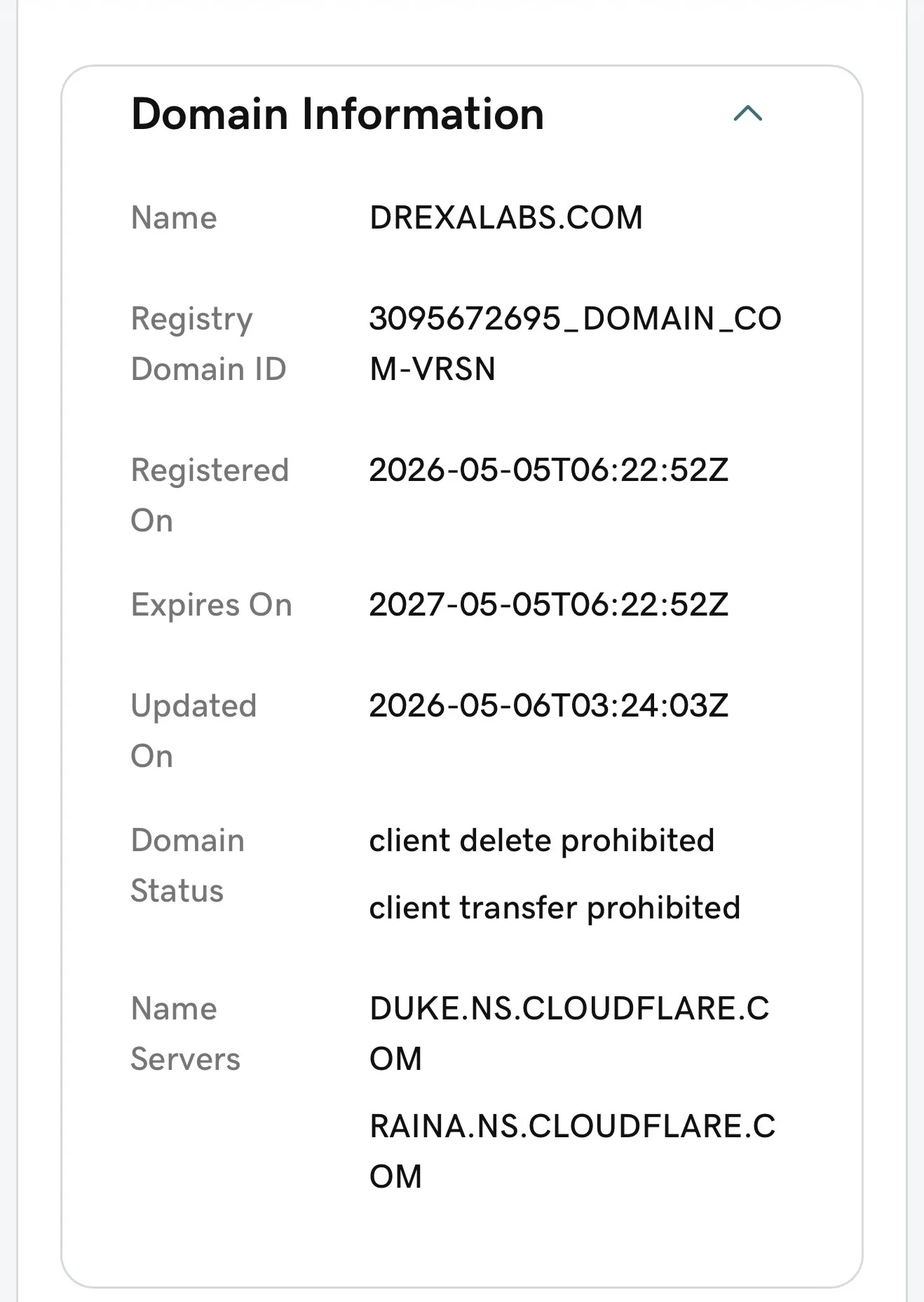
Public domain records indicate that drexalabs.com was registered on 5 May 2026.
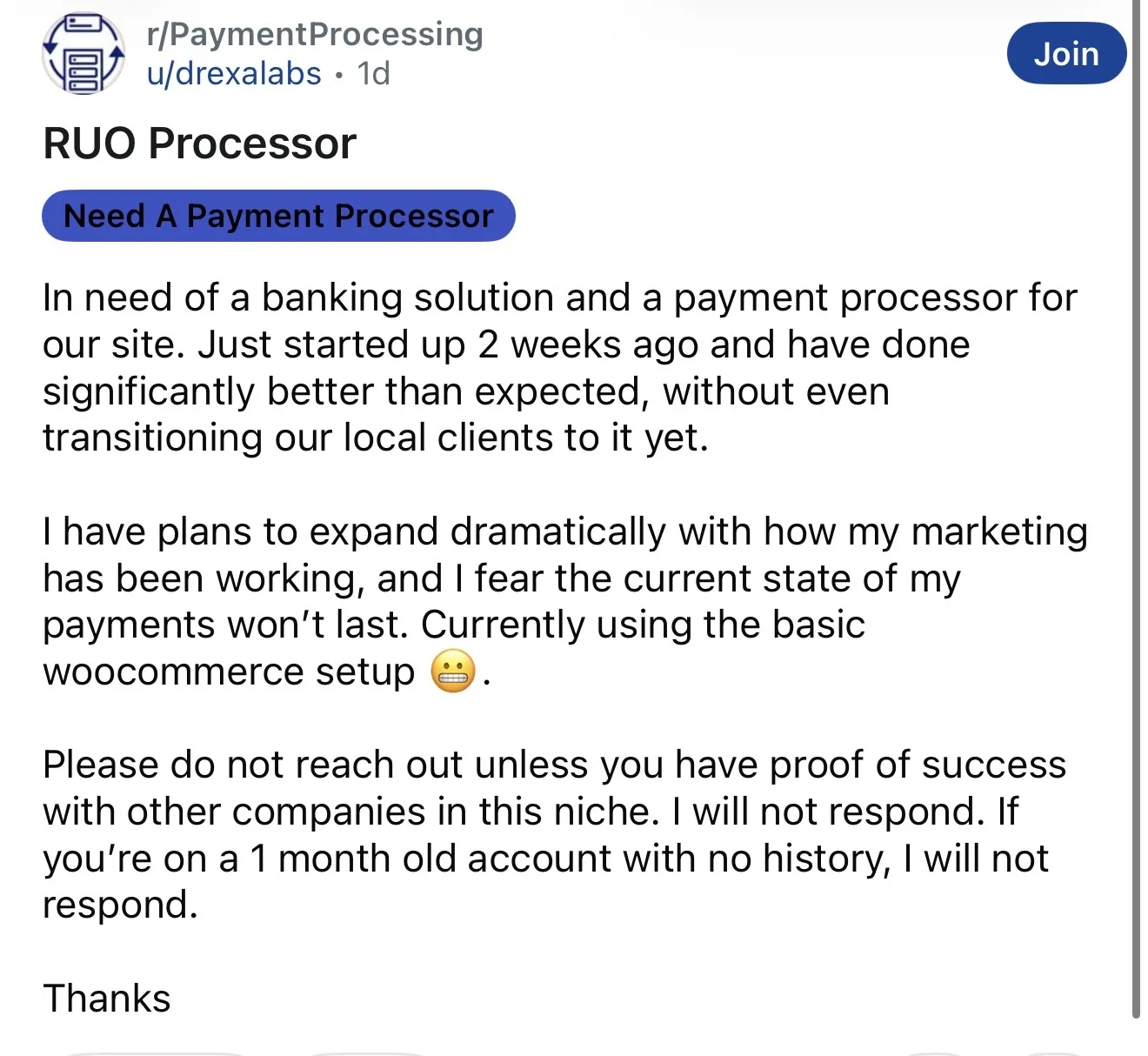
That timeline appears broadly consistent with a recent Reddit post made by the account, which described the business as having started only weeks earlier and already experiencing rapid growth.
There is nothing inherently suspicious about being new and every company starts somewhere. The practical reality, however, is that a newly launched vendor has not yet had years of public testing results, customer experiences, independent reviews, or established reputation to support the claims made on its website.
For that reason, documentation matters even more.
Unlike many vendors, Drexa has invested heavily in presentation. The website is professionally designed, packed with educational content, and includes lengthy articles explaining peptide purity, analytical testing, mass spectrometry, and how researchers should evaluate Certificates of Analysis (COAs).
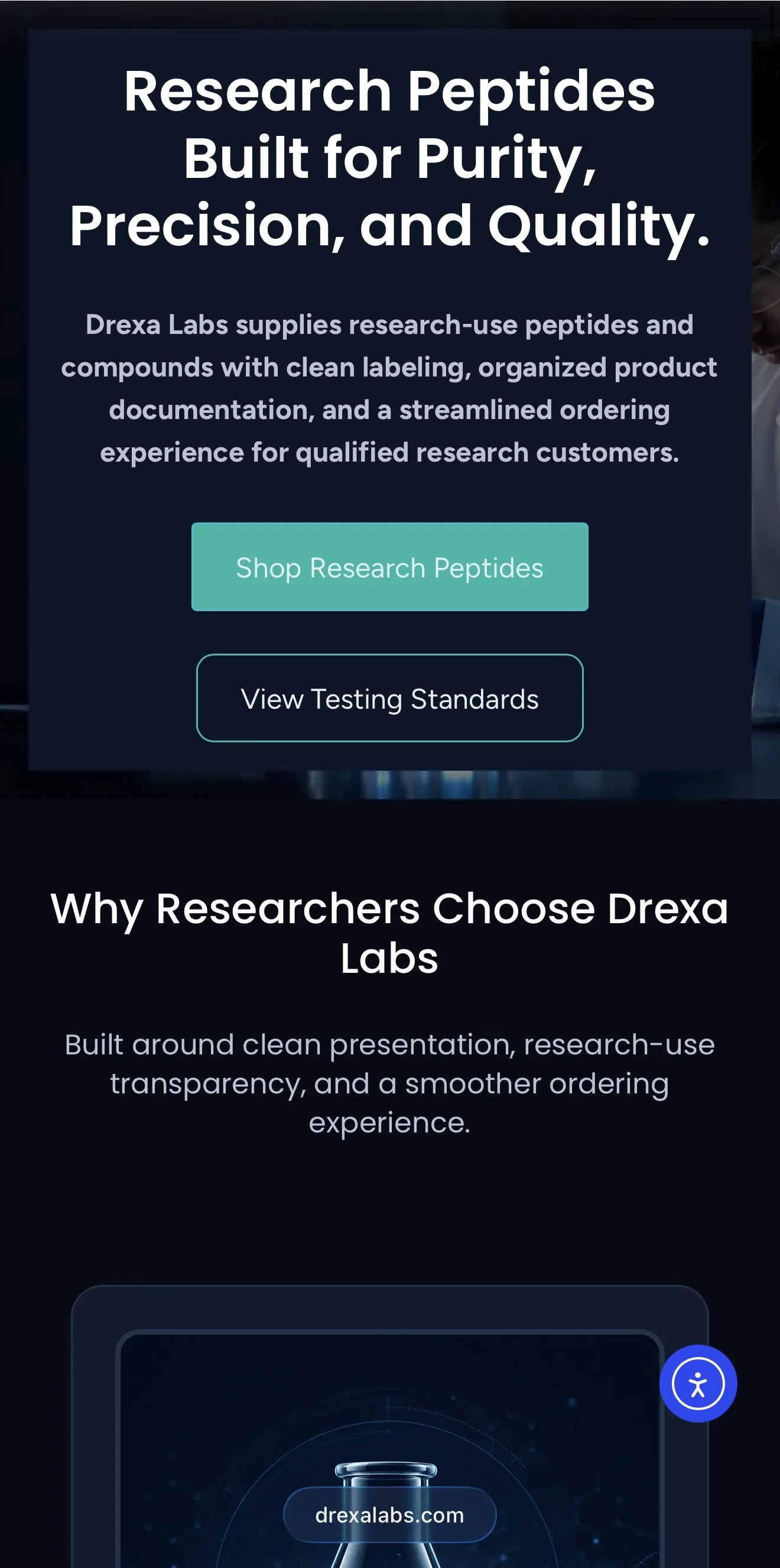
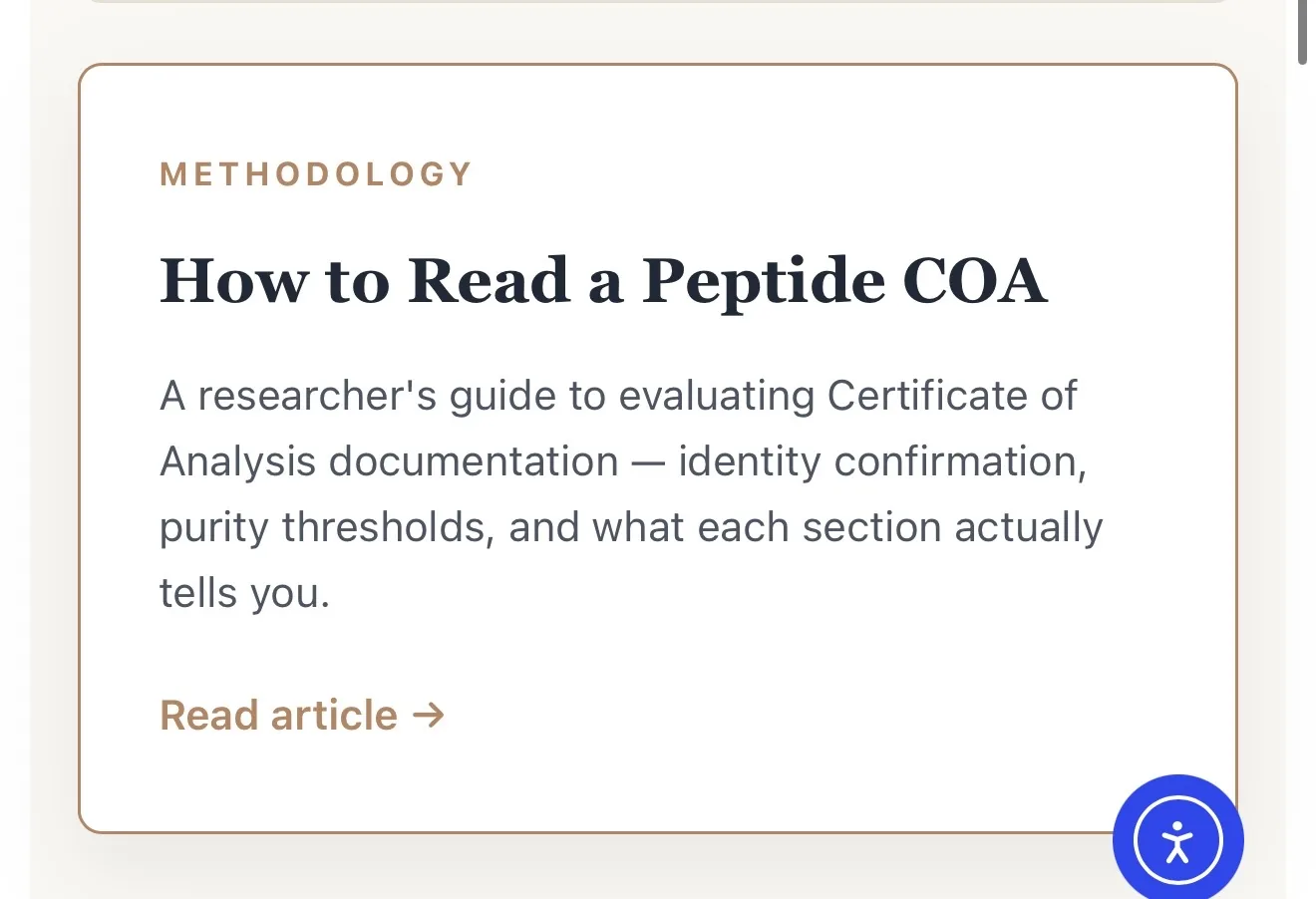
On the surface, it looks like exactly the sort of transparency many buyers have been asking for. The question is whether the documentation published by Drexa actually meets the standards Drexa itself says researchers should expect.
The Guide
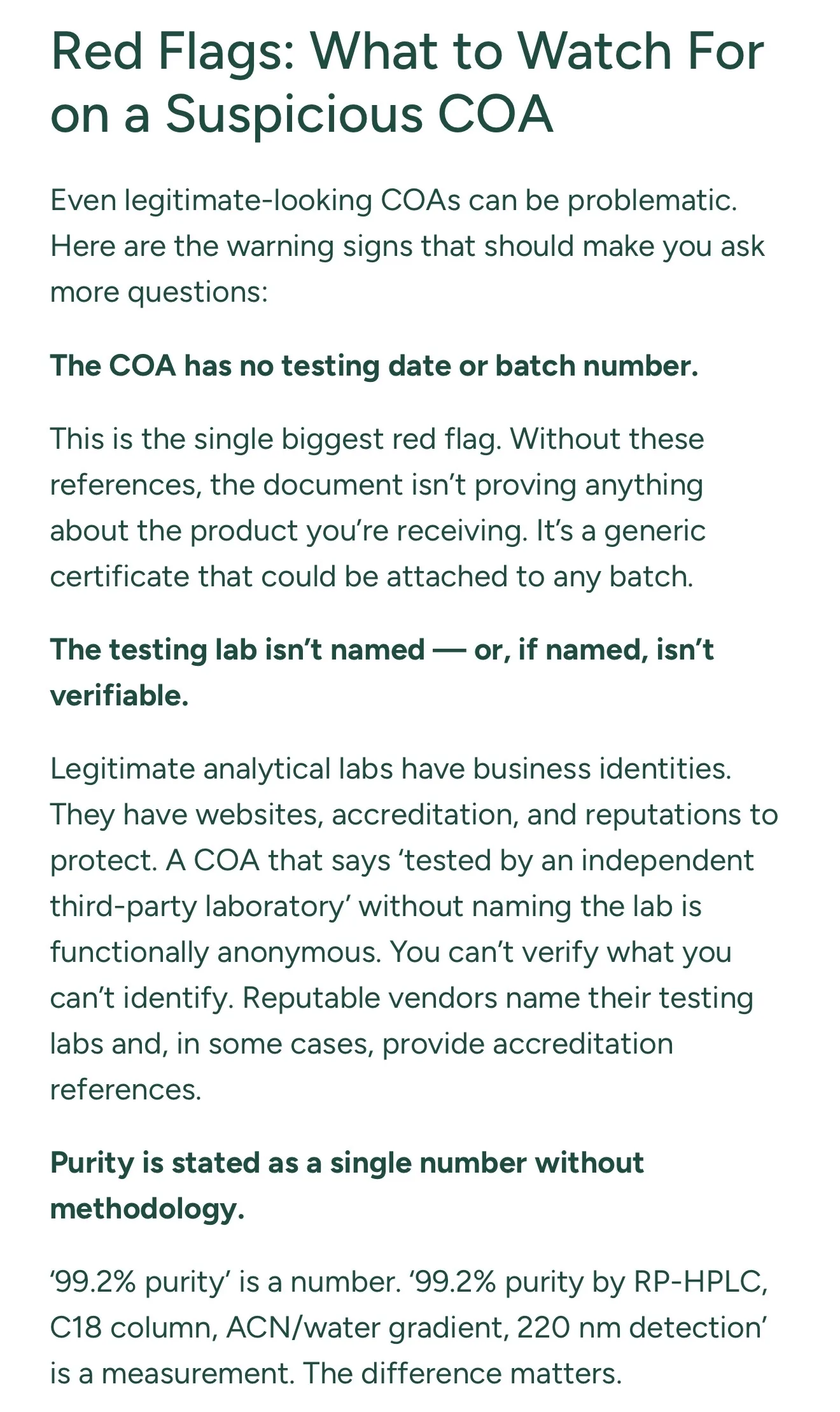
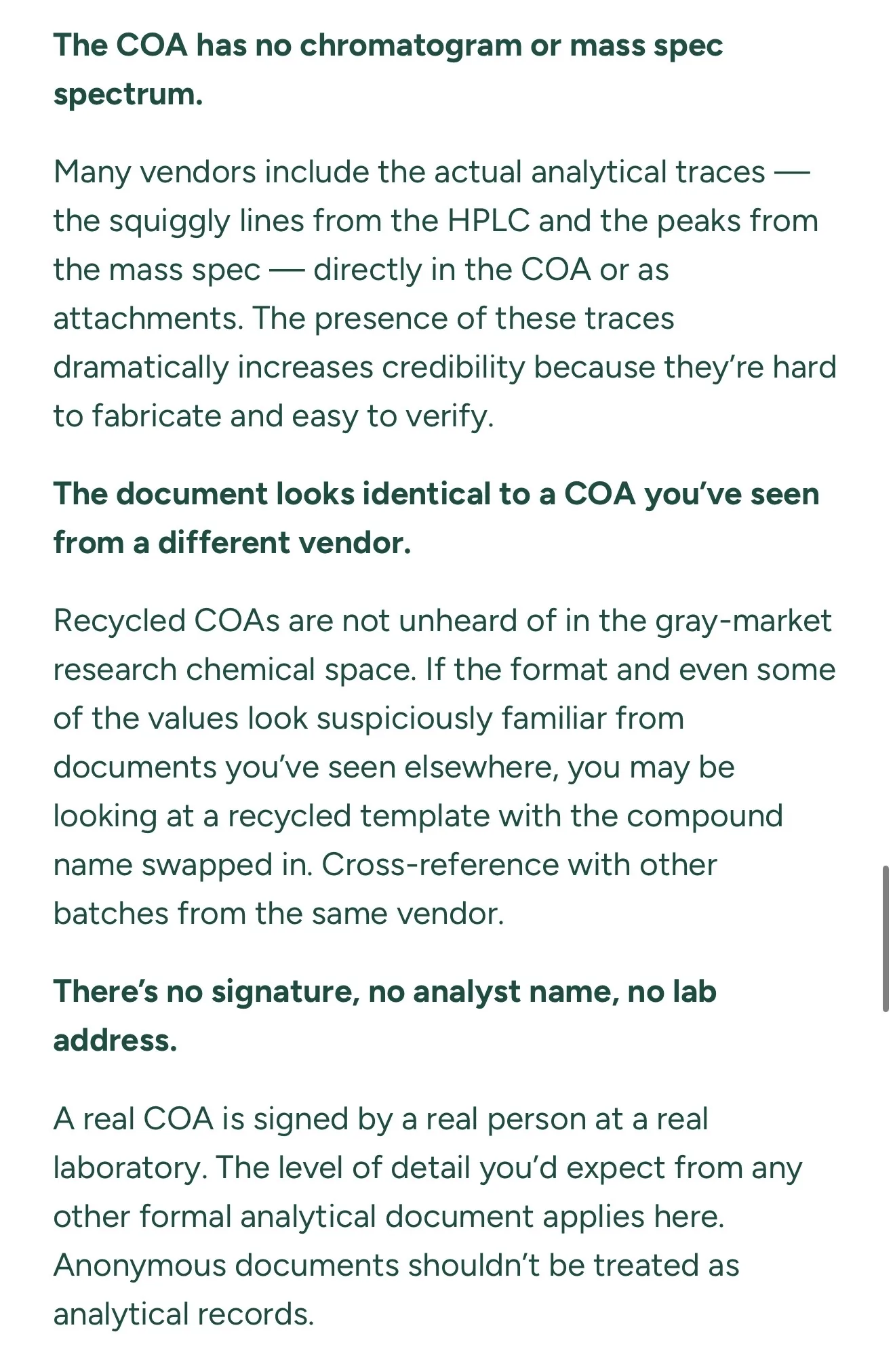
One of the site’s most detailed articles is a guide explaining how to identify incomplete or suspicious COAs. Among the warning signs Drexa highlights are:
“The COA has no testing date or batch number.”
“The testing lab isn’t named, or, if named, isn’t verifiable.”
“The COA has no chromatogram or mass spec spectrum.”
“The document looks identical to a COA you’ve seen from a different vendor.”
“There’s no signature, no analyst name, no lab address.”
The article goes on to state that a legitimate COA should identify the testing laboratory by name, include methodology details, provide mass spectrometric identity confirmation, and contain enough information for a researcher to independently assess the document’s credibility.
The principles themselves are difficult to argue with. In fact, they closely mirror many of the concerns experienced peptide buyers have raised for years.
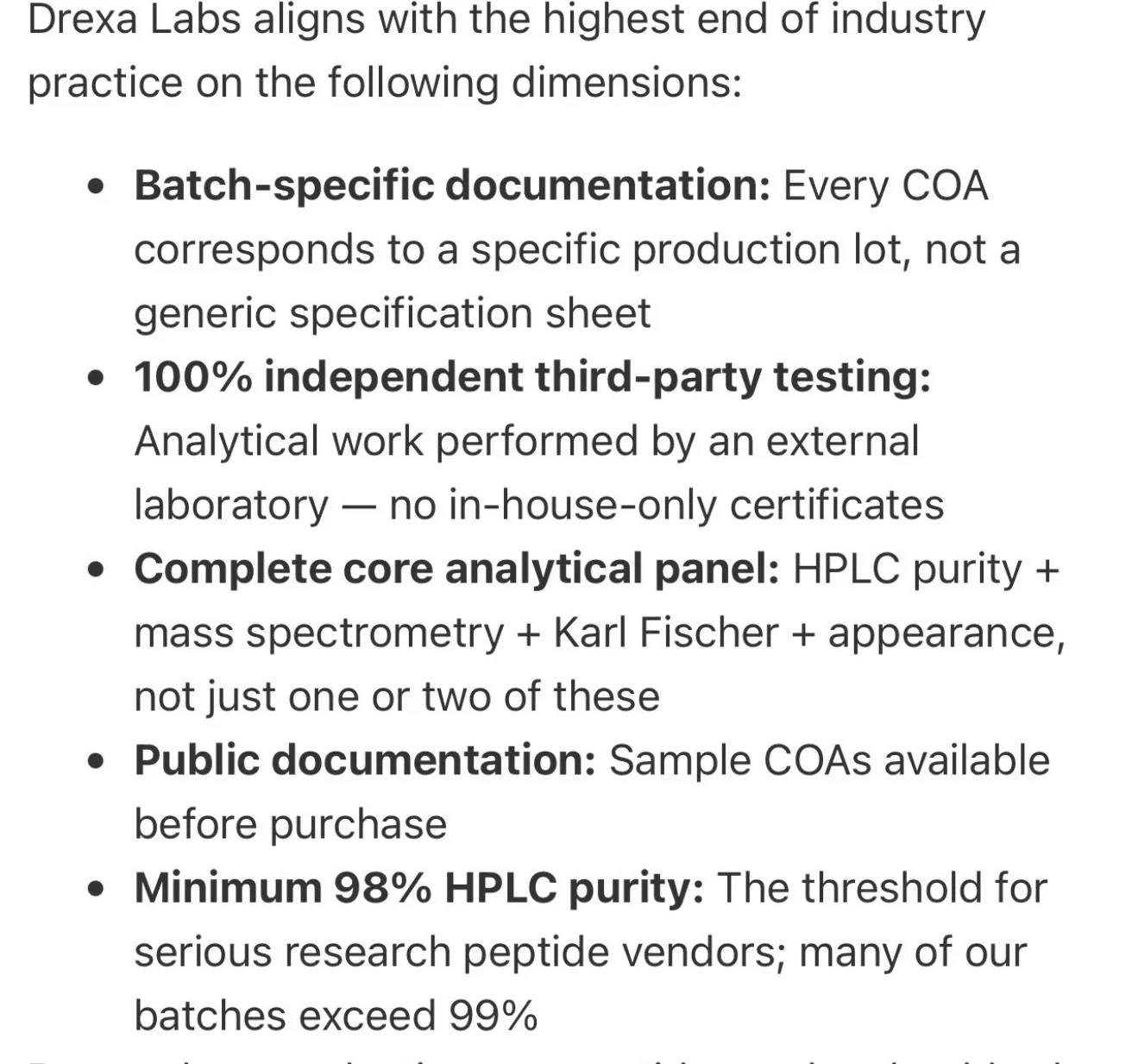
Drexa then goes even further by explicitly stating that all analytical work is performed by an external laboratory and that it doesn’t rely on in-house-only certificates.
Applying The Checklist
When reviewing the COAs currently published on the Drexa website, several questions emerge.
The documents include product information, molecular weights, purity figures, batch numbers, test dates, endotoxin claims, sterility claims and various specifications.
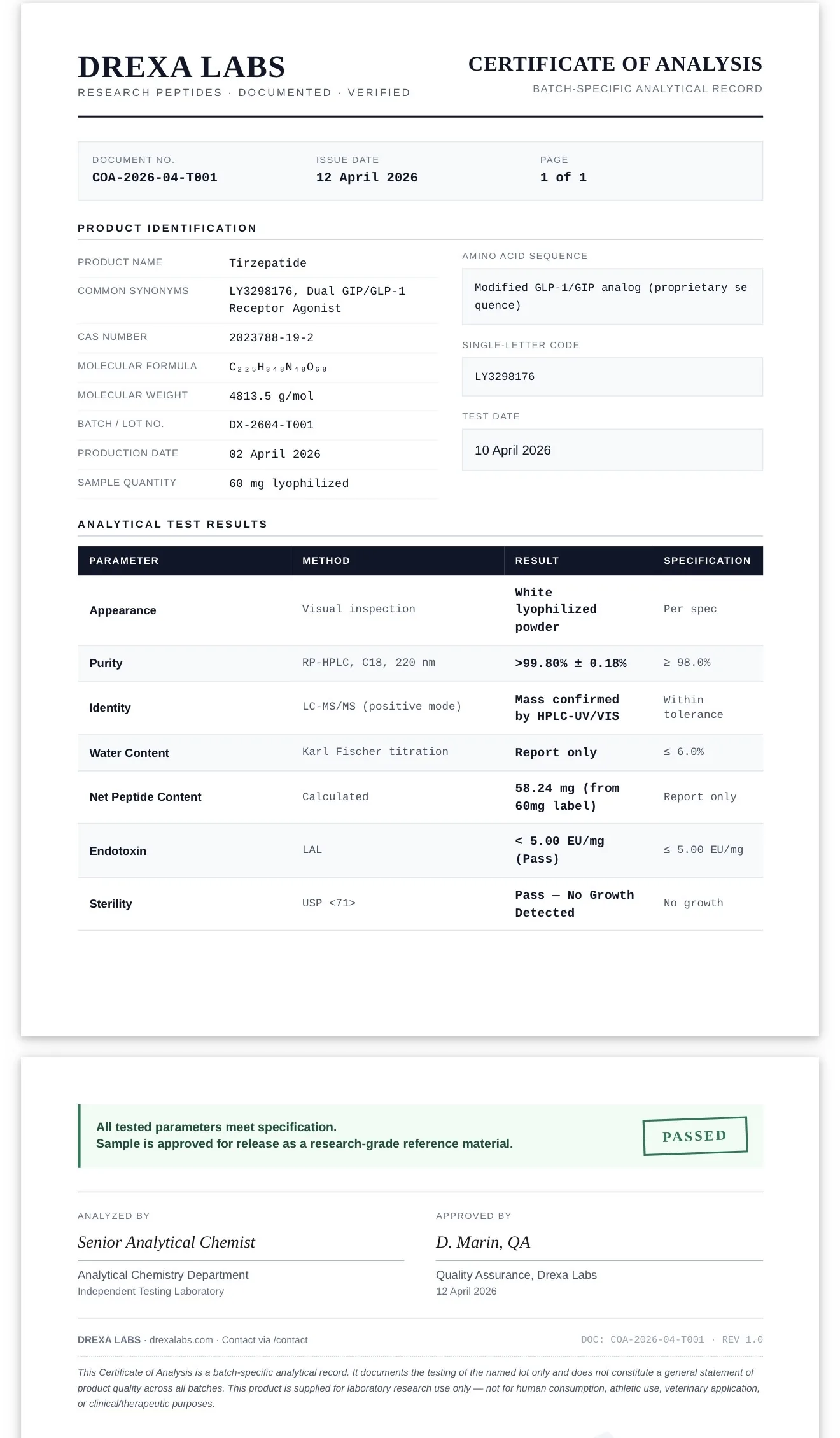
The Testing Lab isn't named and isn’t verifiable
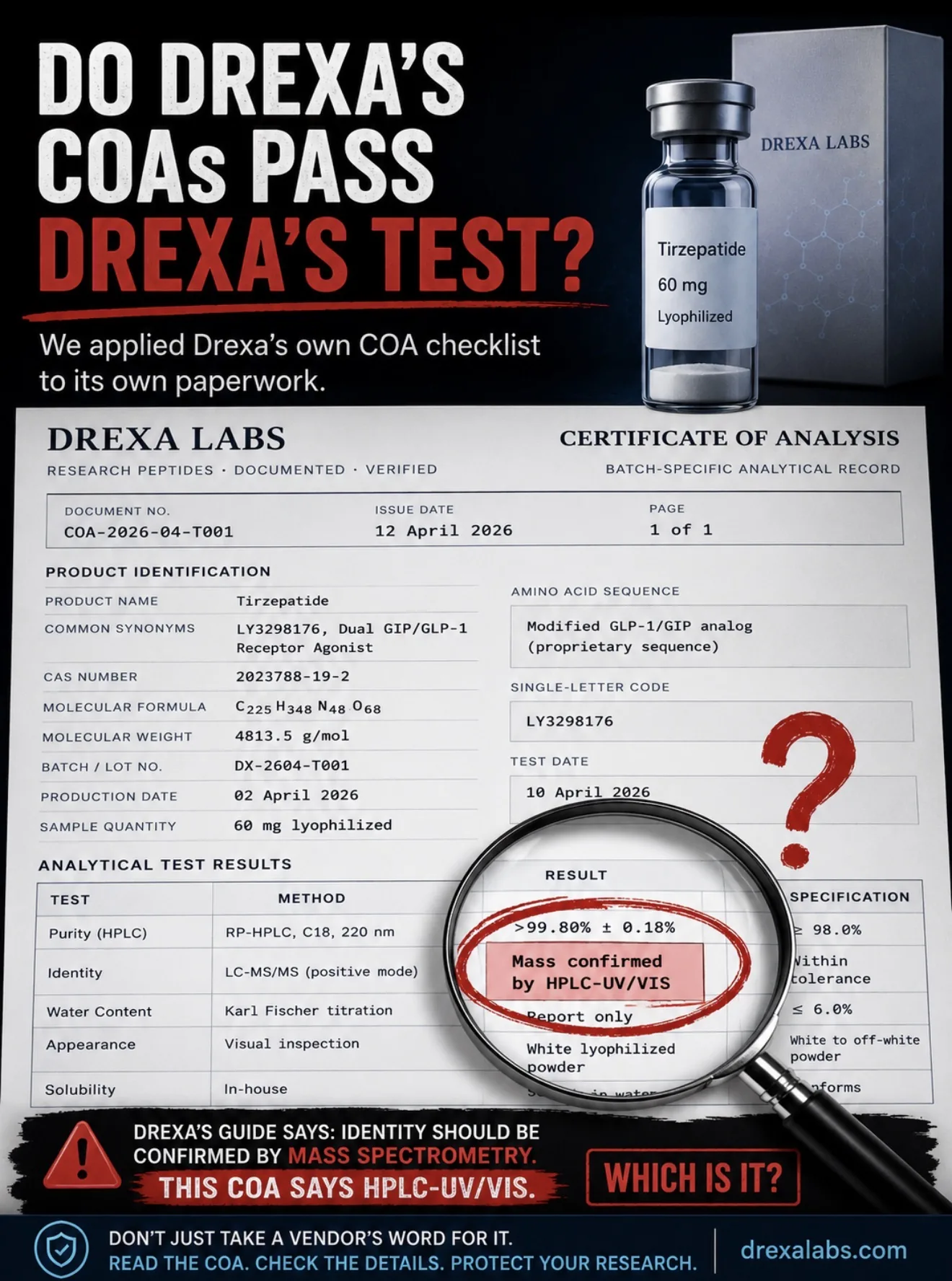
While the COAs reference an “Independent Testing Laboratory,” they don’t appear to identify a specific laboratory by name, website, address, accreditation, or other information that would allow independent verification. This goes against Drexa’s own COA guide, which states that reputable analytical laboratories have identifiable business identities, websites, accreditations, and reputations to protect and a Lab can’t be independently verified if it can’t be identified.
The Missing Raw Data
Drexa’s educational materials repeatedly emphasize the importance of chromatograms and mass spectrometry data. Yet the COAs currently published appear to provide only summary results. No HPLC chromatograms are attached. No mass spectra are shown and no raw analytical traces are included.
This doesn’t automatically mean the testing wasn’t performed as a few labs just publish summary reports. The issue is that Drexa’s own guide presents the absence of chromatograms and spectra as a significant warning sign because they are far harder to fabricate and much easier for experienced researchers to verify.
The Tirzepatide Question


The Tirzepatide COA lists LC-MS/MS as the identity method, but the result says “Mass confirmed by HPLC-UV/VIS.” That wording is internally inconsistent, because HPLC-UV/VIS is not mass spectrometry. Mass confirmation is normally associated with mass spectrometry, not UV detection.
The BPC-157 and Semaglutide COAs report numeric LC-MS identity values
The Signatory
Each certificate is approved by the same individual, D. Marin, QA
The documents don’t appear to provide further information regarding who this individual is, their role, credentials, employer, or relationship to the testing process.Again, this isn’t proof of wrongdoing, however, Drexa’s own guide emphasizes the importance of identifiable people and identifiable laboratories.
Researchers attempting to independently verify the documentation are therefore left with limited information to work from.
Drexa has published a detailed framework explaining how researchers should evaluate Certificates of Analysis. But when that same framework is applied to Drexa’s own published COAs, several of the standards outlined in the guide appear difficult to independently verify.
The Real Question
Perhaps the most interesting aspect of this story is ‘t whether Drexa’s products are good or bad. It’s whether the company’s documentation fully reflects the transparency standards it encourages researchers to demand from everyone else.
So if chromatograms exist, publish them and if mass spectra exist, publish them too. If a third-party laboratory performed the testing, identify it.
If the goal is to raise standards across the peptide industry, the strongest place to start is with your own paperwork.
So to answer the question. “Do Drexa’s COAs pass Drexa’s test?” The answers is a big NO
Comments