
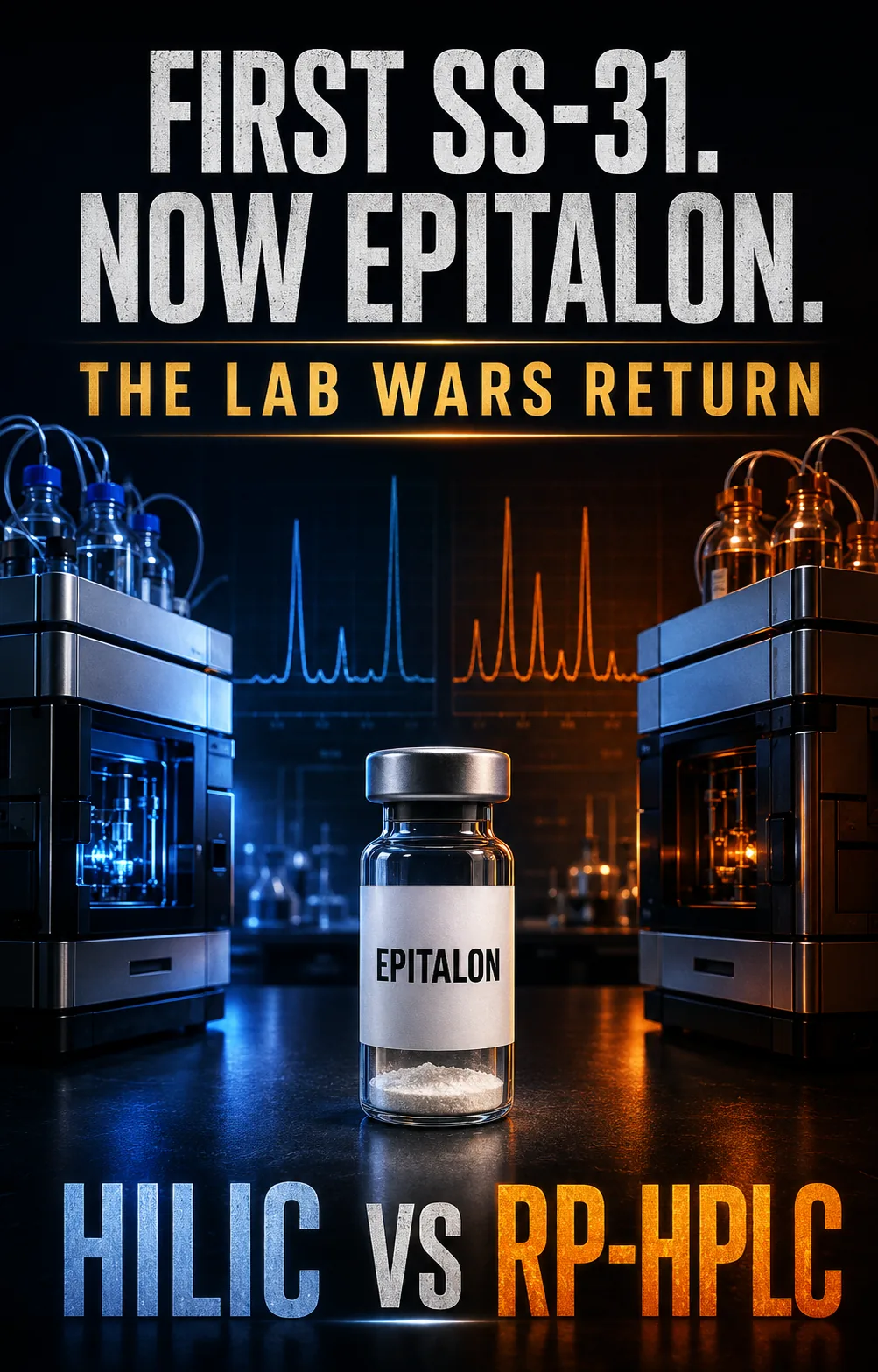
The dust has only just settled from the lab war over SS-31, when Epitalon has now taken its place.
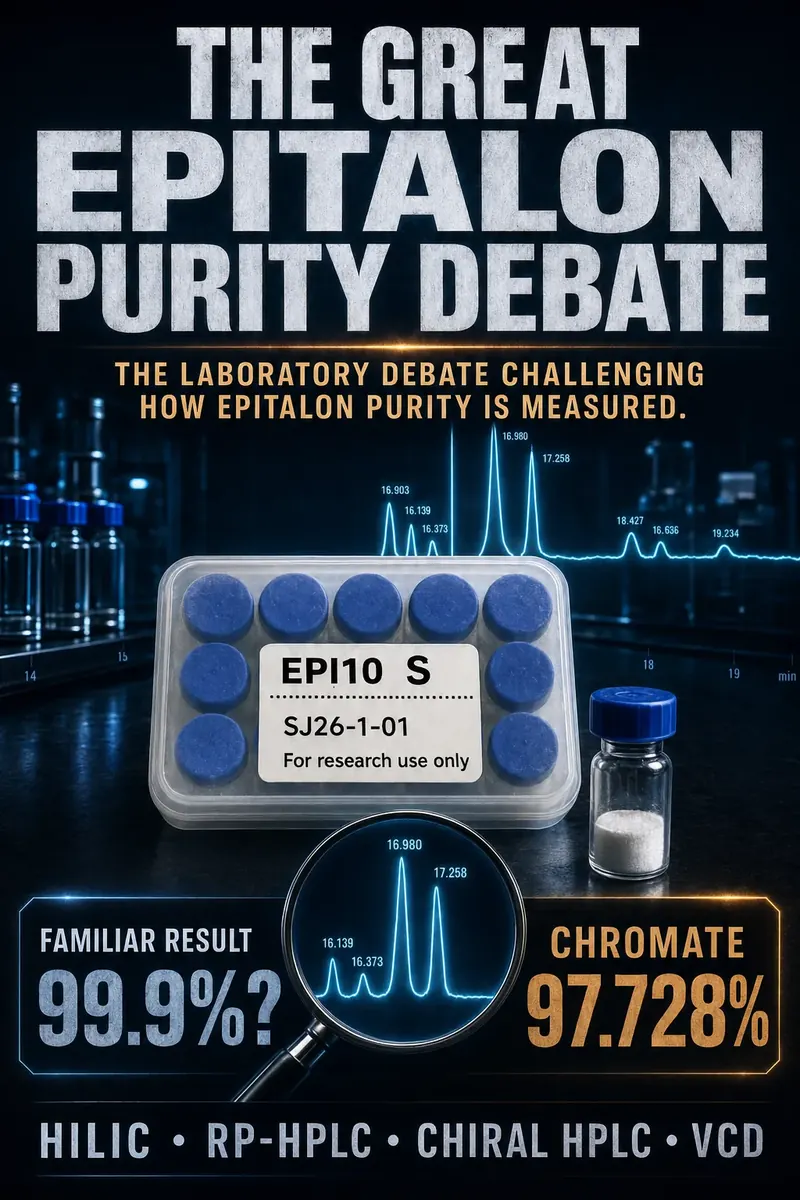
My original article began with Chromate defending its 97.728% purity result for an SPB Epitalon sample. Since then, more labs have released additional information, and what started as an explanation of one result has developed into a much larger argument about Epitalon testing.
The surprising part is that the labs are no longer miles apart on the purity itself. Chromate, MZ Biolabs and Vanguard all say Epitalon commonly tests below the 99% figures seen on many certificates. The fight is now over why, and whether HILIC is required to reveal the impurities.
Vanguard releases 35 recent results
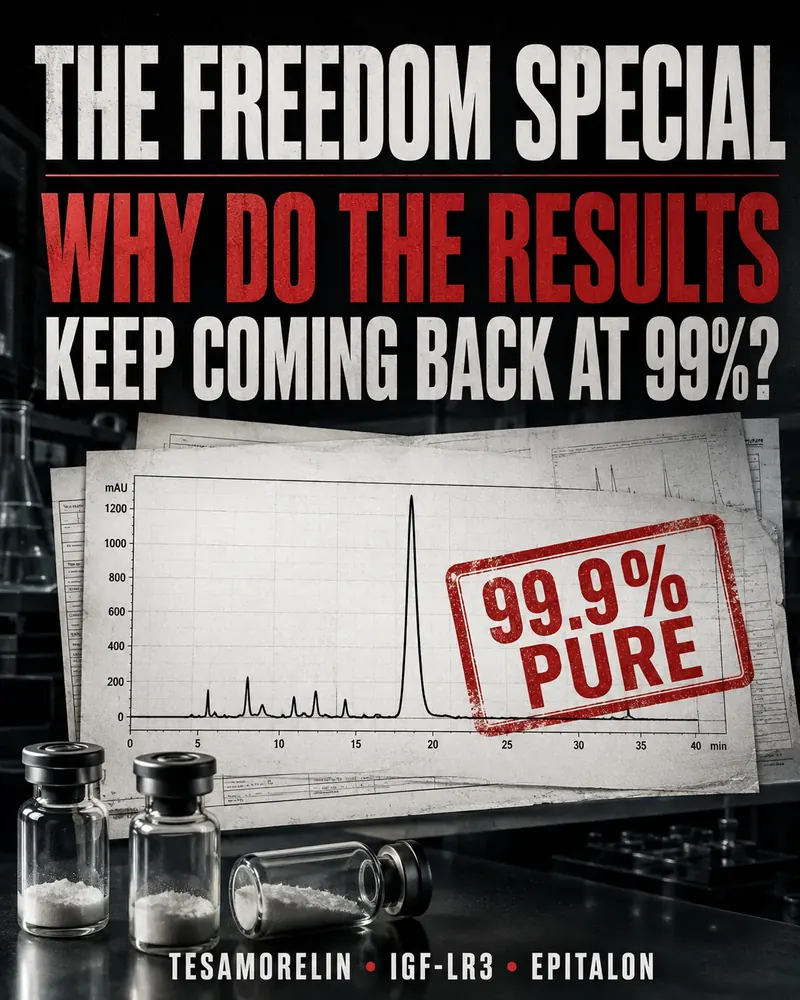
Following the original article, Dustin from Vanguard Laboratory shared the results from 35 recent Epitalon samples. Purity ranged from 78.184% to above 99.8%, with only seven samples reaching 99% or higher. Dustin said many of the samples had been run using HILIC and RP methods. Vanguard does occasionally see Epitalon above 99%, but Dustin said it’s not the norm. He later put Vanguard’s broader average for the compound at approximately 95%.
That largely supports the most important part of Chromate’s original response: a result of 97.728% isn’t automatically “crap” simply because other certificates claim 99% or more.
Janoshik’s results are generally higher
A dataset of Janoshik’s Epitalon results produced a mean purity of 98.318% and a median of 99.028%. Half of the results fell between 98.209% and 99.411%, with a full range extending from 73.710% to 99.912%. This places Chromate’s 97.728% result below the typical Janoshik result, but nowhere near the bottom of the distribution.
The two datasets therefore present slightly different pictures. Vanguard says results above 99% occur but are not the norm. Janoshik’s median sits just above 99%, although his results also include some dramatically lower samples. That difference could come from the products submitted to each laboratory, the methods used or a combination of both. The statistics alone can’t answer that question.
MZ Biolabs enters the debate
Chromate then contacted MZ Biolabs, as according to him, MZ Biolobas is the only other lab correctly employing HILIC analysis for Epitalon. Ken Pendarvis, an analytical chemist at MZ Biolabs, said the laboratory sees Epitalon purity ranging from approximately 85% to 99%, with most samples falling around 93 to 95%.
Those figures are broadly consistent with Chromate’s observations and Vanguard’s stated average. However, MZ Biolabs introduced a major change to the explanation for the missing purity. According to Pendarvis, the additional peaks observed by MZ Biolabs don’t appear to be isomers. They have molecular masses below native Epitalon and are more likely to be deletion sequences or other products of incomplete peptide synthesis. MZ Biolabs intends to provide an annotated chromatogram showing the identities of the peaks when that work is complete.
Chromate revises its original theory
Chromate initially suggested that same-mass isomers could explain why some laboratories reported very high purity while HILIC testing produced lower results. Following the information from MZ Biolabs, Chromate acknowledged that the emerging evidence pointed towards a different and potentially more serious problem: lower-mass synthesis impurities may be going undetected. Chromate now claims that many laboratories could be missing an impurity burden of approximately 5 to 10% in most Epitalon samples, despite using two analytical techniques that should each be capable of detecting those differences.
That is a serious allegation, but it hasn’t yet been demonstrated through direct testing of the same sample across the laboratories.
Chromate says HILIC is required
Asked to summarise the dispute in layman’s terms, Chromate confirmed its position:
“Epitalon requires a different chromatography mode called HILIC to retain and separate the impurities properly.
Most labs do not know or care so they analyse it with no retention peak ( peak appears at the start of the chromotogram/ void volume)”
This means the Epitalon peak appears at the beginning of the chromatogram near the void volume and if the peptide is not sufficiently retained, Chromate says impurities may not be separated properly. Chromate also pointed to the MZ Biolabs results as support for his assessment that typical Epitalon purity is lower than many certificates suggest.
But Vanguard and Janoshik don’t accept the leap from “HILIC works well” to “HILIC is required.”
Vanguard: HILIC works, but RP works too
Dustin agreed that HILIC works well for Epitalon. However, he said Vanguard validated HILIC against its RP-HPLC method and produced comparable results with both.
That distinction is important.
Vanguard isn’t arguing that Epitalon is normally 99.9% pure, his own results suggest otherwise. He’s arguing that a properly developed RP-HPLC method can provide adequate retention and reveal the same impurities without HILIC being mandatory. Dustin also challenged Chromate to provide its validation data and compare results using the exact same sample.
Vanguard has offered to send Chromate samples that he’s already tested but has asked them why they won’t publicly list the address of their lab. He also raised questions about whether Chromate is third-party audited, what validation procedures it follows and whether it participates in proficiency testing.
Those questions move the debate beyond chromatograms. If Chromate is challenging the reliability of other laboratories, the evidence and validation behind its own method will also need to withstand scrutiny.
Janoshik: HILIC is better, but it is not magic
Janoshik’s response was even more direct. He agreed that HILIC may be better suited to Epitalon, but said obtaining adequate retention using RP-HPLC isn’t especially difficult. His position can be summarised simply:
“Is HILIC better for Epitalon? Yes.
Is it magic? No”
Janoshik also said he hadn’t seen convincing evidence for the original isomer theory or the suggestion that they could produce opposing biological effects, which was published for the D-aminos versions. He also questioned (calling it nonsense) why expensive D-amino acids would be used during ordinary manufacturing.
What the laboratories actually agree on
For all the fighting, there is now a substantial amount of common ground:
Chromate says Epitalon commonly tests below 99%.
MZ Biolabs says most of its samples fall around 93 to 95%.
Vanguard says its average is approximately 95%.
Vanguard’s shared results show only seven of 35 samples reaching 99% or higher.
Janoshik’s results are generally higher, but still include samples well below 99%.
All sides agree that Epitalon needs enough chromatographic retention for its impurities to be separated.
What the laboratories disagree on
Chromate says HILIC is required and believes many existing results are missing approximately 5 to 10% of impurities. Vanguard says its validated RP-HPLC and HILIC methods produce comparable results. Janoshik agrees HILIC can be better but rejects the claim that it’s the only route to an accurate result.
MZ Biolabs uses HILIC analysis for Epitalon, supports the lower-purity observations but currently believes the extra peaks are incomplete synthesis products rather than isomers.
The dispute turns to laboratory credentials
The Epitalon disagreement then turned personal. After Dustin questioned Chromate’s validation procedures, proficiency testing and publicly listed address, Chromate pointed to his rapid identification of the contaminant known as “Faketide.” Chromate said he identified the substance within days of encountering it, while other labs sent out thousands of “Unknown” reports and spent months considering it an elusive, mysterious chemical; “faketide” He said that any HPLC proficiency test should be failed if a laboratory can’t demonstrate adequate retention of the analyte being tested.
Dustin responded by defending Vanguard’s record. He said Vanguard has passed every HPLC, GC, GC-MS and LC-MS/MS proficiency test it has taken since 2016, all supplied by ISO-accredited proficiency-testing providers. He added that Vanguard’s results have been audited by clients, ISO 17025 accreditors, the EPA and health authorities, and offered to share the reports.
Dustin said Vanguard investigated the unknown contaminant within approximately 24 hours once it focused on the issue, adding that while Chromate had the time to investigate it sooner, his laboratory was also processing hundreds of samples each day.
He then returned the transparency challenge to Chromate, asking why its business doesn’t appear to have a publicly listed address and whether it’s licensed, accredited or audited. He also questioned whether Chromate’s reports would hold up legally.
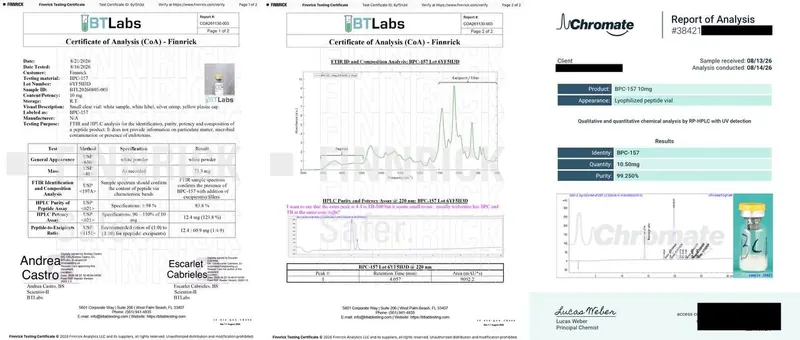
Someone also took the opportunity to ask who “Lucas Weber,” the principal chemist named on Chromate’s reports, actually is, but there’s no response to that yet.
The debate has now split into two separate contests: whether HILIC is necessary for reliable Epitalon testing, and whether each laboratory can publicly demonstrate the credentials and validation behind its claims.
The lab war gets personal
Janoshik rejected Chromate’s claim that it had solved the “Faketide” mystery while other laboratories remained confused for months. He said that once he and Dustin actively investigated it, they identified the compound within approximately ten hours, including a full night’s sleep, and told Chromate not to be “so full of yourself.”
Janoshik then accused Chromate of using AI to write his responses, pointing to what he considered a telltale formatting mark and called him F**Face.
Pacific Coast Biologics also arrived asking “Damn what I miss” and said he was enjoying some coffee while reading the lab chat.
At this stage, the technical questions remain unanswered while the conversation becomes increasingly personal. The useful next step is still the same: test the same Epitalon sample across the competing methods and publish the results.
Comments