
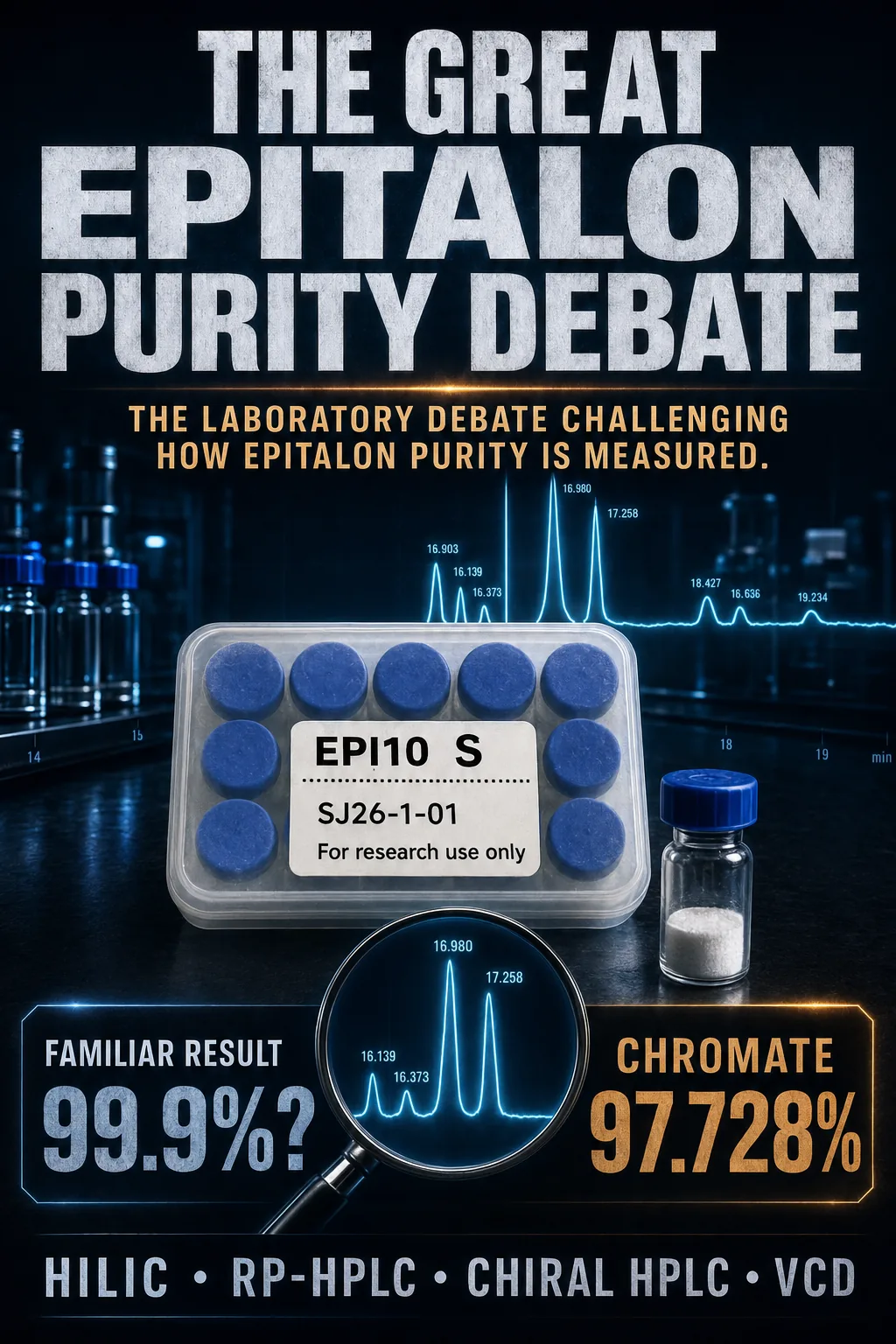
I started this debate with a blunt assessment of the recent SPB Epitalon report,
“This was the original test for the SPB Epitalon, and it’s crap all around with a 97.728% purity.”
Given how routinely grey-market Epitalon is advertised at 99% or higher, 97.728% looked poor. I had rarely, if ever, seen a COA showing Epitalon below 99%.
Chromate responded by challenging the assumption behind that comparison. Their argument wasn’t that 97.728% is pharmaceutical-grade or that impurities don’t matter. It was that a lower purity result can sometimes reflect a more discriminating analytical method, while a COA showing 99% or even 99.8% may overstate purity if the method fails to separate Epitalon from closely related impurities. That response developed into a broader technical debate involving Chromate, Vanguard Laboratory and BT Labs. The central question became:
When two laboratories report different Epitalon purities, are they measuring the same thing, or is one method counting related impurities as part of the main Epitalon peak?
Why Chromate considered 97.728% relatively high
Chromate referred to a 2018 impurity-profiling study by Janvier et al, which he described as the only published impurity profile study of grey market Epitalon. According to Chromate, the Epitalon preparations examined in that study ranged from approximately 80% to 95% purity.
The study didn’t establish that every grey-market Epitalon product falls within that range, nor did it prove that 97.728% is universally acceptable. It examined only three Epitalon preparations. Nevertheless, it provides an important counterpoint to the abundance of near-perfect Epitalon COAs circulating online.
For the three preparations studied, the researchers detected one related impurity peak in each preparation, attributed to aspartimide or succinimide formation. The reported level ranged from roughly 5% to almost 20%. The researchers also found comparatively high levels of related impurities in Epitalon, AOD-9604 and oxytocin when compared with several other peptides in the study. Janvier et al., Talanta, 2018
Chromate’s position was therefore straightforward: judged against that limited published dataset and its own experience analysing Epitalon, 97.7% was not an unusually low result. It was relatively high.
That doesn’t prove the SPB product was properly manufactured. It means my original description of its purity as “crap all around” was too simplistic.
The same SPB vial still produced an extraordinarily high endotoxin result, and another vial associated with the same kit produced an even higher result at Janoshik. That’s a separate and serious quality failure. But it shouldn’t be confused with the question of whether 97.728% chromatographic purity was itself unusually poor for Epitalon.
Why Epitalon is difficult to analyse
Epitalon is a short, highly polar tetrapeptide with the sequence Ala-Glu-Asp-Gly. Its structure and synthesis create several analytical complications. During peptide synthesis, the aspartic-acid residue can undergo aspartimide or succinimide formation and related rearrangements. These reactions can produce structures closely related to the intended peptide. Stereochemical errors can also create molecules with the same elemental composition and nominal mass but a different three-dimensional arrangement.
That distinction matters because routine mass spectrometry primarily establishes molecular mass. If an impurity has the same mass as the intended Epitalon molecule, MS, MS/MS or QTOF may confirm the expected mass without proving that every molecule has the correct structure and stereochemistry.
The compounds must first be separated chromatographically, or examined through another suitably discriminating technique, before the laboratory can determine whether more than one substance is hiding beneath what appears to be a single peak.
Chromate summarised its concern forcefully:
“Purity results of 99% are meaningless when the method permits related substances to coelute with the principal peak.”
That is Chromate’s interpretation rather than a conclusion that automatically invalidates every 99% Epitalon report. But the underlying analytical principle is sound: a purity calculation can only count impurities that the method separates and detects.
If an impurity coelutes with the main Epitalon peak, its area may be counted as Epitalon. The result can look excellent even though the method has failed to distinguish the correct peptide from related substances.
What the published research actually says
Chromate cited two papers by Janvier and colleagues.
The first, published in 2017, developed and validated a HILIC-DAD-MS method for detecting and quantifying illegal peptide preparations. HILIC (hydrophilic interaction liquid chromatography) is particularly useful for retaining highly polar compounds that can be difficult to analyse using conventional reversed-phase chromatography. Janvier et al., Talanta, 2017
The researchers reported that Epitalon eluted too early under the reversed-phase LC conditions evaluated for reliable quantification. They therefore used HILIC, testing several columns and optimising the method for chromatographic resolution, peak shape, mass-spectrometric identification and UV quantification.
The second paper applied impurity-profiling methods to falsified peptide drugs. For Epitalon, HILIC was used to separate the active peptide, related impurities and mannitol. In the three Epitalon preparations examined, the researchers found one related impurity peak per preparation, attributed to aspartimide or succinimide formation, at levels between approximately 5% and almost 20%. Janvier et al., Talanta, 2018
This point needs to be stated precisely. The study did not report multiple individually resolved isomers in every Epitalon sample. It detected one related impurity peak in each of three preparations. Chromate’s discussion of multiple possible structural and stereochemical impurities was a broader explanation of Epitalon chemistry, not a direct description of every peak found in that study.
The studies support the conclusion that Epitalon can be difficult to retain, separate and quantify and that conventional methods may miss relevant impurities. They don’t establish that HILIC is the only possible method or that every RP-HPLC result is invalid.
The stereochemistry question
Rina from BT Labs agreed with Chromate’s broader concern. Epitalon has three chiral centres, creating up to eight possible stereochemical configurations: the intended peptide and seven potential stereoisomeric forms.
Rina explained that chiral HPLC can separate stereoisomers, while BioTools’ VCD technology may help identify each form. She also offered to investigate whether a full VCD study supported by quantum-mechanical calculations had already been published. This adds another layer to the debate: conventional chromatographic purity doesn’t necessarily establish stereoisomeric purity. A sample can produce the expected molecular mass while still containing molecules with an unintended three-dimensional configuration.
A HILIC or carefully developed RP-HPLC method may separate several related impurities without establishing the absolute stereochemistry of every component. Conversely, a chiral or spectroscopic technique may answer stereochemical questions that a general purity assay was never designed to resolve.
The terms must not be treated as interchangeable:
Identity testing asks whether the expected compound is present.
Quantity testing asks how much material is present.
Chromatographic purity measures resolved peak areas under specified conditions.
Related-substances testing looks for synthesis and degradation products.
Stereoisomeric purity asks how much of the material has the intended three-dimensional configuration.
Mass spectrometry can support identity but may not distinguish same-mass isomers without prior separation.
A certificate showing “99% purity” may address only one of these questions.
Why stereochemical impurities could matter biologically
Chromate also referred to research involving thymogen, another short peptide, in which different stereochemical forms reportedly produced biological effects that differed from, or opposed, those of the native peptide. That evidence should be presented as an analogy, not proof that Epitalon’s stereoisomers have the same behaviour. The biological activities of Epitalon’s possible isomers haven’t been established by the information presented in this debate.
However, the analogy demonstrates why stereochemistry isn’t merely an academic concern. Two molecules can share the same amino-acid sequence and molecular mass while interacting differently with biological targets because their spatial arrangement differs.
The current EMA guideline on synthetic peptides treats stereochemical control, related peptide impurities, characterisation and analytical control as specific development concerns. It doesn’t support assuming that every same-mass peak is equivalent to the intended peptide. EMA guideline on synthetic peptides
Can RP-HPLC still work?
Dustin from Vanguard Laboratory said the argument shouldn’t be reduced to HILIC versus RP-HPLC. Vanguard used HILIC while developing its Epitalon method, but Dustin said RP-HPLC can also produce equivalent results when it’s properly developed. He said this could involve an aqueous-compatible column, a shallower early gradient and lower pH. Capillary electrophoresis is another possible option. His point was that the method name alone doesn’t determine whether the result is accurate. What matters is whether Epitalon is retained long enough for related impurities to be separated from the main peak.
Chromate challenges Vanguard’s 99.80% result
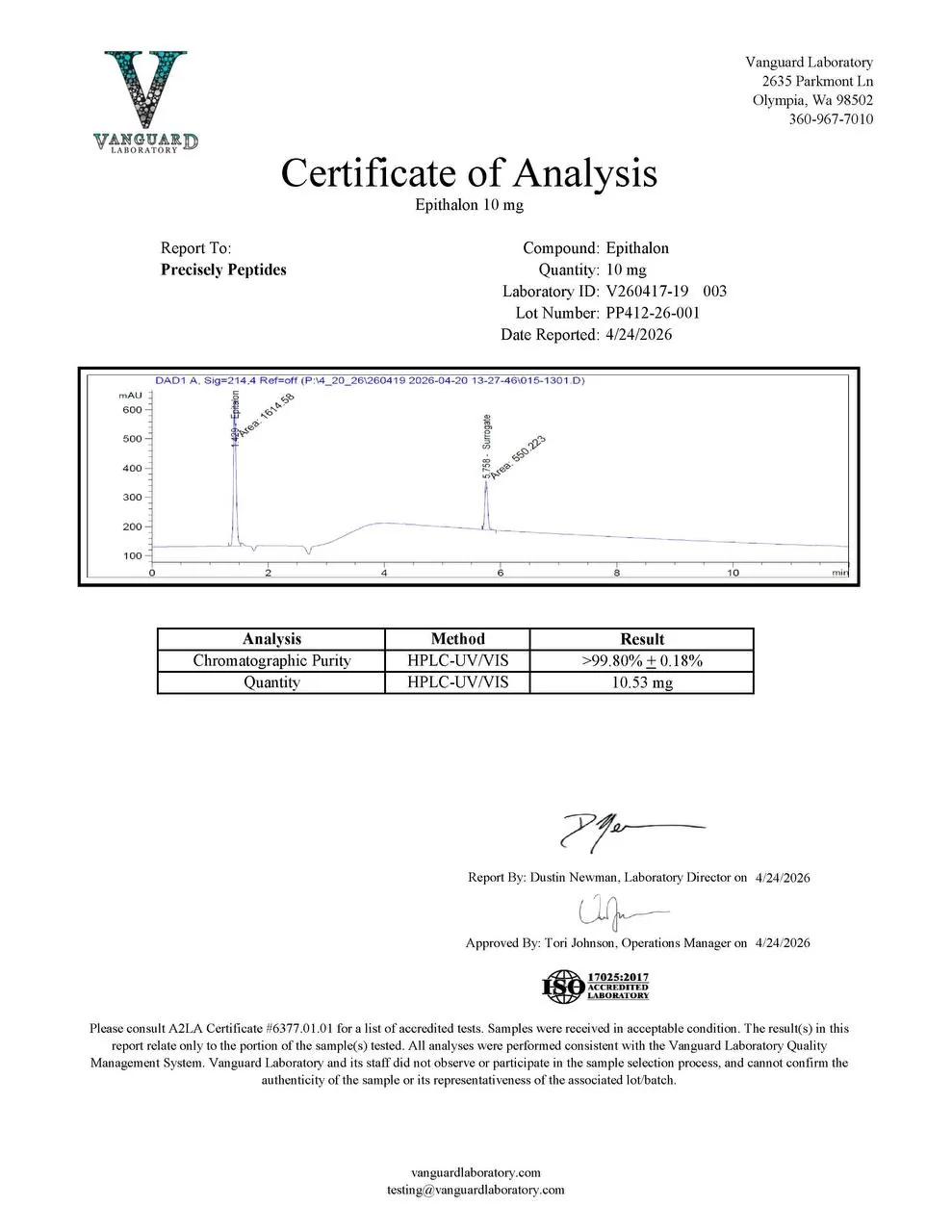
A Vanguard certificate for a different Epitalon product was then shared. It reported;
More than 99.80% purity and 10.53 mg quantity. Tested by HPLC-UV/VIS
Chromate questioned the result because the Epitalon peak appeared very early in the chromatogram.
“It looks like your Epitalon peak is flying through the column faster than the water it was dissolved in.”
Chromate argued that if Epitalon has too little interaction with the column, related structural impurities and diastereomers may travel through with it rather than appearing as separate peaks. If that happens, they could be included within the main peak and the reported purity could appear higher than it really is. Dustin responded that Vanguard had already explored HILIC and believed a properly developed RP-HPLC method could produce equivalent results.
The disagreement therefore wasn’t whether RP-HPLC can ever be used for Epitalon. It was whether the specific method behind Vanguard’s certificate provided enough retention and separation to support a result above 99.80%.
The COA alone doesn’t settle that question. Chromate’s criticism raises a reasonable concern, but the laboratories would need to compare their complete methods and test the same sample before either result could be judged more accurate.
Could most Epitalon be less pure than its certificates claim?
Chromate suggested that much of the Epitalon currently sold as 99% or higher could actually be closer to 90 to 97% if tested using methods capable of separating its related impurities. That remains Chromate’s position rather than a proven description of the entire market. However, it is supported to some extent by the 2018 study mentioned earlier. Chromate said greater use of suitable analytical methods might eventually encourage manufacturers to produce more thoroughly purified Epitalon. But using HILIC for industrial purification would be expensive because of the amount of acetonitrile required.
Testing and manufacturing are separate issues, though. A laboratory may use HILIC to identify impurities without the manufacturer necessarily using the same technique to purify material on an industrial scale.
Summary
I originally treated the SPB result of 97.728% as obviously poor because most Epitalon COAs I had seen reported 99% or higher.
Chromate’s explanation showed why the highest number isn’t automatically the most reliable one. A result of 99% only means what people assume it means if the method can separate Epitalon from its related impurities.
At the same time, Chromate’s lower result shouldn’t automatically be accepted as more accurate simply because it is lower. The laboratories still need to demonstrate that their methods work and compare them using the same material.
BT Labs added another issue by explaining that Epitalon has three chiral centres and may exist in several stereochemical forms. Chiral HPLC and VCD analysis could help determine whether forms invisible to routine testing are being counted as native Epitalon.
No laboratory has conclusively won the debate. Until the laboratories test the same sample and compare their methods, the disagreement remains unresolved.
What has changed is my assumption that the lowest purity result must be the worst one. With Epitalon, a lower number may indicate a poorer product, but it may also indicate that the laboratory was able to see more of what was actually there.
Comments