
Refundable doesn’t mean refundable
In Scamiverse, “refundable” doesn’t mean refundable.
It means: pay again.
This scam doesn’t start with a threat. It starts with a checkout.
A buyer sends a revised order list, multiple items, the kind of list that feels like someone trying to do things properly: peptides, add ons, practical supplies. Olivia replies quickly, totals it up in a neat little arithmetic line, and then pivots immediately to the only question that matters in Scamiverse:
“You have Cash app?”
Cash App is never the destination.
It’s the on ramp.
The coaching phase
Because the buyer isn’t just asked to pay, they’re coached. Step by step.
First: load money into Cash App.
Then: click the Bitcoin icon.
Then: buy.
Then: send.
This is framed as “help.” It’s delivered like customer service, calm, procedural, instructional. It’s made to feel normal.
And that’s the danger.
Because the moment you’re being taught how to pay, you’re not a customer anymore. You’re a participant. The scam is manufacturing compliance one step at a time.
The buyer buys Bitcoin. The value shifts. The amount drops slightly after purchase. The buyer notices and panics, because they can feel the ground changing under their feet.
Olivia’s response is instant and dismissive:
“It’s okay.”
That’s a tell.
Real sellers care about exact totals.
Scammers care about movement.
If the money moved, the system worked.
The sweetener trap
Then comes the sweetener. the same lever used in Scam #1, but expanded into a negotiation trap.
Free vials aren’t simply offered. They’re used to push the buyer to spend more.
“Do you mind adding a $100 product to your order to gain the free 5 vials of each product?”
“If you make it $550 I can still give you the free 5 vials.”
Notice the framing: I’m considerate.
But the function is simple: increase the total.
The buyer hesitates, says they don’t have enough because they’ve been scammed before. Olivia apologises for their previous experience, stays friendly, stays smooth.
Not because she’s kind.
Because the scam can’t afford friction.
Friction makes people stop.
Stopping is the only thing that breaks the spell.
So the scam adapts. Even if the buyer can’t add a full extra product, the buyer ends up adding something, a smaller add on, another payment, a “just a bit more” that keeps the rhythm going.
And the rhythm matters.
Because Scam #2 doesn’t take one payment.
It builds a ladder.
From seller to “logistics manager”
Now comes the moment the scam upgrades from “seller” to logistics manager.
Olivia confirms receipt and promises tracking when the order is “set for shipping.” The buyer asks for something basic: any packing proof, a quick photo of the items or parcel before it leaves.
Instead of providing proof, Olivia keeps the buyer moving through confirmation rituals: screenshots of every step, every send, every confirmation.
The victim becomes their own receipts department.
Then, almost immediately, the next pretext arrives:
FedEx is expensive.
So Olivia uses “a different reliable carrier.”
She says the buyer will be contacted through email or WhatsApp once registration is complete.
And then she adds the line that tells you you’re about to be charged again:
“The agency will contact you as well.”
That’s the handoff.
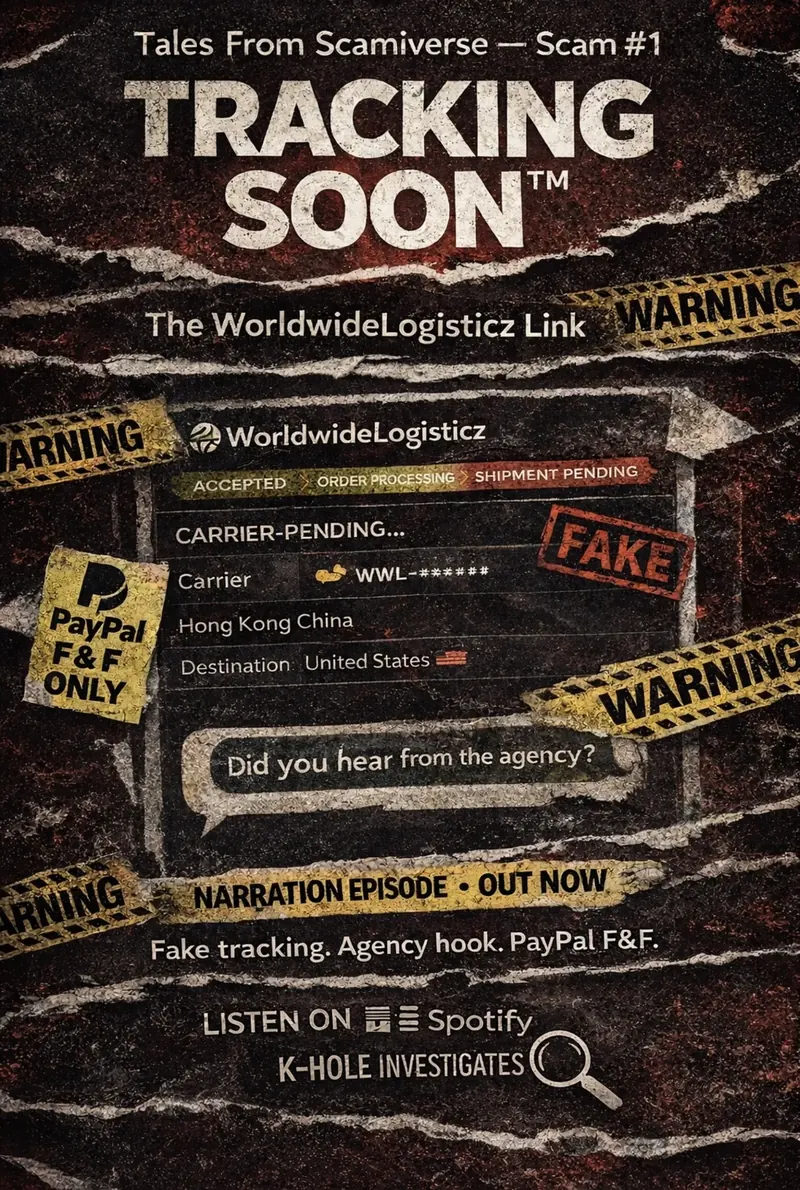
Scam #1 teased the agency.
Scam #2 builds it.
Already handed over
When the buyer asks for anything tangible, a parcel photo, label photo, box photo, anything physical, Olivia delivers the most Scamiverse sentence possible:
“OMG, I completely forgot to take a pic of it and I’m done with your registration.”
“Everything has been handed over to the shipping company.”
This is one of the scam’s core mechanisms: once you ask for proof, the proof becomes impossible, and also already gone.
The buyer asks what company it is.
Olivia names it:
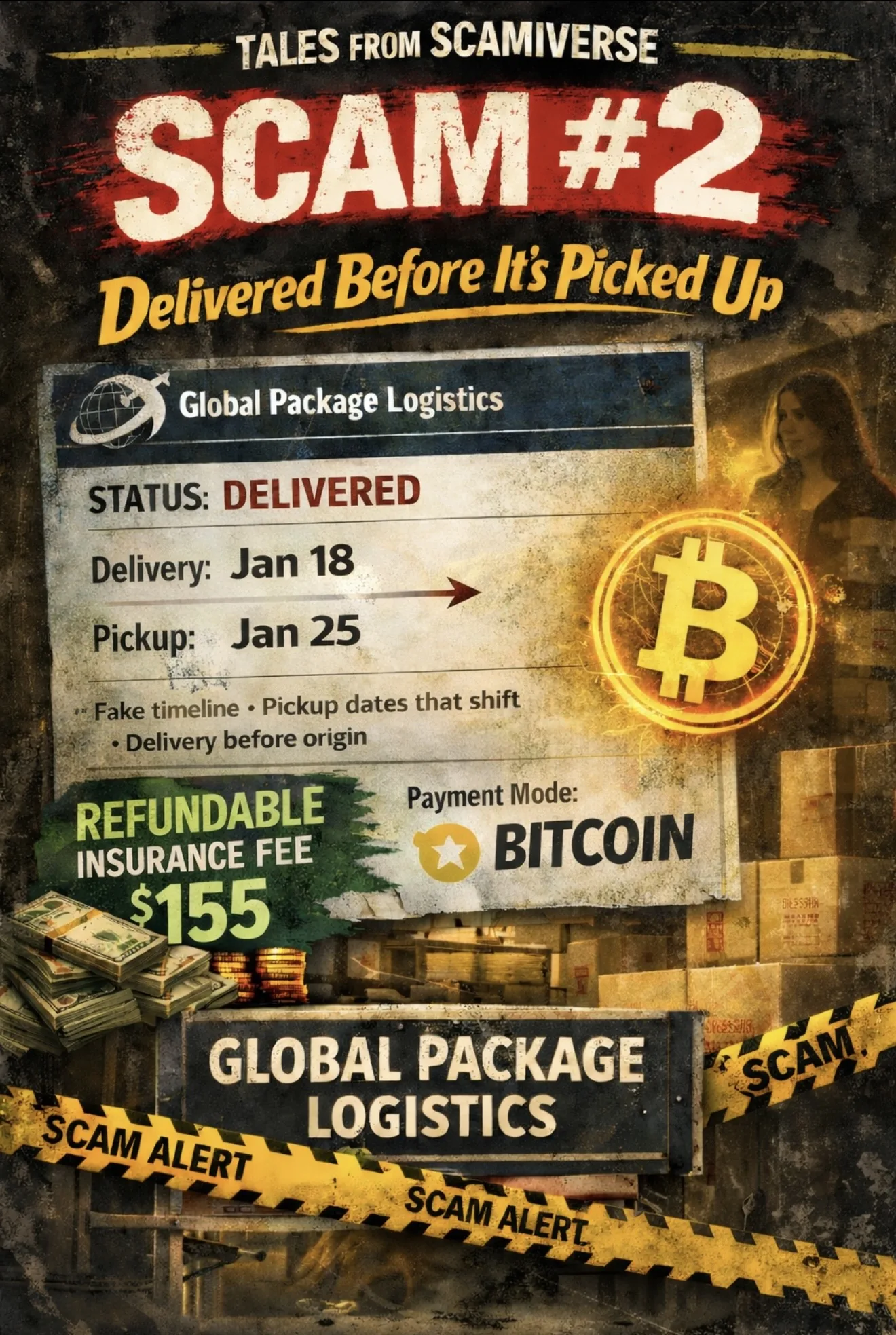
Global Package Logistics.
Then she tells the buyer to be patient and promises it will proceed today and arrive within a week.
The buyer is uneasy. It feels weird. Why WhatsApp? Why email? Why is any of this happening?
Olivia reframes it with reassurance:
“Most often it’s usually through email.”
“You don’t need to worry yourself, everything will definitely work out smoothly with no complications.”
Reassurance is used like a blanket. Not to solve anything, just to keep the buyer warm enough to stay in bed.
The tracking portal
Then the tracking arrives.
A tracking number. A link.
It looks like a carrier portal. It has a progress bar. It has sections for shipper and receiver. It has a “status.”
And if you glance quickly, you can almost feel your brain relax:
Okay. There’s tracking. There’s a system. This is real.
But if you look closely, the system tells on itself.
The portal displays “Shipper Information” in a way a real carrier usually doesn’t, including a shipper name that ties back to Olivia, and contact details that make the whole “third party carrier” illusion feel thin.
Then you hit the next oddity.
Inside “Shipment Information,” it lists:
Payment Mode: Bitcoin.
That’s not normal. Logistics companies don’t track how you paid your seller. They track weight, route, scan events, clearance codes.
Payment mode showing up in shipment metadata doesn’t scream shipping.
It screams billing.
Delivered before pickup
And then comes the line that becomes the episode title.
The timeline is broken.
The portal shows delivery before pickup, a delivery date that comes before the listed pickup date.
That’s not a glitch.
It’s a confession.
Real shipments don’t time travel.
And the details keep shifting. The pickup time changes between screenshots. like someone is editing a template, not like data is being pulled from carrier scans.
So the portal isn’t tracking.
It’s performing.
The “agency” email
Now comes the email.
This is the “agency” in its final form: a bureaucratic voice that makes theft sound like a requirement.
The buyer receives an email asking for a $155 refundable insurance fee. It claims it’s needed to “finalise the shipment” and ensure “security and seamless processing.” It urges immediate payment.
And the payment methods are exactly what you’d expect from a scam:
Bitcoin. Cash App. Chime.
The buyer is confused because the email is weirdly formatted, the “email” is basically a subject line dump. It looks unfinished. It looks templated.
The buyer says it’s weird.
Olivia replies:
“Nothing is weird, it’s for your own safety.”
Then she normalises it:
“All my customers usually pay for insurance and it’s always refundable.”
If the buyer asks whether they’ll have to pay more, customs, more fees, Olivia pre frames the fee before the agency fully demands it:
“Maybe just a refundable insurance fee like how all customers usually do.”
That line is crucial. It plants the idea so when the demand arrives, it feels inevitable.
The buyer reports the fee amount: $155. The buyer asks if they’ll be refunded.
Olivia reassures:
“Yes it will refund.”
“They’re trustworthy and reliable too.”
The middleman move
The buyer asks how to pay. They can’t see clear instructions. They can’t find where to do it.
Olivia offers the most revealing “help” of all:
“Or better still if you want to send directly to me then fine, I’ll reach out to them and send it that way…”
That’s the loudest red flag in Scam #2.
Because it collapses the illusion of separation.
If Olivia can collect the fee and forward it, then Olivia and the “agency” are not separate actors in a process.
They’re one system.
The buyer is scared. They say they don’t have the money. They say they know FedEx doesn’t ask for this.
Olivia escalates reassurance into emotional pressure:
“You won’t get scammed.”
“I swear on my late dad’s head.”
“Keep calm, I promise everything will work out perfectly.”
When the buyer begs for another option, maybe pay for FedEx, Olivia redirects again:
Trust the agency as well.
Responsibility is performed verbally.
Money is routed elsewhere.
Eventually, the buyer pays.
Refund at delivery
And then the last trap appears, the one that keeps victims waiting long after they should stop.
The buyer asks: Will they deliver directly? When will I receive the $155 back? They borrowed it. They’re not in a good place.
Olivia doesn’t give a method.
She doesn’t give a timeline.
She doesn’t give a refund process.
She gives the classic promise tied to a future event:
“The $155 will be refunded back to you same time with your package to your door step.”
Refund at delivery.
A delivery the scam controls.
This is why Scam #2 feels heavier than Scam #1. Scam #1 takes your money and stalls you.
Scam #2 takes your money… then offers you a way to recover it, but only if you keep participating in the illusion.
And the illusion is now a dashboard.
A portal to refresh.
A status to check.
A progress bar to stare at like a slot machine.
And when the portal contradicts itself, Olivia doesn’t correct it.
She relabels it.
Reinterprets it.
Turns facts into vibes.
In Scamiverse, facts don’t get fixed.
They get repainted until the victim is tired.
The warning line
So the warning line for Scam #1 is:
“Tracking soon.”
But the warning line for Scam #2 is:
“Refundable insurance fee.”
Because anything described as refundable right before it demands Bitcoin is not a refund.
It’s a second bite.
And the moment you see a tracking page where delivery happens before pickup, the moment you see “Payment Mode: Bitcoin” inside shipment metadata, the moment you’re told an “agency” will contact you to release your parcel…
You’re not in logistics.
You’re in the sequel.
And you end it the only way Scamiverse ever ends:
By refusing to fund Act Two.

Comments