
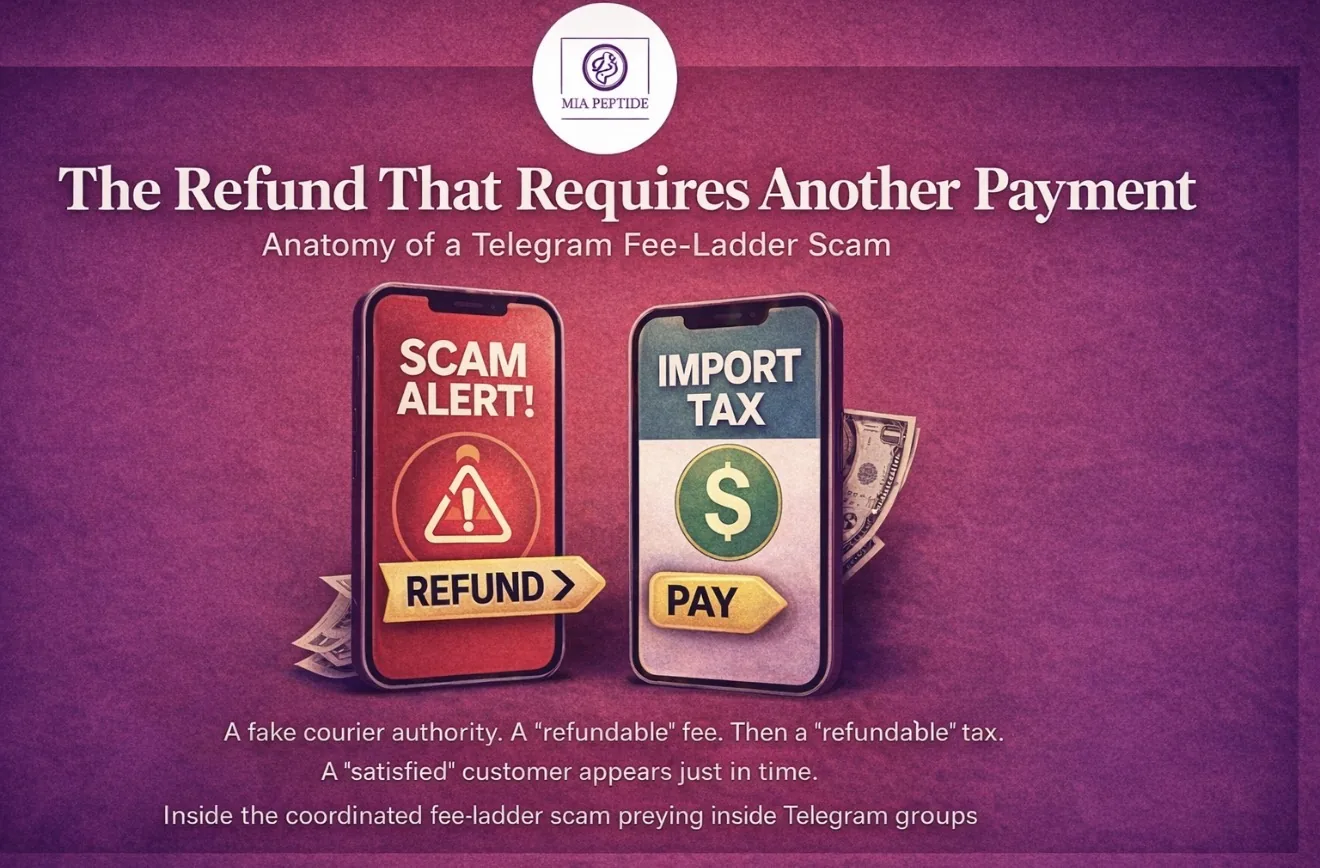
TikTok is the hunting ground for this scam.
The scammer runs a TikTok account, Mia Peptide, used to funnel people into a Telegram group. Inside that group, everything looks staged: the same handful of usernames repeatedly confirm delivery and praise “Mia” in an over the top way, there are no negative reviews (which you normally see in legitimate servers), and there’s virtually no peptide related discussion, just “business as usual,” even during the Chinese New Year period when genuine vendors are typically slower or offline.
The most telling part is how reassurance appears on cue. One user asks for confirmation that there will be no extra fees after payment and is immediately told there won’t be. Later, when our victim asks whether anyone has ever had to pay import tax twice, two accounts instantly appear to reassure her that they did, and that it “worked out in the end.”
Phase 1: Normal Vendor Behaviour
Our victim places an order via DM. Payment options are limited to:
Cash App • Bitcoin • Chime • Zelle • Apple Pay
These are a scammer’s favourite rails: fast, hard to reverse, and light on buyer protection. Every option offered is designed for speed and irreversibility, not consumer protection.
The victim sends payment via Zelle to an individual account named Majeste Madouri: $740 (after a 15% discount). “Mia” confirms casually: “Got it.” Tracking will follow “soon.”
The victim is new and nervous, it’s her first order. “Mia” reassures her repeatedly that she’ll receive everything she paid for, including a promised “free gift” (a mini fridge), and adds relationship framing: she “believes in long term business” a soft credibility signal meant to calm anxiety and reduce scrutiny.
Phase 2: The Fake Authority Layer
Just over an hour later, the victim receives a tracking link, not UPS, FedEx, DHL, or USPS, but a private site:
ExpressRouteHub
A PDF style “Shipment Invoice” follows: barcode, “Order Confirmed,” sender/recipient fields. It looks official. It feels official. But it isn’t tied to any recognised carrier system or pickup scan.
This is authority theatre.
Phase 3: The First Rung, “Refundable Insurance”
The invoice states the shipment is pending an “unpaid refundable insurance fee” of $305.
Refundable is the key word. It’s the bait.
“Mia” reassures the victim: “It’s refunded upon arrival.” Payment is allegedly “crypto only,” but the victim doesn’t know how to use crypto, so Mia “helpfully” suggests she send the money to her Zelle account and she’ll pay the courier on the victim’s behalf.
The victim sends another $305 to the same account. Mia confirms she has “paid the fee.”
Phase 4: Escalation, “Consumer Use Tax”
Once the insurance is paid, a new message arrives:
The shipment is now “ON HOLD pending mandatory Florida Consumer Use Tax.”
The notice includes:
legal definitions of use tax
regulatory/compliance language
a “Refundable Use Tax Fee” of $405
urgency: “Action Required”
Here’s the problem:
states do not collect use tax through private courier websites
use tax is not prepaid before delivery
tax is not “refundable”
tax is not negotiated in chat
And yet… the amount becomes flexible.
Phase 5: Negotiation, the Legitimacy Collapse
When the victim shows the tax demand to Mia, Mia claims she “didn’t see it,” then immediately pivots to normalising it: “This is actually the 5th package they are requesting this.”
She reassures the victim that it is “fully refunded,” and says other customers have been through it successfully. This time, Mia instructs the victim to send the money straight to her Zelle.
When the victim says she can’t afford it, Mia asks:
“How much you got?”
Mia offers to cover $105 of the fee. When that’s still too much, the “tax” drops again: $205, with Mia claiming she will pay the rest. When the victim still struggles, Mia drops it to $150.
Real taxes do not negotiate.
The moment the amount becomes flexible, the regulatory narrative collapses.
Now it’s bargaining.
Phase 6: Emotional Leverage and Refund Hostage
The victim checks ChatGPT and learns that this “tax requirement” doesn’t work the way Mia is claiming. Mia responds with denial and guilt framing: it’s “not a scam,” and the victim is “just concerned with herself” and “being difficult” because she “doesn’t want to pay $200 to get this resolved.”
The victim asks for a refund. Mia goes quiet. Over the next days Mia continues to call and message, pushing the payment again.
When the victim asks for a refund again, Mia says she can’t refund.
Then the victim pleads: “Please help me, I can’t afford to lose my money.”
Mia’s response is:
“I understand. I don’t want you to lose a dime. You pay $150 and I’ll complete the payment.”
The “help” is always the same: pay more.
At this stage Mia repeats the demand coldly, even when the victim offers to pay by PayPal. Mia refuses and keeps the victim boxed into Zelle or Chime, the same low protection rails.
This is the key turning point:
“Pay $150 and I’ll process your refund.”
A refund that requires another payment isn’t a refund.
It’s ransom.
A Second Victim, Same Script
Another victim reports paying a custom fee of $205, then a day later receiving a demand for $400 in “refundable insurance.” When they resist, Mia negotiates the amount down, again, proving it isn’t a real fixed fee.
Then a group member John Kilgore (one of the recurring praise accounts) messages privately, claiming:
the same thing happened to him
he paid half
he was fully refunded
“it’s legit”
No proof. No screenshots. No delivery confirmation. Just reassurance and redirection back to Mia.
This is social proof deployment, a common reinforcement tactic in fee ladder scams.
Seller.
Fake courier authority.
Reassurance sockpuppet.
Three layers. One structure.
The Pattern
1. establish legitimacy
2. introduce fake logistics authority
3. demand “refundable” insurance
4. escalate to “refundable” tax
5. negotiate when resistance appears
6. deploy social proof
7. condition refund on another payment
Each rung is designed to feel like the final step.
It never is.
The Coldest Line
After repeatedly promising that everything is refundable, the moment the victim asks for her money back, Mia’s position becomes:
“Honestly can’t refund.”
That’s when the structure stops pretending.
Conclusion
This wasn’t a shipping delay.
It wasn’t a tax misunderstanding.
It wasn’t compliance confusion.
It was coordinated financial extraction under the cover of logistics authority.
The illusion collapses the moment:
fees become negotiable
refunds require another payment
social proof appears on cue
payment methods are restricted to low-protection rails
Once you see the structure, you can’t unsee it, and once you understand the pattern, you can spot it long before the first “refundable” fee.
This fee ladder setup is extremely common since the removal of the de minimis threshold. Scammers use the same TikTok → Telegram pipeline, then introduce a fake “logistics” company to justify escalating, “refundable” fees.
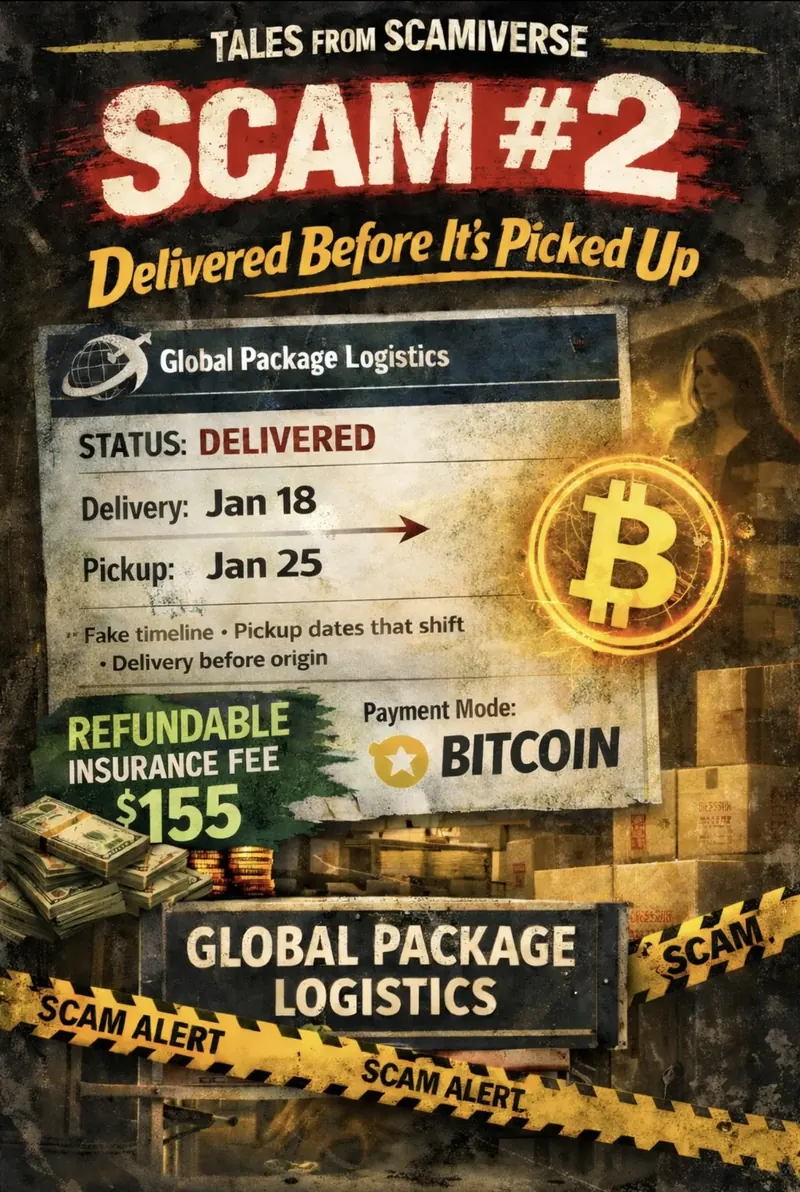
This isn’t isolated to one name. A very similar model has been used by Olivia Grace, also promoted via TikTok and Telegram, with a fake courier brand called Global Package Logistics.
The rule of thumb is simple: if you’ve already paid for your order and someone later asks for extra import tax, refundable insurance, clearance fees, compliance fees, or any additional payment to release the package, treat it as a major red flag. Do not send more money, and never pay a “shipper” through peer to peer methods to “unlock” delivery
Comments