
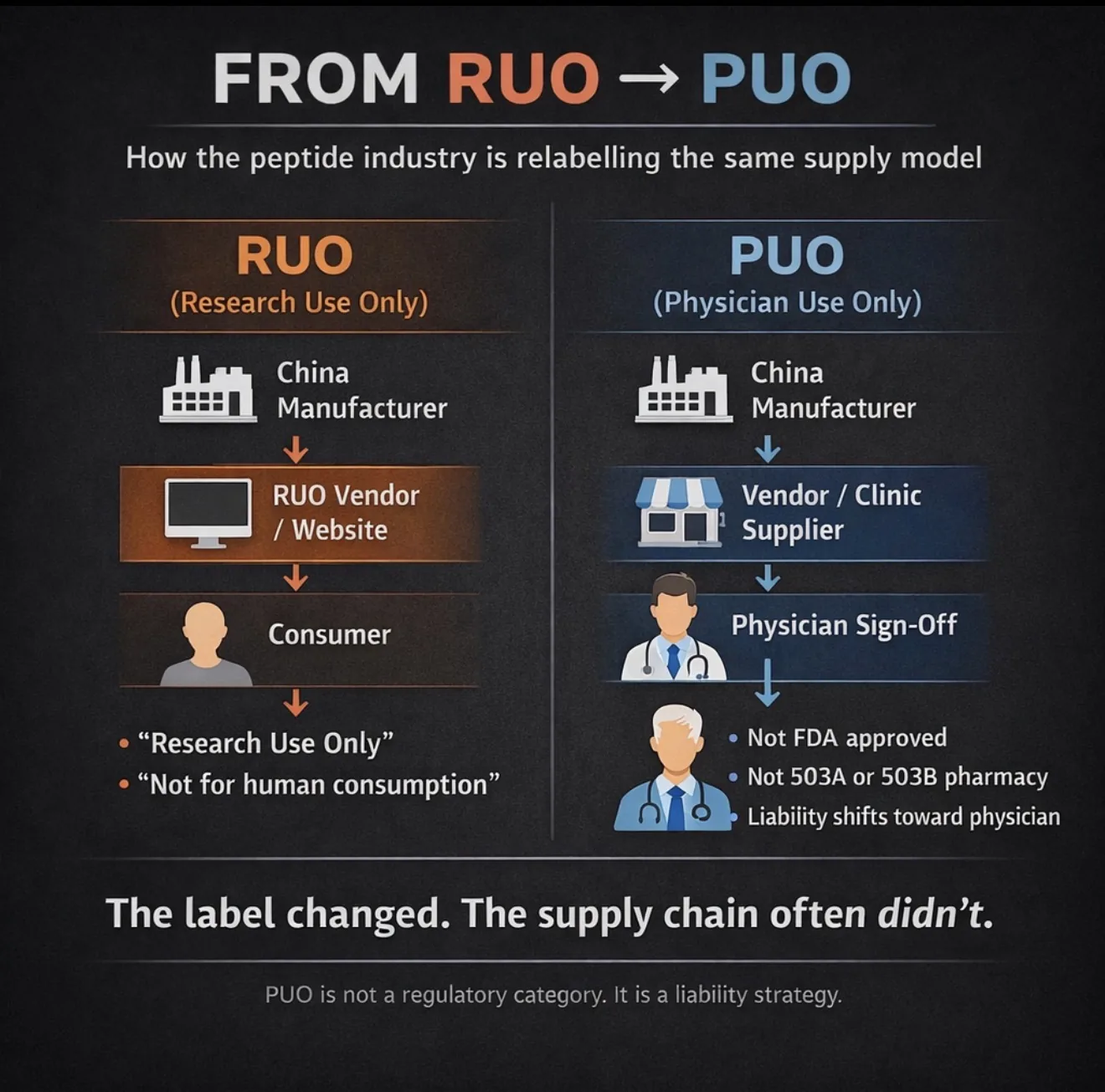
In my last article, I implied that Physician Use Only (PUO) was part of a physician prescription model similar to licensed compounding pharmacies.
After digging further, that now looks incomplete.
PUO is not a formal FDA regulatory category. It is not the same as 503A or 503B compounding, and it does not automatically mean a product is being supplied through a pharmacy.
Instead, PUO appears to function as an industry labelling strategy designed to reposition peptide products away from the increasingly scrutinised Research Use Only (RUO) model.
RUO Was Never Really About Research
Despite the name, the grey market peptide RUO label was never really about research.
The “Research Use Only” label was largely a legal and commercial positioning tool. It allowed companies to sell peptides while distancing themselves from direct human use claims.
One detail that rarely gets mentioned is how the RUO label emerged in the first place. According to healthcare attorney Jeff Cohen, many early peptide companies sought guidance from FDA lawyers on how to operate without being classified as selling unapproved drugs. The advice they received was to label products “Research Use Only” and “Not for Human Consumption.”
This positioned peptides as laboratory chemicals rather than pharmaceuticals.
In other words, RUO was never primarily about research. It was a legal strategy that allowed companies to remain operational while avoiding the drug approval framework.
The current shift toward Physician Use Only appears to follow a similar logic.
Why RUO Stopped Working
Over time, that model became harder to sustain.
The problem was not simply the chemistry. The problem was the contradiction.
Many vendors began publishing:
dosing protocols
wellness applications
therapeutic discussions
while still maintaining the “not for human use” disclaimer.
That created a particular problem for wellness clinics, which represent a large part of the peptide market. A clinician prescribing or administering something labelled “not for human use” creates obvious legal and liability exposure, regardless of the product’s actual quality.
At that point, the word research itself began to function as a red flag.
What PUO Actually Is
This is where PUO appears to come in.
Rather than labelling the product “Research Use Only,” vendors relabel it as “Physician Use Only” or “Professional Use Only.”
But this does not create a new regulatory framework.
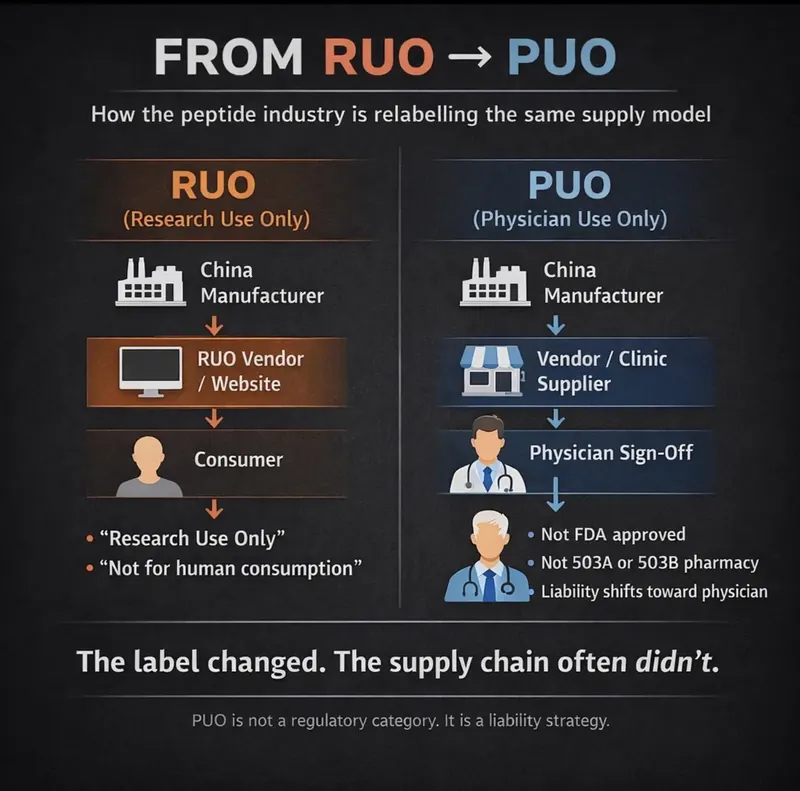
PUO is not an FDA recognised category. It is better understood as a labelling and liability strategy.
What Changes Under PUO
Under a PUO model, the underlying supply chain may not change very much at all.
The product may still be sourced from the same manufacturers, often overseas. The major change is that responsibility shifts.
The vendor attempts to reposition itself as a supplier to physicians or clinics, while the physician becomes responsible for deciding whether the product is appropriate to prescribe or administer.
In that sense, PUO is not really a pharmacy model.
It is better understood as a clinic facing supply model designed to move liability away from the vendor and toward the prescriber.
Why This Is Not the Same as Compounding
This is the key distinction.
When a physician prescribes an FDA approved drug or a medication prepared by a licensed compounding pharmacy, the pharmaceutical manufacturer or the compounding pharmacy operate within a defined regulatory framework and are responsible for how the medication is prepared.
With PUO, the physician is in a much more exposed position.
If physicians choose to use these products, they will need to take on much more of the due diligence themselves. That means understanding:
who manufactured the product
what the Certificates of Analysis actually show
whether independent third party testing was performed
whether the raw peptide API was tested before manufacture
whether the finished product was tested after production etc....
In other words, the physician may have to vet the supply chain in a way they normally would not when prescribing an FDA approved drug or a properly compounded pharmacy product.
What PUO Looks Like in Practice
In many cases, the shift from RUO to PUO appears to be largely cosmetic.
Products may now be marketed toward:
physicians
wellness clinics
professional users
But the underlying disclaimers often remain remarkably similar to the old RUO structure.
Example 1: Path Peptides
One example is Path Peptides, which presents itself as supplying products for physician use only.
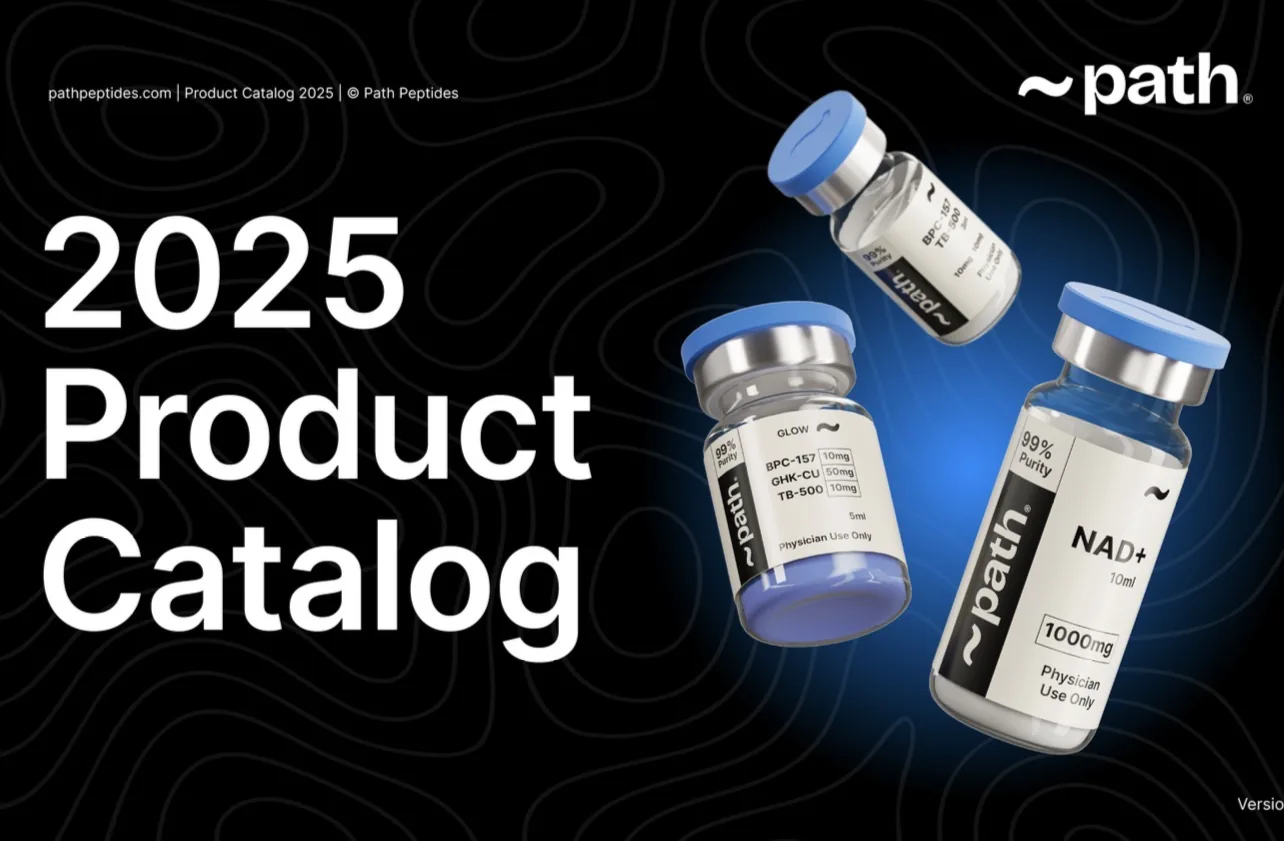
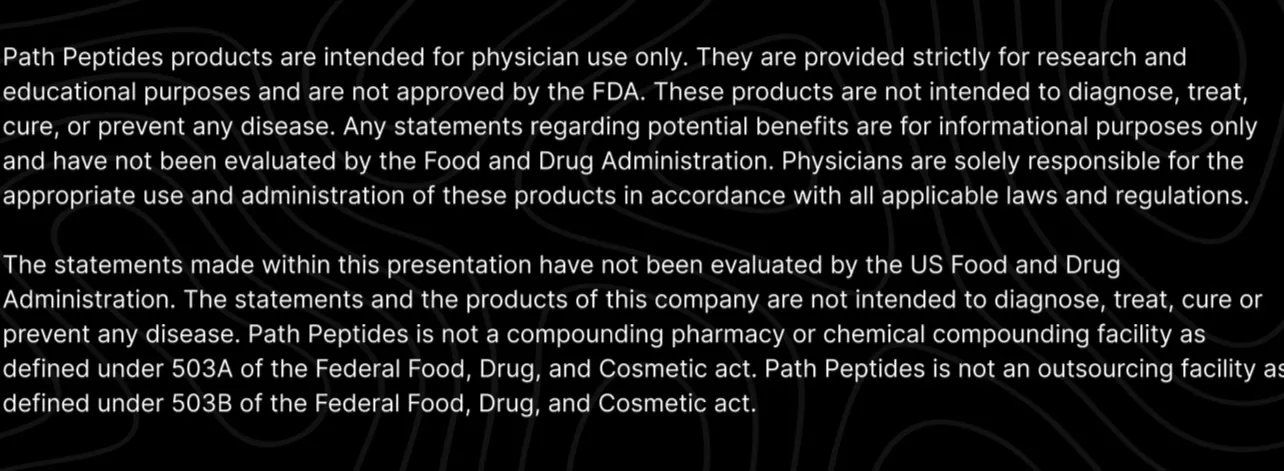
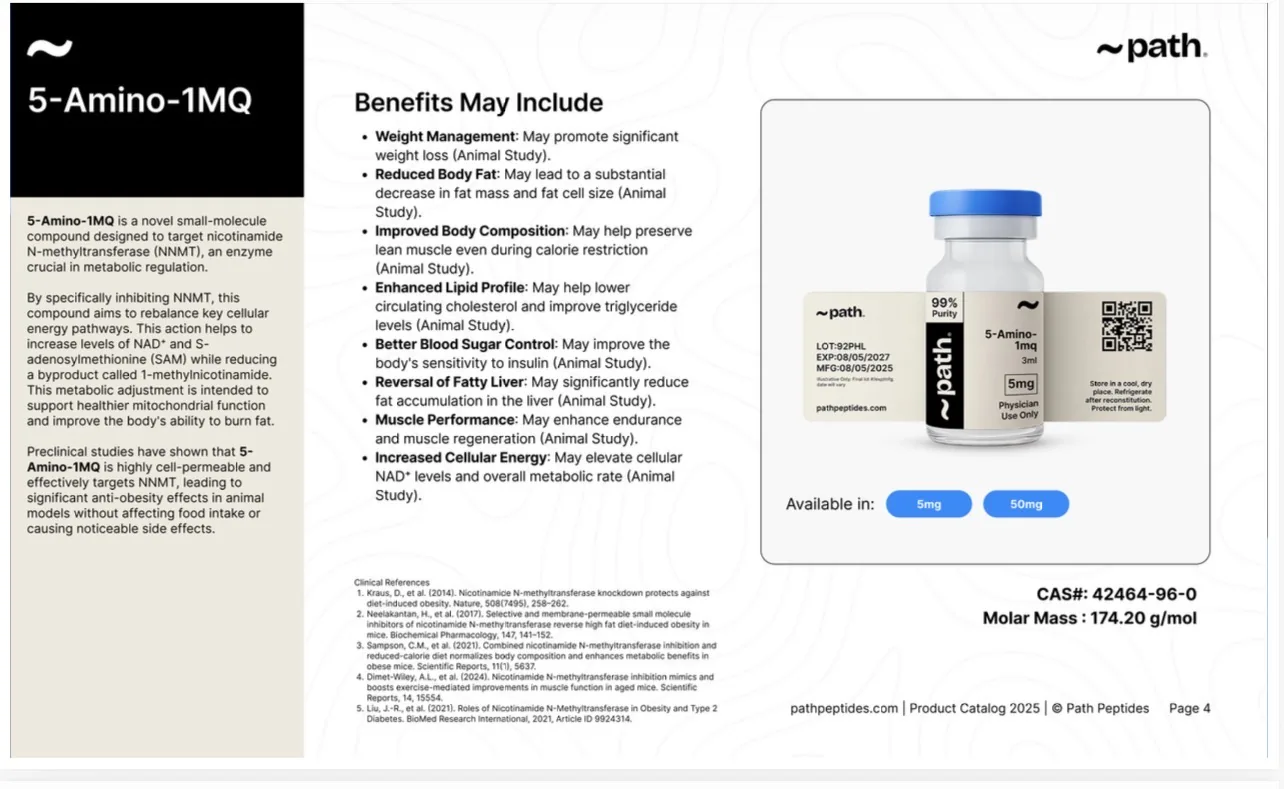
However, the disclaimer also states that the company is:
not a compounding pharmacy
not an outsourcing facility
not operating under 503A or 503B
It also makes clear that its products are:
not FDA approved
provided for research and educational purposes
not intended to diagnose, treat, cure, or prevent disease
So despite the physician oriented language, the product still sits outside the regulated pharmacy framework.
Example 2: PeptSci Research
A similar pattern appears with PeptSci Research.
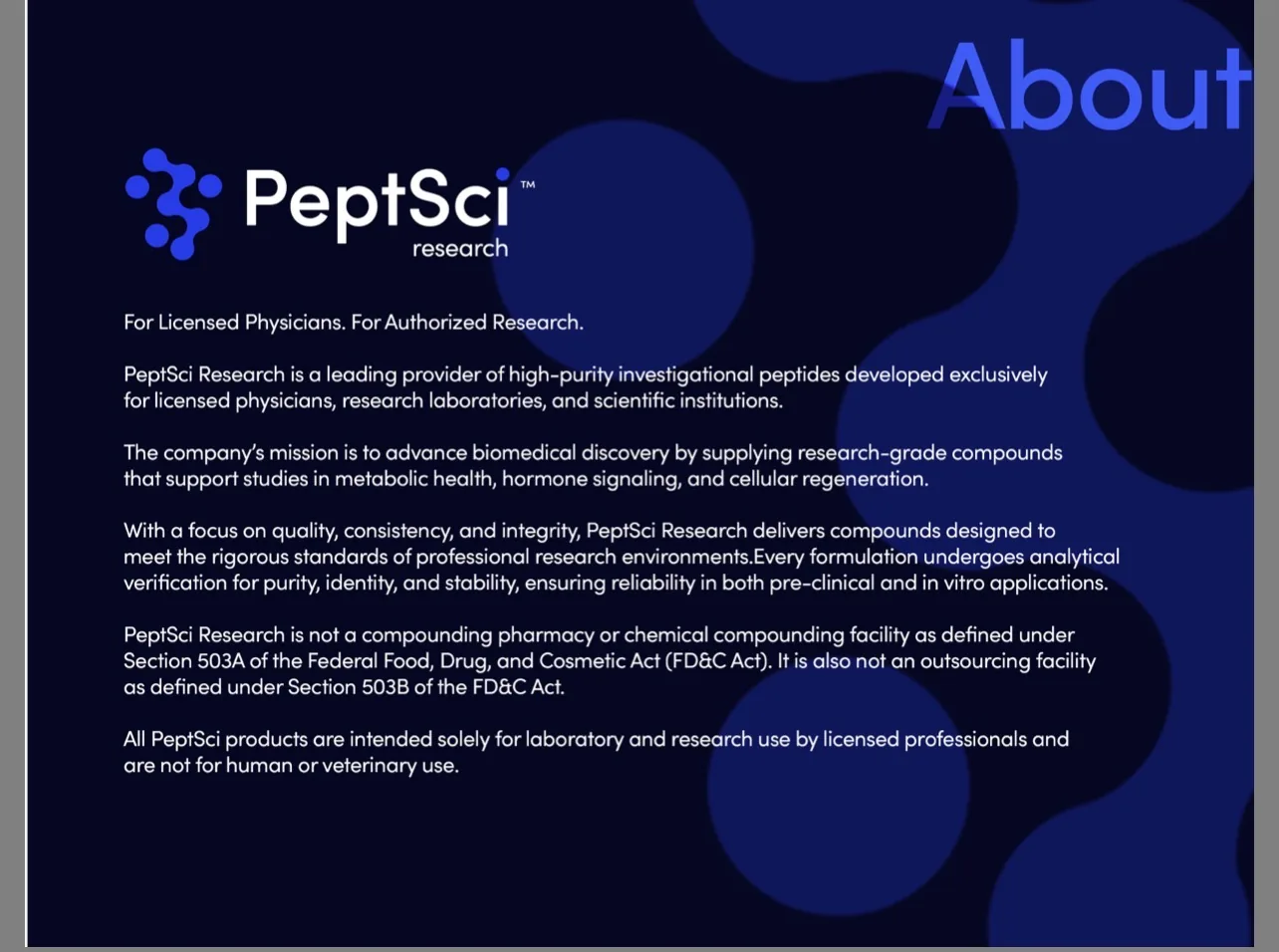
The company uses branding aimed at:
licensed physicians
research laboratories
scientific institutions
It also presents products within clinical style categories such as:
weight management
recovery and performance
longevity and cellular health
cognitive and neurological research
Product descriptions may include language around:
appetite suppression
metabolic regulation
fat oxidation
insulin sensitivity
weight loss effects
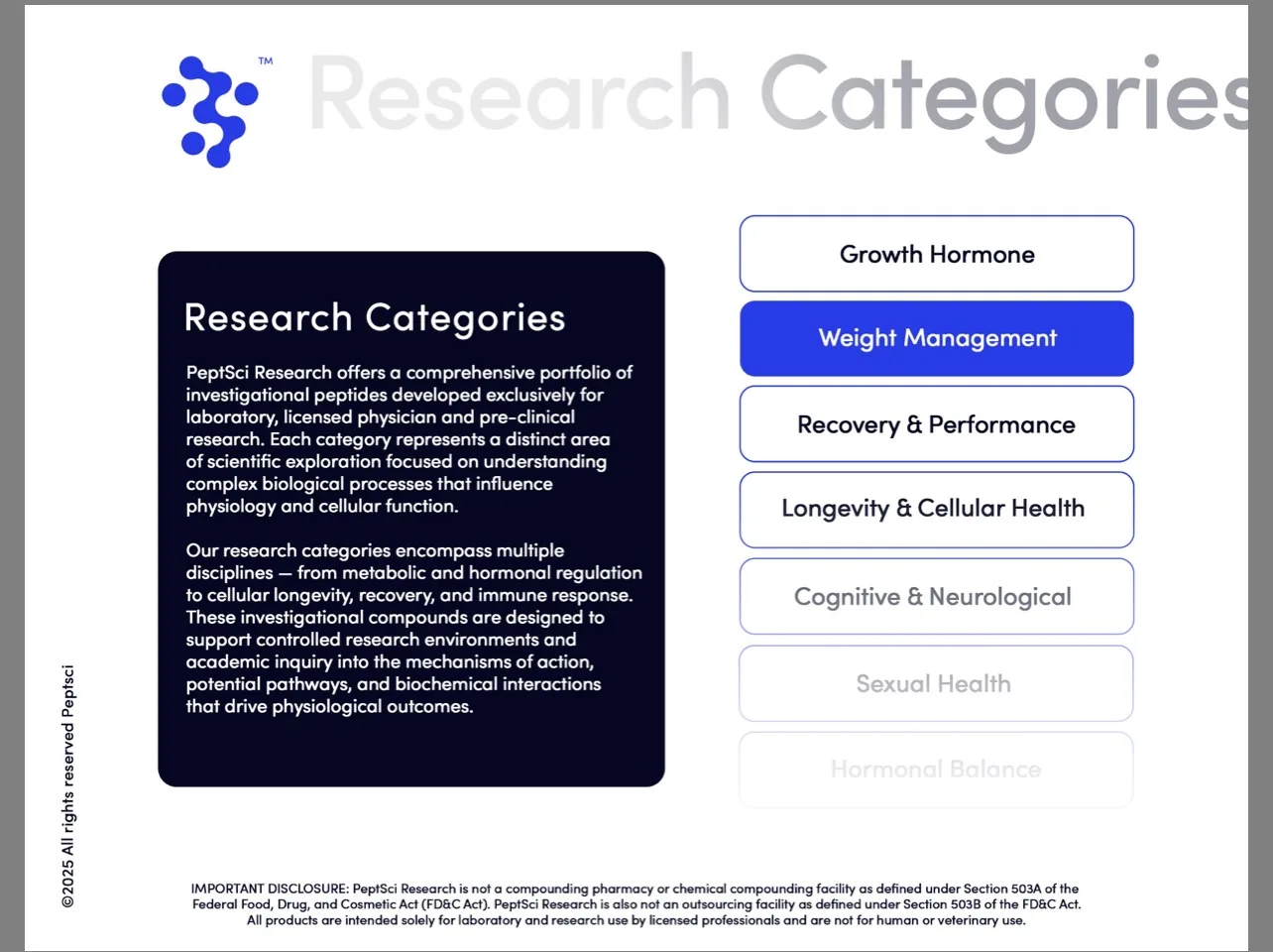
Yet the same disclaimer structure remains:
not FDA approve
not for human use
intended for research use only
not supplied through a 503A or 503B pharmacy structure
This creates a hybrid model.
The marketing resembles therapeutic products, while the legal framework still defines them as research chemicals.
The Contradiction Hasn’t Disappeared
PUO may solve the “research use only” wording problem, but it creates a new contradiction.
Many of these products are described as being for physician use, while also carrying disclaimers that they are:
not FDA approved
still tied to research language
outside the licensed pharmacy framework
In some cases, products may even be shipped directly to the customer.
So the underlying ambiguity often remains.
The label changes
The liability story changes
But the regulatory structure may not.
The Structural Contradiction
These examples highlight the central tension behind the PUO shift.
The product presentation suggests:
physician involvement
therapeutic applications
clinical interest
But the legal framework still treats the compounds as non approved research materials.
In practice, PUO does not appear to create a new regulatory category.
Instead, it functions as a liability repositioning strategy.
The logic works like this:
Under RUO, liability was largely shifted toward the end user.
Under PUO, liability may shift toward the prescribing physician if the product is used clinically.
But the product itself still sits outside any formally recognised FDA drug framework.
The Real Takeaway
The shift from RUO to PUO should not be mistaken for a move into licensed pharmacy compounding.
In many cases, it appears to be something narrower and more strategic:
a relabelling of the same grey market supply model, with responsibility pushed further downstream toward physicians and clinics.
PUO may change the language around peptides.
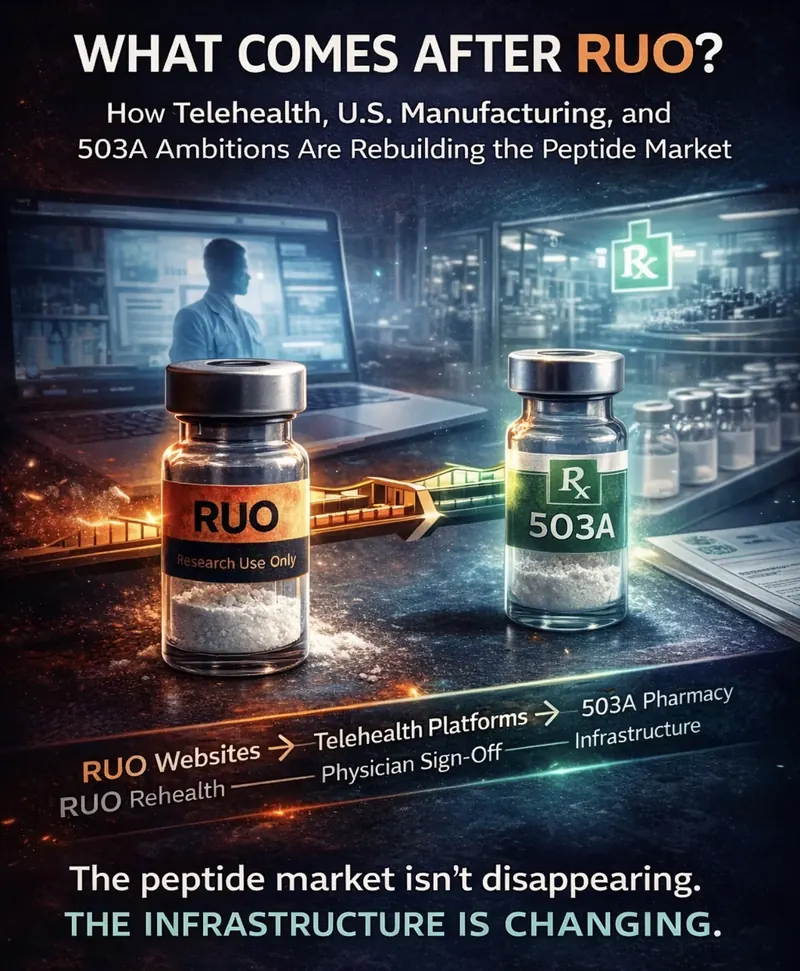
But another model is emerging at the same time.
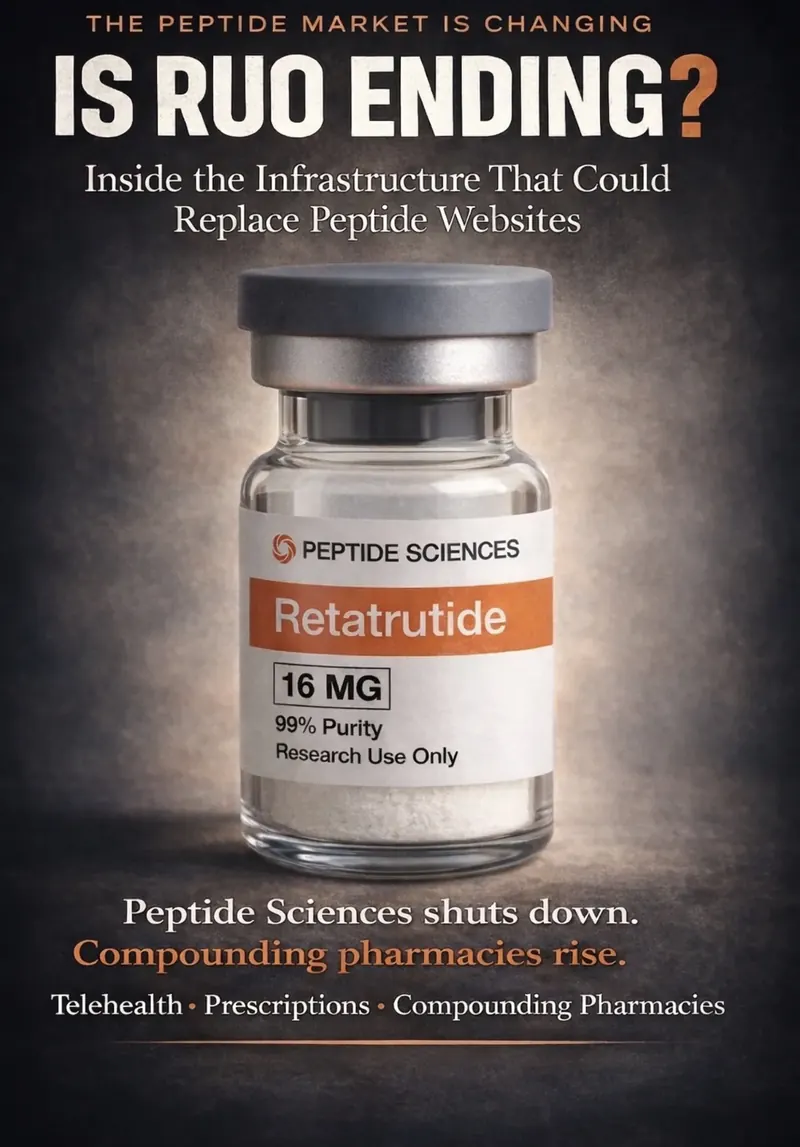
While RUO vendors rebrand, compounding pharmacies and telehealth platforms are rapidly building a parallel distribution system.
That system may end up reshaping the entire peptide market.
In the next article, I’ll break down how the compounding and Telehealth infrastructure actually works, and why it may become the real successor to the RUO era.
Comments