
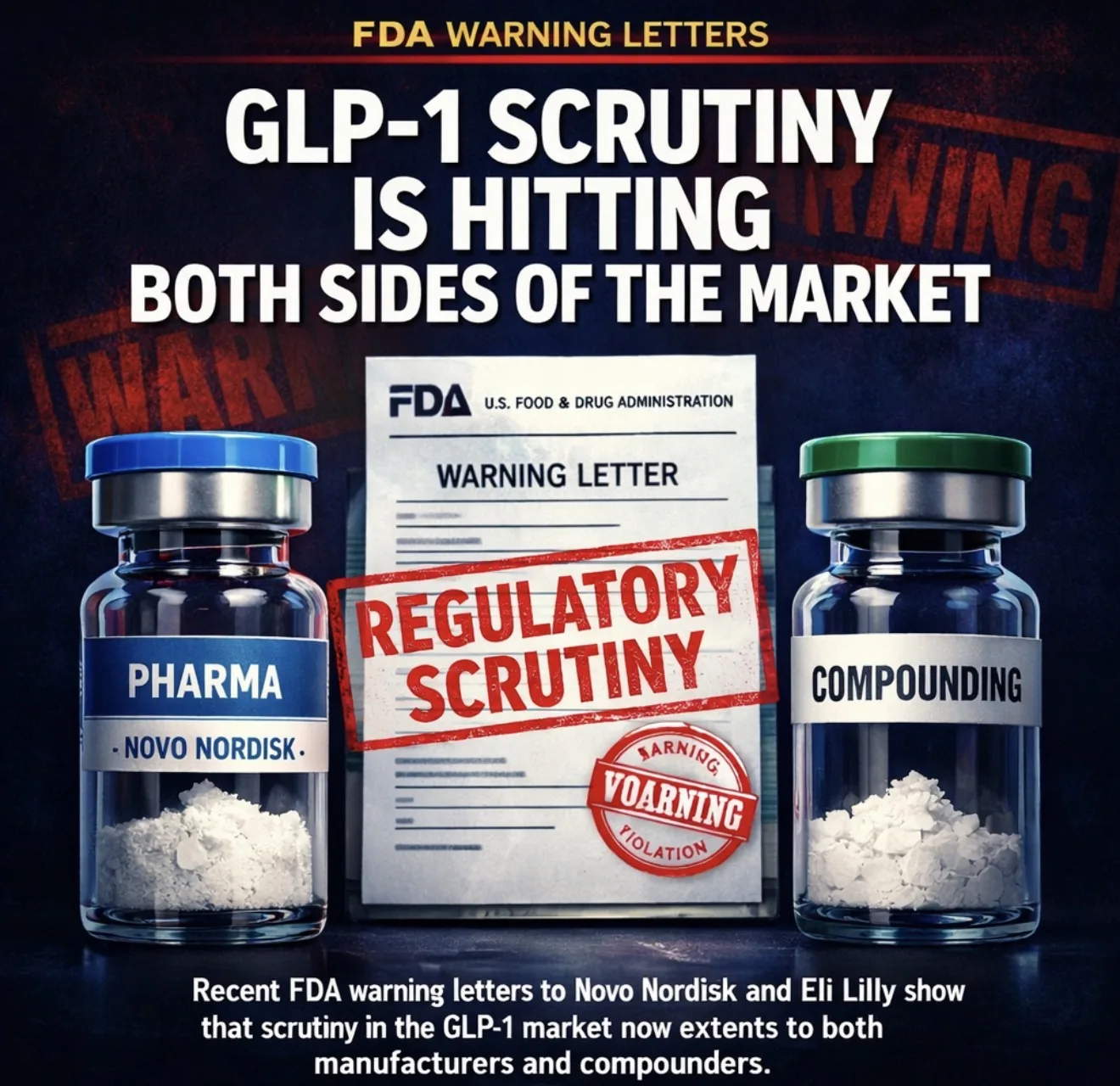
For months the public narrative around GLP-1 drugs has been framed as a conflict between pharmaceutical manufacturers and compounding pharmacies.
Pharma companies argue that compounded GLP-1 drugs raise safety and quality concerns.
Compounders argue they are filling gaps in supply and patient access.
But recent regulatory actions suggest the reality is more complicated.
Scrutiny is now hitting both sides of the market.
Novo Nordisk: FDA Warning Over Safety Reporting
On March 5, 2026, the FDA issued a warning letter to Novo Nordisk citing violations related to post marketing adverse drug experience (PADE) reporting.
The agency identified several serious problems in the company’s pharmacovigilance systems, including:
failures to report certain serious and unexpected adverse events within required timelines
deficiencies in written procedures governing adverse event reporting
weak oversight of contractors responsible for safety monitoring activities
FDA inspectors also identified additional procedural failures.
According to the warning letter, Novo’s internal processes:
allowed adverse event reports to be rejected if a reporter believed the event was unrelated to the drug, even though FDA rules require reporting regardless of suspected causality
invalidated certain serious cases due to supposedly missing patient identifiers even when those identifiers were present in source documentation
allowed cases to remain in “medical review” status for extended periods, leading to missed reporting deadlines
The FDA cited examples including reports involving stroke, suicidal ideation, and deaths that were not processed within the required regulatory timelines.
One example involved a liraglutide case in which a disabling stroke report was rejected and not submitted within the required 15 day reporting window.
Another involved a death case in a patient receiving semaglutide that was incorrectly invalidated despite containing sufficient patient identifiers.
The FDA also found that certain cases sat in medical review long enough to cause missed reporting deadlines. In one instance, a consumer report describing suicidal ideation while taking Semaglutide remained under review until the FDA inspection identified the problem.
Investigators also found that Novo procedures required consent before certain follow up investigations, which FDA said is not required under reporting rules and contributed to failures to investigate serious cases. These included reports involving deaths and a physician reported suicide case associated with semaglutide.
The warning letter ultimately went further than identifying individual late reports.
In unusually blunt language, the FDA stated:
“We have serious concerns about the scope and impact of these violations on your entire product portfolio.”
In other words, the agency suggested the problem may not be confined to a single drug, but could reflect broader weaknesses in Novo’s pharmacovigilance systems.
Source:
https://www.fda.gov/inspections-compliance-enforcement-and-criminal-investigations/warning-letters/novo-nordisk-inc-717576-03052026
Eli Lilly: FDA Warning Over Risk Minimising Promotion
Eli Lilly has also received FDA warning letters in the GLP-1 space, but for a different reason.
In September 2025, the FDA issued multiple warning letters regarding promotional materials for Mounjaro and Zepbound.
The FDA concluded that certain promotional materials:
minimised or omitted important risk information
presented benefits without balanced safety context
used messaging that could mislead patients about the seriousness of potential side effects
The agency specifically cited failures to adequately communicate major risks associated with these drugs, including:
the boxed warning regarding thyroid C-cell tumours (MEN2 / medullary thyroid carcinoma)
pancreatitis risk
gallbladder disease
hypoglycemia in combination therapies
acute kidney injury
severe gastrointestinal reactions
diabetic retinopathy complication
hypersensitivity reactions
suicidal behaviour and ideation
FDA also cited procedural violations, including failure to properly submit promotional materials under Form FDA-2253 at the time of initial dissemination, which is required under federal regulations
One of the warning letters cited a 42 minute televised program hosted by Oprah Winfrey discussing GLP-1 drugs such as Ozempic, Wegovy, Mounjaro, and Zepbound.
According to the FDA, the program highlighted the benefits of the drugs while failing to adequately present key safety risks, creating a misleading impression about their safety profile.
These letters focused on misbranding and promotional compliance, not pharmacovigilance systems.
Sources:
https://www.fda.gov/inspections-compliance-enforcement-and-criminal-investigations/warning-letters/eli-lilly-and-company-716475-09092025
https://www.fda.gov/inspections-compliance-enforcement-and-criminal-investigations/warning-letters/eli-lilly-and-company-716485-09092025
https://www.fda.gov/inspections-compliance-enforcement-and-criminal-investigations/warning-letters/eli-lilly-and-company-716462-09092025
Two Different Violations, Same Regulatory Pressure
Taken together, these cases show something important.
The regulatory environment surrounding GLP-1 drugs is not limited to one side of the market.
Compounders face scrutiny over whether they should be producing these drugs at all.
Pharmaceutical manufacturers face scrutiny over how they monitor safety and communicate risks.
In other words, regulatory pressure is appearing across the entire supply chain.
The Bigger Picture
The GLP-1 market is one of the fastest growing pharmaceutical sectors in decades.
With that growth comes:
increased regulatory oversight
intense commercial competition
political pressure over drug pricing and access
expanding telehealth and compounding activity
That combination means the regulatory spotlight is unlikely to focus on just one group.
Manufacturers, compounders, telehealth providers, distributors, and prescribing networks are all operating inside a high visibility regulatory environment.
The Real Takeaway
The current GLP-1 debate is often framed as pharma versus compounders.
But recent enforcement actions suggest something broader.
The market is evolving so quickly that regulators are now watching everyone involved.
And in a sector growing this fast, that scrutiny is unlikely to decrease anytime soon.

Comments