
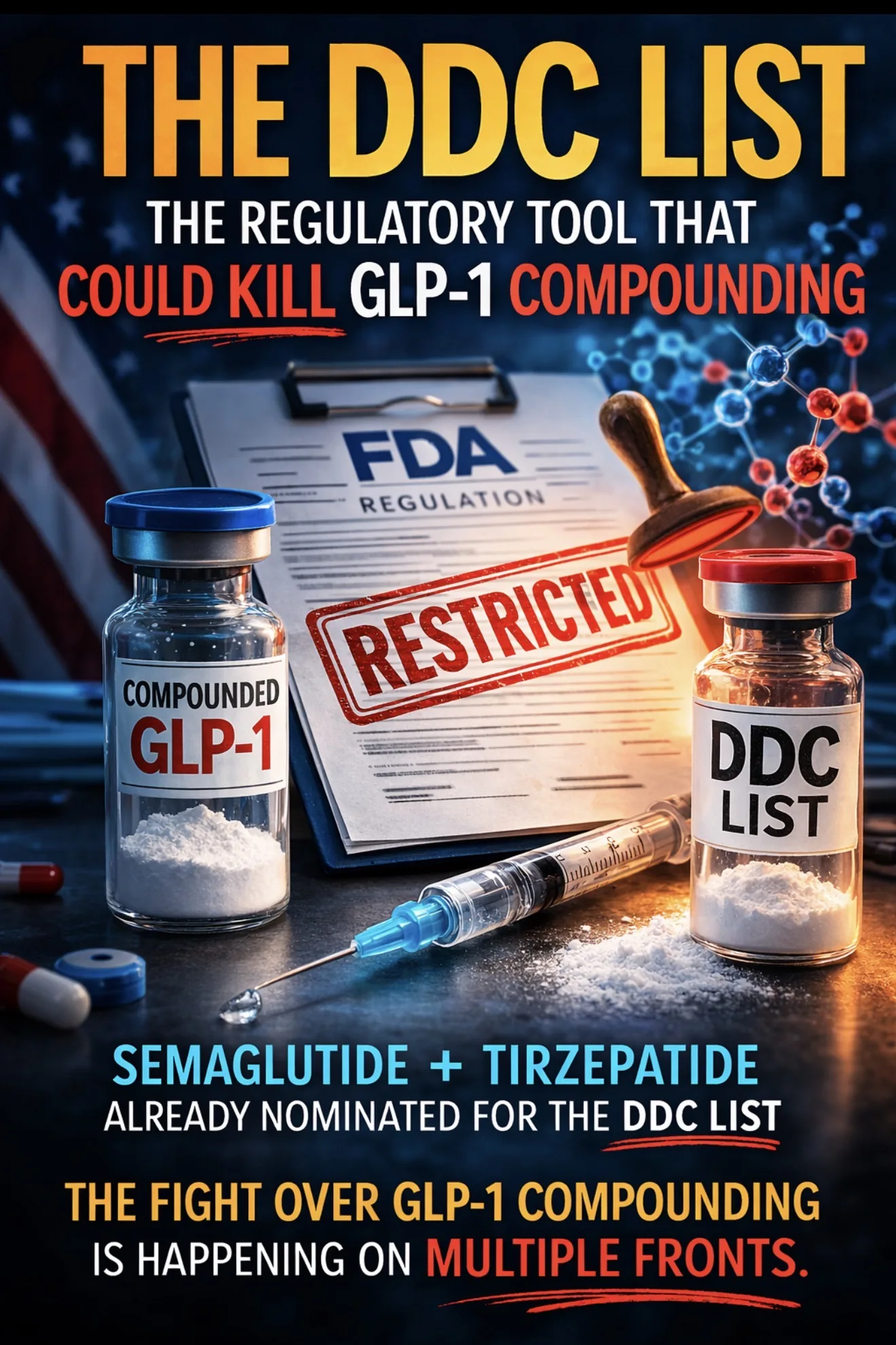
Most of the debate around GLP-1 compounding has focused on familiar battlegrounds: FDA shortage determinations, Telehealth
prescribing models, and aggressive litigation from pharmaceutical companies.
But another regulatory mechanism has been developing in the background.
It’s called the Demonstrable Difficulties for Compounding (DDC) list, and if used aggressively it could eliminate the legal pathway for pharmacies to compound certain drugs entirely.
What makes this particularly interesting is that the two largest GLP-1 manufacturers have already attempted to use it.
Both Eli Lilly and Novo Nordisk have submitted requests asking the FDA to add tirzepatide and semaglutide to the DDC list.
If the FDA ultimately accepted those arguments, compounding pharmacies could lose the ability to produce these drugs at all.
What the DDC List Actually Is
Under the U.S. Food, Drug, and Cosmetic Act, the FDA maintains a list of drugs or drug categories that present “demonstrable difficulties for compounding.”
If a drug is placed on this list, 503A pharmacies and 503B outsourcing facilities cannot compound it under their normal legal exemptions.
In practical terms, this means that adding a drug to the DDC list can effectively remove the legal pathway for pharmacies to compound that molecule.
That makes the DDC list a powerful regulatory lever.
FDA Demonstrable Difficulties for Compounding docket (DDC list nominations):
https://www.regulations.gov/docket/FDA-2017-N-2562
This docket is where:
companies submit nominations asking FDA to add drugs to the DDC list
the public can submit comments
FDA evaluates whether a drug should be classified as “demonstrably difficult to compound.”
If a drug is ultimately finalised onto the DDC list, it no longer qualifies for the compounding exemptions under sections 503A or 503B.
Evidence of DDC Nominations
Both major GLP-1 manufacturers have already attempted to use the FDA’s Demonstrable Difficulties for Compounding (DDC) mechanism.
Semaglutide
Novo Nordisk first asked the FDA to place semaglutide on the Demonstrable Difficulties for Compounding list in October 2024.
In January 2026, the company supplemented that request with additional testing data arguing that compounded semaglutide products showed impurity, potency, and formulation problems.
As of 2026, however, the FDA has not added semaglutide to the DDC list.
Novo’s argument is not simply that semaglutide is a difficult peptide in the abstract.
Instead, the company claims that compounded versions introduce multiple layers of complexity simultaneously.
According to Novo’s submission:
bulk synthetic semaglutide used by compounders may have different impurity profiles than Novo’s recombinant version
testing allegedly found unknown peptide impurities, amino-acid additions or deletions, trace metals, and high molecular weight aggregates
compounded finished products allegedly showed potency failures, impurity loads, problematic sublingual formulations, undeclared substances, and device-related risks in injectable formats
Novo’s overall position is that these combined issues, formulation complexity, stability challenges, delivery mechanisms, bioavailability, and analytical testing requirements, make semaglutide demonstrably difficult to compound safely under 503A and 503B.
In other words, Novo is arguing not merely that compounded semaglutide is imperfect.
It is arguing that the molecule itself is too complex for compounding pharmacies to reproduce safely at scale.
Original submission:
https://www.regulations.gov/document/FDA-2017-N-2562-0029
Supplemental filing:
https://downloads.regulations.gov/FDA-2017-N-2562-0037/attachment_1.pdf
Tirzepatide
Eli Lilly made a similar request in August 2024, asking the FDA to place tirzepatide on the DDC list for both 503A pharmacies and 503B outsourcing facilities.
Submission:
https://downloads.regulations.gov/FDA-2017-N-2562-0028/attachment_1.pdf
In that filing, Lilly argued that tirzepatide is a complex peptide macromolecule requiring sterile injectable formulation that compounding pharmacies cannot reliably reproduce.
The company also pointed to the challenges of ensuring consistent potency, sterility, and stability for compounded injectable products.
The Interesting Part
As of 2026, neither semaglutide nor tirzepatide appears to have been formally added to the DDC list.
That does not mean the arguments were rejected.
It simply means the regulatory process has not produced a final rule yet.
But the submissions themselves reveal something important.
The fight over GLP-1 compounding is not happening on a single regulatory front.
It is happening across multiple mechanisms simultaneously.
A Multi-Front Strategy
The pressure on compounding pharmacies has come from several directions at once:
1. Shortage determinations
Once the FDA declares a shortage resolved, the legal basis for compounding copies of the drug becomes weaker.
2. Litigation and cease-and-desist actions
Pharmaceutical companies have aggressively challenged telehealth platforms and compounding providers.
3. Payment processor pressure
As discussed in my previous article, the payment infrastructure supporting RUO vendors is becoming increasingly fragile.
4. DDC nominations
If accepted, these could remove the compounding pathway entirely for certain drugs.
Taken together, these approaches suggest that the regulatory contest around GLP-1s is structural rather than tactical.
The Bigger Question
The peptide market is currently going through a structural transition.
RUO vendors are being squeezed by payment processors.
Telehealth platforms are expanding rapidly.
Compounding pharmacies are becoming central distribution hubs.
And pharmaceutical companies are looking for ways to reassert control over the supply chain.
The DDC list is just one piece of that puzzle.
But it is an important one.
Because if it is used aggressively, it could determine which peptides remain compoundable, and which ones disappear from the compounding market altogether.
Comments