
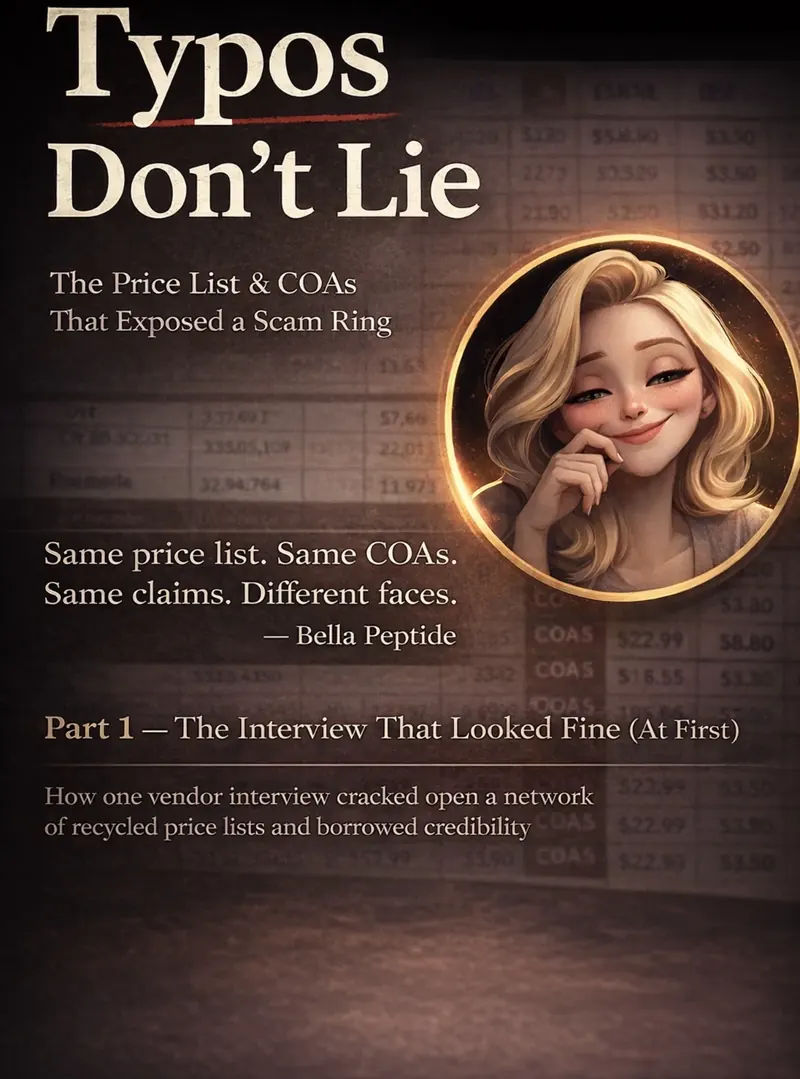
After publishing Typos Don’t Lie: The Price List and COA Trail That Exposed a Scam Ring, I woke up to a comment on one of the posts that stuck with me.
The gist was simple:
How can you call someone a scammer if some people say they received products?
It’s a fair question, and an important one.
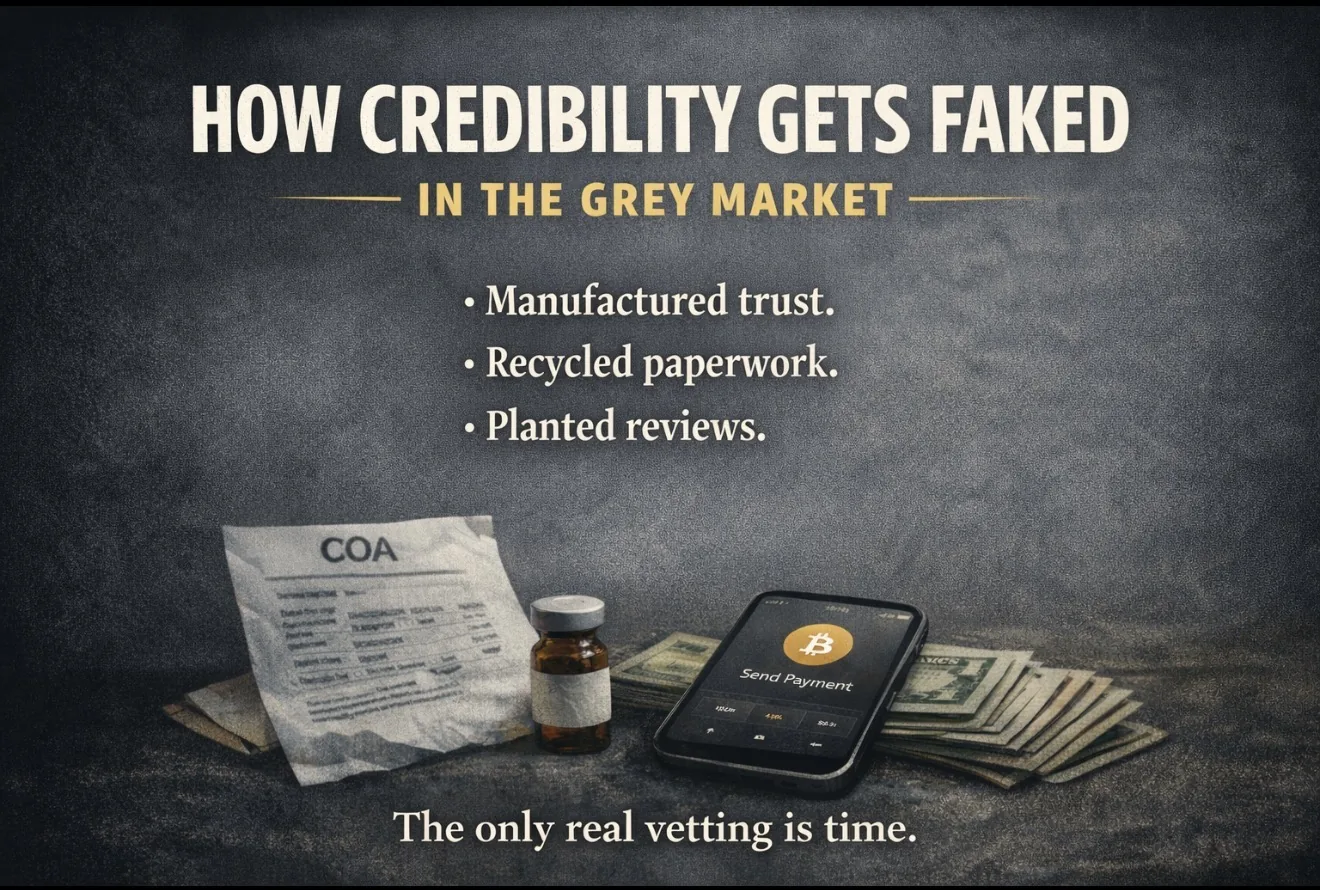
Scams in the grey market rarely look like one clean disappearance. More often they run on manufactured trust: recycled paperwork, rotating identities, and just enough “happy customer” noise to keep doubt alive. In this case, the “I received mine” comments didn’t read like organic feedback. They read like sock puppets.
The language is overly emotional and oddly specific, the kind you see when someone is trying to manufacture trust. Sometimes it’s also clearly written in a way that doesn't read like a native English speaker. One message in particular stood out, thanking Alisa in exaggerated terms:
“I can’t thank you enough… you’re the only person who stood by me through the toughest times.”
That kind of testimonial didn't emerge organically. It appeared before the channel was locked to read only, when visibility still mattered and credibility still needed propping up. Once the channel was closed, the praise stopped, because it had already done its job.
That’s why this series focused on patterns, not outcomes.
Once you join the dots, a number of claims that might sound harmless in isolation begin to matter:
Flat $20 worldwide shipping (too cheap, she later increased it to $39)
Unusual payment methods like Apple Pay (which she later dropped)
A preference for irreversible payment routes (crypto, PayPal Friends & Family)
COAs that didn’t match the seller’s stated identity, or that appeared edited
Company names that changed depending on who was asking ( on What’s App Bella works for Peptide Source Technology and on discord she is now Bella’s Peptide Co.)
None of those things alone proved a scam. But together they formed a system, and the more red flags there were, the more likely it was that the “vendor” wasn’t operating in good faith.
And I’ve now been in enough scam ridden servers to differentiate the legitimate from the non legitimate ones.
Real vendors don’t need to rush you to DMs.
They don’t rely only on glowing testimonials.
They don’t redirect scrutiny instead of answering it.
They will also show less than favourable reviews
Bella circulated Zen COAs. When I approached Alisa, Zen appeared again, the same COAs resurfacing under a different seller name. Their explanations were weak, and when I asked Zen Aminos directly, he told me clearly they had nothing to do with him.
Then came the other pattern: the door slam.
The moment questioning increased, access was cut. The informer was blocked shortly after my Bella interview went live, and I was blocked soon after that. The conversation ended the way these funnels often end: no explanation, no accountability, just closed DMs and no shared servers left to trace. In this space, blocking isn’t random, it’s a reset mechanism.
Bella has now rebranded as Bella’s Peptide Co after her server was finally (and rightly) nuked. She’s also “smartened up” her act so her server looks more professional, with channels laid out more like a legitimate vendor server. Unfortunately, she has 49 members. Funnily enough, Alisa’s server also has 49 members. Hers still looks like a typical scammer server: one read only channel, with reviews posted only by herself.
With the grey market now so visible on social media, especially TikTok, it’s easy to find “reviews,” and pictures of stock (one of the few ways vendors used to be loosely “vetted”) can be pulled from online in minutes. That means they now prove very little. Even factory videos can be scraped and reposted almost instantly.
This still makes me laugh, because when I first started out I was advised not to share factory pictures publicly, because the equipment could be traced back to the owners by the Feds.
This is why, when people ask for “vetted” or “verified” vendors, there is really no way to vet them fully. The clever ones can still pass that stage. The only meaningful “verification” is time, a vendor staying consistent long enough to build a customer base. But even then there’s no guarantee they won’t suddenly vanish, whether for personal reasons or circumstances beyond their control.
And when vendors vanish, the customers caught mid order are the ones left out of pocket. Even if the vendor returns, it’s unlikely they will make those customers whole again. Examples of this are QSC and ASC, who returned but did not make customers whole, and I suspect the same will happen with SSA and SRY.
They can also look like “good vendors” right up until something goes wrong, a shipment seized by customs, a payment flagged, a warehouse issue, a sudden supply break.
That’s when you see the difference between a vendor who stands behind their promises and a vendor who just stood behind good luck.
A good vendor will reship or refund when the risk event happens.
And my next case is about Maggie Zhao, a vendor who was considered as “vetted”until a large shipment was seized. That’s when the mask slipped, and she showed her true colours.
So if there is any piece of advice to take from this series, it’s this:
Never spend more than you are willing to lose.
I understand some people buy on a large scale because it’s their business. But those of us buying for personal use have no reason to send thousands of dollars to one vendor in one go. That’s a lot of money to lose if things go south.
For example, I never spend more than $400 in one transaction.
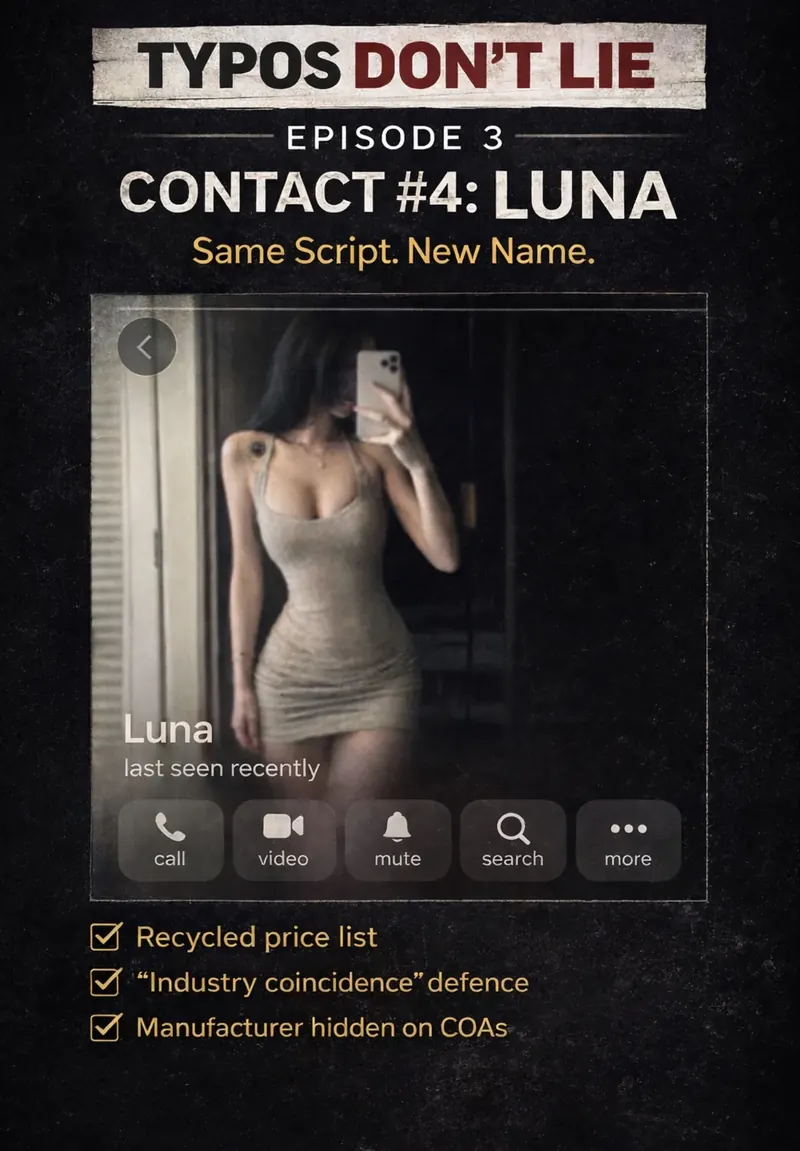
A quick note about Luna: I have no doubt that Bella, Alisa, and Plotting Profits are scammers, but I haven’t made up my mind about her yet. The red flags are real: using the same price list as Bella, COAs that are clearly not hers (SH Peptide), and later Finnrick COAs which I traced back to a company Zztai, for which she wasn’t able to give a satisfactory explanation. However, she hasn’t ghosted me, and she’s trying hard to prove legitimacy.
I’ve sent her to PepChat for verification and plan to post an update on how that turns out. And, by the way, she took my advice and changed her profile picture to a more professional looking one.
That’s why this series is more than just outing the “scammers” It’s about showing how credibility is manufactured, reused, and repackaged in the grey market, and how easy it is to mistake motion for legitimacy, in the hope that people can use pattern recognition to avoid being scammed themselves.
Typos don’t lie.
But neither do workflows.
And once you learn to read them, you can’t unsee them.
Stay safe out there!

Comments