
If there’s one thing I’ve learned from spending too long in the grey zone, it’s this: life in the grey is never dull. And at this point, I think that’s been well and truly established.
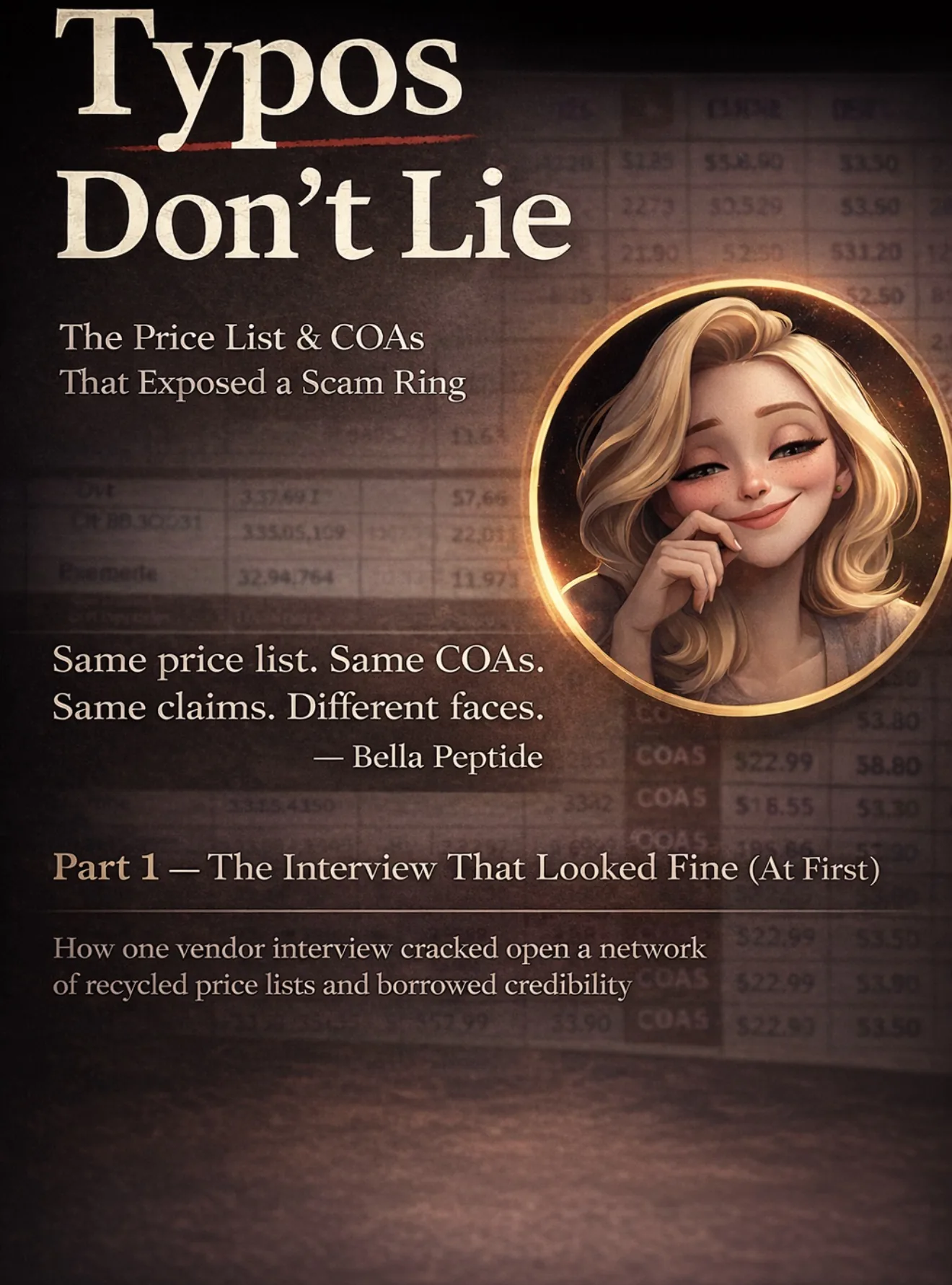
This is Part 1 of a short series where I’ll walk through how one of my recent vendor interviews turned out to be a scam, and how, by following the paper trail, a much wider linked ring started to reveal itself.
The interview that looked fine… at first
On 31 January, I posted an interview with Bella (a China peptides vendor). Initially, it was well received. Engagement was strong, and her server numbers reportedly jumped after it went live.
But within 24 hours, people started flagging red flags.
The first was the shipping claim: Bella was advertising shipping to every country for an unusually low flat rate (around $20). Then there were the payment methods, not just the usual irreversible routes, but also Apple Pay, which isn’t what most people associate with this space.
And then there was the detail that ended up mattering most.
The typo that became a fingerprint
Bella’s price list wasn’t just messy, it contained a spelling mistake so basic it became memorable. “Semaglutide” was misspelled as “samaglutide.”
Normally, a typo is just a typo.
But in this world, a typo can also be a fingerprint, because documents get recycled, shared, rebranded, and passed around between sellers who pretend they’ve never heard of each other.
The “Zen” claim; and the vouch that never existed
The name on Bella’s COAs was Zen-Peptides.
When I asked her who that was, she was vague at first. But when I pushed her, she eventually admitted it was Zen Aminos, and claimed she was a supplier to him.
Then she went further.
I asked her if Zen would vouch for her. She confirmed he would. I asked what Zen thought about her setting up her own server, and she told me he’d been supportive, that he wished her good luck and wished her well.
Those are not small claims. In this space, a “vouch” is currency.
So I did the obvious next step: I asked.
And when I later approached Zen about it, the response was the opposite of what Bella had implied. The vouch was flatly refused.
No endorsement. No confirmation. No “yes, she’s with us.” Just a clean refusal.
That was the moment the story stopped being about one vendor’s credibility and started feeling like something larger: the same names, the same paperwork, the same materials moving through different fronts.
And the typo, that little “samaglutide” would matter again, resurfacing alongside the same Zen COAs under different names.
But the story didn’t actually begin with Bella.
The cold open (16 December): “we are grey market vendors”
A month earlier, a TikTok account called “plotting profits” slid into our informer’s inbox with the classic handshake:
“hello”
then: “we are grey market vendors”
then: “are you interested in peptides?”
No company name. No brand. No context. Just a label that sounds like legitimacy, offered as a substitute for it.
Our informer replied politely and asked the most basic question any normal buyer would ask:
Do you have a Discord?
“Plotting profits” said yes, and posted a screenshot of a Discord profile as proof.
And that’s where the first pattern appeared: platform hopping.
TikTok was the hook. Discord was where the funnel runs.
The Discord funnel (17 December): catalog drop + invite to Alisa’s server
The next day, “plotting profits” asked whether our informer needs the catalog, then dropped a price list, and an invite to Alisa’s server.
There was no pause, no explanation, no context. The conversation simply rolled straight into the next prompts, location, shipping, “we ship to the US.”
The point wasn’t the server itself. The point was momentum. Keep the thread alive, keep the buyer engaged, and move them along the funnel under a different name.
Then it went quiet.
The first receipt: mutual servers
When we later checked the Discord profile, it wasn’t just “a vendor on Discord.”
The account shared two mutual servers.
And they weren’t neutral communities. They were seller servers, Bella Peptide’s server and Alisa’s Peptide’s server, the same names that keep appearing throughout this story.
In other words: the “vendor” wasn’t floating alone.
It was already sitting inside a network.
This is the moment it stopped looking like random vendor outreach and started looking like a shared directory. Because mutual servers aren’t just shared space. They’re a ready made list of targets.
Bella enters (18 January), and the overlap gives it away
On 18 January, Bella appeared in our informer’s DMs with the same opening move:
“Hi”
“Interested in seeing a price list?”
And our informer clocked the detail that matters immediately:
“Odd that the only shared server we have is Alyssa.”
That’s the moment coincidence starts running out of road.
Six days later, Bella sent an invite to her own server. It’s brand new, freshly minted, still warm.
And then came the next routine: the impersonation alibi.
When shown an almost identical TikTok account, Bella immediately labelled it a scam:
“That’s a scam account.”
“That’s still not me.”
“I just followed you back now.”
It’s the “I’m not the scammer” script, delivered by the scammer.
The commission pitch: “help me share the link”
Then Bella made the pivot that matters.
The next step wasn’t selling product. It was recruiting the buyer as infrastructure.
She asked our informer to share her server link to add more members, offering:
“You get a commission in every purchase they make.”
That’s the moment you stop being a customer and become the funnel.
Our informer didn’t take the bait.
So Bella tried a different hook:
“I’m struggling with the business.”
“Wondering if you can help me on this.”
And the story shifted again, away from transparency, toward access points.
The commission pitch: “help me share the link”
Bella then made the pivot that mattered.
The next step wasn’t selling product. It was recruiting the buyer as infrastructure.
She asked our informer to share her server link to add more members, offering:
“You get a commission in every purchase they make.”
That was the pivot. Because once you were pushing someone else’s server link for commission, you were no longer a customer.
You were the funnel.
Our informer didn’t take the bait.
So Bella tried a different hook:
“I’m struggling with the business.”
“Wondering if you can help me on this.”
Sympathy. Soft pressure. A little helplessness theatre.
And it worked, not because he was gullible, but because he thought he was helping a small vendor find legitimate advertising channels.
PepChat onboarding as the “unrestricted peptide community” pitch
Bella was directed to PepChat, framed as a place with sellers, group buys, and access to lots of people.
She couldn’t find the app on Apple. She asked for a link. The informer provided one.
Then Bella reported back:
“Am inside now friend. What’s next?”
And the advice she received was basically a how-to guide for advertising:
“Find admin and send them message asking if you can promote your products.”
“You could have your own channel.”
It was a key moment because it showed how these networks expanded.
Not by quality.
Not by trust.
Not by testing.
By access points.
Borrowed legitimacy: “I’m talking to her now”
Soon after, Bella landed exactly what she wanted: a connection to me.
She sent screenshots of her conversation with me and announced:
“Am talking to her now.”
“Am going interview 😂”
The informer reacted like this was great news:
“PERFECT!! So many people read these interviews.”
“Be funny and cute 😂”
And that was where it became painfully clear: Bella wasn’t chasing an interview for transparency. She was chasing it for permission to look real.
An interview wasn’t just content.
It was a credibility token.
The honeytrap layer: selfies, compliments, and “can I post you?”
Once she had a foothold, Bella’s tone shifted.
She sent “here is me in person” photos. She flirted. She complimented.
Then she asked him what he was taking:
“So you take Reta and GHK-Cu.”
He responded with a full stack list: reta, GHK, HGH, testosterone.
Then she asked:
“Can I post the pic in my server?”
That wasn’t casual. That was testimonial harvesting.
He said no. She laughed it off. But the dynamic was obvious: a seller trying to turn a stranger into a public before/after advert inside her own server.
“There are lots of scammers around” (said by the scammer)
At one point, another account DMed him from inside Bella’s server soliciting sources.
Bella didn’t just comment on it, she showed him the DM, presenting it as proof, and immediately said:
“That’s a scammer. I would move him from my server.”
“There are lots of scammers around.”
It was one of the oldest tricks in the book: play the sheriff so nobody suspected you were the thief.
The door slam
And then, shortly after my interview with Bella was posted, after the promotion attempts, after the PepChat guidance, after the credibility boost, after the photos, Bella blocked him.
The ending was brutal in its simplicity.
“Why did you block me?”
The message failed.
Discord’s system reply filled in the blanks: no shared server, DMs closed, not friends.
It was the cleanest ending scammers loved: cut access, erase the trail, move on.
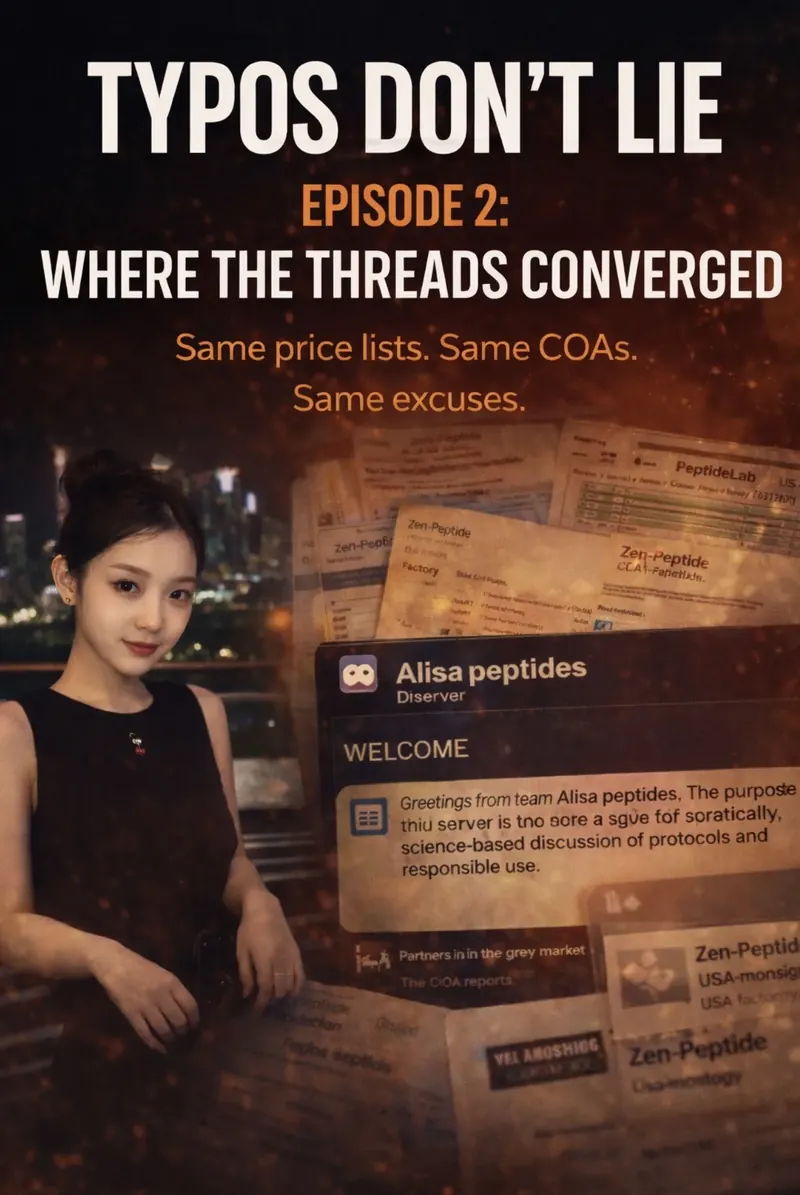
In part 2, this is where the repetition started accelerating, the same price lists and the same COAs turning up again, just under different faces.


Comments