
Can a manufacturer remove Aib and still call the resulting peptide retatrutide? The short answer is no. The question began when a member of the K-Hole Lab Chat reported something they’d been told by an unnamed API source:
“One source that manufactures API states his company removes AIB, but states the long term effects are the same.”
No manufacturer was identified and Janoshik immediately dismissed the claim as “bs”. Another member said they’d previously discussed deletions and truncated peptide chains with Dustin at Vanguard Lab, who hadn’t appeared to consider them a major problem and believed they would show up in the testing normally performed. The discussion then turned to the central questions: if a peptide’s sequence has been altered, is it still retatrutide, and would routine testing detect the difference?
How the laboratories responded
BT Labs explained that deletions, truncations or other modifications could disrupt a peptide’s structure, depending on the position of the affected amino acid. Because structure and function are linked, they said the effect of a new sequence could be explored through molecular-dynamics modelling, but its actual therapeutic outcome would remain unknown without making the peptide and ultimately studying it clinically.
A member then asked the obvious practical question: isn’t the purpose of sending a vial to a testing laboratory to determine whether it really contains retatrutide? If the sample is compared with a standard and matches it, shouldn’t that indicate a good sample?
BT Labs replied: “Reta can have only one sequence, otherwise it is NOT Reta.”
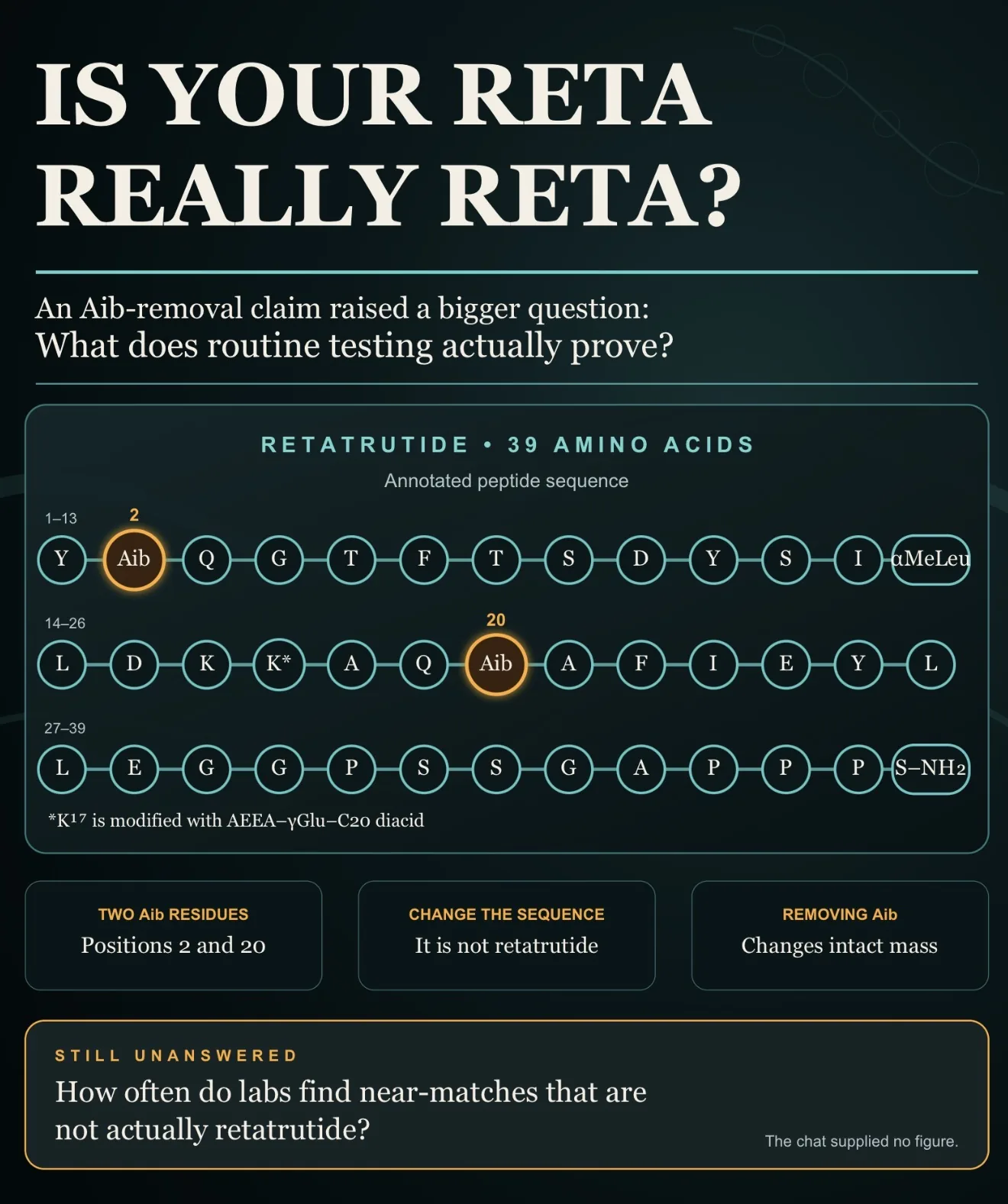
BT Labs added that an altered peptide might still function similarly, but it would be a homologous, (or related), peptide rather than retatrutide itself. They said that some manufacturers could change the C or N terminals which might be ok, but in retatrutide, Aib is loacated at positions 2 and 20, and position 20 is especially important. They then confirmed that samples submitted to the lab are tested to make sure the submitted reta is the same as a standard.
Another member then offered an interpretation of how routine quality control works: laboratories don’t attempt to re-establish the complete molecular structure again for every batch. Instead, they establish the structure when qualifying the reference and method, then use validated tests to decide whether later samples conform.
BT Labs agreed, adding:
“The MS only gives the MW, doesn’t tell you if the amino acids are in the correct order. But the RT and folding / secondary structure will.”
That exchange contains the heart of the issue. Retatrutide has a defined sequence, and routine quality control can legitimately compare new samples with a previously characterised standard. But the strength of that conclusion depends on how the standard was authenticated and what the routine methods can distinguish.
No Aib means no retatrutide
Retatrutide is a 39-amino-acid peptide designed to activate GLP-1, GIP and glucagon receptors. Its published structure contains the non-standard amino acid α-aminoisobutyric acid, Aib, at positions 2 and 20, as well as other deliberate modifications. “Removing Aib” is too vague to assess precisely. It could mean deleting one or both Aib residues or replacing them with different amino acids. Either change would produce a molecule that is not retatrutide.
That doesn’t automatically mean the altered molecule would be inactive, related peptides can retain some activity, and occasionally a modified analogue may have useful properties of its own. However, it does mean that claims of identical long-term effects can’t be assumed from structural similarity or user reports.
A 2025 Journal of the American Chemical Society paper illustrates how much apparently limited changes can affect receptor activity. Researchers created a retatrutide-related variant called RET1 with two substitutions: α-methylleucine at position 13 was changed to leucine, and Aib at position 20 was changed to glutamine. In cell assays, RET1 was hundreds to thousands of times less potent than retatrutide across its three target receptors. Because two residues were changed together, the result can’t be attributed to Aib20 alone. It also wasn’t a test of a grey-market sample or a clinical comparison, but it does show why an altered peptide can’t simply be assumed to perform like retatrutide.
Would routine testing catch it?
Probably, if the change were a straightforward Aib deletion or substitution and the identity testing included a competent intact-mass measurement. Replacing Aib with alanine would reduce the theoretical neutral mass by about 14 daltons for each substitution. Deleting an Aib residue would reduce it by about 85 daltons. Those are measurable differences. A sufficiently accurate intact-mass LC-MS method should detect either uncomplicated change.
Retention time could also change because the altered peptide may interact differently with the chromatographic column. This supports Vanguard’s view that deletions or truncated chains should reveal themselves during routine testing.
However, neither result answers every sequence question and different tests answer different questions:
HPLC purity shows how much of the detected material appears in the main peak. It doesn’t prove that the peak is retatrutide.
Retention time shows whether the sample behaves like the reference under the same test conditions. A match supports identification but doesn’t prove the complete sequence.
Intact-mass LC-MS shows whether the peptide has the expected overall mass. A straightforward Aib deletion or substitution would change that mass and should be detectable.
LC-MS/MS or peptide mapping examines fragments of the peptide and can provide more direct evidence about the amino-acid sequence.
A receptor assay shows whether the peptide activates the relevant receptors, but not whether it’s chemically identical to retatrutide.
For the specific claim being discussed, removing or replacing Aib should alter the peptide’s measured mass. A competent intact-mass test should therefore detect a simple Aib change. However, matching the expected mass still doesn’t prove that every amino acid is in the correct position; that requires sequence-level evidence from methods such as MS/MS or peptide mapping.
“MS only gives the molecular weight” needs qualification
BT Labs’ statement is accurate when “MS” means an intact-mass measurement. That experiment can show whether the whole molecule has the expected mass, but it can’t by itself prove that every amino acid is in the correct position.
Mass spectrometry isn’t limited to intact mass. Tandem mass spectrometry (MS/MS) fragments the peptide and examines the resulting ions. Peptide mapping breaks the molecule into smaller sections before analysis. These methods can provide direct evidence for parts of the amino-acid sequence, including the regions containing Aib, when the relevant fragments are produced and confidently assigned.
The presence of “MS/MS” on a certificate doesn’t automatically mean the full retatrutide sequence was confirmed. A meaningful sequence claim would show which fragments were identified, how much of the chain was covered and whether positions 2 and 20 were directly supported.
Retention time can support a match with a reference, but it can’t confirm that every amino acid is in the correct order. Secondary structure could provide additional evidence if it were measured separately, but HPLC retention time alone does not show how the peptide is folded.
Even complete MS/MS coverage would not amount to literal 100% proof, because mass-based testing may not resolve every isomeric or stereochemical difference. It would, however, provide far stronger sequence evidence than intact mass and retention time alone. That distinction is reflected in the EMA’s 2025 guideline for synthetic peptides. It recommends at least two orthogonal identification methods and says the selected test or combination must be capable of unambiguously confirming the peptide sequence. Relevant techniques include intact-mass LC-MS, LC-MS/MS or peptide mapping, amino-acid analysis and NMR, with separate chiral methods used to examine stereochemical purity. Matching intact mass would exclude a straightforward Aib deletion, but complete structural confirmation requires more than that single result. EMA synthetic-peptide guideline
Compared with which standard?
Laboratories generally identify retatrutide by comparing the sample with a reference. The more important question is how that reference was authenticated and exactly what the comparison confirms. That’s a normal analytical approach. Once a reference has been properly characterised and the method has been shown to distinguish relevant failure modes, routine tests can compare later samples with it. Full de novo sequencing of every submitted vial would be expensive and often unnecessary.
But that only moves the question back one step: how did the laboratory confirm that the reference itself was retatrutide since a comparison is only as reliable as its reference. If a sample matches the reference’s mass and retention time, that shows consistency with the reference under those tests. To turn that into a strong claim of retatrutide identity, the laboratory must know that the reference itself has the correct sequence and modifications.
Is Aib too difficult for grey-market manufacturers to use?
Aib can make peptide synthesis more demanding because its structure creates steric hindrance during coupling. Poorly controlled synthesis can result in incomplete coupling and deletion impurities. It’s not, however, an exotic ingredient that peptide manufacturers are incapable of incorporating. Published research has demonstrated automated solid-phase synthesis of peptides containing many consecutive Aib residues. A retatrutide synthesis patent also describes using preformed peptide fragments, including a Tyr¹-Aib² fragment, to reduce deletion and racemisation impurities and improve yield.
The manufacturing challenge is real, but it is manageable and it provides no basis for assuming that grey-market retatrutide routinely lacks Aib. Although whether a particular batch was made correctly remains a question for competent testing.
Conclusion
For now, the story of Aib being removed from grey-market retatrutide remains an unverified, second-hand claim. No manufacturer, batch or test result has been identified, and there’s no evidence that an altered version would have the same long-term effects. A straightforward Aib deletion or substitution should change the peptide’s mass and would probably affect its retention time, so competent routine testing ought to detect it. Until an actual sample and supporting data emerge, there’s no reason to assume that grey-market retatrutide is routinely being made without Aib.
The more useful question is what a laboratory means when it reports that identity has been confirmed, and exactly how much its testing can prove.
Selected sources
Coskun T, et al. “LY3437943, a novel triple GIP, GLP-1, and glucagon receptor agonist for glycemic control and weight loss: From discovery to clinical proof of concept.” Cell Metabolism. 2022.
Li Y, et al. “Molecular Design of Unimolecular Tetra-Receptor Agonists.” Journal of the American Chemical Society. 2025.
“Method for synthesizing Retatrutide.” CN117903284A.
“Automated solid-phase concatenation of Aib residues to form long, water-soluble, helical peptides.” Chemical Communications. 2020.
“Guideline on the Development and Manufacture of Synthetic Peptides.” European Medicines Agency. 2025.

Comments