
Jack came to me through a recommendation from a UK customer who said she’d bought from him for some time and recommended him to several friends. She suggested that he contact me for an interview and was delighted when I agreed to give him the opportunity
Jack’s Introduction
It didn’t start as a standard vendor interview. Jack’s first message introduced himself as “the peptide merchant introduced by Kirsiya. Do you need to purchase peptides?” Followed by a stream of product photographs and videos. He clearly arrived expecting an order. When I explained that I didn’t want to buy anything and needed him to answer interview questions, he seemed put out. It was only after I told him that he was wasting my time and that there were plenty of other vendors willing to answer my questions that he finally cooperated.
Jack later introduced himself for the interview as Jack Zhang, Sales Director of XYZ Peptide Biotech Co., Ltd.
As part of the interview process, he sent me a video of a young Chinese man claiming it was him. When I asked whether I could post it, Jack said he would send me some “more handsome videos” and followed this with several clips of the man working out. In light of the conflicting identities and companies that have since emerged, I now doubt that he was sending genuine videos of himself.
During the interview, Jack described XYZ Peptide Biotech as both a manufacturer and reseller. He said the company produced some products in-house while sourcing freeze-dried peptides from approximately five selected factories. Its customers supposedly included research institutions, distributors and biotechnology companies worldwide.
According to Jack, XYZ had operated for more than six years and he’d worked there for the same length of time. Before joining the company, he said he worked in pharmaceutical raw-material sales and international trade.
Although he promoted competitive pricing, consistent quality, fast shipping, transparent testing and responsive customer support, he seemed to be realistic about the quality of his products, telling the group early on;
“Our products may not be the very best, but we offer the best quality for the price, and we provide the best service so you can shop with confidence.”
However, the later Vanguard results showed that the problem went far beyond the products simply “not being the very best.”
The Sulan COAS
The Janoshik COAs he provided for the interview were under Sulan, not XYZ and when customers asked him for COAs, he sent COAs belonging to TYP. So from the beginning, the COAs he supplied for XYZ’s products were under the names of other companies.
Sulan Reverses Its Original Response
When Sulan was first contacted, its representative said she was not familiar with Jack and that he wasn’t a member of the team. But that response was later corrected.
After reviewing the company’s full sales records, Sulan apologised and confirmed that Jack was an official sales representative of its factory. The representative explained that Sulan’s sales operation was divided between online customer service and offline wholesale. She had initially checked only part of the online team list and did not have access to the complete staff directory.
Sulan also confirmed that the quotations, product information and COA documents supplied by Jack were official factory materials. This changes an important part of the story. Jack’s connection to Sulan wasn’t fabricated, and the Sulan reports he supplied were authorised. However, it creates another question about how he represented himself. During my interview, Jack introduced himself as the Sales Director of XYZ Peptide Biotech, not as a Sulan factory representative.
However, when TYP was contacted, they denied knowing him. Jack’s explanation was that “he was my friend” and that he showed those COAs by mistake.
Despite these COA inconsistencies, Jack’s arrival still created a storm, since he arrived with some of the lowest prices anyone had seen, and people were immediately excited. Orders followed quickly and all I can remember of that time was constant notifications on my phone with neon flashing stickers.


He seemed to take over my group to the point when newcomers thought he was K-Holes recommended vendor. But not surprisingly, the excitement didn’t last. What appeared to be an incredible bargain became another example of how quickly cheap peptides can become very expensive when the products turn out to be bunk.
XYX, XYZ or Nanjing Biotech?
According to a source, Jack first appeared in the peptide community around July 2024 and by October 2024, he was being described as a representative of Nanjing Biotech, which was also using the initials XYX. That immediately caused confusion because PGB, a group buy vendor, was already using a company called XYX as their supplier. People initially wondered whether the two companies were the same. However, this was just a coincidence and the Nanjing business was advised to stop using the initials because the similarity was causing problems.
Jack was also said to have told some people that he had started XYX ( which is false). Now, in his interview, his company name is XYZ Peptide Biotech. He didn’t answer my question if he is the same Jack from XYX.
But Jack wasn’t only selling products and by October 2024, he was trying to build a US warehouse network through members of the community.
One community member told me back in October 2024, that Jack had offered her a warehouse position and wanted at least three operators across the country. She also said another group-buy organiser established a server to sell his goods after Jack offered her a similar warehouse arrangement. This places Jack behind an early attempt to create a US-based sales and fulfilment network within months of his appearance in the community.
The departure from Nanjing Biotech
By December 2024, Jack had reportedly left Nanjing Biotech and appeared to be operating independently under the name HRT. The GB organizer who was said to be warehousing for him, said her business relationship with him had started well. The products she received tested well, but she became concerned when he began asking for details about the accounts she’d paid and her shipping information. She told me she was told by a Nanjing Biotech contact that Jack had allegedly bypassed company invoices and kept customer payments. She was told that this had happened with multiple customers.
This seemed to be supported by the fact that she’d never received an invoice for her own purchases, despite later being told that invoices were required under the company’s normal policy.
These remain allegations passed to her by a company contact. They don’t prove that Jack stole any money, and she confirmed that her products tested well. The dispute concerned how the payments had allegedly been processed rather than the quality of what she received. She also described Jack as unprofessional.
HRT, XYX and a Dubai Factory

Another person recognised him as the supplier he’d previously known as Jackdilen, although he used a different number when they spoke approximately two years ago. He said they had extensive conversations on WhatsApp and remembered a different version of his business history.
According to him, Jack said he had worked in the wellness industry for around 17 years. His original website reportedly sold vitamins, food products and peptides under HRT Biotech Co., Ltd. He later said he was developing a new company called XYX, which he described as a small trading business.
He also said Jack told him that he supplied a large UK warehouse with approximately 50,000 pieces. He allegedly said that 20,000 pieces were later lost during a raid on a logistics warehouse and that one of the bosses “got out.”
Jack also reportedly connected himself to CJ Biotech FZCO in Dubai. According to the account he gave him, the “C” represented Conrad and the “J” represented Jackdilen. He described CJ Biotech as his Dubai factory and said the business was seeking US FDA certification, with a particular focus on pharmacy agents.
By January 2025, Jack appeared to be operating independently under the name HRT. A recommendation at that time, identified him as Jackdilen Kcheng, a raw-material distributor working under Nanjing HRT Biotech Co., Ltd.
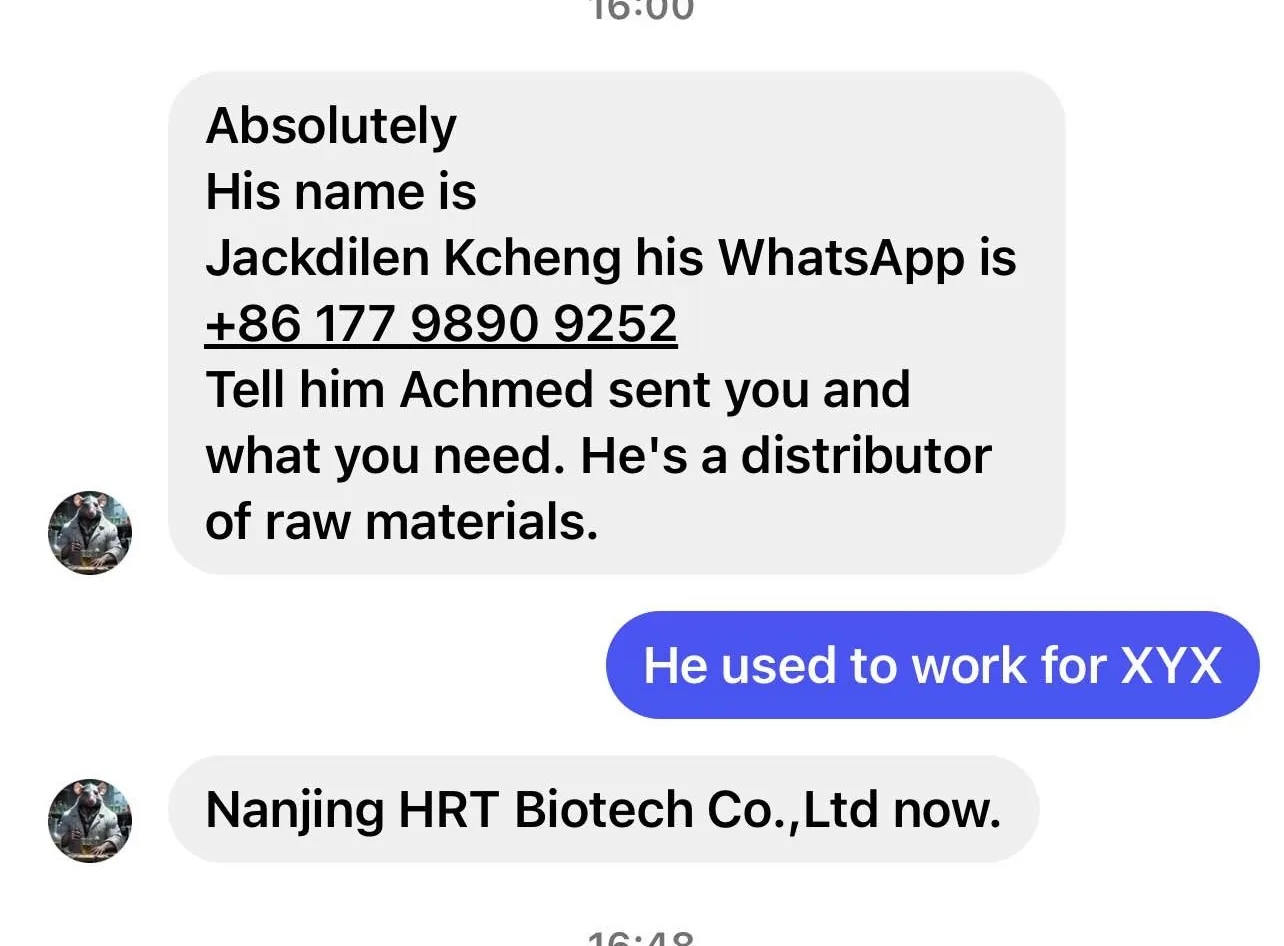
None of these statements has been independently verified, but they add HRT Biotech, XYX and CJ Biotech FZCO to the growing list of companies Jack has associated himself with.
They also conflict with the history he gave during my interview. Jack told me he’d worked for XYZ Peptide Biotech for more than six years.
The $8 million factory
Jack had reportedly discussed buying an $8 million manufacturing facility, although he still needed investors. That ambition sits beside several different versions of his professional position.
So who is Jack? Is he a long-serving Sales Director at XYZ? A representative who left Nanjing Biotech? The founder of HRT? A distributor of raw materials? A reseller sourcing from Sulan? Or someone preparing to buy his own manufacturing facility?
Any of those could be true. The problem is that Jack hasn’t shown how they fit together.
Jack’s Aliases
The names connected to him now include:
Jack Zhang
Wei Zhang
Jackdilen Zhang
Jackdilen Wei Zhang
Jackdilen Kcheng
The company names connected to his activities include:
Nanjing Biotech
XYX
XYZ Peptide Biotech
HRT
Nanjing HRT Biotech
Sulan
Some of these may be employers, trading names, suppliers or partner companies. The problem is that customers are left to work that out for themselves.
The other Jack
Jack’s name also surfaced during the previous zero Pep epidemic in 2024/25. The theory was that fake API had been sold to a manufacturer, passed to fill finishers and eventually reached retailers. During my investigation, another supplier told me that someone called Jack was responsible. However, Jack is a common name and there was never any evidence to suggest that “our” Jack was the culprit.
What Jack said about the zero-peptide case
Although he denied being the other Jack, Jackdilen suggested that he knew something about the people and businesses involved. In direct messages, he said some buyers demanded lower prices to increase their profits. He alleged that people were trying to make money without putting peptide into the vials.
When asked about Benjamin Zhang (one of the suspects in the previous zero peps epidemic), Jack brought up Guangzhou and the name Annie himself. He alleged that Benjamin sold bad peptides obtained from Guangzhou and added, “like Annie.”
He also discussed another manufacturer called Xuishi, referring to product-mixing and quality-control problems. He said he had a connection to Xuishi through a former classmate and later suggested they were working on a joint venture.
The person communicating with him also warned me that he had a habit of exaggerating his industry connections. None of these allegations were ever verified and are likely to be false but I’ve added them in to show the sorts of stories Jack is capable of fabricating.
Then It All Kicked Off
On 14 July, the false confidence surrounding Jack Peptides collapsed when the results from Vanguard Laboratory were released by one of Jack’s Telegram admin.
Until then, the group had been filled with successful delivery posts, positive reviews and members praising the apparent strength of the products. One administrator had become heavily involved in helping Jack build the business. He translated between English and Chinese, created the Telegram group and channels, wrote announcements, helped manage the community and gave him access to other suppliers’ price lists so he could remain competitive.
He also promoted Jack heavily. In return, he received free shipping, product credits and additional discounts on his own purchases. He openly acknowledged these benefits when explaining why he had supported him.
Twelve Kits Sent for Testing
Jack sent 12 product kits to a US contact who lived near Vanguard Laboratory. One vial from each kit was submitted for testing, while the contact kept the remaining unopened vials in return for handling the process. The results were a complete surprise to some but not to others. Every published product failed to contain the full amount advertised. Some were severely underfilled, several had poor purity and entire ingredients were missing from multiple blends.
The cheapest prices everyone had been celebrating suddenly made sense for all the wrong reasons.
Jack Asked for the Results To Be Delayed
By the time the COAs had been sent to the administrator, they’d already been delayed by Jack and he wanted to discuss whether they should be released at all. The admin insisted that the community had to see them. Jack then asked him to delay publication. His explanation was that the tested products had come from the US warehouse and didn’t represent the stock currently being shipped from China.
That created another contradiction. His previous understanding was that the US warehouse had been stocked directly from China. Jack was now separating the two inventories only after the US stock had produced disastrous results. But if the warehouse stock was genuinely different, customers still needed to know because it was stock they’d already been sold. If it wasn’t different, blaming the warehouse allowed Jack to distance his current China inventory from the failures without providing new testing to support that distinction.
The Group Was Wiped
Shortly after the admin challenged Jack’s explanation and insisted upon releasing the reports, his admin access was revoked. He was removed from the main group, the testing group and the admin chat, and his message history was wiped. Two other administrators were removed at the same time.
He’d helped create the group, translate for Jack, promote his products and build the trust that brought customers in, but once the laboratory results contradicted the story customers had been sold, he was removed from the community he’d helped him build.
That was when the cheap prices, borrowed testing, changing company names and Jack’s previous history stopped looking like separate concerns. They’d all led to the same place: products that didn’t contain what customers had paid for.
The Community Turns on Itself
Once the results were published, the group descended into chaos. Some members mocked those who’d rushed to buy because of the low prices, pointing out that customers had ordered without seeing testing connected to the stock and then paid as much as $90 shipping. Others pushed back, arguing that laughing at people who’d lost money achieved nothing.
Several members said they’d warned from the beginning that the prices appeared too good to be true. One said concerns about Jack’s kits resembling other bunk products had been dismissed and turned into a meme. Another had asked whether he was the previously known Jackdilen, only to be told it was a case of mistaken identity.
By the time the reports appeared, Jack’s price list had disappeared and he’d become unusually silent. He later returned and insisted he wouldn’t run away, but the group remained divided over whether he deserved time to investigate.
Some believed Jack could have been deceived by one of his suppliers and should be allowed to arrange new testing, refund customers and correct the problem. Others pointed out that he’d presented XYZ as both a manufacturer and reseller. If he manufactured some products himself, he needed to identify which factory produced the failed stock rather than simply separating it from his current inventory.
The central question was why the products had been sold before Jack tested them. Customers had therefore been buying on the strength of authorised but unconnected Sulan reports, a TYP report belonging to another business, positive anecdotes and Jack’s assurances, not testing tied to the products they received.
Jack’s handling of the failures caused as much damage as the results themselves. Members could accept that a vendor might unknowingly receive bad products. What many couldn’t accept was a vendor selling untested stock, attempting to distance himself from it after it failed and removing the people who insisted customers be told.
The argument was no longer simply about refunds. It was about whether Jack’s response showed a genuine attempt to resolve a supplier failure or an effort to contain the damage once the evidence became public.
Today’s Refund Announcement
Today, Jack introduced a formal refund policy in response to what he described as customers attempting to keep products while demanding their money back.
Under the new rules, anyone requesting a refund must return the complete product to the US warehouse. The refund will be processed only after the warehouse confirms that nothing is missing or damaged. Jack said requests made without a return would be rejected and described some of them as malicious “free-riding.”
He also said customers could submit products for independent testing. XYZ would cover the laboratory fee, but only after the report had been completed. Return shipping would also be reimbursed, but not until the goods reached the warehouse.
Requiring products to be returned before issuing a refund is not unreasonable by itself. The problem is how this policy works when the complaint is supported by failed batch testing. Anyone who sends a vial to a laboratory no longer has a complete kit to return. The announcement doesn’t explain whether those customers will still qualify, whether every buyer must pay for another test or whether customers holding the same failed batch numbers will be refunded without repeating testing that has already been completed.
The wording also redirects attention away from the laboratory findings and towards alleged customer misconduct. Rather than announcing a blanket resolution for the failed batches, Jack is treating refunds individually and warning that he will retain chat records, delivery evidence and customer feedback to challenge claims he considers dishonest.
When I asked Jack what’s going on, he told me;
“Something happened with the goods in the US warehouse. I’m still processing it.”
He’s yet to explain what supposedly happened, who controlled the warehouse, how its products became different from the China stock or why twelve separate products were affected. The announcement establishes a process, but it’s not yet a resolution.
Final Thought
Jack’s history now raises more questions about changing company names, disputed business practices and who he really is. Maybe after this article he will be more forthcoming about his past.
Comments